Text used – Luke 16:19-31
- Reminder of summer sermon series on Beatitudes
- Dive deeper into one Beatitude each week
- Pair Beatitude with another text as well as a focus word (centering prayer for the day)
- A couple weeks ago – “Blessed are those who mourn, for they will be comforted” – was a difficult one because of the way it’s been used to dismiss or diminish people’s grieving processes
- And I think this week’s Beatitude can be another difficult one because of the ways it’s been used in the past.
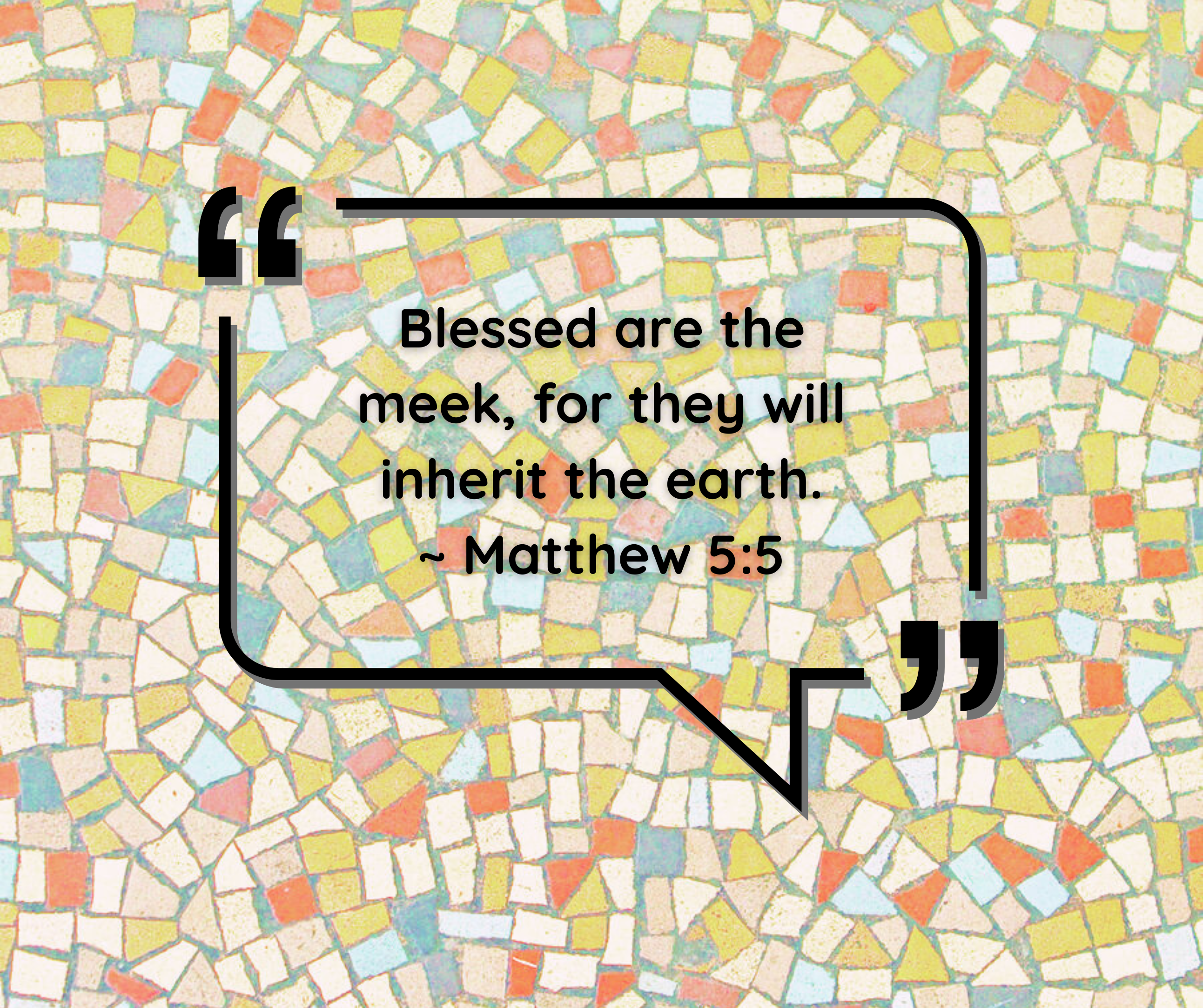
- Blessed are the meek, for they will inherit the earth.[1]
- Used as justification for subjugation
- In cases of slavery
- In unhealthy relationships (abusive, manipulative)
- In religious circumstances that keep women suppressed, subdued, and separate
- But these are all ways that this blessing of Jesus’ has been twisted – twisted for harm instead of good.
- Much of our misunderstanding of this Beatitude comes from the way the term “meek” has come to be almost synonymous with weakness
- What’s a stereotypical “meek” person?
- Quiet
- Small (personality/presence, not necessarily physically)
- Unassuming
- Passive
- But the thing is, none of those things have anything to do with the Greek word Jesus uses in this particular passage. → Gr. “meek” = more about kindness, being gentle but strong, humility
- Word that Jesus uses to describe himself 2 other times in Mt’s gospel
- Mt 11:29: “Put on my yoke, and learn from me. I’m gentle and humble.”
- Mt 21:5 (quoting prophet Zechariah as part of his entry into Jerusalem at the beginning of Holy Week): “Say to Daughter Zion, ‘Look, your king is coming to you, humble and riding on a donkey’”
- So right off the bat, as we consider and dig into this Beatitude, we have to set aside our preconceived notions of what “meekness” might be.
- Beatrice Smith: Meekness is not to be confused with weakness. It is the exercising of strength under control – the demonstration of power but without being unduly harsh. The meaning of meek is to find the balance in exercising power with restraint, in which God is perfectly able.[2]
- Another important layer of definition from Casey Cole: The reality is there is nothing weak or cowardly about being meek. Quite the opposite, actually. What makes someone meek is not fear, but rather unflappable courage. The meek person remains quite because they feel no need to speak; they respond with peace because there is nothing to threaten them.[3]
- Word that Jesus uses to describe himself 2 other times in Mt’s gospel
- What’s a stereotypical “meek” person?
- It’s the flipside of this definition – a lack of courage and humility – that drew me to today’s Scripture reading from Luke’s gospel: Jesus’ story of the rich man and Lazarus.
- Parable = part of Jesus’ teachings about money in Lk’s gospel → end of larger section that begins: The Pharisees, who were money-lovers, heard all of this and sneered at Jesus. He said to them, “You are the ones who justify yourselves before other people, but God knows your hearts. What is highly valued by people is deeply offensive to God.”[4]
- Jesus proceeds to tell story about the rich man and Lazarus
- Lazarus = poor man with a chronic illness who lay at the gate of the rich man → Now, Jesus doesn’t give us any kind of timeframe or definitive timeline for this particular story. We aren’t told how long Lazarus lay at the rich man’s get. But we do get the impression that it was more than just a one-time visit.
- Implications of ongoing nature in the tense of some of the Gr. words in this part of the text, particular when it says: Lazarus longed to eat the crumbs that fell from the rich man’s table.[5] → The tense of that Greek word that gets translated as “longed for” is an ongoing word. It’s a word that implies continuous action as opposed to a one-off action. So however long he was laying there, Lazarus longed more than once for the crumbs from the rich man’s table.
- But alas, Lazarus dies without any alleviation of his troubles. → “carried by angels to Abraham’s side”[6]
- Rich man also dies → “and was buried”[7]
- And this is where the rubber really meets the road for the rich man. Jesus describes him as being “tormented in the place of the dead” when he looks up and sees Lazarus and Abraham side-by-side, presumably in a place of comfort and safety.
- Rich man begs first for his own comfort → denied
- Rich man begs for Abraham to send someone to warn his brothers of their fate (in the same vein as the three spirits that visit Ebenezer Scrooge on Christmas Eve in Dickens’ A Christmas Carol) → once again denied
- And in Abraham’s dialogue with the rich man here, we see something interesting. Or maybe it’s the lack of something that’s interesting. Not once does Abraham condemn the rich man for his wealth alone. Not once does he say anything about money. What he does point out is that in his life, Lazarus received no compassion. Lazarus received no help. “Child, remember that during your lifetime you received good things, whereas Lazarus received terrible things.”[8]
- Scholar highlights further the rich man’s lack of both empathy and humility: Not once does it dawn on the rich man to speak to Lazarus directly as a fellow human being. It does not happen when the two men are alive; it does not happen when they exist in the worlds beyond mortality. The rich man operate on the assumption that Lazarus is beneath him, a mooch sprawled out on his doorstep covered in sores. In death, even after the illusion of supremacy has dissolved around him to reveal the truth about the way his attitude tormented others, the rich man still does not understand.[9]
- Lazarus = poor man with a chronic illness who lay at the gate of the rich man → Now, Jesus doesn’t give us any kind of timeframe or definitive timeline for this particular story. We aren’t told how long Lazarus lay at the rich man’s get. But we do get the impression that it was more than just a one-time visit.
- Jesus proceeds to tell story about the rich man and Lazarus
- When we hold Jesus’ story of the rich man and Lazarus up side-by-side with this morning’s Beatitude – Blessed are the meek, for they will inherit the earth – we find a clear warning about where a distinct lack of meekness can lead. → meekness would have led rich man to be both humble and courageous enough to first see a fellow human being who was suffering, then to move past that suffering to offer help … to offer hope … to offer grace … to offer love
- Fr. Jacques Philippe: Although [meekness] is one of the most precious expressions of love, it is unfortunately quite rare in today’s hard, competitive world. Yet it remains a powerful tool for attracting and opening hearts.[10]
- Parable = part of Jesus’ teachings about money in Lk’s gospel → end of larger section that begins: The Pharisees, who were money-lovers, heard all of this and sneered at Jesus. He said to them, “You are the ones who justify yourselves before other people, but God knows your hearts. What is highly valued by people is deeply offensive to God.”[4]
- And when we roll all those ideas up into one – all those concepts that make up true meekness: humility, courage, and love – we come to our focus word for today: confidence.
- Some might think of confidence as the polar opposite of meekness, but only if one is functioning with the passive, submissive definition of meekness → When we allow ourselves and our faith to embrace a definition of meekness that is more about humility and courage and love, it leads us to a place of recognizing where our truest confidence lies: not in ourselves and our own abilities but in the goodness and love of the God who created us.
- A goodness better than us on our best day
- A love stronger and purer than the deepest love we feel in our own hearts
- Smith: The gift of meekness is not thinking more lowly or more highly of ourselves than we should – it’s the gift of being able to think honestly about ourselves. We must acknowledge our limitations, be honest about the parts of our lives that aren’t yet complete. But we must also be able to recognize our strengths and what we can We can learn to recognize where we are able to make a difference and to celebrate our victories. In short, we can bring our successes and our failures to God.[11]
- “Free to Be Me” by Francesca Battistelli
- Some might think of confidence as the polar opposite of meekness, but only if one is functioning with the passive, submissive definition of meekness → When we allow ourselves and our faith to embrace a definition of meekness that is more about humility and courage and love, it leads us to a place of recognizing where our truest confidence lies: not in ourselves and our own abilities but in the goodness and love of the God who created us.
-
- In a very real way, it’s something we pray every time we lift up the Lord’s Prayer: Thy will be done. → True meekness includes both the confidence in our own gifts to act on our faith in ways that matter – ways that demonstrate God’s love in this world – and also the confidence to lay aside whatever control we have in the midst of a situation and say, “Thy will be done, God. Not my will. Thy will.” Truly, friends, “Blessed are the meek, for they will inherit the earth.” Amen.
[1] Mt 5:5 (NRSV).
[2] Beatrice Smith. The Beatitudes: Eight Reflections Exploring the Countercultural Words of Jesus in Matthew 5. (London: Spring Harvest, 2023), 16-17.
[3] Casey Cole. The Way of Beatitude: Living Radical Hope in a World of Division and Despair. (Notre Dame: Ave Maria Press, 2022), 31.
[4] Lk 16:14-15.
[5] Lk 16:21a.
[6] Lk 16:22a.
[7] Lk 16:22b.
[8] Lk 16:25.
[9] Leah D. Schade. “Luke 16:19-31 – Theological Perspective” in Feasting on the Gospels – Luke, vol. 2. (Louisville: Westminster John Knox Press, 2014), 106.
[10] Jacques Philippe. The Eight Doors of the Kingdom: Meditations on the Beatitudes. (New York: Scepter Publishers, 2018), 101.
[11] Smith, 17.
 Fearfully and Wonderfully Made