Sunday’s sermon: My Way or the High Way?

Text used – Jonah 3:10-4:11

And now the end is here
And so I face that final curtain
My friend I’ll make it clear
I’ll state my case, of which I’m certain
I’ve lived a life that’s full
I traveled each and every highway
And more, much more
I did it, I did it my way

Regrets, I’ve had a few
But then again too few to mention
I did what I had to do
I saw it through without exemption
I planned each charted course
Each careful step along the byway
And more, much, much more
I did it, I did it my way

Yes, there were times I’m sure you knew
When I bit off more than I could chew
But through it all, when there was doubt
I ate it up and spit it out
I faced it all and I stood tall and did it my way

For what is a man, what has he got?
If not himself then he has naught
Not to say the things that he truly feels
And not the words of someone who kneels
Let the record shows I took all the blows and did it my way[1]

  • There it is, right? The Frank Sinatra classic.
    • Lyrics written by Paul Anka → new lyrics to a French song he heard on the radio while at his home in France
      • Anka = acquaintance of Sinatra’s → knew he was considering retiring → wrote the lyrics as a combination of Anka’s own story and Sinatra’s story – Anka: “The song became a composite of my life and his, but mostly his.”[2]
    • Recorded by Sinatra at the end of 1968 → highly successful
      • Debuted at #69 on the Billboard chart in Mar. 1969 (highest new entry that week) → climbed as high as #27 in 6 weeks and stayed there for a while
      • Reached #5 in the UK → spent 124 wks on the UK’s singles chart
        • Longer than any other song ever!
      • Taken back to the charts numerous times by numerous artists/groups covering this song
        • US charts
          • Brook Benton – 1970
          • Elvis Presley (released posthumously) – 1977
        • UK charts
          • Sid Vicious/Sex Pistols – 1978
          • Shane McGowan/The Pogues – 1996
        • Even a part of the recent animated hit “Sing”[3]
    • Clearly, these lyrics have carried weight and meaning for thousands over the years. Indeed, in many of the articles and opinion pieces written about this particular song, it’s declared “an anthem” – for the generation into which it was first released but also for many who followed after. But after reading our Scripture passage for this morning, I think the power and applicability of Sinatra’s song could stretch backward in history, too. Really, couldn’t this be Jonah’s anthem as well? → [reread lyrics] Oh, yeah … that’s definitely Jonah!
  • Let’s talk about Jonah as a book for a moment.
    • As part of the biblical cannon, it’s considered one of the 12 minor prophets (Hosea, Joel, Amos, Obadiah, Micah, Nahum, Habakkuk, Zephaniah, Haggai, Zechariah, Malachia … and Jonah) → But unlike the other 11 minor prophets, the language and literary layout of Jonah is wholly different.
      • Other prophets: almost entirely records of the words of the prophets → their dire warnings for the people of Israel and their praise of the goodness and justice of God
      • But then you have Jonah … which is told as a story.
      • Scholar: Jonah is a difficult book to decide how to read. It is surely prophetic. It has been included among the twelve prophets at least since Qumran [and the finding of the Dead Sea Scrolls]. Its main character is presumably the eighth-century-BCE prophet named in 2 Kings 14:25 [“{Jeroboam} reestablished Israel’s border from Lebo-hamath to the Dead Sea. This was in agreement with the word that the Lord, the God of Israel, spoke through his servant the prophet Jonah, Amittai’s son, who was from Gath-hepher.”], and [Jonah] begins with the conventional prophetic formula, “The word of [the Lord] came to Jonah”. However, Jonah is a didactic narrative or a parable, a short story about the fabulous adventures of a(n anti-) prophet, not a collection of prophecies.[4] → So we have another place in Scripture naming Jonah as a prophet who actually lived and prophesied in the history of Israel, and yet in the book of Jonah, we find this fanciful tale that we know so well from Sunday school coloring sheets, right?
        • Jonah = called by God to deliver a message of/demand for repentance to the people of Nineveh → And it’s important to remember that at the time, Nineveh was considered a place of lawlessness and evil.
          • Modern day equivalent = Tortuga from the Pirates of the Caribbean movies → town built upon the wobbly, flawed legs of drunkenness, debauchery, brawls, gambling, and general piracy
          • And it’s to a place like this that God calls Jonah to deliver a message of repentance. God says, “Go ahead, Jonah. Tell them what they’re doing wrong and remind them that they’re better off with me.”
        • Jonah’s response to God’s call: NO WAY!! → thinking he can hide from God, Jonah hops on a ship headed in the opposite direction
        • God causes a storm to rage up around the ship → those aboard draw lots to decide who’s brought this horrible fortune on their voyage … and guess who draws the short straw? Yup … Jonah.
        • Jonah fesses up → gets tossed overboard → swallowed by a giant fish → spends 3 days and nights in the belly of the fish before repenting and promising God he’ll go wherever God tells him to go → fish pukes Jonah up on the shore just outside of Nineveh
        • And then Jonah actually does as God commands. He goes into Nineveh. He called on them to repent: “Just forty days more and Nineveh will be overthrown!”[5]
          • Notice: not promise of God’s love or grace or forgiveness → just condemnation and warning
        • And miracle of miracles, the people of Nineveh actually listen! They repent. They declare a fast. They put on sackcloth and sit in ashes, the rituals for mourning and deep repentance. From the lowliest citizen all the way up to the king of Nineveh himself.
  • Okay, so that brings us up to today’s portion of the story.
    • God can see that the people’s repentance is sincere – text: God saw what they were doing – that they had ceased their evil behavior. So God stopped planning to destroy them, and he didn’t do it.[6]
    • Jonah’s response = full-on toddler meltdown! – text: Jonah thought this was utterly wrong, and he became angry. He prayed to the Lord, “Come on, Lord! Wasn’t this precisely my point when I was back in my own land? This is why I fled to Tarshish earlier! I know that you are a merciful and compassionate God, very patient, full of faithful love, and willing not to destroy.  At this point, Lord, you may as well take my life from me, because it would be better for me to die than to live.”[7] → Truly, y’all, only Jonah can make thing like mercy and compassion, patience and faithful love sound like insults!

Regrets, I’ve had a few
But then again too few to mention
I did what I had to do
I saw it through without exemption
I planned each charted course
Each careful step along the byway
And more, much, much more
I did it, I did it my way

    • God tries to reason with Jonah, but Jonah chooses to continue his pouting on a hillside outside the city
      • One thing to point out: Jonah is beyond upset about God’s tendency to forgiveness → BUT without that same forgiveness, Jonah would still be in the belly of that fish! → It’s okay for Jonah to receive that forgiveness, but it’s not okay to witness anyone else receiving it.
    • And friends, this next part may be my favorite part in the whole Bible because in it, we are privy to a substantial picture of God’s sense of humor. It’s a little bit dry. It’s definitely ironic. And it’s saturated in a profound lesson to be learned.
      • God grows a shrub up over Jonah for shade → Jonah is happy
      • God sends a worm → worm attacks the shrub
      • Shrub dies → Jonah’s discomfort level and anger rise simultaneously

Yes, there were times I’m sure you knew
When I bit off more than I could chew
But through it all, when there was doubt
I ate it up and spit it out
I faced it all and I stood tall and did it my way

For what is a man, what has he got?
If not himself then he has naught
Not to say the things that he truly feels
And not the words of someone who kneels
Let the record shows I took all the blows and did it my way

      • And then we get the lesson: [Jonah] begged that he might die, saying, “It’s better for me to die than to live.” God said to Jonah, “Is your anger about the shrub a good thing?” Jonah said, “Yes, my anger is good—even to the point of death!” But the Lordsaid, “You ‘pitied’ the shrub, for which you didn’t work and which you didn’t raise; it grew in a night and perished in a night.  Yet for my part, can’t I pity Nineveh, that great city, in which there are more than one hundred twenty thousand people who can’t tell their right hand from their left, and also many animals?”[8]
        • God to Jonah: “You can pity a plant – a plant for which you did zero work but still benefitted. But you can’t pity a whole city full of people? And not only that, you’re going to begrudge me for pitying this city of people that I made? People that I love? People that have come back to me? Really, Jonah? Really?”
        • Scholar pinpoints both the humor in this and the point undergirding the humor: In rhetorical terms, … humor has the ability to disarm those who encounter the story, since laughing at others opens one up to accepting in the end that the joke is on oneself. … the absence of a final response from Jonah transforms our laughter at the petulant prophet into the nervous laughter that fills our own silence in response to the query that comes, when we realize the joke is ultimately on us.[9]
  • You see, that question that God asks Jonah is where the narrative ends. It’s where the whole book of Jonah ends – on that hanging question about whose view of when repentance is appropriate and when it isn’t is correct. Is it Jonah’s way – a way of judgment and punishment and “comeuppance”? Or is it God’s way of compassion and mercy and second chances?
    • Question that needs to be asked in this day in age when we’re so focused on pointing fingers and holding a magnifying glass to others’ faults and flaws → Which way will we strive to follow: our own way of human misintention and misunderstanding and bias … or God’s higher way of trust and compassion and wholehearted forgiveness? Is it more important to see people taken down for their sins? Or is it more important to witness salvation? What’s the ultimate aim of faith: retribution … or repentance? Does God call us to convict … or to love? Amen.

[1] “My Way,” recorded by Frank Sinatra at Western Records, Dec. 30, 1968. Original melody (“Comme d’Habitude”) by Jacques Revaux, Gille Thibault, and Claude François. Lyrics by Paul Anka.

[2] https://www.udiscovermusic.com/stories/frank-sinatra-my-way-story-behind-song/.

[3] “Sing,” written and directed by Garth Jennings, produced by Illumination Entertainment and distributed by Universal Pictures, Dec. 21, 2016.

[4] C. Davis Hankins. “Proper 20 (Sunday between September 18 and September 24 inclusive) – Jonah 3:10-4:11 – Exegetical Perspective” in Feasting on the Word: Preaching the Revised Common Lectionary – Year A, vol. 4. (Louisville: Westminster John Knox Press, 2011), 75 (my own clarifications added).

[5] Jonah 3:4.

[6] Jonah 3:10.

[7] Jonah 4:1-3.

[8] Jonah 4:8b-11.

[9] Timothy B. Cargal. “Proper 20 (Sunday between September 18 and September 24 inclusive) – Jonah 3:10-4:11 – Homiletical Perspective” in Feasting on the Word: Preaching the Revised Common Lectionary – Year A, vol. 4. (Louisville: Westminster John Knox Press, 2011), 77, 79.

Sunday’s sermon: Come Together

Text used – Romans 14:1-12

  • Last Monday, we marked the 22nd anniversary of the horrific terrorist attacks on the World Trade Center and the Pentagon on Sept. 11, 2001.
    • Boys were asking Peter and I about it this week: “Mom, where were you when the planes flew into the towers?” → And it was the first year that I really felt like we could at least start having a more in-depth conversation with them about that day.
      • Part of that conversation = explaining that there are going to be events in their lives that will be so profound that they will remember exactly where they were and what they were doing when they heard about them
        • One my parents always talked about: assassination of President Kennedy and Martin Luther King, Jr.
        • Another in my life: news of the death of Princess Diana
    • Around the anniversary of 9/11 every year, I feel like we hear a lot of news recaps and opinion and reflection pieces about how Americans came together following the tragedies of that day.
      • Study put out by the Pew Research Center in 2021: The enduring power of the Sept. 11 attacks is clear: An overwhelming share of Americans who are old enough to recall the day remember where they were and what they were doing when they heard the news. Yet an ever-growing number of Americans have no personal memory of that day, either because they were too young or not yet born. A review of U.S. public opinion in the two decades since 9/11 reveals how a badly shaken nation came together, briefly, in a spirit of sadness and patriotism … It is difficult to think of an event that so profoundly transformed U.S. public opinion across so many dimensions as the 9/11 attacks. While Americans had a shared sense of anguish after Sept. 11, the months that followed also were marked by rare spirit of public unity. Moreover, the public largely set aside political differences and rallied in support of the nation’s major institutions, as well as its political leadership. In October 2001, 60% of adults expressed trust in the federal government – a level not reached in the previous three decades, nor approached in the two decades since then. … Americans also turned to religion and faith in large numbers. In the days and weeks after 9/11, most Americans said they were praying more often. In November 2001, 78% said religion’s influence in American life was increasing, more than double the share who said that eight months earlier and – like public trust in the federal government – the highest level in four decades. Public esteem rose even for some institutions that usually are not that popular with Americans. For example, in November 2001, news organizations received record-high ratings for professionalism. Around seven-in-ten adults (69%) said they “stand up for America,” while 60% said they protected democracy.[1]
        • Possibly the most telling statistic/trend that came out of that particular Pew Research study: Yet in many ways, the “9/11 effect” on public opinion was short-lived. Public trust in government, as well as confidence in other institutions, declined throughout the 2000s.[2] → Here we find ourselves just 22 years – barely over 2 decades – after such a horrific and life-altering event as 9/11, and as a nation, we seem to be falling further and further apart. And this falling apart isn’t a new phenomenon. We’ve been falling apart since just a few short years after that terrible tragedy brought us together.
  • Today’s Scripture reading make it clear that life within the early Church wasn’t so different
    • Jesus spent a few years teaching, preaching, healing, and completely reorienting people’s entire lives
    • Around 30 C.E. → Jesus is crucified
    • Roughly 30 yrs. later we find Paul writing letters to groups of Christians near and far – Christians he knew and Christians he’d never met (as is the case with the Roman church) – trying to encourage them to continue on – to hang in there together! – instead of falling apart
      • Sometimes Paul’s writings addressed particular issues that had arisen in particular churches
      • Other times (as is the case with Romans), Paul’s writings were more general directive on how to live as Christians and how to live together as Christians
    • Love the intro that one scholar wrote to his interpretation of this particular passage: Hospitality is never easy when suspicion rules the day. Why would anyone want to visit a community—never mind join them!—if they are known for “friendly fire”? If members of the church are targeting one another with verbal attacks and slanderous assaults, then we have become the very thing Christ died to overcome. … How do we live with one another—inhabit the same spaces and share time together—when we treasure opposing rhythms and gather around customary inclinations? Paul continues in this eminently practical section of his magnum opus to address issues related to the nitty-gritty of everyday life together in communion.[3] → “The nitty-gritty of everyday life together in communion” … Paul could be delivering these same words to the Church today, and they would be just as crucial, just as relevant (as much as I hate that word), just as applicable.
  • So let’s dive into today’s passage.
    • Paul approaches overarching issue of differences in opinion coinciding in faith through one particular issue: food → And while this may seem like a trivial way to approach the issue of faith, I think it’s actually kind of genius. Food is not only an essential part of every single person’s day, it’s also an essential yet wildly differing expression of different cultures.
      • Current streaming obsession = The Ultimate Braai Master[4] → South African outdoor cooking competition where teams cook everything from things familiar to us in America (chicken and tuna) to proteins wholly foreign to us (warthog and springbok)
      • Bread is a beautiful example of the similarities and differences of cultures all wrapped up in one simple food
        • Risen or unrisen?
          • If it’s risen, is it a short rise or a long rise?
        • Crunchy crust or soft and smooth?
        • Shape?
        • Flour?
        • Preparation techniques?
        • Other special ingredients?
        • There are as many ways to make bread as there are cultures around the world … and yet, they all make bread in some form.
      • So, really, it makes sense that Paul starts off his conversation about differences and similarities in faith with food. – text: Welcome the person who is weak in faith—but not in order to argue about differences of opinion. One person believes in eating everything, while the weak person eats only vegetables. Those who eat must not look down on the ones who don’t, and the ones who don’t eat must not judge the ones who do, because God has accepted them.[5]
        • Key word in this opening passage comes at the end: Gr. “accepted” (“God has accepted them”) = word of welcoming and receiving someone in – into your society, into your home, into the circle of your life → There’s also an element of togetherness in this word – a connotation of partaking with So Paul is pointing out that no matter how people are honoring God with the food that they’re eating, God is with them. And if God is with them, why should they quarrel among one another about that food?
    • Just for good measure, Paul comes at the same issue from another angle, too. – text: One person considers some days to be more sacred than others, while another person considers all days to be the same. Each person must have their own convictions. Someone who thinks that a day is sacred, thinks that way for the Lord. Those who eat, eat for the Lord, because they thank God. And those who don’t eat, don’t eat for the Lord, and they thank the Lord too.[6] → It’s all about how we observe sacred moments and days.
      • Example of this today = way Catholic and Episcopal churches observe holy days for various saints/prominent religious figures → Do we say, “Man, those Episcopals can’t be real Christians because they’re honoring Hildegard of Bingen today”? Of course not! Are the Episcopals looking at us saying, “Man, those Presbyterians can’t be real Christians because they aren’t honoring Hildegard of Bingen today”? Of course not! We all find and follow different paths, but those paths lead us to reverence and worship of the same God who is God of us all.
    • And this is Paul’s ultimate point. – text: We don’t live for ourselves and we don’t die for ourselves. If we live, we live for the Lord, and if we die, we die for the Lord. Therefore, whether we live or die, we belong to God.[7] → Paul’s way of saying, “It’s not about you!” Right?
      • Emphasis of this point comes in one small word that appears all over throughout Scripture but takes on particular significance here and in one other place = word that conveys being
        • Earlier in Gr. translation of First Testament = 1 of 2 words that make up the holiest name of God when God gives Moses God’s own name at the burning bush[8] → “I AM that I AM” = made up of Gr. for “I” and this word
        • Here: word is translated as “belong” (“we belong to God”)
          • Connotations of being and belonging
          • Connotations of being present with and staying with
          • Connotations of existing and happening
          • Connotations of meaning and possibility
          • With this small, seemingly-simple word, we are assured that our who being – all that we are, all that we do, all that we say, all that we hope for, all that we fear, all that we pray – is with God. “We don’t live for ourselves and we don’t die for ourselves. If we live, we live for the Lord, and if we die, we die for the Lord. Therefore, whether we live or die, we belong to God.”
    • The universality of this statement prompts Paul’s final words in this passage: But why do you judge your brother or sister? Or why do you look down on your brother or sister? We all will stand in front of the judgment seat of God. Because it is written, As I live, says the Lord, every knee will bow to me, and every tongue will give praise to God. So then, each of us will give an account of ourselves to God.[9]
      • Scholar highlights the importance of this point: Paul is not suggesting that we should stop advocating for our respective views. Paul clearly values and regularly engages in theological argument. Paul’s concern and passion here is the spirit of Christians who are arguing, not the rectitude of their position. The radicality of Paul’s passion here is the radicality of grace, the radicality of life lived beyond judgment, beyond justice – life that loves real and enduring enemies. Our spirit for and toward those with whom we bitterly disagree is Paul’s focus.[10]
  • Once again, it’s not about us. Faith is not about us. It’s about God. Enacting our faith is not about us. It’s about God. Embodying our faith is not about us. It’s about God. And what God is calling us to do in this world. We aren’t called to mission for our own sake but for the sake of our siblings who are in need of care and compassion. We aren’t called to share the good news of the gospel for our own sake but for the sake of God’s love and grace.
    • Important distinction: none of the actions/activities that Paul is using as examples are ways that people use their faith to harm/oppress/exclude another → Jesus opened himself up to all people, especially those relegated to the margins by the rest of society but even those with whom he disagreed most vehemently and most often – the Pharisees – when they were willing to open their own minds and hearts to the freedom and openness of God’s grace.
      • Put bluntly by one of my very favorite quotes from contemporary author and theologian Anne Lamott: You can safely assume you’ve created God in your own image when it turns out that God hates all the same people you do.
    • Love the way that scholar concluded his discussion of this passage and Paul’s perspective on Christian disagreement: First and last, we argue for the right and struggle for the good, not for the sake of ourselves or our own opinions or identity – or even for the sake of the church, justice, or the good – but because we are moved by love and concern for every particular other, which is to say, because in life and in death, we belong to God.[11] → If we truly believe that we all belong to God, then isn’t it time – isn’t it past time – to come together? Thanks be to God. Amen.

[1] https://www.pewresearch.org/politics/2021/09/02/two-decades-later-the-enduring-legacy-of-9-11/.

[2] Ibid.

[3] David McCabe. “Commentary on Romans 14:1-12” from Working Preacher, https://www.workingpreacher.org/commentaries/revised-common-lectionary/ordinary-24/commentary-on-romans-141-12-6.

[4] https://ultimatebraaimaster.co.za/.

[5] Rom 14:1-3.

[6] Rom 14:5-6.

[7] Rom 14:7-8.

[8] Ex 3:13-15.

[9] Rom 14:10-12.

[10] William Greenway. “Proper 19 (Sunday between September 11 and September 17 inclusive) – Romans 14:1-12, Theological Perspective” in Feasting on the Word: Preaching the Revised Common Lectionary – Year A, vol. 4. (Louisville: Westminster John Knox Press, 2011), 62, 64, 66.

[11] Greenway, 66.

Sunday’s sermon: Blessed Are You Who Are Persecuted …

Text used – Acts 16:16-34

  • So here we are at the end of this summer journey with the Beatitudes. We’ve talked about …
    • Blessed are the poor in spirit, for theirs is the kingdom of heaven → through lens of surrender
    • Blessed are those who mourn, for they will be comforted → through the lens of heartbreak
    • Blessed are the meek, for they will inherit the earth → through the lens of confidence
    • Blessed are those who hunger and thirst for righteousness, for they will be filled → through the lens of longing
    • Blessed are the merciful, for they will receive mercy → through the lens of solidarity
    • Blessed are the pure in heart, for they will see God → through the lens of authenticity
    • Blessed are the peacemakers, for they will be called children of God → through the lens of liberation
    • Today’s Beatitude = actually the last 2 Beatitudes combined because they’re so similar (we’ll talk about why in just a little bit): (v. 10) Blessed are those who are persecuted for righteousness’ sake, for theirs is the kingdom of heaven. (v. 11) Blessed are you when people revile you and persecute you and utter all kinds of evil against you falsely on my account.[1] → This may be the most countercultural of Jesus’ statements.
      • Cole puts a contemporary spin on this countercultural nature with his opening story for this chapter → [read beginning of ch.[2]]
    • Through the previous Beatitudes, Jesus has already encouraged the people to reject the trappings and pressures and treasures of the world around them to instead focus on a life of faith. In this final pairing of Beatitudes, Jesus is basically promising suffering because of that faith … and yet, wrapped in that less-than-desirable promise is the stronger, even more powerful promise of blessedness. “You will be persecuted,” Jesus says. “You will be insulted, ridiculed, reviled, and pursued. It won’t be comfortable. It won’t be fun. Yet in this, you will be blessed.”
      • So let’s talk about that word “blessed” for a minute.
        • Gr. “blessed” can also mean fortunate or happy = translations I don’t love because I feel like they add a dismissive or even flippant note to some of these really heavy topics that Jesus talks about → I don’t like the way “happy and those who mourn” or “happy are those who hunger and thirst for justice” reads because it can too easily morph into that toxic positivity that tries to force people who are suffering and struggling to slap on a smile no matter what.
        • Another transl. of “blessed” = recipient of divine favor → Recipient of divine favor. So even in the midst of all of these struggles and challenges that Jesus highlights throughout the Beatitudes – culminating in today’s promise that there will be suffering – when we live and speak and respond and react not with whatever defensive emotion first bubbles to the surface but instead with faith, Jesus says, “God sees you. God is with you. And God is pleased.”
          • Catholic theologian John Dear: To risk persecution in the struggle for justice and peace goes against everything we have been taught. The culture encourages us to be successful, powerful, rich, and famous. I figure Jesus knows better than the rest of us, so even if we do not understand, let’s get on with the work for justice and peace, come what may. The kingdom of God is worth it.[3]
  • That’s why the story of Paul and Silas and their miraculous escape from the prison is such a perfect story for today’s Beatitude AND to wrap-up this whole summer-long discussion on the Beatitudes.
    • Context leading up to today’s encounter
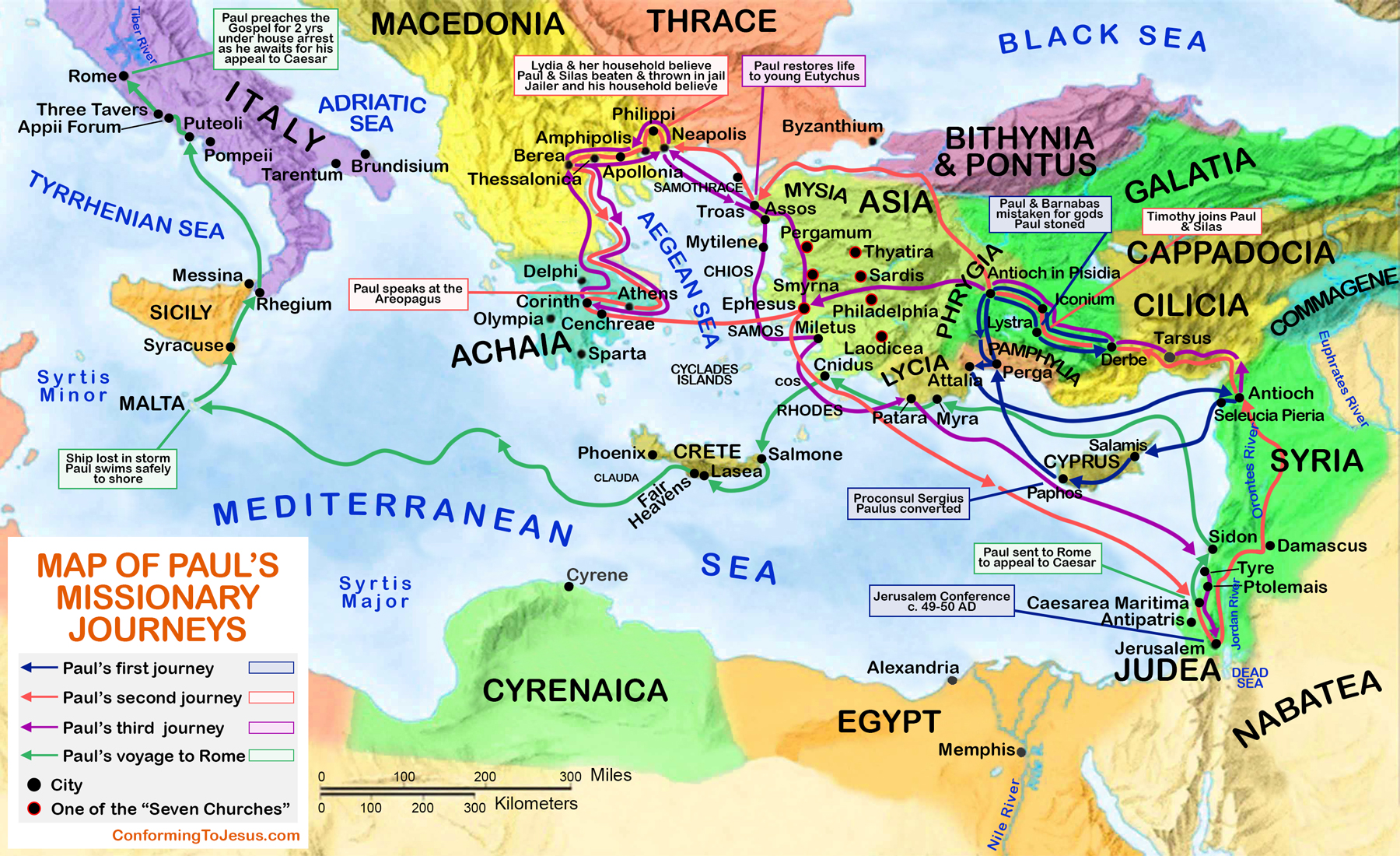
      • Paul is in the midst of his 2nd missionary journey (early 50s C.E.) → starts out in Caesarea on the eastern shore of the Mediterranean Sea → down to Jerusalem → moves inland and turns north → up through modern-day Jordan and Turkey to the southern shore of the Black Sea → west to basically circle the whole of the Aegean Sea (basically all of modern day Greece) → even crosses the Aegean Sea at the southern end after having traveled the whole of the shoreline from east to west → finally gets on a ship in Ephesus and sails back to starting point (Caesarea)[4]
    • Paul and Silas in Philippi → staying with Lydia (local merchant of purple cloth who was baptized along with her whole household)
      • (Interesting little Bible trivia nugget: this is where the book of Acts switches from 3rd person – talking about “Paul did this” and “Paul said that” to 1st person – talking about “We went here” and “We experienced that”)
    • But things don’t exactly go well in Philippi for Paul and Silas. – text: One day, when we were on the way to the place for prayer, we met a slave woman. She had a spirit that enabled her to predict the future. She made a lot of money for her owners through fortune-telling. She began following Paul and us, shouting, “These people are servants of the Most High God! They are proclaiming a way of salvation to you!” She did this for many days. This annoyed Paul so much that he finally turned and said to the spirit, “In the name of Jesus Christ, I command you to leave her!” It left her at that very moment. Her owners realized that their hope for making money was gone. They grabbed Paul and Silas and dragged them before the officials in the city center. When her owners approached the legal authorities, they said, “These people are causing an uproar in our city. They are Jews who promote customs that we Romans can’t accept or practice.” The crowd joined in the attacks against Paul and Silas, so the authorities ordered that they be stripped of their clothes and beaten with a rod. When Paul and Silas had been severely beaten, the authorities threw them into prison and ordered the jailer to secure them with great care.[5]
      • Surely, friends, we can agree that this falls under “Blessed are those who are persecuted for righteousness’ sake, for theirs is the kingdom of heaven. Blessed are you when people revile you and persecute you and utter all kinds of evil against you falsely on my account”? I think we can. And yet, in the midst of that suffering and persecution, that ridicule and reviling, Paul reacts exactly as Jesus encourages through the Beatitudes. → Paul and Silas spend their time in prison praying and singing hymns to God → then …
        • Earthquake that shakes the prison’s foundations
        • Doors fly open
        • Chains fall off
        • And yet instead of running out to freedom as so many probably would have, Paul, Silas, and all the rest of the prisoners remain in the prison … for the sake of their jailer! – text: When the jailer awoke and saw the open doors of the prison, he thought the prisoners had escaped, so he drew his sword and was about to kill himself. But Paul shouted loudly, “Don’t harm yourself! We’re all here!”[6]
    • Final stroke = Paul and Silas use that moment to witness – to share the story of God’s love and their faith – not only with the other prisoners (who we’ve already been told are listening and have clearly already been affected because they chose to remain with Paul and Silas when the prison literally broke open) BUT also to the jailer and his entire household → jailer is literally brought to his knees in awe and gratitude before Paul and Silas → asks “What must I do to be rescued?” → they reply, “Believe in the Lord Jesus, and you will be saved—you and your entire household.” → Paul and Silas spend time witnessing to the jailer and then to everyone in his house → text: Right then, in the middle of the night, the jailer welcomed them and washed their wounds. He and everyone in his household were immediately baptized. He brought them into his home and gave them a meal. He was overjoyed because he and everyone in his household had come to believe in God.[7] → Truly this story puts feet to that last Beatitude pairing.
  • So let’s talk about the pairing for a minute because the fact that these last two Beatitudes are so similar also factors into how we interact with these particular Beatitudes and with all the rest of the Beatitudes as well.
    • Throughout this whole Beatitudes portion of the Sermon on the Mount, Jesus is broad in his blessings → Each of the Beatitudes starts with some general descriptor – either “those” or “the …” to describe who that particular Beatitude encompasses.
      • Blessed are THE poor in spirit …
      • Blessed are THOSE who mourn …
      • Blessed are THE meek …
      • Blessed are THOSE who hunger and thirst for righteousness …
      • Using this arms-length description acknowledges that there will be times when our lives fall into those categories while also recognizing that not all of them will apply to all of us at the same time. The generality of it brings us in. It actually helps us engage and stay engaged because, even if we don’t identify with a particular blessing in that moment, we can hear Jesus’ blanket blessing for all those who are merciful or all those who are peacemakers, and we can say to ourselves, “Okay, maybe that isn’t me personally, but I know this person or that person who falls into that category.”
      • Also give us goals to strive for → when we hear the blessing for a category in which we feel we may be struggling or lacking, we can say to ourselves, “I may not be pure in heart now, but I can work on that.”
    • BUT this last pair of Beatitudes is different
      • Jesus starts with same formula: Blessed are those who are persecuted for righteousness’ sake, for theirs is the kingdom of heaven.[8]
      • BUT then he turns it around and makes it – and by extension, everything that came before it – inescapably personal: Blessed are you when people revile you and persecute you and utter all kinds of evil against you falsely on my account.[9] → By flipping the script in this way, Jesus is reminding us that we cannot escape any of these calls to act and speak and live and be in faith because they are, indeed, for all of us. Inexcusably. Irrefutably. Enduring. These blessings are a personal call for each and everyone one of us to share our faith with the world and, in doing so, take a step closer to God’s kingdom here on earth.
        • Cole: This is what it means to be a witness. It’s not about suffering in itself or seeking a grim death; it’s about having a love for God and neighbor that so far exceeds the fear of death that we would happily give our lives as a sign for those who do not yet believe. It’s about being so enflamed with the truth of the Gospel that we cannot bear the thought of anyone not knowing what we’ve found, even our enemies. We are compelled to do something heroic, emboldened to endure something painful. When all we can think about is making our lives a sign of the coming kingdom, forfeiting even our lives to make it known, we are on the way of Beatitude.[10] → Amen.

[1] Mt 5:10-11 (NRSV).

[2] Casey Cole, OFM. The Way of Beatitude: Living Radical Hope in a World of Division and Despair. (Notre Dame: Ave Maria Press, 2022), 99-101.

[3] John Dear. The Beatitudes of Peace: Meditations on the Beatitudes, Peacemaking and the Spiritual Life. (New London: Twenty-Third Publications, 2016), 102.

[4] https://www.conformingtojesus.com/images/webpages/pauls_journeys_map1.jpg.

[5] Acts 16:16-23.

[6] Acts 16:27-28.

[7] Acts 16:33-34.

[8] Mt 5:10 (NRSV).

[9] Mt 5:11 (NRSV).

[10] Cole, 110-111.