Text used – Acts 16:16-34
- So here we are at the end of this summer journey with the Beatitudes. We’ve talked about …
- Blessed are the poor in spirit, for theirs is the kingdom of heaven → through lens of surrender
- Blessed are those who mourn, for they will be comforted → through the lens of heartbreak
- Blessed are the meek, for they will inherit the earth → through the lens of confidence
- Blessed are those who hunger and thirst for righteousness, for they will be filled → through the lens of longing
- Blessed are the merciful, for they will receive mercy → through the lens of solidarity
- Blessed are the pure in heart, for they will see God → through the lens of authenticity
- Blessed are the peacemakers, for they will be called children of God → through the lens of liberation
- Today’s Beatitude = actually the last 2 Beatitudes combined because they’re so similar (we’ll talk about why in just a little bit): (v. 10) Blessed are those who are persecuted for righteousness’ sake, for theirs is the kingdom of heaven. (v. 11) Blessed are you when people revile you and persecute you and utter all kinds of evil against you falsely on my account.[1] → This may be the most countercultural of Jesus’ statements.
- Cole puts a contemporary spin on this countercultural nature with his opening story for this chapter → [read beginning of ch.[2]]
- Through the previous Beatitudes, Jesus has already encouraged the people to reject the trappings and pressures and treasures of the world around them to instead focus on a life of faith. In this final pairing of Beatitudes, Jesus is basically promising suffering because of that faith … and yet, wrapped in that less-than-desirable promise is the stronger, even more powerful promise of blessedness. “You will be persecuted,” Jesus says. “You will be insulted, ridiculed, reviled, and pursued. It won’t be comfortable. It won’t be fun. Yet in this, you will be blessed.”
- So let’s talk about that word “blessed” for a minute.
- Gr. “blessed” can also mean fortunate or happy = translations I don’t love because I feel like they add a dismissive or even flippant note to some of these really heavy topics that Jesus talks about → I don’t like the way “happy and those who mourn” or “happy are those who hunger and thirst for justice” reads because it can too easily morph into that toxic positivity that tries to force people who are suffering and struggling to slap on a smile no matter what.
- Another transl. of “blessed” = recipient of divine favor → Recipient of divine favor. So even in the midst of all of these struggles and challenges that Jesus highlights throughout the Beatitudes – culminating in today’s promise that there will be suffering – when we live and speak and respond and react not with whatever defensive emotion first bubbles to the surface but instead with faith, Jesus says, “God sees you. God is with you. And God is pleased.”
- Catholic theologian John Dear: To risk persecution in the struggle for justice and peace goes against everything we have been taught. The culture encourages us to be successful, powerful, rich, and famous. I figure Jesus knows better than the rest of us, so even if we do not understand, let’s get on with the work for justice and peace, come what may. The kingdom of God is worth it.[3]
- So let’s talk about that word “blessed” for a minute.
- That’s why the story of Paul and Silas and their miraculous escape from the prison is such a perfect story for today’s Beatitude AND to wrap-up this whole summer-long discussion on the Beatitudes.
- Context leading up to today’s encounter
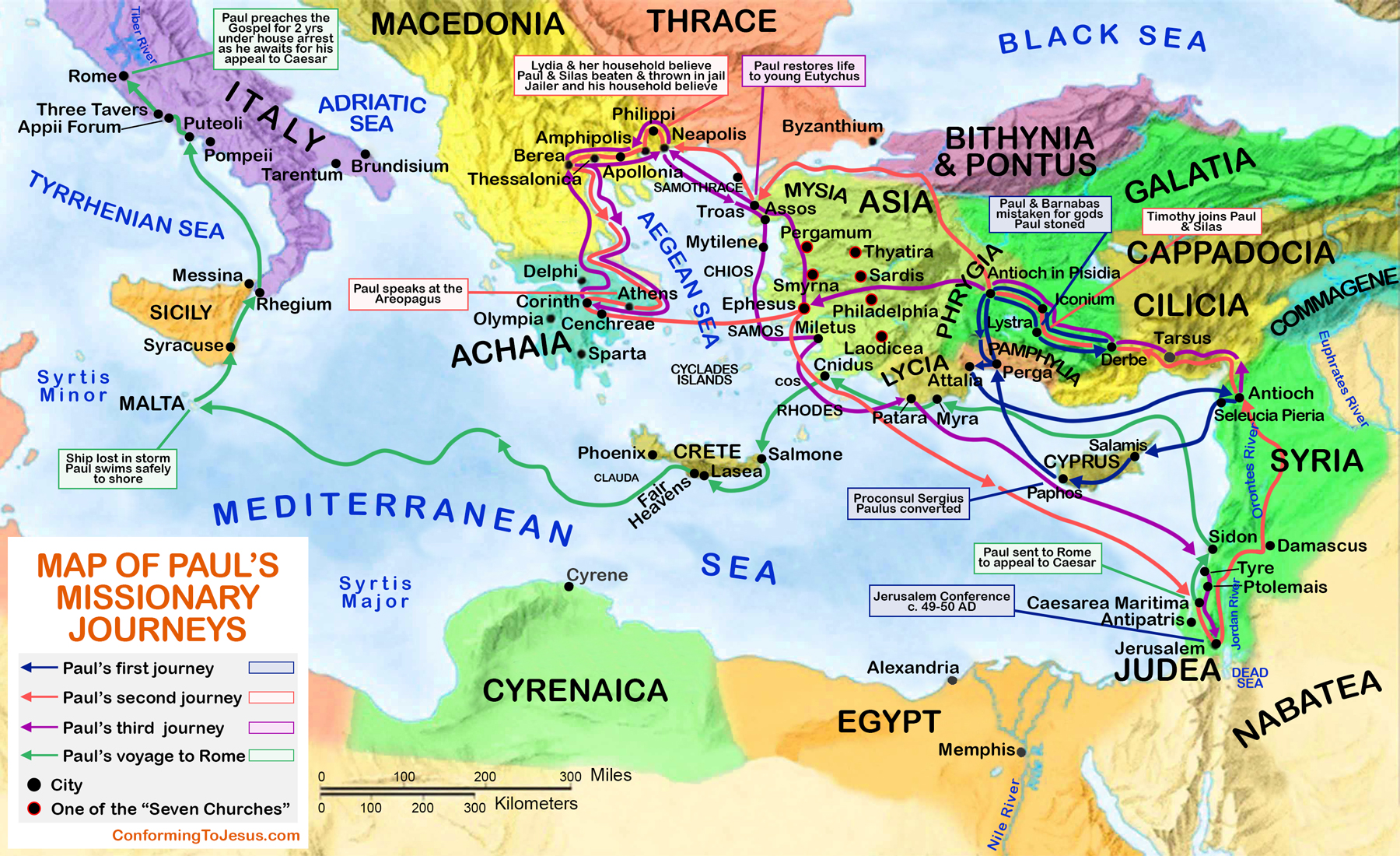
- Paul is in the midst of his 2nd missionary journey (early 50s C.E.) → starts out in Caesarea on the eastern shore of the Mediterranean Sea → down to Jerusalem → moves inland and turns north → up through modern-day Jordan and Turkey to the southern shore of the Black Sea → west to basically circle the whole of the Aegean Sea (basically all of modern day Greece) → even crosses the Aegean Sea at the southern end after having traveled the whole of the shoreline from east to west → finally gets on a ship in Ephesus and sails back to starting point (Caesarea)[4]
- Paul and Silas in Philippi → staying with Lydia (local merchant of purple cloth who was baptized along with her whole household)
- (Interesting little Bible trivia nugget: this is where the book of Acts switches from 3rd person – talking about “Paul did this” and “Paul said that” to 1st person – talking about “We went here” and “We experienced that”)
- But things don’t exactly go well in Philippi for Paul and Silas. – text: One day, when we were on the way to the place for prayer, we met a slave woman. She had a spirit that enabled her to predict the future. She made a lot of money for her owners through fortune-telling. She began following Paul and us, shouting, “These people are servants of the Most High God! They are proclaiming a way of salvation to you!” She did this for many days. This annoyed Paul so much that he finally turned and said to the spirit, “In the name of Jesus Christ, I command you to leave her!” It left her at that very moment. Her owners realized that their hope for making money was gone. They grabbed Paul and Silas and dragged them before the officials in the city center. When her owners approached the legal authorities, they said, “These people are causing an uproar in our city. They are Jews who promote customs that we Romans can’t accept or practice.” The crowd joined in the attacks against Paul and Silas, so the authorities ordered that they be stripped of their clothes and beaten with a rod. When Paul and Silas had been severely beaten, the authorities threw them into prison and ordered the jailer to secure them with great care.[5]
- Surely, friends, we can agree that this falls under “Blessed are those who are persecuted for righteousness’ sake, for theirs is the kingdom of heaven. Blessed are you when people revile you and persecute you and utter all kinds of evil against you falsely on my account”? I think we can. And yet, in the midst of that suffering and persecution, that ridicule and reviling, Paul reacts exactly as Jesus encourages through the Beatitudes. → Paul and Silas spend their time in prison praying and singing hymns to God → then …
- Earthquake that shakes the prison’s foundations
- Doors fly open
- Chains fall off
- And yet instead of running out to freedom as so many probably would have, Paul, Silas, and all the rest of the prisoners remain in the prison … for the sake of their jailer! – text: When the jailer awoke and saw the open doors of the prison, he thought the prisoners had escaped, so he drew his sword and was about to kill himself. But Paul shouted loudly, “Don’t harm yourself! We’re all here!”[6]
- Surely, friends, we can agree that this falls under “Blessed are those who are persecuted for righteousness’ sake, for theirs is the kingdom of heaven. Blessed are you when people revile you and persecute you and utter all kinds of evil against you falsely on my account”? I think we can. And yet, in the midst of that suffering and persecution, that ridicule and reviling, Paul reacts exactly as Jesus encourages through the Beatitudes. → Paul and Silas spend their time in prison praying and singing hymns to God → then …
- Final stroke = Paul and Silas use that moment to witness – to share the story of God’s love and their faith – not only with the other prisoners (who we’ve already been told are listening and have clearly already been affected because they chose to remain with Paul and Silas when the prison literally broke open) BUT also to the jailer and his entire household → jailer is literally brought to his knees in awe and gratitude before Paul and Silas → asks “What must I do to be rescued?” → they reply, “Believe in the Lord Jesus, and you will be saved—you and your entire household.” → Paul and Silas spend time witnessing to the jailer and then to everyone in his house → text: Right then, in the middle of the night, the jailer welcomed them and washed their wounds. He and everyone in his household were immediately baptized. He brought them into his home and gave them a meal. He was overjoyed because he and everyone in his household had come to believe in God.[7] → Truly this story puts feet to that last Beatitude pairing.
- Context leading up to today’s encounter
- So let’s talk about the pairing for a minute because the fact that these last two Beatitudes are so similar also factors into how we interact with these particular Beatitudes and with all the rest of the Beatitudes as well.
- Throughout this whole Beatitudes portion of the Sermon on the Mount, Jesus is broad in his blessings → Each of the Beatitudes starts with some general descriptor – either “those” or “the …” to describe who that particular Beatitude encompasses.
- Blessed are THE poor in spirit …
- Blessed are THOSE who mourn …
- Blessed are THE meek …
- Blessed are THOSE who hunger and thirst for righteousness …
- Using this arms-length description acknowledges that there will be times when our lives fall into those categories while also recognizing that not all of them will apply to all of us at the same time. The generality of it brings us in. It actually helps us engage and stay engaged because, even if we don’t identify with a particular blessing in that moment, we can hear Jesus’ blanket blessing for all those who are merciful or all those who are peacemakers, and we can say to ourselves, “Okay, maybe that isn’t me personally, but I know this person or that person who falls into that category.”
- Also give us goals to strive for → when we hear the blessing for a category in which we feel we may be struggling or lacking, we can say to ourselves, “I may not be pure in heart now, but I can work on that.”
- BUT this last pair of Beatitudes is different
- Jesus starts with same formula: Blessed are those who are persecuted for righteousness’ sake, for theirs is the kingdom of heaven.[8]
- BUT then he turns it around and makes it – and by extension, everything that came before it – inescapably personal: Blessed are you when people revile you and persecute you and utter all kinds of evil against you falsely on my account.[9] → By flipping the script in this way, Jesus is reminding us that we cannot escape any of these calls to act and speak and live and be in faith because they are, indeed, for all of us. Inexcusably. Irrefutably. Enduring. These blessings are a personal call for each and everyone one of us to share our faith with the world and, in doing so, take a step closer to God’s kingdom here on earth.
- Cole: This is what it means to be a witness. It’s not about suffering in itself or seeking a grim death; it’s about having a love for God and neighbor that so far exceeds the fear of death that we would happily give our lives as a sign for those who do not yet believe. It’s about being so enflamed with the truth of the Gospel that we cannot bear the thought of anyone not knowing what we’ve found, even our enemies. We are compelled to do something heroic, emboldened to endure something painful. When all we can think about is making our lives a sign of the coming kingdom, forfeiting even our lives to make it known, we are on the way of Beatitude.[10] → Amen.
- Throughout this whole Beatitudes portion of the Sermon on the Mount, Jesus is broad in his blessings → Each of the Beatitudes starts with some general descriptor – either “those” or “the …” to describe who that particular Beatitude encompasses.
[1] Mt 5:10-11 (NRSV).
[2] Casey Cole, OFM. The Way of Beatitude: Living Radical Hope in a World of Division and Despair. (Notre Dame: Ave Maria Press, 2022), 99-101.
[3] John Dear. The Beatitudes of Peace: Meditations on the Beatitudes, Peacemaking and the Spiritual Life. (New London: Twenty-Third Publications, 2016), 102.
[4] https://www.conformingtojesus.com/images/webpages/pauls_journeys_map1.jpg.
[5] Acts 16:16-23.
[6] Acts 16:27-28.
[7] Acts 16:33-34.
[8] Mt 5:10 (NRSV).
[9] Mt 5:11 (NRSV).
[10] Cole, 110-111.
 Fearfully and Wonderfully Made