Text used – John 10:11-18
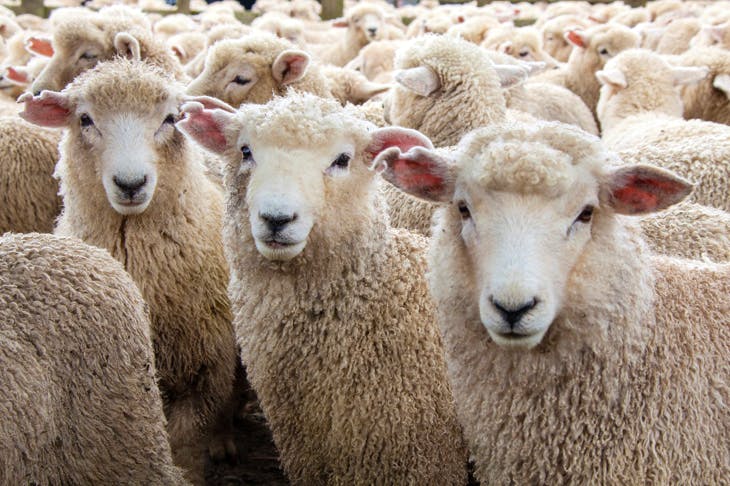
- As I was thinking about this whole image of lambs and sheep and shepherd and Jesus this week, I have to admit that it was challenging.
- Challenging because there’s almost an overabundance of sheep/shepherd/flock imagery throughout Scripture → speaks heavily to the culture in which these sacred texts were first spoken and written and shared
- Culture rife with pastoral scenes
- Sheep and shepherds occupying hillsides all around
- Sheep and shepherds encountered going along the road from one place to the next
- Religious culture rich with the importance of sheep → one of the main animals of sacrifice: “an unblemished sheep” or “the finest of the flock” were some of the most lavish sacrifices offered both in atonement and in thanksgiving
- Other Scriptures speaking of sheep and shepherds (just a small sample, mind you)
- Ps 23: The Lord is my shepherd, I shall not want[1] …
- Ezek 34: The Lord God proclaims: I myself will search for my flock and seek them out. As a shepherd seeks out the flock when some in the flock have been scattered, so will I seek out my flock. I will rescue them from all the places where they were scattered during the time of clouds and thick darkness.[2]
- Jn 21: When they finished eating, Jesus asked Simon Peter, “Simon son of John, do you love me more than these?” Simon replied, “Yes, Lord, you know I love you.” Jesus said to him, “Feed my lambs.” Jesus asked a second time, “Simon son of John, do you love me?” Simon replied, “Yes, Lord, you know I love you.” Jesus said to him, “Take care of my sheep.” He asked a third time, “Simon son of John, do you love me?” Peter was sad that Jesus asked a third time, “Do you love me?” He replied, “Lord, you know everything; you know I love you.” Jesus said to him, “Feed my sheep.”[3]
- 1 Pet 2: Like shepherds, tend the flock of God among you. Watch over it. Don’t shepherd because you must, but do it voluntarily for God. Don’t shepherd greedily, but do it eagerly. Don’t shepherd by ruling over those entrusted to your care, but become examples to the flock.[4]
- Rev 7: They won’t hunger or thirst anymore. No sun or scorching heat will beat down on them, because the Lamb who is in the midst of the throne will shepherd them. He will lead them to the springs of life-giving water, and God will wipe away every tear from their eyes.[5]
- And as I said, these are only a few – a scant few – of the passages I could have pulled to illustrate this. Yes, Scripture is full of references to various aspects of our faith being like sheep … like shepherds … like flock. The sheep/shepherd language is everywhere.
- Challenge presented by this overabundance of sheep/shepherd/flock language – scholar: The good shepherd is one of the most familiar images of Jesus and all the more demanding of theological attention, for the familiar too easily becomes routine and its range of meaning narrows.[6] → I think for today’s particular passage from John 10 – what is most often referred to as “The Good Shepherd” passage – this is particularly true. So after so many references and interpretations and sermons and devotional readings and everything else we’ve encountered about this passage specifically and about sheep/shepherd imagery in the Bible in general, I was struggling with how to come at this from a new vantage point.
- Culture rife with pastoral scenes
- Challenging because there’s almost an overabundance of sheep/shepherd/flock imagery throughout Scripture → speaks heavily to the culture in which these sacred texts were first spoken and written and shared
- But then I stumbled across this piece written by a modern-day shepherd back in 2013. – “10 Things I’ve Learned from Lambs” by Craig Rogers[7] from the Modern Farmer website
- According to bio at the beginning of the piece: Craig Rogers = owner of Border Springs Farm in Patrick Springs, Virginia
- And as I was reading through these 10 things, I thought, “That could be a good way to approach this text, especially for those of us who haven’t grown up on sheep farms” (which I’m relatively sure applies to almost everyone in this room … am I right?)
- Can’t tackle them all – 2 reasons
- ONE: we’d be here all day because there’s a lot here
- TWO: Frankly, the last 3 all deal with eating lamb, and sometimes an illustration can only go so far!
- Can’t tackle them all – 2 reasons
- Lesson 1: “A shepherd’s life is most humble: From the beginning of time, shepherds have been the proverbial ‘ditch diggers,’ the down-trodden, the disrespected. Hence, even the angels came to the shepherds, the lowliest of all men, to share the news of the birth of Christ, as the story is told. Over the centuries, nothing has changed much. From the shepherds of the hills of Scotland, to the shepherds of the new Western frontier, to the Basque shepherds who migrated from Mexico and became the shepherds of the far west and the emancipated slaves who headed west with prolific breeding sheep as their source of livelihood, all have been discriminated upon and viewed as a lowly class over the ages. … [Yet] I find great pride in doing the ancient work of caring for sheep, the humble work of caring for the sick, ensuring the health of each individual, providing feed and shelter and protecting the safety and health of the flock. Shepherding requires more hands-on work than most livestock farming. Lambing (the birthing of lambs) often occurs at night, in the cold, and is a solitary farming task where the reward is personal satisfaction in perhaps saving the life of a ewe or bringing a lamb into the world that otherwise would not make it. It is a personal satisfaction with few equals.”
- The culture in which we reside seems pretty deeply focused on notoriety.
- Think about YouTube, tiktok, FB/IG reels and all the other ways people share short, 15-second snip-its of anything and everything
- Dances
- Major life events
- Personal opinion rants about whatever happened to cross their path in the last 5 mins.
- Cute kids … puppies … kitties … turtles … fill-in-the-blank
- Think about the entire job description of paparazzi: get the best picture you can of celebrities’ most intimate, unguarded moments … the juicier, the better, regardless of the privacy, wishes, feelings, and often even safety of the celebrities involved.
- Think about YouTube, tiktok, FB/IG reels and all the other ways people share short, 15-second snip-its of anything and everything
- I think we can safely say that the photographers and journalists working for all the gossip rags out there aren’t actively seeking out random shepherds in the fields.
- Position with few accolades
- Position with little to no recognition
- Position that requires long days, hard work, and plenty of very messy moments
- Long days … hard work … plenty of very messy moments … I wonder if Jesus would have described his ministry that way? Clearly, there is humility in today’s passage. → Jesus speaks about the shepherd sacrificing for the sheep, particularly in ways the hired hand will not – text: The good shepherd lays down his life for the sheep. When the hired hand sees the wolf coming, he leaves the sheep and runs away. That’s because he isn’t the shepherd; the sheep aren’t really his.[8]
- Work that we do within the life of the church is the same
- Not work that we do for the recognition of it
- Work that is often long … hard … even messy
- It’s work that we do, not for the good of ourselves or our reputations or our bank accounts, but for the good of others.
- Good of those around us in this space (Christian community)
- Good of those whose lives we get to touch through our ministry here (mission and outreach)
- The culture in which we reside seems pretty deeply focused on notoriety.
- Lesson 2: “Sheep are smarter than everyone thinks they are. You just have to be smart enough to recognize it: Over the years I have often been told, generally by non-sheep people or someone with 10 or 20 sheep that are fed from buckets, how dumb sheep are. However, if you pay attention, you cannot help but be impressed by how smart they are to have survived domestication since 10,000 B.C. Although many think of their flocking instinct to be a sign of ‘dumbness,’ it is in fact a community-based survival mechanism where they have learned that their strength is much greater in numbers and their comfort and survival is enhanced as a group rather than as an individual. Not a bad lesson for all of us.”
- This idea of “community-based survival,” as Rogers calls it, is the whole point of today’s Good Shepherd passage. As the Good Shepherd, Jesus speaks of the ability to gather the sheep to himself – to keep them together for the purposes of protection and prosperity, for the good of the shepherd’s purposes as well as the lives of the sheep.
- Rogers’ point: the sheep stick together – the sheep “flock up” – for their own benefit
- Safety
- Warmth
- Companionship
- Jesus speaks to this in our passage today, too – text: I am the good shepherd. I know my sheep and they know me, just as the Father knows me and I know the Father. I give up my life for the sheep. I have other sheep that don’t belong to this sheep pen. I must lead them, too. They will listen to my voice and there will be one flock, with one shepherd.[9]
- And isn’t that why we come here, friends? For safety for our spirits when we’re at our lowest and most vulnerable … for the warmth of seeking God and experiencing God together as the body of Christ … for the companionship of praying and worshiping and exploring and living out our faith together, no matter our current terrain? The whole idea of “church” is a place where we can embody that “community-based survival” together amidst the throes of life – the ups and the downs, the lost moments and the found ones, the green pastures and still waters and everything in between.
- Rogers’ point: the sheep stick together – the sheep “flock up” – for their own benefit
- Lesson 3 rolls into this idea as well: “Tend to the flock, but care for the individual.: Shepherds, like the sheep themselves, learn quickly that the path to success depends on tending to the flock but caring for the individual. Providing clean water, ample forage and shelter to an entire flock is essential to maintaining the health of the flock. But the success of a shepherd or shepherdess is in the compassion they have for each individual. This means being able to identify a sick or injured sheep or lamb within a flock of hundreds or thousands of sheep. … The more concern the shepherd has for the individuals who are in need of health care, supplemental food assistance or individual attention, the healthier the flock and the more profitable the whole operation is. (This lesson applies to more than a flock of sheep.)” → In our passage today, Jesus speaks about the utmost lengths to which he’ll go to care for the sheep, and as Christians – when we choose to follow Christ to the point of bearing his name as part of our identity – we are called to act like Christ as well.
- Caring for the sheep [re-read underlined portion]
- Jesus’ familiar words in another sheep-referencing passage: “Lord, when did we see you hungry and feed you, or thirsty and give you a drink? When did we see you as a stranger and welcome you, or naked and give you clothes to wear? When did we see you sick or in prison and visit you?” Then the king will reply to them, “I assure you that when you have done it for one of the least of these brothers and sisters of mine, you have done it for me.”[10]
- This idea of “community-based survival,” as Rogers calls it, is the whole point of today’s Good Shepherd passage. As the Good Shepherd, Jesus speaks of the ability to gather the sheep to himself – to keep them together for the purposes of protection and prosperity, for the good of the shepherd’s purposes as well as the lives of the sheep.
- No matter how we approach this idea of sheep and shepherds and flocks and faith, friends, nothing about this imagery suggests things are easy.
- Not easy for the sheep
- Constant threats (getting lost, predators, dangerous terrain, etc.)
- Challenges of everyday life (finding food, lambing process, etc.)
- Not easy for the shepherd → needing to protect the sheep in the midst of those same challenges
- Certainly times when it’s easier to scatter – to try to go our own way because we think it will be better … safer … more abundant … more exciting
- World of the church = in a time of scattering right now → It’s no secret that congregations are shrinking, no matter their starting size, and that the fastest growing religious group are the “nones” – those who have no religious affiliation of any kind.
- Statistics that can feel scary … daunting … hopeless
- World of the church = in a time of scattering right now → It’s no secret that congregations are shrinking, no matter their starting size, and that the fastest growing religious group are the “nones” – those who have no religious affiliation of any kind.
- And yet as sheep together, we hold to the compassion and care of the Good Shepherd. We tune our ears to the voice of the One who names us and claims us as his very own. Sometimes we scatter. But be assured, friends, that the Good Shepherd will always seek us out and bring us home … again, and again, and again. Thanks be to God. Amen.
- Not easy for the sheep
[1] Ps 23:1.
[2] Ezek 34:11-12.
[3] Jn 21:15-17.
[4] 1 Pet 5:2-3.
[5] Rev 7:16-17.
[6] Stephen A. Cooper. “Fourth Sunday of Easter – John 10:11-18 – Theological Perspective” in Feasting on the Word: Preaching the Revised Common Lectionary – Year B, vol. 2. (Louisville: Westminster John Knox Press, 2008), 448.
[7] https://modernfarmer.com/2013/12/10-things-learned-lambs/.
[8] Jn 10:11-12.
[9] Jn 10:14-16.
[10] Mt 25:37-40.
 Fearfully and Wonderfully Made