Sunday’s sermon: Blessing Through the Brokenness

Text used – Job 42:1-6, 10-17

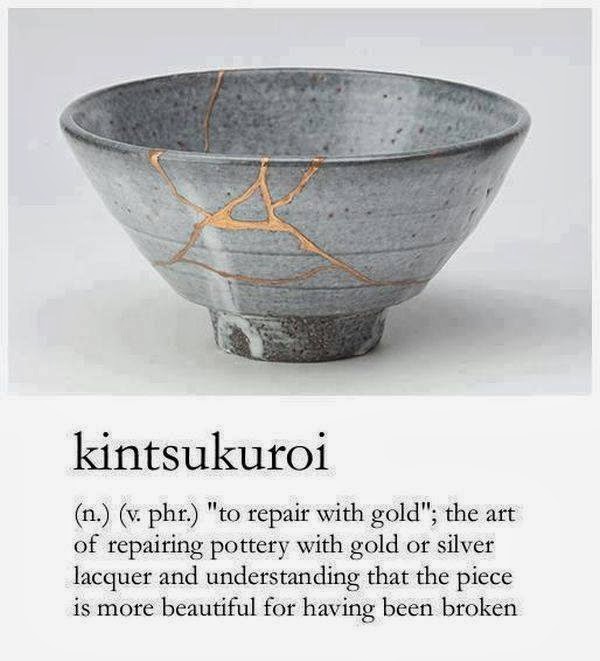
  • I want you to take a look at the picture on the front of your bulletin this morning.
    • Explain idea of kintsukuroi/kintsugi: “to repair with gold”; the art of repairing pottery with gold or silver lacquer and understanding that the piece is more beautiful for having been broken → practice that is thoroughly intentional
      • First, glue the pieces back together, making sure no piece or sliver or shard is missing
      • Paint those glued seams with gold, silver, or even sometimes platinum lacquer
        • Slowly
        • Deliberately
        • Painstakingly
        • Intentionally
      • There is something wholly and sacredly beautiful about an artform that, instead of trying to hide the brokenness of the object, highlights the repairs that have been made – the wholeness that exists in spite of the brokenness.
        • Vaneetha Risner, Christian author and blogger, about kintsugi: A broken piece that is put back together has more of a story, seems more authentic and real, is stronger and more resilient than something that has stayed pristine. The breaking of what once was, the layered and time-consuming process of putting it back together, the mending it with gold, all contribute to its value. And surprisingly, it becomes more resilient after it has been mended by kintsugi, even stronger than it was before.[1] → More beautiful than before it was broken … more valuable … than before it was broken … stronger than before it was broken …
    • What if we in the church lived this way? What if we loved this way? What if we believed this way? What if we ministered this way? → going to talk about some of those “what if”s today using one of the Bible’s most unmitigated stories of brokenness: Job
  • Today’s passage = the very end of the book of Job → But before we skip to the end, let’s talk about the book of Job as a whole.
    • Very deliberately called Job a “story” → Let me tell you why.
      • First Testament divided into 3 parts
        • Torah = history: first 5 books
        • Nevi’im = prophets: Joshua, Judges, 1/2 Samuel, 1/2 Kings as well as Isaiah, Jeremiah, Ezekiel, and the 12 Minor Prophets (Hosea, Joel, Amos, Obadiah, Jonah, Micah, Nahum, Habakkuk, Zephaniah, Haggai, Zechariah, and Malachi)
        • Ketuvim = writings: Hebrew poetry and wisdom literature → And it is within this third category – this wisdom literature category – that we find the book of Job.
          • Biblical scholar Adele Berlin: … often left to the reader has been the actual reading of the poem – the making of sense and beauty from its sounds, words, and structures, the perception that it is a unified entity with a distinctive message.[2]
    • This is particularly important when it comes to the book of Job.
      • Biblical scholar Carol Newsom’s descr. of Job: Job is a challenging book to read, not only because of the theological issues it treat but also because of the form in which it is written. It begins with a simple prose story (1:1-2:13) describing Job’s piety, the conversation between God and the satan, which leads to a decision to test Job, and the disasters that befall Job as the test of his piety. Abruptly, the style of the book changes in chap. 3, as Job and the friends who have gathered to comfort him begin to debate the meaning of what has befallen him and the proper posture Job should assume toward God. In contrast to the simple prose of the first two chapters, this dialogue is composed in elegant, sophisticated poetry, full of rare words and striking images. The climax of this section is the long speech of God from the whirlwind and Job’s brief reply. At that point, just as abruptly, the style again shifts back to simple prose for the conclusion, as Job’s well-being is restored and the remainder of his long life is briefly described. The changes between the beginning, middle, and end of the book are not merely stylistic, but also correspond to changes in the representation of characters and in the nature of the religious issues under consideration.[3] → This understanding is critical because it gives us context for the story of Job. It reiterates for us that Job is a tale from which we can learn something – an ancient fable of sorts. It’s not found in the “history” section of the First Testament. It was never meant to be read as a true story that actually happened to one man thousands of years ago. At it’s core, the book of Job is a story about brokenness and how, no matter how we experience that brokenness, God remains with us – steadfast, compassionate, and wholly present.
  • Think about the beginning of Job.
    • Job = “honest, a person of absolute integrity; he feared God and avoided evil”[4] → also a man who had everything
      • 7 sons and 3 daughters
      • 7000 sheep
      • 3000 camels
      • 500 pairs of oxen (do the math … 1000 oxen)
      • 500 female donkeys
      • “and a vast number of servants, so that he was greater than all the people of the east.”[5]
      • Also a man constantly offering up prayers and burnt offerings on behalf of himself and his family … just in case they were sinning and cursing God in their hearts.
    • Job’s unwavering faith and devotion catch the attention of the Adversary (which is what satan literally means in Hebrew) – beginning of Job: One day the divine beings came to present themselves before the Lord, and the Adversary also came among them. The Lord said to the Adversary, “Where did you come from?” The Adversary answered the Lord, “From wandering throughout the earth.”[6] → And isn’t that often how it feels when bad things happen, all? Especially in this day and age when it feels like every headline is just darker, scarier, uglier than the last. Doesn’t it feel like there’s just an undefinable malevolence “wandering throughout the earth”?
      • This Adversary = ancient Hebrews’ attempt to address what theologians today call the Problem of Evil → “Why do bad things happen to good people?” question
    • With that question in mind, all the bad things happen to Job, a good man.
      • Job’s oxen and camels are all stolen in 2 separate raids[7]
      • Job’s sheep are all burned up in “a raging fire [that] fell from the sky”[8]
      • Job’s children all die
      • Job’s body becomes covered in sores
      • Think about it, friends. Job has lost his security. Job has lost his livelihood – his job, essentially. He’s lost his family. He’s lost his health. Job is awash in grief.
        • Are you familiar with the term “ambiguous grief”? Ambiguous grief describes the grieving process when it involves someone who is still living but changed.
          • Grieving someone who is ill
          • Grieving a lost relationship (divorce, estrangement, incarceration, even a cross-country move)
          • Grieving someone suffering from any number of diseases that can either leave the body struggling but the mind intact (e.g.s – ALS or Huntington’s disease) or diseases that leave the body intact but the mind struggling (e.g.s – Alzheimer’s or dementia)
          • Grieving someone whose personality, whose life, whose circumstances, whose relationship with you has been altered by mental illness
          • There are so many of us wading through ambiguous grief in our lives. → old adage of not judging someone until you walk a mile in their shoes
        • The book of Job addresses so much of that ambiguous grief because Job is suffering both for his own tangible griefs – the loss of his children – as well as his ambiguous griefs. But through it all, God remains with Job.
    • Book of Job also addresses the pressures from the world around us to approach God or to think about God or to feel about God in a certain way
      • The vast majority of the book of Job = conversations btwn. Job and his friends → And there’s a lot that we could take away from these conversations – I mean, we’re talking about basically 38 Biblical chapters worth of conversations! … I mean, that’s not just multiple sermons’ worth of conversations, that’s multiple sermon series’ worth of conversations! But what I want us to notice today is one particular aspect of Job’s conversations with his friends about his circumstances and his faith.
        • Job’s friends = full of advice → full of suggestions and fixes and flowery words and worn out phrases → I’m sure that if “everything happens for a reason” and “when God closes a door, he opens a window” had been common phrases back when Job was written, they would be in there.
        • What Job’s interactions with his friends are lacking = listening → Job’s friends are all about telling him what to do and think and believe when it comes to God. But nothing in Job’s story tell us that his friends simply sat with Job and gave him space to be … to grieve … to find his own way back to God. They were there to convince Job, not to comfort him. And that’s so indicative of human nature, isn’t it? Especially here in the Midwest, I think. “How can I fix it? What can I do to make it better? Give me a task.” But what if the task needed most is just sitting quietly with someone utterly overwhelmed with their grief? With their brokenness? With their pain?
    • End of Job’s story – portion that we read today – is Job finding his way back to God on his own → Job has railed at God against his own self, against the land, against those who stole from him, and against even his friends who are trying to help him … but he never blames God. Throughout the entire book, Job continues to place trust in God. But he also places a little too much trust in himself.
      • Buried deep within Job – ch. 32: [Job’s three friends, Eliphaz, Bildad, and Zophar] stopped answering Job because he thought he was righteous. Elihu son of Barachel the Buzite from the clan of Ram was angry, angry with Job because he considered himself more righteous than God.[9] → In this and in the multiple chapters of Elihu’s response to Job that follow, we learn that Job’s understandable “why me?” grief response is more than likely tinged with a “why not them?” response as well. “I’ve been great, God … so why me instead of those sneaky Chaldeans who stole my camels? Why me instead of those sinners? Why me instead of … instead of … instead of …?”
        • Large portions of Job = Job listing all the ways he isn’t broken instead of bringing his true brokenness to God → out in the open, genuinely and honestly … maybe not for all the world to see, but at least with enough integrity for those who love him to see.
  • You see, it’s only after Job has acknowledged God’s supreme goodness above even his own goodness at the beginning of our text this morning that we find Job restored.
    • Today’s text: Job answered the Lord: I know you can do anything; no plan of yours can be opposed successfully. You said, “Who is this darkening counsel without knowledge?”I have indeed spoken about things I didn’t understand, wonders beyond my comprehension. You said, “Listen and I will speak; I will question you and you will inform me.” My ears had heard about you, but now my eyes have seen you. Therefore, I relent and find comfort on dust and ashes.[10] → There is humility in Job. There is acknowledgment in Job. In his brokenness and through his brokenness, he is finding the beauty of God’s love and compassion and presence.
      • Your $10 theological term for today = theodicy: a defense of God’s goodness and power in the face of evil → The entire book of Job is exactly that: a defense of God’s goodness and power in the face of all the many and varied evils we find in the world.
        • What’s the lesson I DON’T want you to take away from today: that God causes those evils just to bring us closer → That’s not what happened. In the words of contemporary Christian writer Sarah Bessey: This world has enough horrifying tyrants and torturers and cruel monsters: we don’t need to make God into one or try to baptize such things with sacred language. That is truly profane.[11]
        • What we CAN take from Job = God’s abiding and blessed presence with us no matter our stage or state of brokenness → God will always be there to put us back together, making us more beautiful, more valuable, and even stronger than we were before. Amen.

[1] https://www.vaneetha.com/journal/kintsugi-beauty-in-the-broken.

[2] Adele Berlin. “Introduction to Hebrew Poetry” in The New Interpreter’s Bible Commentary series, vol. 4. (Nashville: Abingdon Press, 1996), 314.

[3] Carol A. Newsom. “The Book of Job: Introduction, Commentary, and Reflections” in The New Interpreter’s Bible Commentary series, vol. 4. (Nashville: Abingdon Press, 1996), 320.

[4] Job 1:1.

[5] Job 1:2-3.

[6] Job 1:6-7.

[7] Job 1:14, 17.

[8] Job 1:16.

[9] Job 32:1-2.

[10] Job 42:1-6.

[11] Sarah Bessey. Field Notes for the Wilderness: Practices for an Evolving Faith. (New York: Convergent Books, 2024), 61.


Sunday’s sermon: First … Is the Worst?

Text used – Mark 10:35-45

  • Ahhh … that childhood spirit of competitiveness that has given birth to the age-old playground chants:
    • “We want a pitcher, not a belly-itcher!”
    • “See ya … wouldn’t wanna be ya!”
    • As well as the ever-classic, “Na na na na na na!”
    • And, inevitably when your team came in second at something, you touted out that tried and true chant: “First is the worst, second is the best, third is the one with the hairiest chest!” Not that we knew anything about that as elementary school kids, but hey … it rhymed, right?
      • At the core of this particularly playground gem = reality that nobody likes to lose, right?
      • Lots of different things motivate competitiveness
        • Intrinsic factors: self-worth, desire to master a task/skill, desire to be accepted
        • Extrinsic factors: presence of a rival, potential future effects of event (e.g. – being selected for a team/role or college scouts in the stands at a sporting event), desire for others to find your own contribution valuable
        • Article from ZME Science: Just as with many behavioral traits, competitiveness is not an absolute quality but instead exists on a continuum. Some individuals are highly competitive, others less so, and a select few appear to be constantly compelled to outdo others. Our perception of competitiveness also varies, with most individuals acknowledging a line between healthy and unhealthy competition. Yet, drawing this line within any specific context can be a contentious task.[1]
  • And trying to draw this particularly contentious line between healthy and unhealthy competitiveness is where we find James and John in our gospel story this morning.
    • Take a minute – remind ourselves who James and John are
      • Mk’s own descr. of their call story with Jesus: As Jesus passed alongside the Galilee See, he saw two brothers, Simon and Andrew. They were fishermen, so they were throwing fishing nets into the sea. “Come, follow me,” he said, “and I’ll show you how to fish for people.” Right away, they left their nets and followed him. After going a little farther, he saw James and John, Zebedee’s sons, in their boat repairing their fishing nets. At that very moment he called them. They followed him, leaving their father Zebedee in the boat with the hired workers.[2]
      • Mk = also the only gospel that gives James and John their infamous nickname: the Sons of Thunder – Mk 3: [Jesus] appointed twelve: Peter, a name he gave Simon; James and John, Zebedee’s sons, whom he nicknamed Boanerges, which means “sons of Thunder”; and Andrew; Philip; Bartholomew; Matthew; Thomas; James, Alphaeus’ son; Thaddeus; Simon the Cananaean; and Judas Iscariot, who betrayed Jesus.[3]
        • Scholars speculate that this particular moniker – this “sons of Thunder” – has to do with James’ and John’s personalities
          • Boisterous
          • Loud
          • Brash
          • Quick to act before thinking
    • Certainly sound like the kind of traits that could have led to today’s uncomfortable gospel situation: James and John approach Jesus à “Teacher, we want you to do for us whatever we ask.”[4] → Okay … timeout for a second. Any parent … any teacher … any babysitter … anyone who’s ever been around kids for more than 5 minutes could tell you that an opening like this is a RED FLAG!! “Mom, whatever I’m about to ask you to do … could you just, you know, say ‘yes’ to it?” Never. Gonna. Fly. Flox!! Okay, James and John … we’ll pretend we didn’t hear that … continue à next comes The Big Ask: They said, “Allow one of us to sit on your right and the other on your left when you enter your glory.”[5] → Woah woah woah woah!! Lay it all out there, why don’tcha, James and John!? Sheesh!
      • Ask = audacious because they are asking for the two seats of greatest power
        • Two seats closest to power
        • Two seats on both sides of the throne = Jesus’ 2nd and 3rd in command
        • Two seats generally reserved in the culture for those deserving the greatest honor and glory and respect
      • Ask = even more audacious when we consider what Jesus said in the verses just prior to what we read today: Jesus and his disciples were on the road, going up to Jerusalem, with Jesus in the lead. The disciples were amazed while the others following behind were afraid. Taking the Twelve aside again, he told them what was about to happen to him. “Look!” he said. “We’re going up to Jerusalem. The Human One will be handed over to the chief priests and the legal experts. They will condemn him to death and hand him over to the Gentiles. They will ridicule him, spit on him, torture him, and kill him. After three days, he will rise up.”[6] → So Jesus has just foretold his own horrible arrest, torture, death, and resurrection … and directly following that, James and John sidle up to him and say, “Hey, Jesus … can you just say yes to whatever we’re about to ask you?”
        • Scholar: To ambition and vanity, Mark adds dramatic irony. Jesus has just foretold his coming condemnation, humiliation, and death, but James and John are still dreaming of power and position. … Eager to ease into positions of power and glory, the brothers do not realize that they will soon be called upon to sacrifice everything for their cause.[7]
    • Jesus clearly isn’t thrilled with this ask – response: Jesus replied, “You don’t know what you’re asking! Can you drink the cup I drink or receive the baptism I receive?”[8] (referring to the torment and death that await him)
    • Other disciples are also definitely not thrilled with this little side conversation – text: Now when the other ten disciples heard about this, they became angry with James and John.[9] → And it’s this conflict that brings about Jesus’ often-quoted phrase about how important it is to not be first.
      • Mk’s language isn’t quite the same as the “first shall be last and the last shall be first” that we’re probably most familiar with (that language comes out of Mt’s gospel) – text: Whoever wants to be great among you will be your servant. Whoever wants to be first among you will be the slave of all, for the Human One didn’t come to be served but rather to serve and to give his life to liberate many people.[10]
  • What I find most interesting about the way Jesus frames this discussion here in Mark’s gospel is him emphasis on serving. And in this emphasis, Jesus is teaching us an important lesson about serving, and that is that the attitude behind the serving matters.
    • Poor sons of Thunder gets used as the “what not to do” example here: portrayed as serving (at least in this particular moment) for the sake of the glory it will bring to them, not for the sake of the service itself → Now, I don’t think we can paint James and John with a brush broad enough to say that’s the only reason they followed Jesus from day one or that that’s the only reason they stayed with Jesus to the end and continued to spread the gospel message long after Jesus’ death, resurrection, and ascension. We just happen to have caught James and John in this particular moment of imperfection for which they’ve become a little bit infamous.
      • Something I think “doubting Thomas” could probably understand
      • Also important to notice that James and John are more than likely not alone in this particular moment of imperfect motivation – scholar: James and John are not alone. The other disciples do not fare any better. Hearing what has happened, they get angry, and one can imagine the ensuing squabble among the disciples, which Jesus must counter with his teaching about greatness and servanthood.[11]
    • So maybe all the disciples were in a less-than-charitable mood. Maybe they all needed a refresher on why they were doing what they were doing in the first place. Maybe they all needed a bit of a spiritual and service-oriented reset. And that’s okay. I think that in the world today – even in the work of the church today – we often find ourselves in a similar place.
      • E.g. – Operation Christmas Child run by Samaritan’s Purse
        • Pack shoeboxes with small gifts for children around the world → Sounds like a great thing, right? Except when you find out that these boxes also end up including a wide array of highly fundamental religious pamphlets and tracts, and that those who receive boxes are later pressured/guilted into participating in further “religious education”/rigid indoctrination.
        • Also doesn’t take into account anything about who the children receiving these boxes are, what they or their communities actually need, how to best support their families and/or their communities, or where they might be located
          • (Admittedly tame) e.g. – shoebox with warm hat, mittens, scarf, etc. being given to a child who lives someplace where it never snows
          • Less tame e.g. – any of the ridiculous “white idea of beauty” dolls (oh … say, Barbie, for example) being sent to countries where their idea of beauty is vastly different
        • Do I believe that those sitting and filling those shoeboxes with various toys and trinkets for children are doing so out of malice or apathy? Of course not. They’re doing it because they want to help. They want to feel good about helping … but is there a true spirit of service behind that help – a spirit that seeks out the actual needs of those being served as opposed to just imposing whatever is easiest for helpers and gives that quick “Look at the good I did!” moral boost?
    • Often a pitfall for the church – has been for centuries àBut this idea of helping without truly considering the attitude behind that service and the most genuine way to go about that service can lead to some pretty atrocious things.
      • Doctrine of Discovery
      • Indian/Aboriginal Boarding Schools
      • Colonization “for the good of the natives”
      • And so on. And so on.
    • As Christians, we have the perfect example of service in Jesus Christ.
      • Jesus … who met people where they were at, not where he thought they should be
      • Jesus … who asked people what they needed of him instead of simply assuming he knew best
      • Jesus … who served those who needed it first before ever turning to those who already had enough
      • Jesus … who reached out to those whom the rest of society had long since left behind.
    • Now, I will say that service has always been something this church strives to embody. It’s something that’s at the core of who we are as this particular body of Christ here in Oronoco. It’s even part of our mission statement: “We are a community of believers whose mission is to share God’s Word, show God’s Love, serve God’s World, and strive for God’s Peace.” And I know that a lot of you are involved in various service acts and organizations within this community and beyond. And that’s great! Jesus literally calls us to serve!
      • Mt 25: “I assure you that when you have done it for one of the least of these brothers and sisters of mine, you have done it for me.”[12]
      • I just want to be sure that as we continue in this life of service to which we have been called – through this church and out in the wider world – that we remember to ask and to keep asking ourselves two questions:
        • Why am I serving?
        • How is this service helping someone today?
        • Amen.

[1] Tibi Puiu. “Why are some people so competitive? The psychology of competitiveness” from ZME Science, found at https://zmescience.com/feature-post/health/mind-brain/why-people-are-competitive/. First posted July 20, 2023, edited January 4, 2024, accessed October 20, 2024.

[2] Mk 1:16-20.

[3] Mk 3:16-19.

[4] Mk 10:35.

[5] Mk 10:37.

[6] Mk 10:32-34.

[7] James J. Thompson. “Proper 24 (Sunday between October 16 and October 22 inclusive) – Mark 10:35-45 – Theological Perspective” in Feasting on the Word: Preaching the Revised Common Lectionary – Year B, vol. 4. (Louisville: Westminster John Knox Press, 2009), 188, 190.

[8] Mk 10:38.

[9] Mk 10:41.

[10] Mk 10:43b-45.

[11] Charles L. Campbell. “Proper 24 (Sunday between October 16 and October 22 inclusive) – Mark 10:35-45 – Homiletical Perspective” in Feasting on the Word: Preaching the Revised Common Lectionary – Year B, vol. 4. (Louisville: Westminster John Knox Press, 2009), 189.

[12] Mt 25:40.

Sunday’s sermon: Jesus Loves You … And I’m Tryin’

Text used – Hebrews 2:5-12

  • The sermon title this morning is one of my favorite phrases: “Jesus loves you … and I’m tryin’!” It’s such a favorite phrase that I have a t-shirt with this phrase on it … this t-shirt, in fact!
    • Admittedly, it’s a phrase that’s often said a little tongue-in-cheek – a phrase akin to the Southern expression “bless your heart” … which actually means “you’re driving me crazy but I can’t express that in this particular moment without being rude” → Jesus loves you … and I’m tryin’.
    • As far as I can tell, it’s actually a phrase that originated from a song by contemporary Christian singer (and fellow Minnesotan!) Jason Gray – a song, oddly enough, called “Jesus Loves You (And I’m Trying).”[1] I want to read you the lyrics to that song because I want to be sure you catch them. They’re actually pretty poignant. [read lyrics]
  • And it’s that sentiment – that acknowledgment of the inherent worth of even the people we find it the hardest to get along with … the hardest to tolerate … the hardest to love … that resonates with our Scripture reading this morning.
    • Right off the bat: feels like a difficult passage because of one simple/not-so-simple word: angels – text: God didn’t put the world that is coming (the world we are talking about) under the angels’ [2] → When you pair that with the sentence it’s found in – a sentence about “the world that is coming” – and we find ourselves in one of those really difficult texts particular to the New Testament: eschatological texts.
      • “Eschatological” = simply big, fancy word for the end-times
      • Texts that scholars, pastors, Bible-thumpers and regular confused folx have been arguing over for centuries
      • My take (and the take of some of the scholars that I’ve read): the framing of this text within this idea of “the world that is coming” = not a literal prediction about the end of the world but a literary device meant to give the reader a sense of the absolute, endless nature of God – of God’s power, of God’s love, of God’s presence, of God’s grace
        • Scholar: The author of Hebrews reminds us quite early that the beginning and ending of all Christian thinking and living is God. God is the subject of the New Testament as well as of the Old.[3] → In other words, from the moment time began to the moment time ends, all of it – the everything of the world we know and the everything beyond this world – belong to God.
          • Unknown writer of Heb underscores this point with the text that s/he quotes in the next few vv: Instead, someone declared somewhere, What is humanity that you think about them? Or what are the human beings that you care about them? For a while you made them lower than angels.You crowned the human beings with glory and honor. You put everything under their control.[4] → passage from Ps 8 – a psalm of praise to the awesome power of God [read Ps 8]
            • Awesome power of God
            • Fleeting nature of humanity in the face of that awesomeness
    • Heb writer then bring it full circle to the “Jesus loves you” part of our phrase by explaining the grace poured out for us through the love and life, the death and resurrection of Jesus – text: However, we do see the one who was made lower in order than the angels for a little while—it’s Jesus! He’s the one who is now crowned with glory and honor because of the suffering of his death. He suffered death so that he could taste death for everyone through God’s grace.[5] → Hear that again, friends: “He suffered death so that he could taste death for everyone through God’s grace.” It doesn’t say Jesus tasted death so only the people I like could experience God’s grace. It doesn’t say Jesus tasted death so only the people who look like me … think like me … pray like me … love like me … speak like me … vote like me could experience God’s grace. We do such a thorough job nowadays of dividing ourselves – of walling ourselves off from one another while vilifying “the other.” The rhetoric about “the other side” has gotten so vicious, so vitriolic that we can’t even come to the same table anymore. And yet the life and love that Jesus lived – the ministry that he both preached and embodied – was a ministry of coming together.
      • Including those who had been excluded
      • But also extending the invitation to those who had done the excluding
      • Jesus gave every single person the choice: “Learn from me. Live like me. Love with me. Or don’t.” He didn’t mandate it. He didn’t force it. Because, in the end, forced love isn’t really love, is it?
  • “Yes, Jesus loves you … and I’m tryin’.” → The second half of that phrase is just as necessary as the first for two important reasons.
    • FIRST, it’s a recognition of our own faults – our own tendencies to draw those lines between “us” and “them” instead of trying to cross those lines [re-read last verse of Jason Gray’s song] → Basically, these three little words – “and I’m tryin’” – are a confession. “I’m trying, God, but sometimes … lots of times … maybe even all the time, I’m failing. I’m trying, God, but today, I’m just too angry, too scared, too hurt, too overwhelmed, too worried, too stressed. I’m trying, God. I’m trying, God. I know I’m not getting it right all the time … but I’m tryin’.”
      • Purpose of the confession portion of the prayer that we pray at the beginning of worship every Sunday morning (from the Book of Common Worship): Having praised the holiness of God, we must also face the sinful state of the world and of our lives, confessing our unworthiness to enter into God’s presence. Nevertheless, we approach God with confidence, trusting in the mercy of Jesus Christ. This turn from communal praise to corporate confession, established on the promise of God’s grace, is one of the hallmarks of the Reformed tradition. … As members of Christ’s body, we confess the reality of sin, captivity, and brokenness in personal and common life and ask God’s saving grace.[6] → Yes, Jesus loves you … and I’m tryin’.
    • SECOND reason this part of the phrase is important = it’s a pledge → It’s simultaneously a promise and a prayer to do better – to try to live and love out loud and in the most difficult circumstances the way Jesus did.
      • Heb passage speaks to this at the very end of today’s reading: This salvation belongs to many sons and daughters whom he’s leading to glory. This is because the one who makes people holy and the people who are being made holy all come from one source. That is why Jesus isn’t ashamed to call them brothers and sisters when he says, I will publicly announce your name to my brothers and sisters. I will praise you in the middle of the assembly.[7] → If Jesus himself – even with the knowledge of our imperfections and struggles – isn’t ashamed to call us siblings … If Jesus himself – even with the weight of our mistakes and our prejudices stacked upon his own shoulders – could publicly announce our name to all the world as God’s own beloved child, then we have to try to do the same.
        • Through our words
        • Through our actions
        • Even through our thoughts (which I know is such a hard part because, hey – who hears my snarky thoughts but me, right?)
        • The whole sentiment behind “Jesus loves you … and I’m tryin’” is an acknowledgment that even in the most difficult circumstances, we will try to live out our faith – to ensure that our actions and our words out there match the devotion and the grace that we crave … that we seek … that we come to find in here every Sunday morning. “Jesus loves you … and I’m tryin’” is about bridging the gap between this hour on Sunday morning and the rest of the week.
  • Conclude with story of Mister Rogers from Holy Troublemakers & Unconventional Saints by Daneen Akers[8]“Yes, Jesus loves you … and I’m trying.” Amen.

[1] Jason Gray. “Jesus Loves You (And I’m Trying)” from Land of the Living album, released by Centricity Music, November 17, 2023.

[2] Heb 2:5 (emphasis added).

[3] Fred B. Craddock. “The Letter to the Hebrews: Introduction, Commentary, and Reflections” in The New Interpreter’s Bible Commentary series, vol. 12. )Nashville: Abingdon Press, 1998), 42.

[4] Heb 2:6-8a.

[5] Heb 2:9.

[6] From “The Lord’s Day – Confession and Pardon” in the Book of Common Worship. (Louisville: Westminster John Knox Press, 2018), 5.

[7] Heb 2:10b-12.

[8] Daneen Akers. “(Mister) Fred Rogers” in Holy Troublemakers & Unconventional Saints. (Oceanside: Watchfire Media, 2019). 68-73.