Text used – Job 42:1-6, 10-17
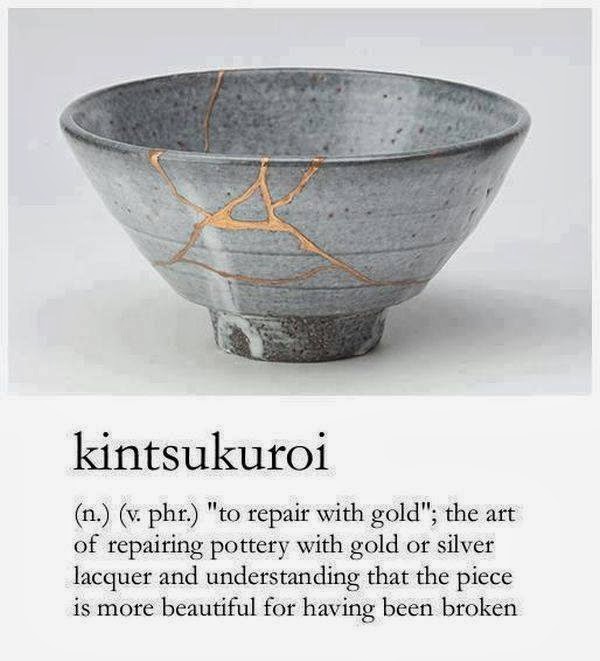
- I want you to take a look at the picture on the front of your bulletin this morning.
- Explain idea of kintsukuroi/kintsugi: “to repair with gold”; the art of repairing pottery with gold or silver lacquer and understanding that the piece is more beautiful for having been broken → practice that is thoroughly intentional
- First, glue the pieces back together, making sure no piece or sliver or shard is missing
- Paint those glued seams with gold, silver, or even sometimes platinum lacquer
- Slowly
- Deliberately
- Painstakingly
- Intentionally
- There is something wholly and sacredly beautiful about an artform that, instead of trying to hide the brokenness of the object, highlights the repairs that have been made – the wholeness that exists in spite of the brokenness.
- Vaneetha Risner, Christian author and blogger, about kintsugi: A broken piece that is put back together has more of a story, seems more authentic and real, is stronger and more resilient than something that has stayed pristine. The breaking of what once was, the layered and time-consuming process of putting it back together, the mending it with gold, all contribute to its value. And surprisingly, it becomes more resilient after it has been mended by kintsugi, even stronger than it was before.[1] → More beautiful than before it was broken … more valuable … than before it was broken … stronger than before it was broken …
- What if we in the church lived this way? What if we loved this way? What if we believed this way? What if we ministered this way? → going to talk about some of those “what if”s today using one of the Bible’s most unmitigated stories of brokenness: Job
- Explain idea of kintsukuroi/kintsugi: “to repair with gold”; the art of repairing pottery with gold or silver lacquer and understanding that the piece is more beautiful for having been broken → practice that is thoroughly intentional
- Today’s passage = the very end of the book of Job → But before we skip to the end, let’s talk about the book of Job as a whole.
- Very deliberately called Job a “story” → Let me tell you why.
- First Testament divided into 3 parts
- Torah = history: first 5 books
- Nevi’im = prophets: Joshua, Judges, 1/2 Samuel, 1/2 Kings as well as Isaiah, Jeremiah, Ezekiel, and the 12 Minor Prophets (Hosea, Joel, Amos, Obadiah, Jonah, Micah, Nahum, Habakkuk, Zephaniah, Haggai, Zechariah, and Malachi)
- Ketuvim = writings: Hebrew poetry and wisdom literature → And it is within this third category – this wisdom literature category – that we find the book of Job.
- Biblical scholar Adele Berlin: … often left to the reader has been the actual reading of the poem – the making of sense and beauty from its sounds, words, and structures, the perception that it is a unified entity with a distinctive message.[2]
- First Testament divided into 3 parts
- This is particularly important when it comes to the book of Job.
- Biblical scholar Carol Newsom’s descr. of Job: Job is a challenging book to read, not only because of the theological issues it treat but also because of the form in which it is written. It begins with a simple prose story (1:1-2:13) describing Job’s piety, the conversation between God and the satan, which leads to a decision to test Job, and the disasters that befall Job as the test of his piety. Abruptly, the style of the book changes in chap. 3, as Job and the friends who have gathered to comfort him begin to debate the meaning of what has befallen him and the proper posture Job should assume toward God. In contrast to the simple prose of the first two chapters, this dialogue is composed in elegant, sophisticated poetry, full of rare words and striking images. The climax of this section is the long speech of God from the whirlwind and Job’s brief reply. At that point, just as abruptly, the style again shifts back to simple prose for the conclusion, as Job’s well-being is restored and the remainder of his long life is briefly described. The changes between the beginning, middle, and end of the book are not merely stylistic, but also correspond to changes in the representation of characters and in the nature of the religious issues under consideration.[3] → This understanding is critical because it gives us context for the story of Job. It reiterates for us that Job is a tale from which we can learn something – an ancient fable of sorts. It’s not found in the “history” section of the First Testament. It was never meant to be read as a true story that actually happened to one man thousands of years ago. At it’s core, the book of Job is a story about brokenness and how, no matter how we experience that brokenness, God remains with us – steadfast, compassionate, and wholly present.
- Very deliberately called Job a “story” → Let me tell you why.
- Think about the beginning of Job.
- Job = “honest, a person of absolute integrity; he feared God and avoided evil”[4] → also a man who had everything
- 7 sons and 3 daughters
- 7000 sheep
- 3000 camels
- 500 pairs of oxen (do the math … 1000 oxen)
- 500 female donkeys
- “and a vast number of servants, so that he was greater than all the people of the east.”[5]
- Also a man constantly offering up prayers and burnt offerings on behalf of himself and his family … just in case they were sinning and cursing God in their hearts.
- Job’s unwavering faith and devotion catch the attention of the Adversary (which is what satan literally means in Hebrew) – beginning of Job: One day the divine beings came to present themselves before the Lord, and the Adversary also came among them. The Lord said to the Adversary, “Where did you come from?” The Adversary answered the Lord, “From wandering throughout the earth.”[6] → And isn’t that often how it feels when bad things happen, all? Especially in this day and age when it feels like every headline is just darker, scarier, uglier than the last. Doesn’t it feel like there’s just an undefinable malevolence “wandering throughout the earth”?
- This Adversary = ancient Hebrews’ attempt to address what theologians today call the Problem of Evil → “Why do bad things happen to good people?” question
- With that question in mind, all the bad things happen to Job, a good man.
- Job’s oxen and camels are all stolen in 2 separate raids[7]
- Job’s sheep are all burned up in “a raging fire [that] fell from the sky”[8]
- Job’s children all die
- Job’s body becomes covered in sores
- Think about it, friends. Job has lost his security. Job has lost his livelihood – his job, essentially. He’s lost his family. He’s lost his health. Job is awash in grief.
- Are you familiar with the term “ambiguous grief”? Ambiguous grief describes the grieving process when it involves someone who is still living but changed.
- Grieving someone who is ill
- Grieving a lost relationship (divorce, estrangement, incarceration, even a cross-country move)
- Grieving someone suffering from any number of diseases that can either leave the body struggling but the mind intact (e.g.s – ALS or Huntington’s disease) or diseases that leave the body intact but the mind struggling (e.g.s – Alzheimer’s or dementia)
- Grieving someone whose personality, whose life, whose circumstances, whose relationship with you has been altered by mental illness
- There are so many of us wading through ambiguous grief in our lives. → old adage of not judging someone until you walk a mile in their shoes
- The book of Job addresses so much of that ambiguous grief because Job is suffering both for his own tangible griefs – the loss of his children – as well as his ambiguous griefs. But through it all, God remains with Job.
- Are you familiar with the term “ambiguous grief”? Ambiguous grief describes the grieving process when it involves someone who is still living but changed.
- Book of Job also addresses the pressures from the world around us to approach God or to think about God or to feel about God in a certain way
- The vast majority of the book of Job = conversations btwn. Job and his friends → And there’s a lot that we could take away from these conversations – I mean, we’re talking about basically 38 Biblical chapters worth of conversations! … I mean, that’s not just multiple sermons’ worth of conversations, that’s multiple sermon series’ worth of conversations! But what I want us to notice today is one particular aspect of Job’s conversations with his friends about his circumstances and his faith.
- Job’s friends = full of advice → full of suggestions and fixes and flowery words and worn out phrases → I’m sure that if “everything happens for a reason” and “when God closes a door, he opens a window” had been common phrases back when Job was written, they would be in there.
- What Job’s interactions with his friends are lacking = listening → Job’s friends are all about telling him what to do and think and believe when it comes to God. But nothing in Job’s story tell us that his friends simply sat with Job and gave him space to be … to grieve … to find his own way back to God. They were there to convince Job, not to comfort him. And that’s so indicative of human nature, isn’t it? Especially here in the Midwest, I think. “How can I fix it? What can I do to make it better? Give me a task.” But what if the task needed most is just sitting quietly with someone utterly overwhelmed with their grief? With their brokenness? With their pain?
- The vast majority of the book of Job = conversations btwn. Job and his friends → And there’s a lot that we could take away from these conversations – I mean, we’re talking about basically 38 Biblical chapters worth of conversations! … I mean, that’s not just multiple sermons’ worth of conversations, that’s multiple sermon series’ worth of conversations! But what I want us to notice today is one particular aspect of Job’s conversations with his friends about his circumstances and his faith.
- End of Job’s story – portion that we read today – is Job finding his way back to God on his own → Job has railed at God against his own self, against the land, against those who stole from him, and against even his friends who are trying to help him … but he never blames God. Throughout the entire book, Job continues to place trust in God. But he also places a little too much trust in himself.
- Buried deep within Job – ch. 32: [Job’s three friends, Eliphaz, Bildad, and Zophar] stopped answering Job because he thought he was righteous. Elihu son of Barachel the Buzite from the clan of Ram was angry, angry with Job because he considered himself more righteous than God.[9] → In this and in the multiple chapters of Elihu’s response to Job that follow, we learn that Job’s understandable “why me?” grief response is more than likely tinged with a “why not them?” response as well. “I’ve been great, God … so why me instead of those sneaky Chaldeans who stole my camels? Why me instead of those sinners? Why me instead of … instead of … instead of …?”
- Large portions of Job = Job listing all the ways he isn’t broken instead of bringing his true brokenness to God → out in the open, genuinely and honestly … maybe not for all the world to see, but at least with enough integrity for those who love him to see.
- Buried deep within Job – ch. 32: [Job’s three friends, Eliphaz, Bildad, and Zophar] stopped answering Job because he thought he was righteous. Elihu son of Barachel the Buzite from the clan of Ram was angry, angry with Job because he considered himself more righteous than God.[9] → In this and in the multiple chapters of Elihu’s response to Job that follow, we learn that Job’s understandable “why me?” grief response is more than likely tinged with a “why not them?” response as well. “I’ve been great, God … so why me instead of those sneaky Chaldeans who stole my camels? Why me instead of those sinners? Why me instead of … instead of … instead of …?”
- Job = “honest, a person of absolute integrity; he feared God and avoided evil”[4] → also a man who had everything
- You see, it’s only after Job has acknowledged God’s supreme goodness above even his own goodness at the beginning of our text this morning that we find Job restored.
- Today’s text: Job answered the Lord: I know you can do anything; no plan of yours can be opposed successfully. You said, “Who is this darkening counsel without knowledge?”I have indeed spoken about things I didn’t understand, wonders beyond my comprehension. You said, “Listen and I will speak; I will question you and you will inform me.” My ears had heard about you, but now my eyes have seen you. Therefore, I relent and find comfort on dust and ashes.[10] → There is humility in Job. There is acknowledgment in Job. In his brokenness and through his brokenness, he is finding the beauty of God’s love and compassion and presence.
- Your $10 theological term for today = theodicy: a defense of God’s goodness and power in the face of evil → The entire book of Job is exactly that: a defense of God’s goodness and power in the face of all the many and varied evils we find in the world.
- What’s the lesson I DON’T want you to take away from today: that God causes those evils just to bring us closer → That’s not what happened. In the words of contemporary Christian writer Sarah Bessey: This world has enough horrifying tyrants and torturers and cruel monsters: we don’t need to make God into one or try to baptize such things with sacred language. That is truly profane.[11]
- What we CAN take from Job = God’s abiding and blessed presence with us no matter our stage or state of brokenness → God will always be there to put us back together, making us more beautiful, more valuable, and even stronger than we were before. Amen.
- Your $10 theological term for today = theodicy: a defense of God’s goodness and power in the face of evil → The entire book of Job is exactly that: a defense of God’s goodness and power in the face of all the many and varied evils we find in the world.
- Today’s text: Job answered the Lord: I know you can do anything; no plan of yours can be opposed successfully. You said, “Who is this darkening counsel without knowledge?”I have indeed spoken about things I didn’t understand, wonders beyond my comprehension. You said, “Listen and I will speak; I will question you and you will inform me.” My ears had heard about you, but now my eyes have seen you. Therefore, I relent and find comfort on dust and ashes.[10] → There is humility in Job. There is acknowledgment in Job. In his brokenness and through his brokenness, he is finding the beauty of God’s love and compassion and presence.
[1] https://www.vaneetha.com/journal/kintsugi-beauty-in-the-broken.
[2] Adele Berlin. “Introduction to Hebrew Poetry” in The New Interpreter’s Bible Commentary series, vol. 4. (Nashville: Abingdon Press, 1996), 314.
[3] Carol A. Newsom. “The Book of Job: Introduction, Commentary, and Reflections” in The New Interpreter’s Bible Commentary series, vol. 4. (Nashville: Abingdon Press, 1996), 320.
[4] Job 1:1.
[5] Job 1:2-3.
[6] Job 1:6-7.
[7] Job 1:14, 17.
[8] Job 1:16.
[9] Job 32:1-2.
[10] Job 42:1-6.
[11] Sarah Bessey. Field Notes for the Wilderness: Practices for an Evolving Faith. (New York: Convergent Books, 2024), 61.
 Fearfully and Wonderfully Made