Sunday’s sermon: Fifth Enemy of Gratitude: Disappointment

disappointment

Texts used – Deuteronomy 34:1-12; 2 Corinthians 4:7-18

  • When I was in 2nd grade, the Disney movie “The Little Mermaid” was all the rage.
    • Watched that movie over and over and over again as a kid
    • Could do the whole movie – dialogue and songs – from start to finish by memory (frankly … I’m fairly certain I still can!)
    • I had lots of Little Mermaid stuff
      • Handheld video game
      • Pajamas
      • Books
      • Coloring books
      • Cheapo little kid jewelry
    • Daycare friends (almost same age) → birthdays that year
      • Jessie’s birthday in October → got a Little Mermaid Barbie
      • Kami and I – birthdays only 4 days apart → celebrated at the same time before Christmas break
        • Kami opened her present first → Little Mermaid Barbie
        • And I was SO EXCITED!!! Jessie got a Barbie. Kami got a Barbie. My daycare lady knew how much we all loved the Little Mermaid, so of course, she’d gotten a Little Mermaid Barbie for me, too! And then I opened my gift. And it wasn’t a Little Mermaid Barbie. It was a Little Mermaid … suitcase. → was about to leave on a road trip with my family to go spend Christmas/my birthday with my grandparents in New York – she thought I could use the suitcase
      • But I was SO DISAPPOINTED. I don’t remember crying then and there. My mom had taught me to be appreciative even when I didn’t like my gift, so I’m sure I smiled and said “thank you” just like I was supposed to. But to this day, I deeply remember how I felt inside: I was just crushed. I didn’t want a suitcase. I wanted a Little Mermaid Barbie, just like my friends.
        • Did I use that Little Mermaid suitcase for a LONG time afterward – long after I’d given up my Barbies? Sure.
        • BUT … did it still bother me every time Kami and Jessie brought their Little Mermaid Barbies to daycare? You bet.
  • Disappointment … our last enemy/obstacle of gratitude.
    • Sermon series so far → been through nostalgia and worry, entitlement and greed
      • Talked about how they get in the way of us experiencing gratitude
      • Talked about how they get in the way of us expressing gratitude
    • And along those lines, disappointment is no different.
      • Disappointment = stifling, smothering sort of emotion → lays on you like a wet, heavy blanket
        • Smothers any excitement
        • Smothers any enthusiasm
        • Smothers any passion
        • Smothers any joy
        • All of those things we need to experience gratitude – all of those pleasant emotions that inspire gratefulness in us – are smothered by disappointment. And when you’re feeling disappointed, even if you know you’re supposed to be grateful … even if there might actually be gratitude buried deep down … it’s very hard to genuinely, convincingly express any gratitude.
  • Israelites in our OT passage for today know all about disappointment = story of the Israelites finally reaching the Promised Land after wandering around in the desert wilderness for 40 years → Now, that sounds like something to celebrate, doesn’t it? Finally reaching the Promised Land sounds like something for which they would be exceedingly grateful! But just getting there isn’t the whole story.
    • Pause for a minute to do a quick refresher of first 5 books of the OT
      • Lev = book of the Law → rules and regulations for the people of Israel – those 613 laws we’ve talked about
      • Gen, Ex, Num, Deut = history
        • Gen = beginning of the story (creation, Abraham, Isaac, etc.)
        • Ex, Num, Deut = accounts of the Israelites in Egypt, the escape from Egypt, and the wandering in the wilderness
          • Not necessarily the same story → These 3 books are sort of like the gospels in that some of the stories line up, but they all flesh out different aspects of the Israelites’ wilderness journey, too.
      • Today’s part of the story comes from Deut BUT necessary background comes from Num
    • Lead up to today’s passage – the Israelites have been complaining to God for the umpteenth time: “If only we had died in the land of Egypt or if only we had died in the desert! … Let’s pick a leader and let’s go back to Egypt.”[1]  → comes after the Israelites actually reach the Promised Land – the land of Canaan – and realize that it’s already occupied and they’re going to have to battle to inhabit the land … And they’re disappointed. More than that, they’re afraid. So the back down before even trying. Instead of saying, “God, thank you for bringing us out of the horrible oppression of Egypt. Thank you for bringing us across the Red Sea on dry land. Thank you for providing for us while we traveled through the desert. Thank you for protecting us,” … instead of saying that, they say, “Nope. Forget this. We’re going back to what’s familiar, no matter how horrible it was.”
    • God’s frustration come out in God’s response – text: None of you who were enlisted and were registered from 20 years old and above, who complained against me, will enter the land in which I promised to settle you … Your bodies will fall in this desert, and your children will be shepherds in the desert for forty years. … This is how you will understand my frustration.”[2]  → So basically all of the Israelites who left Egypt – anyone age 20 or older – will not be allowed to enter the Promised Land because of their constant complaining and unwillingness to trust in God.
      • Gave into their disappointment → allowed it to smother their faith to the point of choosing slavery over trusting God
        • How often do we choose slavery – unhealthy subjegation to things that are detrimental to us (bad habits, poor financial decisions, vices, negative self-talk, complaining, judging, etc.) over trusting God’s goodness/God’s call in our lives?
      • God’s ban on entering the Promised Land even extends to Moses himself (from 1st of Deut, Moses speaking to people after they turned away from the Promised Land): The Lord was even angry with me because of what you did. “You won’t enter the land either,” God said.[3]
    • And so we come to today’s part of the story = the end of that portion of Israel’s history, the death of Moses 40 yrs. later on the very doorstep of the Promised Land – text: Then the Lord said to Moses: “This is the land that I swore to Abraham, Isaac, and Jacob when I promised: ‘I will give it to your descendants.’ I have shown it to you with your own eyes; however, you will not cross over into it.” Then Moses, the Lord’s servant, died – right there in the land of Moab, according to the Lord’s command.[4]  → I think we could qualify this as one of the ultimate disappointments in the Bible. This is Moses we’re talking about. This is the man who …
      • Survived infant basket ride down the Nile River to end up at the Pharaoh’s palace
      • Was called by the voice of God in a burning bush
      • Confronted Pharaoh – the most powerful man in the world, at that point – over and over again
      • Called down plagues on the people of Egypt
      • Led the people across the Red Sea on dry ground
      • Received the 10 commandments from God’s own hand
      • This is Moses, one of the bedrocks of the faith. When the people doubted, Moses encouraged their belief. When God was angry with the people, Moses argued for mercy on their behalf. When the people complained, Moses acted as the mediator between them and God, securing quail and manna and water from the rock. And yet, despite all those trials, Moses gets to see the Promised Land … but not go in.
        • Disappointment in the extreme
        • Certainly the kind of disappointment that could dampen faith … or even snuff it out entirely → But here’s the thing: Moses knew this was going to happen long before this moment – 40 years before this! It was no secret that this would be his fate. That pronouncement from God that he would not enter the Promised Land came before they even started wandering for those 40 years in the desert. Moses could have given up. He could have washed his hands of the whole situation – the complaining, the threats, the backpedaling, all of it – and said, “Nope. There’s no reward in this for me. I’m out!” But he didn’t. He stuck with the people of Israel even as they wandered … because he chose to stick with God and God’s call in his life. Moses chose to trust even in the midst of his disappointment – to be grateful for God’s presence among his people and to be grateful for their freedom, difficult and challenging though it may have been.
          • Important lesson: disappointment and gratitude are not mutually exclusive → You can still feel the slight sting of disappointment and be grateful at the same time. The problem comes when we let our disappointment become the only thing that we feel and express.
  • And as we all know, disappointment is a part of life. I don’t know anyone in this entire world who hasn’t been disappointed at one time or another … who hasn’t struggled at one time or another … who hasn’t been challenged at one time or another.
    • Promise we read in Paul’s 2nd letter to the Christians in Corinth: We are experiencing all kinds of trouble, but we aren’t crushed. We are confused, but we aren’t depressed. We are harassed, but we aren’t abandoned. We are knocked down, but we aren’t knocked out.[5]  → And y’all, if this alone was the end of the story, it would be pretty easy to find ourselves awash in disappointment. Trouble … confusion … harassment … knocked down … none of these are things that we want to be or experience. Thankfully, Paul doesn’t stop there.
      • (Paul Harvey) The rest of the story: We always carry Jesus’ death around in our bodies so that Jesus’ life can also be seen in our bodies. … I had faith, and so I spoke. We also have faith, and so we also speak. We do this because we know that the one who raised the Lord Jesus will also raise us with Jesus, and he will bring us into his presence along with you. … Our temporary minor problems are producing an eternal stockpile of glory for us that is beyond all comparison. We don’t focus on the things that can be seen but on the things that can’t be seen. The things that can be seen don’t last, but the things that can’t be seen are eternal.[6]  → Friends, I think this is one of the most powerful passages in the New Testament because it reminds us that we belong to a God of unending grace and mercy – a God whose power is greater than life, greater than death, greater than all the obstacles we can try to put up between us. All of those things that we think disqualify us from the love and consideration of God mean nothing to the One who has called each and every one of us by name.
        • Scholar: What we can do is look for the faith of Moses, perhaps best displayed not in front of the Pharaoh but sitting alone with his God watching the horizon of his life’s work, feeling not resentment but gratitude. What we all need is … to cling to the central claim of our faith: that a grander story is being told. We can rejoice and give thanks for our place in that story, in spite of disappointments we’ve faced along the way.[7]
  • Even in the face of all of those obstacles that we face – nostalgia, worry, entitlement, greed, disappointment, and everything else – we can always be grateful that we do not face those obstacles alone. God journeys with us – encouraging us, guiding us, strengthening us, teaching us.
    • Pitfalls along the way? Sure.
    • Times when we feel totally lost in the moment and can only see God in the looking-back? Absolutely.
    • Moments when we become overwhelmed by our obstacles? Yes.
    • But God is still there. Even when the road is rough, God is still there. Even when the answer to our most desperate plea is “no,” God is still there. God is still there. Reassured in that knowledge, how can we release our disappointment and express our gratitude for what we are doing here and now? Amen.

[1] Num 14:2, 4.

[2] Num 14:29b-30, 32a, 34b.

[3] Deut 1:37.

[4] Deut 34:4-5.

[5] 2 Cor 4:8-9.

[6] 2 Cor 4:10, 13b-14, 17-18.

[7] Brian Erickson. “Fall Series 2: The Enemies of Gratitude – Proper 21: Nostalgia” in A Preacher’s Guide to Lectionary Sermon Series: Thematic Plans for Years A, B, and C. (Louisville, KY: Westminster John Knox Press, 2016), 73.

Another worship piece

This summer, we had a special worship service outside. As part of that service, we read a beautiful children’s book called The Word Collector by Sonja Wimmer. It’s the story of a little girl who collects words. One day, she realizes that all the fun, beautiful words in the world have disappeared. So she packs up all the words that she has collected and heads out into the world. She encounters pain and conflict, mean words and ugly words and hard words. So The Word Collector starts scattering all the words she’s collected into the world again … and her words begins to change things. When she suddenly discovers that her words are all gone, at first, she is disappointed. Then she looks out into the world again and realizes that the people have started sharing her words and making up their own fun, beautiful words again. 

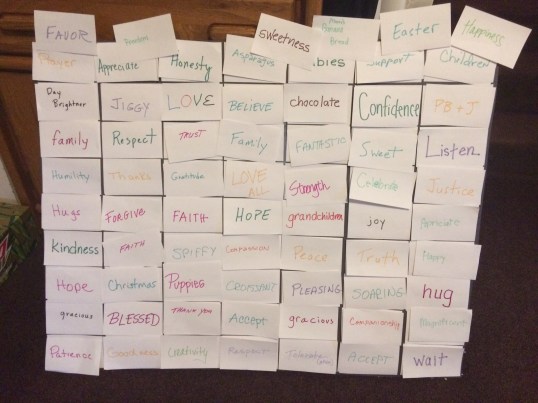
It’s truly a beautiful story. After we read it, we talked about all the places we find ugly words in the world and all the ways we can find to spread beautiful words instead. To help with this, we had a visual representation. I made a board covered in 3×5″ notecards. Each notecard had an ugly, divisive, hard word on it. 

IMG_2607IMG_2608IMG_2609

The words we used were:

  • Neglect
  • Distress
  • Distrust
  • Conflict
  • Blame
  • Fear
  • Hararss
  • Contention
  • Torture
  • Accuse
  • Agony
  • Rage
  • Saddness
  • Hurt
  • Fighting
  • Lie
  • Despair
  • Abuse
  • Fake
  • Worry
  • Destroy
  • Evil
  • Prejudice
  • Threat
  • Anxiety
  • Malice
  • Slavery
  • Ignore
  • Exclude
  • Assume
  • Hate
  • Racism
  • Grief
  • Attack
  • Suspicion
  • Scorn
  • Abandon
  • Trouble
  • Corrupt
  • Violence
  • Supremacy
  • Anger
  • Shame
  • Pain
  • Isolation
  • Sin
  • Intimidation
  • Steal
  • War
  • Lonely
  • Bully
  • Disrespect
  • Argue
  • Riot
  • Suffering
  • Beating
  • Force
  • Divisive
  • Killing
  • Loss
  • Indifference
  • Estranged
  • Offensive

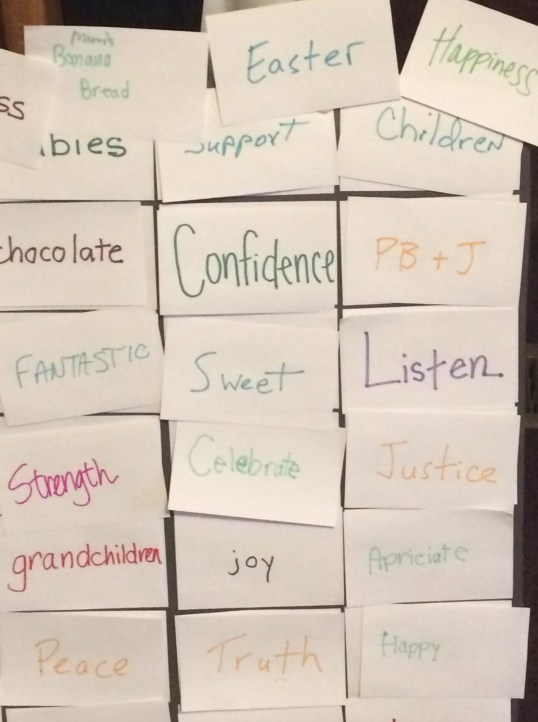
That’s a lot of ugly words. So during our prayer time, we used new notecards to write our own fun, beautiful words to cover up all the ugly words on the board. 

IMG_2604IMG_2605IMG_2606

Our fun, beautiful words were:

  • Happiness
  • Children
  • PB & J
  • Listen
  • Justice
  • Appreciate
  • Hug
  • Happy
  • Magnificent
  • Wait
  • Accept
  • Companionship
  • Soaring
  • Sweet
  • Celebrate
  • Joy
  • Truth
  • Confidence
  • Easter
  • Support
  • Mom’s Banana Bread
  • Babies
  • Chocolate
  • Fantastic
  • Strength
  • Grandchildren
  • Peace
  • Pleasing
  • Gracious
  • Tolerance
  • Respect
  • Accept
  • Croissant
  • Compassion
  • Hope
  • Love All
  • Family
  • Believe
  • Sweetness
  • Asparagus
  • Love
  • Honesty
  • Trust
  • Gratitude
  • Faith
  • Spiffy
  • Puppies
  • Thank You
  • Creativity
  • Blessed
  • Goodness
  • Patience
  • Gracious
  • Christmas
  • Faith
  • Forgive
  • Thanks
  • Respect
  • Jiggy
  • Hope
  • Kindness
  • Hugs
  • Humility
  • Family
  • Day Brightener
  • Freedom
  • Appreciate
  • Favor
  • Prayer

Yes, I know some of those are repeats. But that’s okay. That makes it even more beautiful. Also, if you compared the lists, you’d notice that we ended up with more beautiful words than we did ugly words … which I also find beautiful. Our beautiful words were overflowing the board, covering all the ugly words and more. Hallelujah! Amen.

Sunday’s sermon: Fourth Enemy of Gratitude: Greed

greed

Texts used – Psalm 99; Matthew 22:15-22

  • 2nd to last week of our stewardship series – enemies/obstacles of gratitude
    • Talked about nostalgia and worry
    • Last week: talked about entitlement
    • This week is the obvious week. – talking about how greed gets in the way of both experiencing and expressing our gratitude → And I think in terms of illustrations for this obstacle, we find ourselves in the most appropriate of seasons.
      • Christmas decoration items hit stores on Nov. 1
        • Even earlier at Costco and Hobby Lobby
      • Mailboxes inundated with catalogues, sales fliers, coupons, etc.
      • Christmas commercials abound
      • All aimed at selling us more and more and more stuff
        • Stuff that we “need”
        • Stuff that we want
        • Stuff that we “deserve”
      • And it’s the Christmas commercials that have really been driving the point home for me lately.
        • IN PARTICULAR: 2 commercials for the same company (which I won’t name) → similar settings, similar storylines
          • Montage of families in pajamas opening gifts on Christmas morning
          • Gifts = big and small but all have obvious big impact on those opening the gifts
            • Wide eyes
            • Huge smiles
            • Obvious delight written all over their faces
          • 2 different songs playing the background of these commercials → not some sweet, tender Christmas music … nope!
            • 1st: 90’s classic “Whoomp There It Is” by Tag Team
            • 2nd: 80’s classic “You Dropped a Bomb on Me” by The Gap Band
        • Just the songs alone paired with these commercials sit a little funny with me. They seem to be especially illustrative of greed – of a season that often becomes driven by want want want want want.
    • Now, don’t get me wrong, I love finding “the perfect gift” for people I love, too. I love watching them open something that I know is going to make them happy – something they can use or enjoy or cherish. But as we consider gratitude today – how we experience it and how we express it, especially in terms of our stewardship – and how greed gets in the way of that gratitude, we’re going to come at it from a particular angle: where do those things for which we are grateful – our truest, most enduring and most precious blessings – actually come from?
  • Tackle this angle with the help of our NT reading this morning → This is another one of those Scripture readings I’ve never preached before because frankly, it’s another one of those readings that can make us feel uncomfortable. We don’t like talking about money – especially in church! – but here’s Jesus … talking about money!
    • Reminder: throughout the gospels, Jesus actually talks about money more than anything else except of the Kingdom of God → And today’s Scripture reading is no different.
      • Context:
        • Part of Jesus’ teaching in the temple in the lead-up to Holy Week → comes on the heels of him driving the merchants and money changers out of the temple
        • Comes directly after Scripture we read last week: parable of the wedding party in which those who are invited spurn the invitation, so the king invites all the people on the edges of the city – the unwanted, unwelcomed, “uninvitables” – to his son’s wedding feast → parable about the openness and blessing of the kingdom of heaven
    • Today’s reading begins with the Pharisees conspiring → Now, leading up to this passage, Jesus has really turned the heat on the Pharisees – calling them out on their hypocrisy and putting them on the spot again and again. And so today, the Pharisees attempt to rhetorically strike back – text: Then the Pharisees met together to find a way to trap Jesus in his words. They sent their disciples, along with the supporters of Herod, to him. “Teacher,” they said, “we know that you are genuine and that you teach God’s way as it really is. We know that you are not swayed by people’s opinions, because you don’t show favoritism. So tell us what you think: Does the Law allow people to pay taxes to Caesar or not?”[1]
      • Let’s break this down a little bit. – 3 significant things to notice
        • 1: significance of “the supporters of Herod” = shows the desperation of the Pharisees
          • Scholar points out: The Herodians [are] Jews who have benefited rather nicely from the Roman occupation. As you might imagine, the Pharisees and the Herodians did not get along very well. The only platform they share is that Jesus needs to go.[2]  → The Pharisees despised the Herodians because they were basically sell-outs – Jews who did the bidding of the Roman occupiers and took payment for it – tax collectors, for example. But in the face of their desperation to see Jesus gone, the Pharisees have actually chosen to collude with this group they so despise.
        • 2: significance of what’s behind their words → It sounds like the Pharisees are being nice to Jesus, flattering even. “Teacher, we know that you are genuine and that you teach God’s way as it really is. We know that you are not swayed by people’s opinions, because you don’t show favoritism. So tell us what you think.” Sounds okay, right? No. Nope.
          • Pharisees are ingratiating
          • Pharisees are contemptuous
          • Pharisees are about as disingenuous as it gets
          • It’s important that we understand how truly insincere the Pharisees are being. Of course, they don’t actually believe any of what they’re saying. They’re just afraid that if they publicly proclaim what they really think of Jesus, the adoring crowd will turn on them … as they will on Jesus himself in just a few short days’ time.
        • 3: significance of their question – text: Tell us what you think: Does the Law allow people to pay taxes to Caesar or not? → This is most definitely a trick question.
          • Scholar explains: If Jesus says it’s unlawful to pay taxes (as the Pharisees think but are too afraid to teach publicly), then the Romans will snatch him up for being an instigator. If he says that it’s fine to pay taxes to the Romans, then the religious zealots in the crowd will stone him for going against God’s Word. It’s a no-win situation for Jesus.[3]
    • So we understand the situation that has been set up for Jesus in this passage. → circumstances make Jesus’ response all the more powerful
      • 1st Jesus flat out calls them out on their “evil motives” (as Scripture calls them) – text: “Why do you test me, you hypocrites?”[4]  → Jesus is only a few days away from his persecution and death, so at the point, he’s pulling no punches.
      • Next, Jesus throws their sarcasm and derision right back at them by asking them an obvious question: “Show me the coin used to pay the tax. Whose image is and inscription is this?”[5]  → This is really a “duh” question. If I asked any one of you to pull out a coin from your pocket, you could tell me who’s on it. Jesus is playing off the Pharisees’ tendency to ask circuitous questions and their self-aggrandized knowledge.
      • Then, Jesus gets to the punchline: Then he said, “Give to Caesar what belongs to Caesar and to God what belongs to God.” When they heard this they were astonished, and they departed.[6]  → This is really Jesus’ mic drop moment. “You think you’re going to set me up to fail, but I’m going to turn this right back on you.” Bam. Done.
        • Unpack this a little bit: Gr. “give” = “pay back” – “Pay back to Caesar what is Caesar’s and pay back to God what is God’s.”
          • Scholar: Jesus says, let Caesar have his little coins. But let the people of God decide today whom they serve. Let the followers of God decide today that what they have, what they are, what they do, what they think – it all belongs to the One who knew you before he knit you together in your mother’s womb.[7]
  • When we get so wrapped up in the getting and accumulating and maintaining of stuff stuff stuff, we forget two things.
    • 1: what our blessings truly are
    • 2: where those blessings come from – God
    • And when we forget, we render ourselves unable to either experience or express our gratitude.
      • Makes me think of “The Grinch Who Stole Christmas” – the live-action movie with Jim Carrey that came out in 2000[8]  → In this version, little Cindy Lou Who is “all discombobulated” because she sees all the people around her obsesses with giving and getting and Christmastime while she feels that something about Christmas – the togetherness, the blessedness, the gratitude – is missing.
      • Forgetting blessings certainly speaks to a lot of situations beyond holiday shopping
        • Current political climate
        • Current state of poverty/wealth disparity in the U.S. and around the world
        • Many of the places of conflict and oppression around the world
  • OT reading this morning is a reminder of the true source of all that for which we are grateful
    • Speaks of the power and majesty of God – text: The LORD rules— the nations shake! He sits enthroned on the winged heavenly creatures— the earth quakes! The LORD is great in Zion; he is exalted over all the nations.[9]
      • Speaks of some of the incredible blessings that God has bestowed in the past: Strong king who loves justice, you are the one who established what is fair. You worked justice and righteousness in Jacob. … Moses and Aaron were among his priests, Samuel too among those who called on his name. They cried out to the LORD, and he himself answered them – he spoke to them from a pillar of cloud. They kept the laws and the rules God gave to them. LORD our God, you answered them. To them you were a God who forgives but also the one who avenged their wrong deeds.[10]
      • Speaks of giving our gratitude to God: Let them thank your great and awesome name. He is holy! … Magnify the LORD, our God! Bow low at his footstool! He is holy! … Magnify the LORD our God! Bow low at his holy mountain because the LORD our God is holy![11]
  • So as the holiday season rapidly approaches, friends, let us remember in the midst of all the buying and wrapping, the cooking and baking, the decorating and the caroling, the hosting and traveling, the giving and getting … in the midst of all of that, let us remember that our truest, most enduring, and most precious blessings come not from Target or Amazon or Toys R Us but from a God who loved us more than enoughmore than enough to become human for us, more than enough to live and work and play and love among us, more than enough to sacrifice God’s very own self on the cross for us, more than enough to extend us a grace that surpasses anything we could ever even imagine on our own. So how can we set aside our greed and express our gratitude for what we are doing here and now? Amen.

[1] Mt 22:15-17.

[2] Brian Erickson. “Fall Series 2: The Enemies of Gratitude – Proper 21: Nostalgia” in A Preacher’s Guide to Lectionary Sermon Series: Thematic Plans for Years A, B, and C. (Louisville, KY: Westminster John Knox Press, 2016), 70-71.

[3] Erickson, 71.

[4] Mt 22:18.

[5] Mt 22:19-20.

[6] Mt 22:21-22.

[7] Erickson, 71-72.

[8] How the Grinch Stole Christmas. Imagine Entertainment. Released Nov. 17, 2000.

[9] Ps 99:1-2.

[10] Ps 99:4, 6-8.

[11] Ps 99:3, 5, 9.

Sunday’s sermon: Third Enemy of Gratitude – Entitlement

entitlement

Texts used – Matthew 22:1-10; Philippians 4:1-9

  • Week 3 of our stewardship series – Enemies/Obstacles of Gratitude
    • Gratitude is such a crucial part of stewardship → foundation of stewardship
      • Basis of where our stewardship comes from – give because we are thankful → stewardship = powerful, tangible expression of our gratitude
    • Now, over the last couple of the weeks, the enemies or obstacles that we’ve talked about have been things that have both a positive side and a negative side.
      • Nostalgia can comfort and teach us BUT, as we’ve said, focusing solely on the past impedes our progress into the future
      • Worry indicates a level of care/investment in whatever it is that you’re worrying about BUT worry is an ineffective waste of energy in the face of problems
        • Aunt Karen: Worry is a prayer for the negative
  • However, this week is different. This week, the enemy of gratitude that we’re talking about is entitlement. And when you think about it, there really isn’t a positive side to entitlement. No one walks around saying, “Y’all, I am so proud because I’m entitled!” In fact, there are a lot of celebrities and other people born into incredible circumstances to do everything they can to prove that they’re not
    • E.g. – Dr. Jack Hodges on Bones
    • And yet we know full well that we live in a world in which entitlement runs rampant. We’ll address the specifics of that later, but before we dive into our Scripture readings for today, we need to think about how entitlement relates to gratitude.
      • 2 definitions of entitlement: the belief that one is inherently deserving of privileges or special treatment; AND the fact of having a right to something → Now, in terms of gratitude, both definitions become problematic. If you either already believe that you are inherently deserving of privileges and special treatment or have been told that these things are yours by right – as a solid, irrefutable fact – are you going to be inherently grateful for them? Probably not because there is no question in your mind that they shouldn’t be yours. Without that question – without that possibility that you may not have that precious thing – you lose the potential to be grateful. So entitlement eclipses gratitude. The two cannot exist simultaneously.
  • Interesting blog post I found this week as I was working on my sermon → Googled “opposite of entitlement” just to see what came up – post: “Gratitude is the Opposite of Entitlement. How Entitled Are You?”[1]
    • Speaks of how, when we take for granted the opportunities that we have, we are acting from a place of entitlement.
      • Blogger: Opportunity is priceless, and having a chance is a gift, not an entitlement. … I have access to education, medical care, clean water, electricity, safe housing, well paid jobs, and as much food as I please. I can follow my passions such as playing sports. learning musical instruments, reading, writing, swimming, watching movies. I have the opportunity to create my life how I choose. I am privileged not just for WHAT I have, but for the OPPORTUNITIES I have. By forgetting I have these opportunities, I am behaving with entitlement.
    • This because it gets at the heart of how entitlement can eclipse gratitude AND it gets at the heart of the way that our Scripture readings address gratitude this morning. This is exactly what Jesus is talking about in our Gospel reading this morning, and it’s also the situation addressed by Paul in our reading from Philippians – taking for granted opportunities we have been given by God.
  • Gospel text
    • Now, I have to admit that this is a difficult text to wrestle with. For my own organizational purposes, I keep a running spreadsheet of all the Scriptures that I’ve preached along with the date and title of the sermon/s that go with those Scriptures, and in the 6½ years that I’ve been regularly preaching, I’ve never once preached this text. It’s hard. It’s challenging. It’s uncomfortable.
      • CONTEXT:
        • Part of 2½ chs. full of Jesus’ parables about the Kingdom of God and judgment
        • Jesus = teaching the disciples but also a crowd that has gathered around him
        • Location: temple courtyards
        • Follows Jesus’ Palm Sunday ride into Jerusalem
        • Follows Jesus’ rage against the money changers and vendors selling their goods in the very same temple courtyards → After Jesus overturns the tables and chases them out with a whip, he sits down and begins with all of these difficult, demanding parables about the Kingdom of God and judgment.
          • Not the only ones who find these uncomfortable – these teachings/parables = the last straw for the Pharisees → they hear these teachings, realize that Jesus is talking about them (today’s text = just before Jesus’ outburst when he calls the Pharisees a “brood of vipers”), and decide to have him arrested
    • Today’s text: parable of the wedding feast
      • Starts out harmlessly enough – text: Jesus responded by speaking again in parables: “The kingdom of heaven is like a king who prepared a wedding party for his son. He sent his servants to call those invited to the wedding party. But they didn’t want to come. Again he sent other servants and said to them, ‘Tell those who have been invited, “Look, the meal is all prepared. I’ve butchered the oxen and the fattened cattle. Now everything’s ready. Come to the wedding party!”[2]  → Sounds good, right? “Everything’s ready. Come to the wedding party!”
        • Especially important when we understand cultural context → The wedding receptions that we attend nowadays, with all their dancing and feasting and cake and laughter, are nothing compared to the wedding parties that were thrown during Jesus’ time, especially wedding parties thrown by kings. Those wedding parties were feasts that lasted for days. The longer the party, the richer the king. They were a way to celebrate, for sure, but also a way for families to show off their wealth and privilege.
      • But then, everything turns.
        • Guests again refuse the wedding invitation → some go so far as to kill the messengers that the king has sent with the 2nd invitation!
          • This is where entitlement has gotten in the way of gratitude. For the invited guests, they took for granted that they would be invited to this lavish feast. It was a privilege bestowed on them simply because of who they were – important, wealthy, influential people of the kingdom. And so they felt no gratitude for the generous invitation or the feast that the king had prepared. And in that lack of gratitude, they turned their backs.
          • Parable breakdown
            • God = king sending the invitation
            • Kingdom of heaven = wedding feast
            • Messengers = OT prophets that were sent by God to declare God’s word to the people
            • Invited guests = those who refuse God’s invitation
        • King’s response: to welcome the un-welcomed to his son’s wedding feast – text: Then he said to his servants, ‘The wedding party is prepared, but those who were invited weren’t worthy. Therefore, go to the roads on the edge of town and invite everyone you find to the wedding party.’ Then those servants went to the roads and gathered everyone they found, both evil and good. The wedding party was full of guests.[3]
          • Breakdown: final set of servants = Jesus → inviting all those who have been neglected, pushed to the margins (to “the edge of town”), left out up until this point: lepers, sinners, those who have been deemed “unclean,” even Gentiles – those who are the exact opposite of those guests initially invited: hungry, poor, underprivileged.
            • Scholar: [This parable] teaches us something about all those who are too comfortable in their standing with the king. The good news is meant for the hungry, for those who would drop everything for an invitation to the banquet. When we lose sight of the radical grace of the invitation, we have forgotten who we are.[4]
  • And the radical grace of that invitation is what inspired Paul for our reading from Philippians this morning.
    • Encouraging radical grace and invitation when it comes to those who minister with him, asking the Christians in Philippi to welcome and help Euodia, Synthyche, Clement, “and the rest of my coworkers whose names are in the scroll of life”[5]  → And remember, Paul is asking for this help from the Philippian church because he is once again in prison – detained yet again for speaking the radical good news of God’s love and grace through Jesus Christ.
    • Paul also embodies that radical grace and invitation → Despite his circumstances, Paul is joyous! Paul is practically effervescent! Paul is overflowing with gratitude! – text: Be glad in the Lord always! Again I say, be glad! Let your gentleness show in your treatment of all people. The Lord is near. Don’t be anxious about anything; rather, bring up all of your requests to God in your prayers and petitions, along with giving thanks. Then the peace of God that exceeds all understanding will keep your hearts and minds safe in Christ Jesus. From now on, brothers and sisters, if anything is excellent and if anything is admirable, focus your thoughts on these things: all that is true, all that is holy, all that is just, all that is pure, all that is lovely, and all that this worthy of praise. Practice these things: whatever you learned, received, heard, or saw in us. The God of peace is with you.[6]
      • Paul understands the gift of grace – his very own invitation to God’s kingdom, the heavenly feast laid out by the outstretched arms and nail-scarred hands of Jesus Christ on the cross. He knows he did not earn it. He knows he does not deserve it. He knows he is not entitled to it by anything he is or was or will ever be. And yet assured in that holy invitation, Paul is profoundly grateful.
        • Scholar: Whenever we allow ourselves to believe that we deserve what we have, or that we are somehow more worthy than another, we will find ourselves incapable of gratitude.[7]  → Whenever we allow ourselves to believe … that we are somehow more worthy then another …
          • I am more worthy because I am white
          • I am more worthy because I am male
          • I am more worthy because I am an American
          • I am more worthy because I am straight
          • I am more worthy because I identify with the physical gender with which I was born
          • I am more worthy because I am educated
          • I am more worthy because I have a good job
          • I am more worthy because of my bank account
          • I am more worthy because I am a Christian
          • Entitlement specifically in the church:
            • I am more worthy because I sit on this committee
            • I am more worthy because I’ve been coming here this long
            • I am more worthy because I come here this often
            • I am more worthy because I give this much
          • All of the ways that we shut people out … that we uninvited them to the feast … that we limit their participation and contributions … that we place them beneath us because we see ourselves as “more worthy” … all of the ways that our entitlement gets in the way of our gratitude are exactly the reasons that God says to everyone, “Look, the meal is all prepared. Now everything’s ready. Come to the wedding party!” So friends, how can we release our entitlement and express our gratitude for what we are doing here and now? Amen.

[1] Kate J. Parker, http://vivalame.com/gratitude-is-the-opposite-of-entitlement/.

[2] Mt 22:1-4.

[3] Mt 22:8-10.

[4] Brian Erickson. “Fall Series 2: The Enemies of Gratitude – Proper 21: Nostalgia” in A Preacher’s Guide to Lectionary Sermon Series: Thematic Plans for Years A, B, and C. (Louisville, KY: Westminster John Knox Press, 2016), 70.

[5] Phil 4:3.

[6] Phil 4:4-9.

[7] Erickson, 70.

Sunday’s sermon: Second Enemy of Gratitude: Worry

worry

Texts used – Psalm 19; Matthew 6:25-34

  • This week = week 2 of our stewardship sermon series “Enemies of Gratitude” → recap
    • Talking about gratitude – the “why” behind stewardship → what inspires us to give of our time, talents, resources, and devotion when it comes to the church
      • Last week: We give of ourselves to this church because we are thankful for its presence – in our lives, in our journeys of faith, in this community. We’re thankful for the people here. We’re thankful for the mission and ministry done both in and through this church. We’re thankful for the ways that we encounter God here.
      • BUT there are things that sometimes get in the way of our ability to both feel that gratitude and to express it à these are the enemies/obstacles of gratitude that we’ll be talking about
        • Last week = nostalgia → talked about how we can certainly be blessed by lessons from the past but also how looking only to the past can impede our progress into the future
        • This week = worry → going to talk about how worry can immobilize us in the face of God’s mission in the world
  • And so, as I often do, I want to introduce you to a book this morning. It’s called Wemberly Worried.[1] Now, Wemberly is a little mouse who worries about everything – big things and little things, scary things and silly things. She worries that everyone will have the same costume that she does, but when she shows up at the Halloween party, she worries that no one has the same costume that she does. She worries that no one will come to her birthday party, and then when all of her friends show up, she worries there won’t be enough cake. Her mother and father and grandmother are always telling her that she worries too much, but poor Wemberly just can’t help it. She worries and she worries and she worries. All. The. Time.
    • Then comes Wemberly’s biggest, most worrisome day of all: first day of school à causes Wemberly even more worries
      • About her teacher
      • About snack time
      • About having someone to play with
      • About finding the bathroom
      • “What if no one else wears stripes? What if no one else brings a doll? What if the room smells bad? What if I have to cry?”
    • Wemberly’s teacher introduces her to someone special: Jewel
      • Jewel is standing all alone … just like Wemberly
      • Jewel is wearing stripes … just like Wemberly
      • Jewel is holding a doll … just like Wemberly
      • Jewel has a very worried look on her face … just like Wemberly
      • And before you know it, Jewel and Wemberly have become fast friends. They do everything together, and in their companionship, they are able to let go of their worries enough to really enjoy all of the things going on around them – story time, snack time, art time, music time, even recess.
    • Friends, as individuals and as the church, too often we find ourselves in a Wemberly state of mind – a place where all of our joy, all of our strength, all of our ability to engage is eaten up by worry.
      • Can even become paralyzing – story of trying to choose a Barbie dress when I was a kid/boys trying to choose car at HyVee this week → It wasn’t a lack of good choices that caused such moments of frozen indecision. It was a worry – a fear – that we would make the “wrong choice,” a choice that we would later regret. As individuals and as the church, how often does that type of worry and fear direct the decisions we do – or don’t! – make in our lives? As individuals and as the church, how often do we let that kind of worry and fear determine our course?
  • Worry = issue addressed by Jesus in Gospel reading
    • Context:
      • Part of the Sermon on the Mount
        • Collection of Jesus’ teachings on morality
        • Most notably begun with the beatitudes – “Blessed are the poor in spirit, for theirs is the kingdom of heaven. … Blessed are the meek, for they will inherit the earth.”[2]
        • Also includes the Lord’s Prayer
      • Today’s Scripture reading is also part of that teaching. And it’s all about how fruitless it is to worry. – opening of text: “Therefore, I say to you, don’t worry about your life, what you’ll eat or what you’ll drink, or about your body, what you’ll wear. Isn’t life more than food and the body more than clothing?”[3]
        • Goes on to speak of how God …
          • Keeps birds fed
          • Gilding the lilies of the field in beauty
          • But they do not work or toil or strain or worry about these things being done. They don’t concern themselves with what tomorrow may bring for them. God simply takes care of them.
    • Jesus’ point: Aren’t you worth much more than [the birds]? … If God dresses the grass in the field so beautifully, even though it’s alive today and tomorrow it’s thrown into the furnace, won’t God do much more for you, you people of weak faith?[4] → confession: my first reaction to this passage has always been discomfort and maybe a little irritation
      • Part of me wants to say, “Easy for you to say, Jesus … you’re Jesus! You’re God’s very own son. What about us ‘normal people’?”
        • BUT … remember what Jesus has just been through (formidable temptation in the wilderness) and what Jesus will go through (suffering, humiliating death on the cross)
        • Realize that this is my worry talking – my anxiety, my fear, my lack of trust
      • Other source of discomfort: “people of weak faith” = phrase that has always troubled a lot of people → The Sermon on the Mount comes directly after Jesus has fasted for 40 days and nights and been tested by the devil in the wilderness. After this ordeal, Jesus has finally emerged and has chosen to speak not just to the disciples, not just to the Pharisees, but to a whole, giant crowd of people, as many as have ears to hear … including us. And having Jesus tell us that we are a people of weak faith makes us uncomfortable.
        • Gr. “weak faith” = “little trust” → not that we do not believe enough or pray hard enough but that we do not trust enough
          • Scholar: Letting go of our worry is not a matter of ignoring what’s wrong; it’s a confidence in what is right. It’s dropping anchor in the good news of Christ Jesus rather than waiting for the news of the world to calm us down. … Ridding your life of worry is not a matter of reducing stress but of increasing trust.[5]  → As long as I can remember, my aunt has always said, “Worry is a prayer for the negative.”
  • Passage from ps for this morning reinforces power of trusting God over worrying
    • Speaks of God’s greatness
    • Speaks of God’s glory
    • Speaks of the goodness of God’s teaching and commands → But as wonderful and true as they are, the psalmist acknowledges that those very same laws and regulation are sometimes where our trouble and our worry creep in. – text: The Lord’s regulations are right, gladdening the heart. The Lord’s commands are pure, giving light to the eyes. Honoring the Lord is correct, lasting forever. … No doubt about it: your servant is enlightened by them; there is great reward in keeping them. But can anyone know what they’ve accidentally done wrong? Clear me of any unknown sin and save your servant from willful sins. Don’t let them rule me. Then I’ll be completely blameless; I’ll be innocent of great wrongdoing.[6]
      • Sounds a lot like Paul in Phil: Do not worry about anything, but in everything by prayer and supplication with thanksgiving let your requests be made known to God. And the peace of God, which surpasses all understanding, will guard your hearts and your minds in Christ Jesus.[7]  → Like the psalmist – who was obviously facing some struggles of his or her own (praying “Don’t let my sins rule me”) – and like Jesus fresh out of his wilderness temptations, Paul is speaking these words from a difficult place. He’s in prison … again. He’s probably been mistreated – beaten or malnourished – again. He’s been publicly humiliated … again. All for preaching the good news of Jesus Christ. And yet he speaks of releasing worries. He speaks of peace.
  • This message – all of this talk of not worrying and giving thanks and peace – is all beautiful and comforting in theory … But in practice, we often find this so hard to do! We worry about anything and everything. We worry about our families. We worry about our friends. We worry about our jobs. We worry about our nation and our world. We worry about what we said or done. We worry about what we didn’t say or do. We worry about our church.
    • Worry comes from a place of caring – a place of being invested in something/someone
    • But worry also comes from a place of fear – fear that our strength, our intelligence, our determination, our ability isn’t strong enough. And that often paralyzes us, keeping us from making decision and stepping out in faith, even when we know it’s going to be hard … especially when we know it’s going to be hard. But that is no way to be the church. And that is no way to preach the good news of Jesus Christ – love, resurrection, grace, hope. These are the gifts from God for which we are often so grateful, but when we are mired down in worry and in fear, we are separated from our gratitude to God. We cannot feel it. We cannot express it. It is a bold message and a strong message that we carry, and in order to take that message into all the places into which God calls us, we must trust not in our own selves and abilities and strength, but in the God who calls and compels us.
      • Jesus as the end of our gospel passage this morning: Desire first and foremost God’s kingdom and God’s righteousness, and all these things will be given to you as well. Therefore, story worrying about tomorrow, because tomorrow will worry about itself. Each day is trouble enough of its own.[8]
      • Corrie ten Boom: Worry does not empty tomorrow of its sorrow, it empties today of its strength.
    • And the best part, friends, is that like Wemberly and Jewel, we are not alone in this. We are a part of a community – here in this congregation and around the world – a community of people willing to love on us and pray for us and remind us that God is God and we are not and help us to trust when we become overwhelmed by worry and fear. And for that, we can be truly and especially grateful.
    • Final question – same question we’re ending every sermon of this series with: How can we release our worry and express our gratitude for what we are doing here and now? Amen.


Benediction

In his book The Light in the Heart, author Roy T. Bennett writes, “More smiling, less worrying. More compassion, less judgment. More blessed, less stressed. More love, less hate.” Words to live by … words to leave with.

[1] Kevin Henkes. Wemberly Worried. (New York, NY: Greenwillow Books), 2010.

[2] Mt 5:3, 5 (NRSV).

[3] Mt 6:25.

[4] Mt 6:26b, 30.

[5] Brian Erickson. “Fall Series 2: The Enemies of Gratitude – Proper 21: Nostalgia” in A Preacher’s Guide to Lectionary Sermon Series: Thematic Plans for Years A, B, and C. (Louisville, KY: Westminster John Knox Press, 2016), 68-69.

[6] Ps 19: 8-9a, 11-13.

[7] Phil 4:6-7 (NRSV).

[8] Mt 6:33-34.

Stewardship Giving Tree

This year for our stewardship campaign, we decided to try something different. Our congregation has never been much for traditional stewardship pledges, especially since many of us now do our giving through automatic electronic transfer.

But we still wanted to bring attention to stewardship, especially to how much it actually costs for some our basic church functions on a regular basis. So we decided to try a stewardship giving tree. The idea is similar to that our Christmas giving trees that will be going up in many other congregations as the holiday season approaches, but instead of hanging items needed by adopted family members (e.g.s – boots for a 9-yr-old girl or a book for a 4-yr-old boy), we’ve hung envelopes with our various monthly expenses on them as well as a few other regular expenses:

  • Natural gas
  • Electric
  • Phone/internet
  • Insurance
  • Copy machine
  • City water
  • Trash/recycles
  • Bi-monthly Upper Room subscription
  • Snow plowing ($XX per event)

As we progress through our 5-week stewardship series, we are encouraging people to take envelopes from the tree –  items/bills they wish to “sponsor” for a month or two. They should put their contributions in the envelopes themselves so we can both know what the contribution is for and track how well this experiment is going. The beauty of the envelopes is that even after we’ve taken down the tree and moved on from our stewardship campaign, we can keep a basket of the envelopes out throughout the year.

We are pretty excited about this new endeavor. It keeps people aware of what our necessary expenses are (without shoving an often-confusing spreadsheet in front of their noses), and it is more interactive than a basic pledge campaign. Plus, it gives congregation members a little bit more ownership of what’s going on in the church building itself. The hope is that they’ll feel even more engaged when they can say, “I’m sponsoring the electric bill this month,” or “I’m sponsoring the snow plowing today.”

Since we just started yesterday, we don’t have much of a gauge on how effective this will be yet. But we’ll let you know how it goes! 🙂

Sunday’s sermon: First Enemy of Gratitude: Nostalgia

nostalgia

Texts used – Exodus 17:1-7; Philippians 2:1-13

  • Today we embark on our stewardship sermon series for this year. So let’s talk a little bit about what stewardship is and means before we begin.
    • General understanding: stewardship time = fundraising time for the church → And of course, there is some truth to that.
      • Describe stewardship giving tree
      • More than just about money → We talk about giving of our time. We talk about giving of our gifts, our passions. We talk about giving of our hearts, our dedication.
    • But what I’d like to explore as we talk about stewardship this year is not how stewardship happens because that’s going to be different for every person. We all live very different lives. We have different gifts. We come from different circumstances. The ways that we give to the church are always going to be different. And thank God for that! Because each one of us – every person in this room – can be a blessing to this congregation and to God’s mission out beyond these walls in a unique and special way. What I’d like to explore as we talk about stewardship this year is the why behind stewardship. Why do we choose to give – of our time, of our talents, of our resources, of our devotion?
      • Simple answer = gratitude → We give of ourselves to this church because we are thankful for its presence – in our lives, in our journeys of faith, in this community. We’re thankful for the people here. We’re thankful for the mission and ministry done both in and through this church. We’re thankful for the ways that we encounter God here.
  • But sometimes, things get in the way of us both expressing and even experiencing our gratitude. And some of those obstacles – those enemies of gratitude – are what we’ll be exploring through the next few weeks.
    • What they are
    • How we may encounter them in our own lives and in the life of the church
    • How we can move beyond those obstacles to truly express and experience that gratitude again
  • Today – tackling our first enemy of gratitude: nostalgia → Now, I want to recognize right off the bat that nostalgia is tricky. I mean, who among us doesn’t love sitting down and going through old pictures, old yearbooks, old keepsakes, or old scrapbooks? It can be a powerful experience to look back and remember.
    • Put it this way: if nostalgia weren’t an often-pleasant experience, the U.S. scrapbooking industry wouldn’t be valued at $44 billion[1] (yes … billion … with a B!)
    • And I’ve had conversations with a number of you over the years about various reunions that you’ve attended – high school class reunions, reunions for various clubs/interest groups, professional reunions, etc.
      • Describe Sharon’s/Marsha’s GAC nursing cohort reunions
    • Nostalgia can certainly bring us joy, contentment, and even amusement in our “looking back” moments. But we also cannot spend all our time looking backward.
      • One of the dangers of nostalgia = rose-colored glasses phenomenon: looking backward and remembering only the good, ignoring the challenges/struggles/conflicts → And I think that as the church, we are especially prone to this. We look so fondly back on what I tend to call the 2 “golden eras” of the church – the 1950s and the 1980s.
        • 1950s:
          • Church attendance was booming after the end of WWII
          • Churches were expanding – adding on large education wings and office suites and building bigger sanctuaries
          • Time when “everyone went to church”
        • 1980s:
          • Churches were still pretty full – maybe not as full as the 1950s, but average Sun. attendance, even in small churches like this one, was still at or just below 100
          • Most churches still had a busy and well-attended youth program for all ages
            • Youth groups
            • after-school programs
            • Large confirmation classes
            • Full Sunday school for everyone – K-12
          • Sunday worship almost always included 1-2 songs offered by a large and vocally diverse choir
        • And sure, all of that was great. Would we love to have at least some of that today? Of course we would. But there were certainly ugly spots in those eras of the church as well – the prejudice and exclusion of the 1950s (all pastors were still men, and the vast majority of them were still white), and the over-emphasis on programs in the 1980s that led to an institutional belief in a quick and easy fix for whatever ails you. And each church had its own struggles during those times as well. But we don’t like to remember those struggles.
  • And we certainly aren’t alone in our reticence to remember those times. – today’s OT reading = part of the Israelites’ journey through the wilderness after they’ve escaped from Egypt
    • Context: comes right after what we read last week when the Israelites’ were complaining about not having food → God’s answer: provide quail and manna
    • Basic storyline: people have wandered a little bit farther into the wilderness and set up camp at a place where there is no water (admittedly kind of a big deal when you and your family and your livestock have been walking through the desert all day) → people complain to Moses (again) → in fear and frustration, Moses cries out to God, “What should I do with this people? They are getting ready to stone me!”[2] → God instructs Moses to take his staff (same staff used to turn the Nile River to blood and part the Red Sea) and strike the Rock of Horeb with it → Moses strikes rock in the presence of the Israelite elders and out comes water
    • Last week, I pointed out that there are basically 2 frequent complaints that the Israelites utter over and over again throughout their wilderness journey:
      • 1) “We wish God had just killed us in the land of Egypt. At least then we wouldn’t be here.”
      • 2) “Life was better back in Egypt!” … Life. Was better. Back. In. Egypt. Back when we were slaves. And mistreated. And Pharaoh was free to kill our children. But at least we had food. At least we had water! Life was better back in Egypt. → today’s text = variation on that – text: The people argued with Moses and said, “Give us water to drink.” Moses said to them, “Why are you arguing with me? Why are you testing the Lord?” But the people were very thirsty for water there, and they complained to Moses, “Why did you bring us out of Egypt to kill us, our children, and our livestock with thirst?”[3]
        • Seems to be a pretty ultimate case of rose-colored glasses nostalgia – illustrates a powerful danger when we look backward and only remember the good: neglect to see the good going on around us in the here and now and even forget some of the good of our more recent history → At this point in their journey, the Israelites are only about a week or so out from their experience of God providing the quails and the manna. One week. And yet they have already forgotten. They have forgotten God’s provision and God’s faithfulness. They have forgotten God’s compassion and God’s protection. In a moment of need and panic, they have turned their gaze away from the One who rescued them from slavery, and they’ve begun to look to each other and to Moses for what they need.
          • Scholar: In slavery, every day is the same. There is something comfortable about suffering, because it is predictable. Freedom can be much more trying. Out here in the wilderness, when they have to depend on God, when they are in uncharted territory, there is no predictability. They wake up every day having to trust that God is going to lead them somewhere.[4]
            • Joy of their freedom wore off pretty quickly
            • All they are left with = powerful desire to survive → survival that they knew for so long, oppressed and threatening and painful though it was, was what they wanted to return to
    • But the Israelites could not go backward. And friends, neither can the church. This is where our nostalgia can get in the way of our gratitude. Like the Israelites, we look to times past. We remember the good. We want to experience that good again. And none of those are bad things! What turns our nostalgia sour in the church is when we try to go back to “the way things were” – when we choose to withhold our stewardship (in whatever form) until things go back to the way we remember them … But really, there is no going back. Only forward.
      • Same scholar: It is telling that this generation of exodus wanderers never makes it to the promised land, perhaps because their nostalgia won’t let them go there. Liberation and hope lie in wait for those who can stop pretending that the past was perfection and who can walk in faith toward God’s future.[5]
      • 7 last words of the church: “We’ve never done it that way before.” → extreme nostalgia leading to fear of looking toward the future with something new
  • Now, this is certainly understandable because new is scary. New is uncertain. When we try new things, we don’t know whether they’ll succeed this time. Or the next time.
    • Our Chocolate Affaire = perfect e.g.
      • Tried it the 1st yr → fairly successful
      • Tried it the 2nd yr → flop
      • But there is encouragement in that A) we had the courage to try something new and B) when it didn’t work quite so well the 2nd year, we were able to let it go. We appreciated it for what it was, but we moved on to something new.
    • NT text combats that unhealthy form of nostalgia by reminding us that we are a community, and that we find God together – text: Therefore, if there is any encouragement in Christ, any comfort in love, any sharing in the Spirit, any sympathy, complete my joy by thinking the same way, having the same love, being united, and agreeing with each other. Don’t do anything for selfish purposes, but with humility think of others as better than yourselves. Instead of each person watching out for their own good, watch out for what is better for others.[6]
      • Goes on to remind us who Jesus was and what God has done for us through Jesus’ death and resurrection
        • Grounds us in the core of our faith
        • Helps us remember why we come to church, why all of this matters to us
        • Helps turn our eyes and hearts and attention to what God may be doing now and in the future
  • Friends, there has to be a balance in the life of the church as in any other aspect of life. We cannot move forward by simply forgetting our past and refusing to honor it because when we do that, we forget all of the people and experiences that have shaped us and made us who we are today. But we also cannot live in that past. We cannot go back there and recreate what was because we are different and the church is different and the world is different. And to be honest, I think that this is something this congregation is actually pretty good at – honoring those people and traditions that built us up while also looking forward and trying new things. We have one heck of an example in our decision to dissolve the yoke and try to go it on our own – a decision that seems to have made us stronger and helped us grow just in the last 6 months. So friends, I’d like to end with a question this morning – a question that I will ask with each sermon in this series on the obstacles or enemies of gratitude: How can we release our nostalgia and express our gratitude for what we are doing here and now? Amen.

[1] https://qz.com/928235/the-business-of-creativity-is-worth-44-billion/.

[2] Ex 17:4.

[3] Ex 17:2-3.

[4] Brian Erickson. “Fall Series 2: The Enemies of Gratitude – Proper 21: Nostalgia” in A Preacher’s Guide to Lectionary Sermon Series: Thematic Plans for Years A, B, and C. (Louisville, KY: Westminster John Knox Press, 2016), 66.

[5] Erickson, 67.

[6] Phil 2:1-4.

Sunday’s sermon: Equal and Fair?

equal vs fair

Texts used – Exodus 16:2-15; Matthew 20:1-16

  • With two 4-yr-olds at home, you can probably guess what one of the most common phrases in our household is right now – 3 little words: It’s. Not. Fair. Frankly, you don’t even have to have kids to know just how prevalent this phrase is in childhood. You only need to have been around children who’ve been playing together for more than 5 minutes. Inevitably, you will hear one of them lament, “It’s not fair!” Maybe it has to do with a toy. Maybe it has to do with a game. Maybe it has to do with a snack. In our house, it often has to do with who gets to pick the afternoon movie. And maybe it doesn’t have to do with anything specific at all!
    • IF we’re being honest – “it’s not fair” is a phrase that is far from restricted to childhood alone → hear it from adults almost as frequently
      • In terms of relationship
      • In terms of work-related issues (benefits, pay, treatment, etc.)
      • In terms of politics
      • Just about anywhere and everywhere.
    • Childhood phrase “It’s not fair” has become replacement for “I’m not getting my way”
    • With children (and maybe even sometimes adults) → many typical responses to this
      • Simple logic: “It was your turn last time. Now it’s your brother’s turn.”
      • Long-winded explanation: “Johnny gets bigger portions than you because he’s older. His stomach can hold a little more than yours can, and his nutritional needs are different than yours.” (admittedly: often lose children long before you finish the explanation)
      • Playful response (from a familiar member of our congregation): “Some kids get nice moms and some kids don’t.”
      • Somber: “Life’s not fair” (also not super effective for a young child who doesn’t really understand the gravity of a statement like that anyway)
      • Our response at home: “That doesn’t mean anything” → fairness for you ≠ fairness for me
        • Granted, this is a concept that flies pretty well over the heads of two 4-yr-olds. But think about it for a minute. How often, out in the world, do we deem something “not fair” at a glance? And how often are our ideas of fairness and equality so intertwined that we cannot separate the two? Do we even need to separate the two?
        • Scripture readings for today address fairness and equality and whether or not we can call them the same thing
        • Before we dive in, let’s set down a couple definitions so we’re clear as to what we’re talking about.
          • Equal: being the same in quantity, size, degree or value
          • Fair: in accordance with rules or standards
  • So as I said, both our Scripture readings for today address fairness and equality, but probably not in the way you might be thinking. Both our Old Testament and New Testament readings tell stories, stories in which the characters are basically saying, “Wait a minute! That’s not fair!!”
    • OT – story of Moses and Aaron leading the Israelites through the desert after their escape from slavery in Egypt → In fact, this story comes follows directly on the heels of the Israelites crossing the Red Sea on dry land and leaving the Egyptian army to be obliterated as the waters crashed back together.
      • Not exactly a pretty time in their history → This is part of that period where the people’s elation at being freed from the oppressive hand of Pharaoh has actually worn off, and now they’re beginning to realize how difficult this journey through the wilderness is going to be … and they don’t like it very much.
        • Verse after verse … story after story of the Israelites complaining against Moses and against God → 2 frequent phrases:
          • 1: (heard in our story today) “Oh, how we wish that the Lord had just put us to death while we were still in the land of Egypt.”[1]
          • 2: “We were better off in Egypt! At least there, we had food and water.”
        • Basically the Israelites’ version of “It’s not fair!”
      • And this is exactly how our story this morning starts out – text: The whole Israelite community complained against Moses and Aaron in the desert. The Israelites said to them, “Oh, how we wish that the Lord had just put us to death while we were still in the land of Egypt. There we could sit by the pots cooking meat and eat our fill of bread. Instead, you’ve brought us out into this desert to starve this whole assembly to death.”[2]
    • But the Israelites certainly aren’t alone in their complaining in our Scripture readings this morning → NT – parable of the workers in the vineyard
      • Basic storyline
        • Landowner goes out early in the morning to hire workers for his vineyard → agrees to pay workers one denarion
          • 2 important points
            • Pt. 1: “early in the morning” → What time to farmers get up?
              • Jack – 4:30 a.m.
              • Gregory – 3:30 a.m.
              • Dad – 5:30 a.m.
              • So the first workers are recruited basically at the crack of dawn to start their work day in the vineyard.
            • 2: Denarion = 1 day’s wages for field worker → translated to U.S. minimum wage for 10 hrs. work = $72.50
        • NEXT → landowner goes out again a few hrs later (~9:00a), sees more people standing around in the marketplace with nothing to do → hires them as well
          • Text: He said to them, “You also go into the vineyard, and I’ll pay you whatever is right.”[3]
        • Process is repeated at noon, at 3:00 in the afternoon, and again at 5:00 in the evening
        • At the end of the day → landowner instructions to his manager: “Call the workers and give them their wages, beginning with the last ones hired and moving on finally to the first.”[4]
        • Now this is where the trouble comes in: When those who were hired at five in the afternoon came, each one received a denarion. Now when those hired first came, they thought they would receive more. But each of them also received a denarion. When they received it, they grumbled against the landowner, “These who were hired last worked one hour, and they received the same pay as we did even though we had to work the whole day in the hot sun.”[5] → field workers’ version of “It’s not fair!”
          • And maybe that’s our reaction to this parable, too. “What do you mean the people who worked for one hour got the same pay as the people who worked all day? How does that work? How’s that fair?” If we stick with the math we did earlier – 1 denarion = $72.50 today – then some people made $6.04/hr while some made a whopping $72.50/hr! And everything in between. That’s not fair! That is definitely not fair!”
  • But is it truly not fair? Or is it not equal?
    • Remember definitions from earlier
      • Equal: being the same in quantity, size, degree or value
      • Fair: in accordance with rules or standards
    • Pay of the workers in the vineyard certainly isn’t equal (obvious) BUT is it in accordance with the rules/standards set out?
      • Landowner’s reply in the text: “Friend, I did you no wrong. Didn’t I agree to pay you a denarion? Take what belongs to you and go. I want to give this one who was hired last the same as I gave you. Don’t I have the right to do what I want with what belongs to me? Or are you resentful because I’m generous?”[6]  → “Are you resentful because I’m generous?” There it is. This question strikes right at the heart of the difference between equal and fair. When things are equal, it’s quantifiable. It’s is measurable. It is objective – not influenced by emotions, opinions or personal feelings. But when things are fair, there is a measure of generosity involved. Fairness isn’t quite as measurable. It’s subjective – open to interpretation based on emotions, opinions and personal feelings. Fairness is a motion of the heart, not the head.
        • Tricky distinction because there are plenty of things in the world that are equal but not necessarily fair
          • In the U.S., women make $.72 for every $1 a man makes[7]  → all women basically equal to each other … but is it fair?
          • In MN, minimum wage is $7.75/hr but in order to afford Fair Market Rent for a two-bedroom unit, families must earn $17.20/hr (working 40 hrs/wk, 52 wks/yr)[8]  → equal for all those working BUT … If you did the math on that in your head, even if that household includes 2 full-time working adults (which many households certainly don’t), that still doesn’t add up with the minimum wage. $7.75 x 2 = $15.50. Not $17.20. Is that fair?
          • In the U.S., the Family Medical Leave Act only requires employers to provide job protection and unpaid leave for qualified medical and family reasons MEANING when it comes to maternity/paternity leave in America, men and women are guaranteed 0 weeks of paid leave. à equal requirement for everyone (though certainly carried out differently by different employers) BUT … compared with the rest of the world[9]
            • Mexico = 12 weeks paid leave
            • Korea = 41 weeks paid leave
            • Estonia = 87 weeks paid leave
            • Where is what’s fair?
  • Even trickier distinction when it comes to faith → theologies of the past have muddied the waters about what’s fair and equal when it comes to God
    • Perfect e.g. – Doctrine of Discovery: series of papal bulls from the 15th century “gave Christian explorers the right to claim lands they ‘discovered’ and lay claim to those lands for their Christian monarchs. Any land that was not inhabited by Christians was available to be ‘discovered,’ claimed, and exploited. If the ‘pagan’ inhabitants could be converted, they might be spared. If not, they could be enslaved or killed.”[10]  → bred the mentality that not all are equal in God’s eyes,
      • Europeans were better and more worthy
      • Everyone else was a “pagan” and deserved to either be converted, enslaved, or killed
      • Now, we certainly don’t want to say that we think like that anymore – that we’ve spent centuries trying to shake off that unequal, unfair mentality – but there are still remnants of that superior thought that circulate today.
        • In the form of racism (my race is better than your race)
        • In the form of sexism (my gender is better than your gender)
        • In the form of nationalism (my country is better than your country)
    • But what do our readings today actually teach us? How does God react?
      • With the whining, complaining Israelites: Then the Lord said to Moses, “I’m going to make bread rain down from the sky for you. The people will go out each day and gather just enough for that day. … The Lord spoke [again] to Moses, “I’ve heard the complaints of the Israelites. Tell them, ‘At twilight you will eat meat. And in the morning you will have your fill of bread. Then you will know that I am the Lord your God.’” In the evening a flock of quail flew down and covered the camp. And in the morning there was a layer of dew all around the camp. When the layer of dew lifted, there on the desert surface were thin flakes … When the Israelites saw it, they said to each other, “What is it?” … Moses said to them, “This is the bread that the Lord has given you to eat.”[11]  → God’s response had nothing to do with what the Israelites deserved for all their whining and complaining. It had to do with God’s loving response. It had to do with God’s compassion. It had to do with God’s generosity.
      • God’s response in Mt = short but to the point: So those who are last will be first. And those who are first will be last.[12]  → Again, it has nothing to do with equality. If God were worried about equality, then those who were first would be first. Or all would receive the same at exactly the same time. But God’s concern is fairness and generosity – covering the needs of those who come, no matter when we come, how we come, or what we bring with us. God’s radical inclusiveness isn’t about balancing some great book of pluses and minuses in the sky. It’s about compassion and generosity in the face of … whatever … whether we understand it or not. 
        • Should be our example for how we live out our faith
        • Quote from Glennon Doyle Melton: Christianity is not about joining a particular club; it’s about waking up to the face that we are all in the same club. Every last one of us. So avoid discussions about who’s in and who’s out at all costs. Everybody’s in, baby. That’s what makes it beautiful. And hard.[13] Amen.

[1] ,Ex 16:3.

[2] Ex 16:2-3.

[3] Mt 20:4 (emphasis added).

[4] Mt 20:8.

[5] Mt 20:9-12.

[6] Mt 20:13-15.

[7] http://reports.weforum.org/global-gender-gap-report-2016/rankings/.

[8] http://www.independent.co.uk/news/world/americas/minimum-wage-in-us-not-high-enough-in-any-state-to-rent-a-one-bedroom-apartment-report-says-10292224.html.

[9] http://www.pewresearch.org/fact-tank/2016/09/26/u-s-lacks-mandated-paid-parental-leave/.

[10] http://www.doctrineofdiscovery.org/.

[11] Ex 16:4, 11-14a, 15.

[12] Mt 20:16.

[13] Glennon Doyle Melton. Carry On Warrior: The Power of Embracing Your Messy, Beautiful Life. (New York, NY: Scribner Publishing, 2014), 141.

Sunday’s sermon: Who Is This God Character?

who is God

Texts used – Genesis 3:1-15; 1 John 2:24-3:3

  • When I went to college at the University of Wisconsin – Eau Claire, I settled pretty quickly into a Religious Studies major.
    • Found the classes fascinating
      • In-depth study of various world religions
      • Philosophy of religion courses – Modern Religious Thought and Religion and Morality
      • Topical exploration courses – Women in World Religions, The Problem of Evil
    • Among all of these requirements and electives, there was one class that I found particularly challenging: “Critiques of God”
      • Basic break-down of the class: 400 level course, small attendance (~12 students), exceptionally intelligent professor, met for one 3-hr. class per week to hash through things
      • Description from the course catalogue: “Criticisms and objections to the concept of a Supreme Being, leading either to atheism or to non-theistic religions. Movements, systems of thought, and major thinkers who for various reasons have rejected the idea of a God.”[1]  → Basically, this class presented us with every major argument posed throughout history for why God could not/should not exist.
      • I have to be honest with you, this class was really difficult for me. I’d never had my faith questioned like that before – directly denounced on an intellectual level. This class didn’t just challenge aspects of my faith – a doctrine here or a Scriptural interpretation there. It challenged the very foundation of my faith – the existence of God.
    • Now, for the last month, we’ve been talking about various uncomfortable aspects of faith – relationships and stepping outside our comfort zones, wrestling with God and hope. But today, I want to talk about how uncomfortable it can be to cling to faith even when it is challenged and questioned. In our empirically-minded, proof-centered society, we have to admit that it can sometimes be uncomfortable for us to ground ourselves in One who is intangible and unexplainable, inconceivable and ultimately unproveable.
  • OT passage w/Moses illustrates just how unexplainable and undefineable the nature of God truly is → catch Moses in a particularly uncomfortable moment
    • On the one hand, Moses is trying to come to terms with God’s actions.
      • 1st: appears in a burning bush and speaks to Moses out of nowhere
      • Next: declares this scrubby little patch of desert “holy ground”
      • Then: fills Moses in on God’s grand intention to free Israelites from centuries-old Egyptian enslavement
      • Final wrap-up: “Oh, by the way, Moses, you’re going to do this for me.” – God in text: So get going. I’m sending you to Pharaoh to bring my people, the Israelites, out of Egypt.[2]  → Imagine how dumbfounded Moses must have been by all of this.
        • Scholar: In one brief utterance, the grand intention of God has become a specific human responsibility, human obligation, and human vocation. It is Moses who will do what Yahweh said, and Moses who will run the risk that Yahweh seemed ready to take.[3]
    • And as if dealing with all this isn’t enough, Moses also finds himself struggling to grasp the nature of God, to understand who God really – text: Moses said to God, “If I now come to the Israelites and say to them, ‘The God of your ancestors has sent me to you,’ they are going to ask me, ‘What’s this God’s name?’ What am I supposed to say to them?”[4]
      • God’s reply = cryptic at best
        • Heb. word = difficult to pin down – repetition of word “life,” verb “to be” → being of being … becoming of becoming … “I am who I am”[5] … “I will be who I will be”
        • We have to feel for Moses here. I mean, he asks God for a name, some sort of identifier that he can take back to the people of Israel – proof in the face of anticipated skepticism, a name that will speak persuasively and rationally and convincingly to their minds. But instead, God gives Moses something even more vague and confounding than anything Moses could’ve come up with on his own: a name-formula meant to speak abstractly and transcendently to their hearts.
      • Brueggemann: [This] formula bespeaks power, fidelity, and presence. This God is named as the power to create, the one who causes to be. This God is the one who will be present in faithful ways, to make possible what is not otherwise possible.[6]  → This is a truly beautiful description. It’s poetic. It’s inspiring. It carries an indelible implication of holiness – sacred mystery and divine otherness … which is great … when you already believe. But today, the skepticism and incredulity of a post-modern world demands something measurable, something concrete and definitive, and for us, this causes an uncomfortable tension.
  • But I want you to stop and think for a minute about the life of Jesus – teaching when and where he shouldn’t, spending time with people that the Jewish leaders had already written off, loving his neighbors and his enemies alike, preaching a message of forgiveness for all. Jesus lived the gospel message directly into those times and places of uncomfortable tension, and we know that when Jesus faced the ultimate test of skepticism and spiritual hesitancy on the cross, he prevailed! So why should we be so afraid to even try?
    • NT passage speaks to this tension btwn. the faith in our heart-descriptions of God and the stipulations of our “prove it” culture → text: And now, little children, remain in relationship to Jesus, so that when he appears we can have confidence and not be ashamed in front of him when he comes. … Dear friends, now we are God’s children, and it hasn’t yet appeared what we will be. We know that when he appears we will be like him because we’ll see him as he is.[7]
      • This passage is full of incomplete language. It acknowledges that what God is doing “hasn’t yet appeared.” The work of the gospel isn’t done yet. God is still working on us, in us, and through us. And it’s always harder – more uncomfortable – to describe a work-in-progress.
        • Scene from movie “The Vow” → artist is creating art/sculpture → boyfriend asks: “What is it?” → her response: “I don’t know yet.”
        • That’s the way we are, too. That’s the way our faith is. It’s not a definition. It’s not measurable or concrete. It’s not a moment of perfection frozen in time but a journey designed to bring us closer to God each and every day.
    • NT text also guarantees bumps in the road: I write these things to you about those who are attempting to deceive you.[8]  → Gr. “deceive” = “lead you astray,” “cause you to wander” – The deception the author is talking about goes beyond harmless, little white lies. This deception refers to those people and things and ideas that try to distract us. It refers to anything that tries to pull us away from our faith.
      • Relate to this → Toward the end of my senior year in college, I was struggling with reconciling the 4 years I’d spent intellectually studying religion with the faith that had fed my heart and soul my whole life. Somehow, in the midst of one critical-thinking class after another, my faith had migrated from my heart to my head … and it was stuck there.
        • Worship – hymns, prayers, Scriptures, sermons, all of it – became something to analyze, a source of study instead of a source of joy and renewal
        • Fortunately, I had a professor who, though she couldn’t talk about her personal faith in the classroom, was willing to speak to students outside of class. → helped me delineate between the intellectual side of things and the faith side – eventually freed me to lose myself in the awe and adoration of worship again
      • Scholar’s advice: When we center our selves, not in secular society’s immediate interests or anxious fears, but in God’s claims and intentions for us, we remember the One to whom we are finally accountable and from whom we draw our strength.[9]
      • Reassurance from text: See what kind of love the Father has given to us in that we should be called God’s children, and that is what we are![10]  → “God’s children … that is what we are!” Even in the face of the most scrutinizing questions and uncomfortable challenges, this love – this title “God’s child” – cannot be taken from us.
  • So how do we respond to those scrutinizing questions and uncomfortable challenges – doubts, skepticism, incredulity? → Sorry, all … I don’t have any concrete answers for you today. But let’s think about some important concepts.
    • First, we need to be okay with not knowing the answers to all the questions. Moses surely didn’t know all the answers after his encounter with God in the desert … but he went anyway. Faith, at its very core, is unexplainable. Unproveable. Intangible. Inconceivable. We need to learn to be comfortable with that discomfort, to rely on the sovereignty of God – Creator, Redeemer, and Sustainer of all – even in the face of all the world’s skepticism and doubt.
      • Book of Heb: Faith is the reality of what we hope for, the proof of what we don’t see.[11] → As Christians, we are not called to have the answers all the time. We are called to ground our identity and hope in the God that we know in our hearts.
    • Flip side – means we don’t give up
      • Don’t give up on continuing to learn about our faith → God at work in us
        • Remember text: [God’s] anointing teaches you about all things … and it hasn’t yet appeared what we will be.[12]  → God is continually teaching us. Yes, there will always be some questions that we can’t answer, but how can we keep moving forward in our journey toward God if we stop trying to learn about God?
      • Also important to not give up on sharing God with the world – continue to share the gospel, when it’s comfortable … and when it’s not → Remember, God is still at work in us and through us. As Christians, we are called to carry God’s message of love and forgiveness to the world and to portray that love and forgiveness however we can. We are called to embody the gospel in the face of whatever the world may throw at us … because you never know who your words and actions are going to effect. You never know who God is touching through you.
      • v. 5 – “The Summons” calls us to this embodiment of the message → I find it powerful and telling that this verse comes at the end of the song. All the prior verses are full of questions – questions about who and where and how God is, questions about how and when and why we encounter God, questions about trust and commitment, hope and faith. And yet, when all the questions have been exhausted, there is this final verse – this statement of belief and devotion and faithfulness.
        • Lord, your summons echoes true when you but call my name. Let me turn and follow you and never be the same. In your company I’ll go where your love and footsteps show. Thus I’ll move and live and grow in you and you in me.[13]
    • It kind of reminds me of my “Critiques of God” class. That class was full of questions: questions posed by the professor, questions posed by our readings, questions posed by my classmates – questions that haunted me long after I’d headed home at night. Fortunately, there were other Christians in the class with me – people who could talk their way through their faith intelligently and calmly without getting defensive or flustered or resorting to the “Because I said so” line of reasoning.
      • Without even knowing it, embodied God’s presence for me – taught strength, love and gracious in the face of uncomfortable questions and challenges
      • At the end of the class, their words and actions helped me remain grounded in God. When all those penetrating philosophical questions had been exhausted, the words and actions of these other Christians reassured and even strengthened my belief, my devotion, and my faithfulness.
    • In a world full of questions and doubt, how can you embody God’s love? In a society focused more on fact and figures than devotion and discipleship, how can you proclaim God’s forgiveness? What will win out in your heart, the skepticism … or the summons? Amen.

[1] From The University of Wisconsin – Eau Claire’s online course catalogue: http://www.uwec.edu/OAKDEV/RAR099/CATALOGUES/2009-2010/SPRING/RELS.HTM#450

[2] Ex 3:10.

[3] Walter Brueggemann. “Exodus: Introduction, Commentary, and Reflections” in The New Interpreter’s Bible Commentary series, vol. 1. (Nashville, TN: Abingdon Press, 1994), 713.

[4] Ex 3:13.

[5] Ex 3:14.

[6] Brueggemann, 714.

[7] 1 Jn 2:28; 3:2.

[8] 1 Jn 2:26.

[9] C. Clifton Black. “The First, Second, and Third Letters of John: Introduction, Commentary, and Reflections” in The New Interpreter’s Bible Commentary series, vol. 12. (Nashville, TN: Abingdon Press, 1998), 410-411.

[10] 1 Jn 3:1.

[11] Heb 11:1.

[12] 1 Jn 2:27b; 3:2b.

[13] “The Summons.” Traditional Scottish melody, words by John Bell. The Iona Community, Scotland, 1987.

Sunday’s sermon: Knock-Down, Drag-Out Faith

wrestling with god

Texts used – Genesis 32:22-32; Acts 10:9-23

  • Okay, for the past few weeks we’ve been talking about how our faith needs to be uncomfortable sometimes, and we’ve been walking through a number of different Scriptural passages:
    • Stories
      • Jonah pouting over Nineveh
      • Shadrach, Meshach, & Abednego in the fiery furnace
      • Peter walking on the water
    • Other types of passages → dealing with uncomfortable topics like difficult relationships and hope
      • Psalms
      • NT letters
    • So we’ve talked about the ways that faith can be uncomfortable, but we haven’t talked about why faith needs to be uncomfortable … yet. J
    • Essentially all traces back to something we will pray together soon: “Thy kingdom come, thy will be done” → dangerous prayer
      • In this short and seemingly-simple phrase, we are fully offering ourselves up to God – no strings attached, no escape clauses, no questions asked, no holds barred. “Your will, God, not mine. Your plan God, not mine. Your way, your path, your message … your everything, God, not mine.”
      • But what if we don’t like where God is leading us? What if we don’t like what God is doing or saying? What if we’d rather resist God’s call than follow it?
        • It’s questions like these that make us uncomfortable, and it’s because of questions like these that sometimes, God has to wrestle us out of our comfort zones instead of just asking politely.
  • Both Scriptures for today deal with wrestling
    • OT passage = obvious, physical wrestling – text: But Jacob stayed apart by himself, and a man wrestled with him until dawn broke.[1]
    • But we find Peter wrestling in our New Testament passage, too. → not physical wrestling but mental, spiritual, emotional wrestling in his crazy dream of sheets full of animals descending from on high
      • Acts: Inside the sheet were all kinds of four-legged animals, reptiles, and wild birds. A voice told him, “Get up, Peter! Kill and eat!” Peter exclaimed, “Absolutely not, Lord! I have never eaten anything impure or unclean.” The voice spoke a second time, “Never consider unclean what God has made pure.”[2]  → Now, I think it’s probably tough for us to appreciate what a serious struggle this is for Peter. He’s a devout Jew who’s spent his entire life abiding by all 613 Jewish laws … including all the laws concerning dietary restrictions laid out in Leviticus 11.
        • E.g.s – forbidden to eat every animal with divided hooves but doesn’t chew cud (cows = okay, pigs = not okay)[3], all that walk on paws[4], and all creatures that swarm or move on their bellies[5]
      • And yet here in this vision, Peter sees all those unclean animals and more lowered down in a sheet before him and hears God saying, “Eat.” Peter vehemently replies, “Of course I’m not going to eat that, God! I’ve never broken the rules before, and I’m not about to start now.” But God again instructs Peter to eat, and this time, the command comes with a chastisement: “What God has made clean, you must not call profane.”
        • Response leaves Peter struggling against his history, his faith, everything he’s learned about how to live his life – leaves Peter wrestling with God in his head and in his heart → Peter: I know you’re saying this to me now, God, but what about everything I’ve been taught that you said before?
          • Sounds like some of the arguments going on throughout the denomination and larger church today, doesn’t it?
  • This struggle takes us back to questions we asked at the beginning: What if we don’t like where God is leading us? What if we don’t like what God is doing or saying? What if we’d rather resist than follow?  We find some aspect of God’s call uncomfortable, and so we resist. We resist the discomfort. We resist the change we feel is coming. We resist the path that God has laid out before our feet because it might be hard. It might be uncertain. And so when God asks us to go and do, instead, we wrestle.
    • Not alone in this discomfort, desire to resist → in fact, in pretty good company
      • Even Jesus wrestled with God in the face of discomfort. → Garden of Gethsemane in Matt: Then [Jesus] went a short distance farther and fell on his face and prayed, “My Father, if it’s possible, take this cup of suffering away from me. However—not what I want but what you want.” … A second time he went away and prayed, “My Father, if it’s not possible that this cup be taken away unless I drink it, then let it be what you want.”[6]
        • Did you catch those words? Did you hear that dangerous prayer? “Not what I want but what you want. … Father, your will be done.” There was a part of Jesus – a very human part – that didn’t want to suffer the excruciating pain he knew was coming, that didn’t want to die such an agonizing death. And yet even in the midst of wrestling with God, what was Jesus’ prayer? “Thy will be done.”
    • We see 2 things in this example
      • First, it’s okay to wrestle with God → Somewhere along the way, we got the idea that we’re never supposed to express frustration or confusion or doubt or anger – especially not anger! – over what God is doing. Questioning – wrestling with God – is wrong, unfaithful somehow. But Jesus shows us that it’s actually okay! Why? Because God is big enough to be able to take it, all of it – all our questions, our fears, our doubts and anxieties … all of it.
      • 2nd – God is always in control → in control in the Garden of Gethsemane, and clear in NT and OT texts, too
        • Gr. in Acts: “never consider unclean” = literally “you not unclean/unholy/profane” – could be translated as text does (“never consider unclean”), could also be “cannot make unclean” … SO Gr. “make,” not just “call” → God is making it clear that Peter doesn’t have the power or the authority to declare what is clean and what is unclean, what is holy and what is profane. That charge belongs to God and God alone.
        • In Gen., God tells Jacob “you struggled with God and with men and won.”[7] – Heb. “won” = more like “you are capable” → implies Jacob is less the victor than he is the endurerThere isn’t actually a winner here. God is commending Jacob for being capable of wrestling with God, for having the strength to persevere.
          • Important to note: God doesn’t abandon us once the match is over. → Scholar: The author does not report that Jacob let go of God or even that God left him. … In some sense, this means that God and Jacob remain bound to each other, facing this future. … An individual may hang on to God, claiming the promises, persisting in relationship.[8]
  • So not only is God not offended when we need to wrestle, but God may even encourage it. Sometimes we need to wrestle with God – really, uncomfortably wrestle! – because only through this wrestling is God finally able to persuade us – perhaps kicking and screaming – out of our comfort zones. If it looks like we’re not willing or able to take that first step outside, God will “help” us … like it or not. Remember, our comfort zones are small – no space, really, for change or growth. Only when we are outside these comfort zones can we be truly open to the great and beautiful things God has in store for us.
    • See this in Jacob’s life and legacy
      • Directly following blessing – returns to Esau, not in fear and trembling or in danger but in love → restores relationship with his brother
      • Sons become 12 tribes of Israel
      • Joseph → Jesus!
    • Also see this in Peter’s ministry
      • Vision of the animals in the sheet challenged Peter’s view of clean vs. unclean, expanded and enlightened Peter’s view on who was “worthy” of hearing the good news of the gospel
        • Ministry up to this point was strictly for the Jews
        • After this = Cornelius – Roman Centurion, Gentile → becomes a dedicated follower of Jesus Christ along with his whole family and his whole household (servants, etc.)
        • Internet Monk and college chaplain Michael Spencer’s description of Peter’s vision: It was an inexplicable encounter with the Holy Spirit totally outside the bounds of safe church teaching. It was an experience with God that got through to Peter and helped him form his Jesus-shaped life.[9]
    • See something like this at just about every General Assembly
      • Lots of serious struggling and wrestling → week basically dedicated to hashing out hot-button church issues, no matter what those might be
        • Clashing opinions
        • Arguments
        • Hurt feelings
      • But even in the midst of this contentious, uncomfortable wrestling, there is prayer. There is worship. There is fellowship among God’s children on both sides of the issues.
        • Scholar: When it comes to struggles in daily life, we can count on God’s mixing it up with us, challenging us, convicting us, evaluating us, judging us. … God honors the relationship both by engaging in the struggle in the first place and by persisting in that struggle through thick and thin. The most meticulous of preparations cannot guarantee a certain shape for the future. God may break into life and force a new direction for thought and action.[10]
    • Also see this wrestling – this tension between where we’re comfortable and where we’re called – in v. 4 of “The Summons”
      • Will you love the “you” you hide if I but call your name? → Think of it this way: How much of our wrestling deals with who we think we are vs. who we think we should be for the world? God is trying to show us that we and all those we encounter in life are blessed and forgiven – precious children – but that’s not always how we feel … and so we wrestle.
      • Will you quell the fear inside and never be the same? → This is Jacob’s question – Jacob’s struggle. He feared where God was sending him – back to the land of Esau, back to the brother he’d wronged. And though in reality God is bigger than all our fears, we are often afraid of where God is sending us … and so we wrestle.
      • Will you use the faith you’ve found to reshape the world around, through my sight and touch and sound in you and you in me? → This is Peter’s question – Peter’s struggle. Peter wasn’t sure God’s message was meant for Gentile ears, and so he was reluctant. But like Peter, God wants us to share our faith – share God’s very self, sight and touch and sound – with the world around us. But reshaping is hard. Before we can participate in that reshaping, we must be reshaped ourselves … and so we wrestle.
  • We don’t like wrestling with God because it means we know God wants us to change something. God wants us to take a chance – to go somewhere we’re afraid to go, to say something we’re afraid to say, to spend time with someone we’re afraid to get close to. But we don’t want to cause trouble. We don’t want to make waves – not in our own lives, not in the lives of those around us. At the same time, we are followers of Jesus, the Risen Christ – the ultimate boat-rocker, the one who brought revolutionary messages like “Love your enemy” and “Take up your cross” and “Father, forgive them.” Ultimately, the gospel wasn’t meant to be comfortable.
    • Bishop Gene Robinson’s question to the 220th GA (in Minneapolis in 2010): If you’re not in trouble for the gospel you’re preaching, is it really the gospel?
    • If growing in our faith doesn’t occasionally lead us to those uncomfortable times of wrestling with God, what does that say about our faith? Amen.

[1] Gen 32:24.

[2] Acts 10:12-15.

[3] Lev 11:26.

[4] Lev 11:27.

[5] Lev 11:41-42.

[6] Matt 26:39, 42.

[7] Gen 32:28.

[8] Fretheim, 568, 570.

[9] Michael Spencer. Mere Churchianity. (Colorado Springs, CO: WaterBrook Press, 2010), 127.

[10] Fretheim, 569-570.