Sunday’s sermon: More Than Meets the Eye

more than meets the eye
artwork by Maurizio Nannucci

Texts used – 1 Samuel 16:1-13 and Ephesians 5:8-14

  • I have to remind you all of something before we start this morning. Once a year, I spend a couple of days holed up in my office, and I plan the sermons for the following 12-18 months.
    • Pick Scriptures
    • Plan various series
    • Jot down a main idea or two
    • Sometimes even get so far as a sermon title
    • For a whole year
    • I’m reminding you about this little yearly practice of mine because as you listen to the sermon this morning, I want you to keep in mind that these Scriptures and this basic theme were chosen months ago … way back in Nov. … funny God moment. Trust me.
  • Now, 1991 was a magical year for one reason and one reason only: Disney. That was the year that Disney released the animated version of Beauty and the Beast.[1]
    • Especially appropriate seeing as the live-action version[2] just came out
      • SIDE NOTE: If you haven’t gone to see that movie yet, you need to. Seriously. It’s amazing … whether you saw the animated version 26 years ago or not. 
    • When the animated Beauty and the Beast came out, I was 7 years old. I vividly remember going to see it in a theater in Lake Placid, New York with my mom and my grandma.
      • First movie I remember seeing in a movie theater
      • Magical theater
      • Magical movie → All of the characters are more than what they appear to be at first glance.
        • Belle à more than your stereotypical, helpless, daydreaming Disney princess
          • Smart
          • Spirited
          • Courageous
          • And she’s a HUGE reader!!! What’s not to love?!
        • Living inanimate objects (talking clock, candelabra, teapot and cup, etc.)
        • And, of course, there’s the Beast – a rude and arrogant prince turned into a horrible beast by an enchantress as a way to try to teach him a lesson about the power of kindness and love.
        • Idea of there being more below the surface than what meets the eye, of course, inspires Belle to get to know the Beast, to eventually fall in love with him, and to break the spell
    • Seeing that movie is one of my favorite childhood memories, and it’s a perfect illustration for what we’re talking about today: uncovering hidden potential, diamonds in the rough, having faith in there being more than meets the eye.
      • Lenten series about boot camp for the soul → time of challenging, intense personal work
        • On our relationship with God
        • On our relationships with one another
        • On our own journeys of faith
        • We’ve talked about how hard – how grueling and demanding and taxing boot camp experiences can be.
          • Tough on the body
          • Tough on the spirit
        • And most people who decide to put themselves through an experience like that do so believing that they can come out better on the other side – that there’s something inside them waiting to be unleashed, something that is stronger … greater … more valuable just waiting to break out of whatever shell its hiding in.
    • Faith has to have that element of belief, too
      • Belief in a strength greater than what we feel we have
      • Belief in a cause greater than ourselves
      • Belief in that we are more than we are capable of
        • That God can save us
        • That God can use us
        • That God can make us new
        • That by the grace of God in Christ Jesus, we are indeed more than meets the eye.
  • Paul’s essential message in Eph passage
    • CONTEXT FOR EPH:
      • Speaks powerfully and poetically of Paul’s vision for the church
        • Unity
        • Community
        • Reconciliation
        • New life in Christ
      • Intro from New Oxford Annotated Bible: “The church must recognize both Christ as its Lord and exemplar and its own exalted status as a spirit-filled community that brings the power and presence of God to the world.”[3] → hear this in first verse that we read today – text: You were once darkness, but now you are light in the Lord, so live your life as children of light.[4]
        • Call to action
        • Call to faith
        • (Maybe not necessarily in that order)
    • Throughout this Lenten season, as we’ve talked about boot camp for the soul and how we can grow in our faith, we’ve talked some about change – about how boot camp experiences are specifically meant to change us and about how sometimes that change is a hard, hard thing. And one of the hardest things about that change is the uncertainty.
      • Don’t know where exactly we’re going
      • Don’t know exactly what the end is going to look like
      • Don’t know what opportunities will arise out of our boot camp transformations
      • We know that something – something new and different – is coming, but we do not and cannot know what that is … and that scares us. [PAUSE] Hmmm … do you remember when I told you to keep in mind that these Scriptures and this basic theme were chosen months ago … way back in Nov. … and that this was a funny God moment. Hmmm … does this seem eerily appropriate to anyone else? “For such a time as this,” huh?
    • Eph text also addresses that tension between what used to be/what is and what can be – tension that motivates us to want to be more than meets the eye – text: Therefore, test everything to see what’s pleasing to the Lord, and don’t participate in the unfruitful actions of darkness. Instead, you should reveal the truth about them.[5] → “Test everything” – what we do, what we cherish, what we say, what we believe – that is our call: to test everything about who we are and how we “do” faith, both as individuals and as a community, so that we can continue to live as children of light.
      • Lent = all about that testing
      • Boot camp = all about that testing
      • Testing reveals undiscovered potential buried underneath all the fears, all the uncertainties, all the worries, all the doubts … But only if we have the courage to test it in the first place, and to refuse to “participate in the unfruitful actions of darkness.” Only if, in learning how to say a stronger and more faithful ‘yes’ to God, we also learn how to say ‘no’ to the things that hold us back.
        • Presumptions
        • Prejudices
        • Pre-conceived notions
        • Last 7 words of the church: “That’s the way we’ve always done things”
  • That’s what our Old Testament story is all about this morning. → story of prophet Samuel finding a new king for the people of Israel
    • Story where we picked it up today sort of hits the ground running, so BACKGROUND:
      • Samuel = prophet
      • Time when people of Israel were demanding a human king instead of series of judges that had been governing people up to that point
      • Previously, God had directed Samuel to appoint first king: Saul
        • Saul started off as a good king → did what God wanted, listened to Samuel/took his advice, continued to worship God
        • But this blissful state of ruling the people and serving God faithfully didn’t last for Israel’s leader.
          • Began to ignore Samuel’s advice about engaging with other nations
          • Began to make rash, cruel decisions involving his army and war
            • Didn’t consult Samuel
            • Didn’t consult God
    • Today’s Scripture: God directs Samuel to find a new king for Israelites
      • Obviously a tricky deal → Saul hasn’t died. Saul hasn’t abdicated the throne of his own choosing. Saul is technically still the king. He still very much wants to be king and very much enjoys being king. And yet God is telling Samuel to go find and anoint a different
        • Hear Samuel’s hesitation in beginning of this morning’s Scripture story – both grief over Saul’s failure and fear that Saul, upon hearing about being replaced, will fly into a rage and kill him for this betrayal → So God – the Lord Almighty, the Creator of Heaven and Earth – God actually comes up with a sneaky plan to help Samuel find a new king and keep Saul in the dark. – text: “Take a heifer with you,” the LORD replied, “and say, ‘I have come to make a sacrifice to the LORD.’ 3 Invite Jesse to the sacrifice, and I will make clear to you what you should do. You will anoint for me the person I point out to you.”[6]
    • So Samuel takes the heifer and goes to find a new king.
      • Comes across a man named Jesse, just as God said he would
      • Meets what he thinks are all of Jesse’s sons – strong, handsome, grown men that over and over again make Samuel think, “Surely, that must be the guy!” “Surely, that must be the guy!” “C’mon God, surely, THAT must be the guy!” → God’s response: But the LORD said to Samuel, “Have no regard for his appearance or stature, because I haven’t selected him. God doesn’t look at things like humans do. Humans see only what is visible to the eyes, but the LORD sees into the heart.”[7]
        • (Nerds of the world, rejoice!!)
    • Samuel goes through all seven of Jesse’s oldest sons this way → Not to heap too many Disney references in one sermon, but this Bible scene always makes me think of the end of Cinderella when the prince is trying to find his mysterious princess and tries the glass slipper on one woman after another. “Is this the one?” “Nope.” “Could she be the one?” “Nope.”
    • Finally, Samuel asks Jesse if there could possibly be anyone else – someone that he might have overlooked. And Jesse remembers his youngest son, David, the scrawny little guy hanging out with the sheep. – text: Then Samuel asked Jesse, “Is that all of your boys?” “There is still the youngest one,” Jesse answered, “but he’s out keeping the sheep.” “Send for him,” Samuel told Jesse, “because we can’t proceed until he gets here.” So Jesse sent and brought him in. He was reddish brown, had beautiful eyes, and was good-looking. The LORD said, “That’s the one. Go anoint him.” So Samuel took the horn of oil and anointed him right there in front of his brothers. The LORD’s spirit came over David from that point forward.[8]
      • David becomes one of the greatest kings in Israel’s history
      • God saw that in David before he even saw it in himself
      • Remember Paul’s words from Ephesians this morning? – text: You were once darkness, but now you are light in the Lord, so live your life as children of light. 9 Light produces fruit that consists of every sort of goodness, justice, and truth. … But everything exposed to the light is revealed by the light. 14 Everything that is revealed by the light is light. Therefore, it says, Wake up, sleeper! Get up from the dead, and Christ will shine on you. → Wake up to your own potential! Wake up to your own worth! Wake up to what incredible, powerful, beautiful, God-given gifts are inside you just waiting to be discovered! God knows you. God loves you. And God has a purpose for you – a purpose for which God has specially and specifically equipped you. You are more than meets the eye.
        • Goes along with what we say as part of every invitation to communion: No matter who you are … no matter where you come from this morning … no matter what you bring with you à All those external things that others judge don’t matter because God sees what’s in your heart. God sees the light in you, and that’s what matters.
  • One last thing for us and who we are here and now in this place: David had hidden potential. David was a diamond in the rough. As the Lord looked not at David’s appearance but at his heart, God saw that there was more to David than met the eye. More than his age. More than his size. More than his inexperience. More than his meager beginnings. God looked at his heart and saw that there were great things in him. … Friends, that is this church! There is hidden potential here – more than meets the eye. We are more than our age, more than our size, more than our meager beginnings. I truly believe that God has great things in store for this little white church on the hill.

[1] Beauty and the Beast (animated), released by Walt Disney Pictures November 22, 1991.

[2] Beauty and the Beast (live-action), released by Walt Disney Pictures March 17, 2017.

[3] “The Letter of Paul to the Ephesians: Introduction” in The New Oxford Annotated Bible, 3rd edition: New Revised Standard Version with the Apocrypha. (New York, NY: Oxford University Press, 2001), 320.

[4] Eph 5:8.

[5] Eph 5:10-11.

[6] 1 Sam 16:2b-3.

[7] 1 Sam 16:7.

[8] 1 Sam 16:11-13.

Sunday’s sermon: A Persistent Hydration Station

living water

Texts used – Exodus 15:22-27 and John 4:4-15, 25-26, 39-42

  • Step … step … step … One foot in front of the other. Step … step … step … One weary, arduous mile after another. Step … step … step … just as the feeling of being parched and depleted are about to become too much to bear, there it is: water.
  • In 2005, I had a brilliant idea. I was sitting at my parents’ house over Christmas break. It was my senior year of college. My brand new husband of 6 months was spending Christmas in the Kuwaiti desert courtesy of the Wisconsin National Guard and wouldn’t be home for another 10 or 11 months. I knew that after graduating from college in the spring, I would be taking a year off before starting seminary while I waited for that husband to come home. Bottom line: I needed something to do! And then I saw this commercial: “60 miles. 3 days. A walk to end breast cancer.” And I thought, “Why not?”
    • Somehow convinced by mom to embark on this crazy journey with me
    • 11 yrs. later (last summer) – inspired to do it again and somehow convinced Jenny Rand to do it, too
      • [ADVERTISEMENT: Jenny liked walking 60 miles so much that she’s doing it again this summer – so be on the lookout for ways to support her and help her reach her $2500 goal!]
    • After having been through it twice, Susan G. Komen 3-Day = actually pretty similar to a boot camp experience
      • Challenging
      • Strenuous
      • Intense
      • Now, we’ve been talking about boot camp experiences during Lent this year – the challenge, the strenuousness, the intensity. And we’ve tied that into the self-examination and soul-work that we do as individuals and as a community during the season of Lent. Challenging. Strenuous. Intense.
    • One of the most crucial elements of an experience like the 3-Day and like boot camp = WATER
      • 3-Day: strongly encouraged to carry some form of hydration with you at all times (either water or Gatorade) → big hydration stations at each rest stop (every 3 miles or so)
      • Water = critical need for our bodies
        • Bodies = 60% water
        • Drinking enough water affects all aspects of our health
          • Joint health
          • Weight control
          • Skin health/elasticity
          • Flushes toxins out
          • Boosts immune system
          • Increases energy/relieves fatigue
          • There is not a single system in our entire bodies that is not positively affected by drinking water.
        • Need becomes even more crucial in the face of strenuous activity – things that make us sweat … Things like boot camp and experiences like the 3-Day. Those hydration stations were more than just a fun idea. They were essential to the health and success of our endeavor.
      • Today’s Scripture readings – all about water → hydration stations for the soul, necessary for the health and success of our journeys of faith
  • Step … step … step … One foot in front of the other. Step … step … step … One weary, arduous mile after another. Step … step … step … just as the feeling of being parched and depleted are about to become too much to bear, there it is: water.
  • The Israelites had only been out of Egypt for a short time. They had been so excited when Moses came to them and told them that the Most Holy God had sent him to lead them out of slavery and bondage in Egypt to a land of freedom – a land that God was giving them. A land like that which God had promised to their ancestor Abraham – one flowing with milk and honey and all good things. That was what they had been longing for, dreaming for, desperate for for so long … and the time had finally come. Through the slave masters’ punishments, through the plagues, through the waters of the Red Sea, they had stuck with Moses. And now, they were expecting results. … But instead, they got desert. They got wilderness. Step … And they started to worry. Step … And they started to fear. Step … And they started to doubt.
    • Text: Then Moses had Israel leave the Red Sea and go out into the Shur desert. They traveled for three days in the desert and found no water. When they came to Marah, they couldn’t drink Marah’s water because it was bitter. That’s why it was called Marah. The people complained against Moses, “What will we drink?”[1]
      • “What will we drink?” = question motivated by fear and doubt
      • “What will we drink?” = question motivated by desperation and an attitude of scarcity
      • In that moment, the Israelites’ belief lay not in their God but in their deficiency. They trusted not in God’s abundance but in their own anxiety. Their thirst extended deeper than their physical bodies. They were thirsty in spirit. They were thirsty in heart.
        • Found themselves in a parched landscape
        • Found themselves full of parched landscapes deep within
        • And yet, even in those parched and doubt-filled, fear-filled, anxiety-filled places, God provided.
          • Moses cried out to God
          • God pointed a particular tree out to Moses
          • Moses threw the tree in the water
          • Water became sweet and potable
          • Further provision – text: The Lord said, “If you are careful to obey the Lord your God, do what God thinks is right, pay attention to his commandments, and keep all of his regulations, then I won’t bring on you any of the diseases that I brought on the Egyptians. I am the Lord who heals you.” Then they came to Elim, where there were twelve springs of water and seventy palm trees. They camped there by the water.[2] → In the face of utter scarcity, God’s plenty was literally overflowing.
  • Step … step … step … One foot in front of the other. Step … step … step … One weary, arduous mile after another. Step … step … step … just as the feeling of being parched and depleted are about to become too much to bear, there it is: water.
  • Those parched places inside of us can be just as frightening and disconcerting as a vast, empty wilderness. Sometimes those weary, arduous miles come in minutes and days and weeks, not in distance. And sometimes the water that we need is more for our spirits than our bodies. Such is the story of the woman Jesus found at the well.
    • So much in this encounter, we could spend all of Lent talking about just this story
    • Today = focus on the woman, Jesus, and the living water
    • Woman = often described as “a woman of the city”
      • Woman of questionable background
      • Woman of dubious reputation
      • Down throughout history, she has been put down and called out based solely on a tiny bit of information that Jesus revealed about her – during part of the story that we didn’t read today: Jesus said to her, “Go, get your husband, and come back here.” The woman replied, “I don’t have a husband.” “You are right to say, ‘I don’t have a husband,’” Jesus answered. “You’ve had five husbands, and the man you are with now isn’t your husband. You’ve spoken the truth.”[3]
        • Makes me think of a country song from the early 90s: “Alibis and lying eyes and all the best lines / Lord knows she’s heard them all / She’s been cheated on and pushed around and left alone”[4]
        • This is why the woman is at the well in the middle of the day – the hottest, most sun-baked, least popular time of the day. In this part of the country, no doubt the rest of the women of the village had done the challenging, strenuous, intense work of going to the well and drawing up the water they needed early in the day – when the air was still cool and the sand had not yet reached blistering. But this woman, this woman whom Jesus encountered, waited until the middle of the day when it was hotter than hot … because only at this insufferable time could she be alone at the well.
          • Away from the prying eyes
          • Away from the judgmental stares
          • Away from the whispers and veiled comments
      • In truth, we know almost nothing about this woman’s life, but by her timing and her actions, we do know that she had been ostracized to the point of venturing out in the boiling heat of midday to draw water from the well. She was so parched in heart and soul that she had purposefully isolated herself.
    • Makes Jesus’ encounter with her all the more disturbing → She was looking to avoid anyone and everyone, and instead she came face-to-face with a man … a Jewish man … alone at the well … who had the audacity and the gall to ask her for water.
      • Persistent Jesus
      • Pesky Jesus
      • Jesus that just won’t leave well enough alone
      • As a single Jewish man, he had no business talking to a single Samaritan woman, let alone asking her for a drink of water.
        • Hear it in the woman’s response – text: Jesus responded, “If you recognized God’s gift and who is saying to you, ‘Give me some water to drink,’ you would be asking him and he would give you living water.” The woman said to him, “Sir, you don’t have a bucket and the well is deep. Where would you get this living water? You aren’t greater than our father Jacob, are you? He gave this well to us, and he drank from it himself, as did his sons and his livestock.”[5]
          • Read skepticism
          • Read irritation
          • Read disbelief
          • “Really, man? Really? You’ve got no bucket, and this well is deep. Where do you think this ‘living water’ is going to come from? Who do you think you are? This is Jacob’s well. It was good enough for him. It was good enough for his sons and his livestock. It’s been good enough for our ancestors. You think you’re better than all that?”
  • Step … step … step … One foot in front of the other. Step … step … step … One weary, arduous mile after another. Step … step … step … just as the feeling of being parched and depleted are about to become too much to bear, there it is: water.
  • This woman at the well was parched, parched, parched. She had been mistreated. She had been marginalized by her people. She had been isolated. … But even in the face of all her desolation, all her insecurities, all her fears and doubts and every wall she tried to put up, Jesus persisted. Jesus knew she needed more than just plain old well water. She needed living water – something to quench her parched spirit and renew her weary soul.
    • Text: Jesus answered, “Everyone who drinks this water will never be thirsty again. The water that I give will become in those who drink it a spring of water that bubbles up into eternal life.” The woman said to him, “Sir, give me this water, so that I will never be thirsty and will never need to come here to draw water! … I know that the Messiah is coming, the one who is called the Christ. When he comes, he will teach everything to us.” And Jesus said to her, “I AM – the one who speaks with you.”[6]
      • Jesus brings reassurance to wash away all her uncertainty
      • Jesus brings affirmation to wash away all her self-doubt
      • Jesus bring hope to wash away all her pain and grief
      • And she was so moved by her interaction with Jesus that she ran back to the village – to the people from whom she had so carefully and deliberately isolated herself – and she told them not only about this man but about herself. – text: Many Samaritans in that city believed in Jesus because of the woman’s word when she testified, “He told me everything I’ve ever done.” → This is where we see her parched places overflowing with living water! Before her encounter with Jesus, do you really think she would have said anything to her neighbors, let alone anything pertaining to whatever past they may have assumed she had?! Of course not! The woman was venturing out in the scorching heat of midday for water just to avoid all the gossip and comments and stares and cold shoulders! And yet, after her encounter with Jesus, she went directly to those same people whom she had so painstakingly tried to avoid and admitted to them, “He told me everything I’ve ever done” … and all that that statement implies. Think about what that would mean for you for a minute: “He told me everything I’ve ever done.” Mmm hmmm. The part of that that we don’t hear her say: “He told me everything I’ve ever done … and he still talked to me. He told me everything I’ve ever done … and he still accepted me. He told me everything I’ve ever done … and he still loved me.” A spring of water … a spring of hope … a spring of everlasting love bubbling up into eternal life.
  • Step … step … step … One foot in front of the other. Step … step … step … One weary, arduous mile after another. Step … step … step … just as the feeling of being parched and depleted are about to become too much to bear, there it is: water. Whatever miles you’ve traveled … however parched you may be … whatever doubts and despair linger within … leave your bucket and come to the well, because Jesus is waiting. “I know that the Messiah is coming, the one who is called the Christ. When he comes, he will teach everything to us.” And Jesus said to her, “I Am – the one who speaks with you.” Amen.

[1] Ex 15:22-24.

[2] Ex 15:26-27.

[3] Jn 4:16-18

[4] “Alibis” by Tracy Lawrence from Alibis album, 1993.

[5] Jn 4:10-12.

[6] Jn 4:13-15, 25-26.

Sunday’s sermon: Stepping Up in a Big Way

stepping up

Texts used – Psalm 130 and Hebrews 10:19-25

  • Started talking last week about Lent being a boot camp for our souls
    • Time of testing and brutal honesty – can’t hide anything in a boot camp situation (military boot camp, fitness boot camp, corporate boot camp, or otherwise)
    • Time of intense and intentional work – enter boot camp experience looking to be changed and change takes work → Boot camp experiences may be a lot of things but they are NOT passive!
      • Intense work on and within ourselves
      • Intense work on our relationship with other people
      • Intense work on our relationship with God
    • We also talked about how challenging that can be. It can be scary. It can be daunting. It can be intimidating. There’s no doubt that any boot camp experience – whether we’re talking about military boot camp, fitness boot camp, or some other boot camp context – requires those going through it to step up … to set aside all their fears, worries, and intimidations and just go all-in. And faith is no different. God has claimed us. Now it’s our turn to respond – to go all-in, to step up in a big way, to invest in this faith this with all that we have and all that we are.
  • One of the ways we can respond in faith is to put our absolute trust in God because no matter what – whether we’re feeling isolated or overwhelmed, boxed in or stretched too thin, under-appreciated or inexperienced – God remains our hope. → both passages for today talk about having hope in the Lord
    • Ps – we find hope in the Scriptures: I hope, LORD. My whole being hopes, and I wait for God’s promise.[1]
      • “I wait for God’s promise.” I bet that if I polled everyone sitting here this morning, you could probably tell me about a passage – some portion of God’s promise in Scripture – that makes your whole being hope in tough times.
        • Psalm 23 – Even when I walk through the darkest valley, I fear no danger because you are with me.[2]
        • John 3:16 – God so loved the world that he gave his only Son, so that everyone who believes in him won’t perish but will have eternal life.
        • James – My brothers and sisters, think of the various tests you encounter as occasions for joy. After all, you know that the testing of your faith produces endurance.[3]
        • Jesus in the Gospels – Come to me, all you that are weary and are carrying heavy burdens, and I will give you rest.[4]
        • Maybe one of these is the Scripture you use as a source of strength and hope. Or maybe you look to a different passage. The point is that our hope is alive in the Word and promises of God, and it’s just waiting for us to encounter it, waiting for us to be open to its light.
    • Our passage from Hebrews touches on another place we find hope, and that is in God’s forgiveness. – text: Let’s draw near with a genuine heart with the certainty that our faith gives us, since our hearts are sprinkled clean from an evil conscience and our bodies are washed with pure water. Let’s hold on to the confession of our hope without wavering, because the one who made the promises is reliable.[5]
      • “Our hearts are sprinkled clean from an evil conscience and our bodies are washed with pure water.” There’s no mincing of words here. Clean and pure … we have been made clean and pure by the forgiveness provided through Christ’s sacrifice on the cross. Our sins – no matter how big or dark they are – have been obliterated by God’s forgiveness. And before even knowing what those sins would be, Jesus stepped up and took our punishment on himself.
        • We are able to find our hope in God’s forgiveness because of Christ. – Heb. text: We have confidence that we can enter the holy of holies by means of Jesus’ blood, through a new and living way that he opened up for us through the curtain, which is his body … Therefore, let’s draw near.[6]
        • Scholar: No place or circumstance is beyond the reach of God’s forgiving, loving, redeeming presence and power.[7]
    • Also see forgiveness in Ps: I cry out to you from the depths, LORD— … If you kept track of sins, LORD— my Lord, who would stand a chance? But forgiveness is with you— that’s why you are honored.[8]
      • If you kept track of my sins, Lord, who would stand a chance? If you, O Lord, were tallying up my every stumble, my every mistake, my every sin, Lord, who would stand a chance? This part is actually kind of opposite of what often ends up happening in a boot camp scenario.
        • Boot camps: tendency to draw attention to mistakes as an extreme way to correct them → part of that whole break-you-down-to-build-you-up-better mentality
        • And when we’re being honest with ourselves, God has every right to do that … to point out all of our missteps – all of the ways that we have turned away, fallen away, been led away. But that’s not the way it works with God. The psalmist says, “IF you kept track of my sins, Lord, who would stand a chance?” → means that, contrary to many of those ideas and off-center theologies that have St. Peter waiting with a grand “in or out” list at the pearly gates, there is no grand list of our sins in some massive book in the sky
        • We all make mistakes. We all hurt people in ways that are intentional and unintentional. Paul reminds us that we all have sinned and fallen short of the glory of God. And so we all cry out to God for forgiveness, and God responds with grace upon grace. Maybe that’s exactly why the psalmist follows such a difficult, sobering question – Who would stand a chance? – by a reassurance of God’s forgiveness … because we all need to hear it. We all need hope.
  • And there are plenty of other places that we encounter hope in this world. Unexpected places. → “God Moments” board in the hallway at LS Pres
    • Hope in unexpected places seems to be something that Jesus counted on – something that fed and supported his earthly ministry.
      • Pastor Barb Lindgren: “Jesus has a knack for transforming lives as he’s passing through to somewhere else.” → Many of Jesus’ most profound encounters happened “while he was on the way” to this place or that place.
        • E.g.s. – Zacchaeus[9], the woman healed by simply touching the fringe of Jesus’ clothing[10] → people who encountered hope when they least expected it
    • Do you want to hear something truly mind-blowing? Every day we have the chance to be someone else’s “unexpected place” to encounter hope. This is why we need to step up and claim our faith – to swallow our fears, our hesitations, our pride and have the courage and the strength to step up. The world is full of darkness, but as Christians – as those who find our hope in God’s word and forgiveness – we carry a special light that we need to have the courage to bear. You never know whose day you’re going to touch … whose life you’re going to change.
      • Play Newsboys song[11] → Doesn’t this song sound a lot like our psalm for today? It begins with a cry to God from the depths, a cry from someone who feels like he or she may have been forgotten by God – one who desperately wants to return to God’s presence. “Will you take me back again?” This is someone looking for hope but in all the wrong places.
        • The song drives home the point that hope is always available. God will never stop waiting for us – 24 hours a day … 7 days a week … while the TV screen flashes and the night becomes history. Even when we feel cut off from God, God remains our hope. We just have to recognize it … and that’s the hard part.
        • Now, I don’t know about you, but I hear a sense of regret in this song. It’s talking about life passing us by. But there’s also hope because in the next breath, it encourages us to figure out how to step up and shine Christ’s light in the dark and difficult corners of our lives before it’s too late.
    • Heb. passages encourages this, too
      • “Let us draw near with a genuine heart” = Gr. “let us draw near with a true heart, a dependable heart, a real heart” → These are the hearts that have been overwhelmed by anxiety and doubt. These are the same hearts that have been broken by pain and betrayal. These are the same hearts that flutter in fear at the thought of sharing our faith with someone new. But these are also the same hearts that we’re told have been sprinkled clean by God. These are the same hearts that experience the relief, comfort, joy, and reassurance of eternal hope. And these are the same hearts that should be bursting to express and share that hope with those around us.
        • Spelled out pretty clearly toward the end of the passage: And let us consider each other carefully for the purpose of sparking love and good deeds. Don’t stop meeting together with other believers, which some people have gotten into the habit of doing. Instead, encourage each other, especially as you see the day drawing near.[12] → Spark one another to love and good deeds. Encourage one another to live into Christ’s example of transforming lives. Remind one another to express and share the hope that banishes all darkness.
  • With all the dark and difficult corners that we encounter today – in our own lives and in the live of those we know and love – how can we not step up? How can we not let the light of Christ shine in us and through us? How can we not share the source of our hope?
    • Think of how immobilizing it can be to be afraid of the dark.
      • People young and old alike = afraid of the dark because everything – even the tamest and most familiar things – look scarier and more menacing when bathed in shadows
    • We don’t want to struggle among the shadows, and because of the hope we find in God’s Word and forgiveness, we don’t have to. We do have the responsibility to share that hope with those who desperately need it. So step up. Don’t let the moment pass you by. Don’t let the night become history. Amen.

[1] Ps 130:5a-b.

[2] Ps 23:4.

[3] Jas 1:2-3.

[4] Matt 11:28 (NRSV).

[5] Heb 10:22-23.

[6] Heb 10:19-20, 22.

[7] J. Clinton McCann, Jr. “The Book of Psalms: Introduction, Commentary, and Reflections” in The New Interpreter’s Bible, vol. 4 (Nashville, TN: Abingdon Press, 1996), 1207.

[8] Ps 130:1, 3-4.

[9] Lk 19:5.

[10] Mt 9:20.

[11] Newsboys. “Entertaining Angels” from Step Up to the Microphone album, 1998.

[12] Heb 10:24-25.

Sunday’s sermon: The Need for Change

change is hard

Texts used – Psalm 32 and Matthew 4:1-11

  • To be tested. To challenge the relative comfort and ease of the day-to-day. To find out what’s really underneath – underneath the heart and the skin, underneath the excuses and expectations, underneath the conveniences and the cover-ups. To be pushed to the limit … over … and beyond.
    • Boot camp
      • Earliest known use: (~)1916 → Marine training in WWI → used pretty exclusively by the military for a long time
      • Term that has become much more widespread over the last few decades → It seems as though everyone and everything has a “boot camp” nowadays. The term “boot camp” has permeated …
        • Fitness world = “a class focused on intense and difficult training”
        • Corporate world = a crash course in management, orientation, leadership, etc.
        • Self-help world = retreats strictly focused on bettering some facet of your life (marriage, organizational skills, etc.)
        • All cases = boot camp is deep, dedicated, demanding process meant to build you up in ways you may never have even thought possible à And if that means tearing you down a bit in the process to facilitate that rebuilding, all the better.
  • Lent = time of self-reflection, pure/unabashed truth in our innermost places, personal investigation, and contrition – “the intentional work of seeking a change of heart or actions”[1]
    • Call from Ps 51 on Ash Wed.: A broken spirit is my sacrifice, God. You won’t despise a heart, God, that is broken and crushed.[2]
    • Lent = time of repentance → Heb.: literally “re-turning to God” (physical connotation to Heb. word – movement/reorientation)
    • Like boot camp, the work of Lent can be hard and demanding. Indeed, Lent can be like a boot camp for the soul – a chance to turn and return to God, a chance to put some intense and intentional work into some specific area in our lives … an area that we feel could use a bit of a restart.
      • Not all going to have the same need → need for change in …
        • Habits
        • Actions
        • Thoughts
        • Attitudes
        • Relationships
        • But we all have need for change somewhere, and we are all walking this Lenten journey toward change together.
      • Winnie Varghese (Episcopal priest for Justice and Reconciliation at Trinity Church in New York City, author, speaker, blogger, contributor to Huffington Post, all-around crazy-amazing YCW): We walk this season together, demanding the best of ourselves, ready to support one another, and prepared to see truths that shatter our self-understanding.[3] → “Prepared to see truths that shatter our self-understanding” … that’s hard work! But as we go through this, it’s important to remember that we don’t do this for the purpose of shaming ourselves or each other. We don’t do this to feel bad just for the sake of feeling bad. We do it so that we can approach God with openness and sincerity – honest with ourselves and honest with God.
        • Paul in Rom: All have sinned and fall short of God’s glory, but all are treated as righteous freely by his grace because of a ransom that was paid by Christ Jesus.[4]
        • Today is about taking the first tiny, baby step of this journey, and sometimes, that first step is a doozy.
  • NT reading – Jesus’ temptation in the wilderness
    • CONTEXT:
      • Comes straight off the heels of Jesus’ baptism in the Jordan River
        • Jesus comes upon John baptizing people in the river
        • Jesus requests to be baptized
        • John is taken aback – text: John tried to stop him and said, “I need to be baptized by you, yet you come to me?”[5]
        • But Jesus was insistent – text: Jesus answered, “Allow me to be baptized now. This is necessary to fulfill all righteousness.” So John agreed to baptize Jesus.[6]
        • Jesus came up out of the water à heavens opened → voice of God emanated from the cloud: “This is my Son whom I dearly love; I find happiness in him.”[7]
    • And then just after this great, glorious, uplifting, affirming, literally-heavens-opening moment … Jesus takes off into the wilderness for 40 days and 40 nights specifically to be tempted by the devil. – text: Then the Spirit led Jesus into the wilderness so that the devil might tempt him.[8]
      • No food
      • No water
      • No company (no physical ones, anyway)
      • Seemingly no defense
      • And yet this is the path that Jesus chose. True, he was led into the wilderness by God’s Holy Spirit. You probably missed it unless you were reading along, but that Spirit that led Jesus into the wilderness is a capital-S Spirit – a Holy-Spirit-of-the-Most-High-God Spirit – not just some open-to-interpretation twinge in Jesus’ gut saying, “Yeah … maybe. We could possibly almost sorta go. Maybe.” True, the Holy Spirit of God led Jesus into the wilderness … but Jesus made the conscious decision to follow. à chose to take that first doozy of a step
    • Read this text at the beginning of Lent because Jesus’ 40 days/nights IS Lent → Lent = period of 40 days before Easter (not counting Sundays) → chose 40 because of Jesus’ time of fasting and temptation in the desert
      • Time of removal
      • Time of confronting
      • Time of trial
    • Brutal ordeal awaited Jesus
      • Step 1: depravation – fasting … for 40 days and 40 nights → Let me ask you this: Have you ever fasted? Maybe for medical reasons or personal reasons or even spiritual reasons? It is difficult.
        • My attempt in seminary (part of a spiritual formation group) → became more about how I was doing it than why I was doing it: “Water? Okay. Nutrients? Better choke down an electrolyte drink (Gatorade, etc.) or a V8. Gum as a distraction? Sort of looked at as ‘cheating.’” And so on.
        • BUT lots of people incorporate a fast of some sort into their spiritual practice during Lent – very powerful spiritual practice for some à idea (Guidepost article): “Fasting is less about what we’re giving up and much more about what we’re making room for. When we fast, we exchange what we need to survive for what we need to live—more of God.”[9]
      • Step 2: Satan’s temptation → And these temptations were no joke.
        • Tempted with food as his own stomach surely roared with hunger – Satan: “Since you are God’s Son, command these stones to become bread.”[10]
        • Tempted with danger/allure of safety atop the highest point of the temple in Jerusalem – Satan: “Since you are God’s Son, throw yourself down; for it is written, I will command my angels concerning you, and they will take you up in their hands so that you won’t hit your foot on a stone.”[11]
        • Tempted with infinite power and prestige with the whole world laid out at his feet – Satan: “I’ll give you all these [kingdoms of the world and their glory] if you bow down and worship me.”[12]
        • Jesus’ continually response = turning and returning to God → quotes Scripture (OT – God’s instruction to Moses in Deut) at Satan again and again
    • Central theme in all 3 temptations: turn from God … follow me … put yourself – your needs, your desires, your ambitions – before anything and everything else → And when we boil it down like that, it doesn’t sound all that different from the temptations that we face today, does it?
      • Temptations to fill our own cupboards to bursting with giant Costco/Sam’s Club multi-packs of this or that … But do we know whether our own neighbors have enough to eat? Do we know how stocked the shelves are at our local food shelf? Are there children walking past our house on their way to school with full book bags but empty stomachs?
      • Temptation to attempt to ensure our own safety not only above the safety of others but at the expense of others (as individuals and as a body – as a church, as a society, as a nation) … We talk about building walls and closing borders, turning away people literally fleeing for their lives – from persecution, from war, from famine … people who have waited years, paid thousands of dollars (for many, literally a lifetime’s worth of wages!), endangered their own lives, left their families behind, and endured an insanely complicated process just be turned away at the last minute because of prejudice and fear.
      • Temptation to grab hold of whatever modicum of power flashes before us and exercise that power whatever the cost – Sir Joh Dalberg-Acton (British Catholic historian, politician, and writer: “Power tends to corrupt, and absolute power corrupts absolutely.” → What ways do we as individuals need to repent of our use/abuse of authority? What ways to we as a society need to repent of the same? As a nation? As the human race? When it comes to power and authority, how have we turned away and chosen to serve not God but ourselves instead?
        • Jesus’ words just a few chapters later in Mt: Stop collecting treasures for your own benefit on earth, where moth and rust eat them and where thieves break in and steal them. Instead, collect treasures for yourselves in heaven, where moth and rust don’t eat them and where thieves don’t break in and steal them. Where your treasure is, there your heart will be also.[13] → And so, during Lent, we examine where indeed our hearts are and turn them back to God.
  • Friends, anyone that’s endured a boot camp, planned a boot camp, led a boot camp, or even watched a little bit of one on TV can tell you that they aren’t supposed to be easy. That’s kind of the point: to take you down to such a level of discomfort that you’re able to be built up again – stronger, better, more knowledgeable, more capable. No one goes into boot camp – military, fitness, corporate, or otherwise – looking to come out exactly the same on the other side. But in order to start that journey toward becoming a better version of ourselves, we have to first acknowledge that something needs to change.
    • Often the most challenging, uncomfortable part of boot camp – 1st step
    • Change = hard
    • Change = unpleasant
    • Change = awkward
    • Change = scary
    • But change is the first step in a beautiful journey.
      • Crucial change for Jesus → after being baptized and enduring those wilderness temptations = ministry began
        • Teaching
        • Healing
        • Introducing people to the Kingdom of God – in all its grace and glory and beauty and compassionate embrace.
        • Ultimately dying on a cross and being resurrected to bring us salvation and God’s everlasting grace
      • Assurance also comes from the psalm we read → 1st-hand acct. of someone who made a change – someone who was at first separated from God but then, after returning and repenting – after not only recognizing but also acting upon that need for change – psalmist = someone who felt the blessing of God’s grace
        • Text: When I kept quiet, my bones wore out; I was groaning all day long – every day, every night! – because your hand was heavy upon me. My energy was sapped as if in a summer drought. Selah. So I admitted my sin to you; I didn’t conceal my guilt. “I’ll confess my sins to the Lord,” is what I said. Then you removed the guilt of my sin. Selah. … You who are righteous, rejoice in the Lord and be glad! All you whose hearts are right, sing out in joy![14]
      • So as we begin our own Lenten boot camp for the soul, let us first take a moment within ourselves and before God to acknowledge that we do, in fact, need and desire change within our inmost being. Let’s take that first doozy of a step together. [PAUSE] Amen.

[1] Winnie Varghese. “Lenten Series: Boot Camp for the Soul – Series Overview” from A Preacher’s Guide to Lectionary Sermon Series: Thematic Plans for Years A, B, and C. Compiled by Jessica Miller Kelley. (Louisville, KY: Westminster John Knox Press, 2016), 21.

[2] Ps 51:17.

[3] Varghese, 21.

[4] Rom 3:23-24.

[5] Mt 3:14.

[6] Mt 3:15.

[7] Mt 3:17.

[8] Mt 4:1 (emphasis added).

[9] Brooke Obie. “5 Spiritual Benefits of Fasting” from Guideposts, https://www.guideposts.org/better-living/health-and-wellness/5-spiritual-benefits-of-fasting?nopaging=1. Accessed Mar. 3, 2017.

[10] Mt 4:3.

[11] Mt 4:6,

[12] Mt 4:9.

[13] Mt 6:19-21.

[14] Ps 32:3-5, 11.

Mar. 2017 newsletter piece

judean-desert

Jesus returned from the Jordan River full of the Holy Spirit, and was led by the Spirit into the wilderness. There he was tempted for forty days by the devil. – Luke 4:1-2

Wilderness journeys …

That’s what Lent is all about. It’s a time of year paralleling those 40 days of Jesus’ in the desert – 40 days of searching, 40 days of self-examination and reflection, 40 days of turning and returning to God.

Have you ever seen a picture of the wilderness that Jesus wandered through? It’s not like the wilderness that we have up here in the northern part of the world – trees and soft grass or pine needles underfoot, bushes with berries or mushrooms or other possibly edible things, shade and brooks babbling here and there with their refreshing water, an abundance of shelter possibilities.

No.

That was not the wilderness that Jesus wandered through. Jesus’ wilderness was barren and dry. Jesus’ wilderness was rocky and desolate – littered with only a few scraggly bushes, some tough and bristly desert grass, and very, very little water.

It wasn’t a pretty place.
It wasn’t a safe place.
It wasn’t an easy place.
It wasn’t an enjoyable place.

For Jesus, this wilderness wandering was no vacation. The difficulty of his journey over those 40 days is meant to inspire repentance and contrition in our own Lenten journeys. That’s why many people give up things in which they normally find great enjoyment during Lent – chocolate, social media, meat, etc. This sacrifice makes them a little less comfortable, a little less easy … a little more challenged, a little more aware of struggle and discomfort.

But Lenten sacrifices are not the only wildernesses we find ourselves in, are they?

Grief can be a wilderness far vaster than any other.

It isn’t a pretty place.
It isn’t a safe place.
It isn’t an easy place.
It isn’t an enjoyable place.

It is the place in which I recently found myself over Christmas and through January – grieving the loss of not one but two children for which I had so desperately wished and prayed and hoped and dreamed. It was my 40 days of wilderness – ugly, insecure, difficult, and horrible. And that rocky, desolate path of grieving was just as real as the carpet and concrete beneath my own feet.

When we are grieving, very often we need people to walk alongside us. We are desperate for compassion – for a kind word, a gesture that reminds us in the midst of our sorrow that we are not alone. As Jesus wandered the wilderness for those 40 days, there were no other people with him … but God remained by his side. God was with him as he faced his temptations – as he literally faced off with Satan. And in the face of those battles, God strengthened him. God held him up, encouraged him, and protected him.

In the midst of our own grief, we can feel like we are facing off against our own demons – inner, outer, or somewhere in between. But like Jesus, we are not alone. God walks with us. God blazes a path before us in the darkness. God shelters us when no other shelter can be found and nourishes our spirits when the food and the water are scarce. God reaches out a hand to us, very often in the form of the people who love us and hold us dear, to remind us that even in the ugliest, more insecure, hardest, and more horrific places, we are beloved children.

Thanks be to God.

Pastor Lisa sign

Sunday’s sermon: Crazy Mountain Journeys

mountains

Texts used – Exodus 24:12-18 and Matthew 17:1-9

  • There’s something magical and mystical, spiritual and stunning about mountains. It’s their grandeur – the way their peaks sometimes reach so high they are obscured by clouds, the way their sheer size and magnitude dwarf anything and everything about being a human, the way they embody beauty and life and danger and isolation all in one breathtaking moment.
    • First time I remember seeing the mountains – visiting Aunt Karen when I was 10 (Kalispell, MT on the edge of Glacier National Park)
      • Cabin up in the mountains – “rustic” to say the least!
      • Walking through the forest → no big deal … we have forests back home
      • But then: Mountain meadow!
      • Now, I could attribute my feelings of awe and reverence to growing up in the Midwest – this place of flat plains and rolling hills at best. The things we call “mountains” around here don’t even reach “foothill” status in places where there are real mountains! But I think it’s more than just that. Because my aunt grew up in New York spending her summers in the Adirondacks … and she’s still blown away by the beauty of the Rockies out her front door every morning. My cousin’s spent her whole life in Montana, and she has a deep, powerful, spiritual connection to those mountains in a way that lets her see them new every time she goes for a hike. Like I said, no matter where you grew up or how many times you’ve seen them, there’s just something magical and mystical, spiritual and stunning about mountains.
        • John Muir (naturalist and conservationist, founding member of Sierra Club, inspired Pres. Teddy Roosevelt to establish first national monuments and congress to establish first national park): “Thousands of tired, nerve-shaken, over-civilized people are beginning to find out that going to the mountains is going home; that wildness is a necessity.”
    • Mountains have captivated the attention of artists for thousands and thousands of years
      • Poems
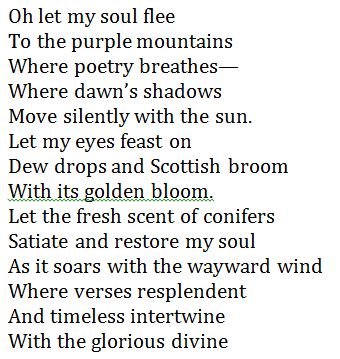
        • New – “Let My Soul Flee” by Connie Marcum Wong[1]
        • mountain-poem
        • Paintings
        • Photography
        • Songs
        • And so on. Be honest … does anyone else see Julie Andrews in their head? Twirling ‘round and ‘round with her arms outstretched and singing, “The hills are a live with the sound of music?” You know what, though? That’s the thing about mountains – the magic, the mystery, the pull that they have. When you’re near them, whether you’re standing at the base of the foothills or somewhere higher up among the ridges and peaks, mountains can feel alive.
          • Ever-changing as the earth shifts and changes
          • Makes them a challenge
          • Makes them unpredictable – both dangerous and exciting
          • For people who climb mountains – whether they’re attempting to summit Everest or hiking the Rockies – this is one of those things that keeps them coming back: the changes, the challenge, and the sense of exhilaration that comes from that experience.
  • “Mountaintop experiences” in terms of faith: those highest-of-high moments when something about our faith has us overjoyed and enthusiastic
    • Feeling of harmony and connection and encouragement and strength, feeling that you have been in God’s presence → These are the moments that bolster us and empower us to continue putting one foot in front of the other. These are the moments that sustain us in the difficult times, the dry times, the low times, the dark times.
    • Today’s Scripture readings = mountaintop experiences, both literally and figuratively → But from the outside looking in, they’re not the mountaintop experiences we might expect.
  • OT reading = Moses and Joshua heading up Mt. Sinai to be with God
    • CONTEXT:
      • After Moses has brought the people of Israel out of Egypt and they’ve escaped Pharaoh’s army by parting the Red Sea and some pretty rough experiences in the wilderness (scarce food, scarce water, lots of whining/complaining Israelites)
      • Before the incident with the golden calf à Israelites decide to make a false idol to worship because they feel too far removed from God
        • Want something tangible
        • Want something visible
    • Actually, it’s today’s Scripture reading that leads to the Israelites feeling like they needed the golden calf in the first place. – text: Moses had said to the elders, “What for us here until we come back to you. Aaron and Hur will be here with you.” … Then Moses went up the mountain, and the cloud covered the mountain. … To the Israelites, the Lord’s glorious presence looked like a blazing fire on top of the mountain. Moses entered the cloud and went up the mountain. Moses stayed on the mountain for forty days and forty nights.[2] → Moses went up Mount Sinai to meet with God and ended up staying there for 40 days and 40 nights. He didn’t tell the Israelites exactly when he would be back, and from the ground, it looked like Moses had walked right into an apocalypse – clouds and fire! – and he just stayed there! For more than a month, Moses stayed on top of that mountain.
      • Caused the Israelites to worry and be afraid because Moses was their connection to God → his sudden and extended absence led them to seek out another god experience
    • “Mountaintop experience” for Moses = incredible
      • Receives 10 commandments from God on the stone tablets
      • Receives all sorts of other instructions about how the tabernacle is to be constructed, how offerings are supposed to be made, how the priests are supposed to present themselves, how Sabbath is to be observed, etc. – 7 long chapters in Ex = God’s instructions to Moses up on that mountain)
      • “Mountain experience” for those left waiting on the ground = fear, anxiety, uncertainty, loneliness → thought that Moses had abandoned them
        • Needed another leader → choose Aaron in Moses’ absence
        • Needed another god → create the golden calf
  • And the people of Israel were not alone in their “outside-looking-in” mountaintop experience. → NT reading
    • Today’s story = often called “The Transfiguration” (hence Transfiguration Sunday) because Jesus is transfigured by God
      • Transfigured in appearance: shining face and shining clothes
      • Also transfigured in his ministry → From this point on – after Jesus comes down that mountain with Peter, James, and John – his ministry moves from one of healing and teaching to one focused on Jerusalem and Golgotha and the cross, a journey that will be just as baffling and unsettling and frightening for his disciples as Moses’ journey was for the people of Israel.
    • I must admit that I’ve always found this one of the strangest stories in the Bible. Jesus and his closest disciples go up on this mountain, Jesus is transformed into this shining being, and then suddenly Moses and Elijah show up to have a quick chat with the Son of God. Peter, being thoroughly perplexed but also feeling like he has to do something, offers to building a couple of shrines – “one for you [Jesus], one for Moses, and one Elijah”[3] – because what else are you supposed to do in a situation like that?! Then God’s voice comes booming out of the cloud declaring again what was said at Jesus’ baptism: “This is my Son whom I dearly love. I am very pleased with him. Listen to him!”[4] And the disciples, so overwhelmed by the magnitude of this experience, fall to the ground in awe. (Because really … who wouldn’t?!) And Jesus (being Jesus) leans over them and says, “Get up. Don’t be afraid.”[5] And when they get up, Moses and Elijah are gone and it’s time to head back down the mountain … expect that on the way down to join all their companions, Jesus says, “Hey, by the way, don’t tell anybody about the vision until the Human One is raised from the dead.”[6] Yup … just a typical day in the lives of the disciples? Not so much.
      • Weird story, right?!
      • Again, mountaintop experience for one person (Jesus) = vastly different than experience of those observing it (disciples)
  • Therein lies both the blessing and the curse in mountaintop experiences: they’re exceedingly personal. They are a moment between you and God. Period. No spectators or peanut galleries allowed. So sometimes, to the people around us – no matter how close those people are to us – our euphoric mountaintop experiences are going to look like crazy mountain journeys. → reality that speaks to the importance of how we share our faith with others, how we tell our story
    • Importance of something that’s become a pretty scary word in mainline Christian tradition: EVANGELISM (*gasp*)
      • Word that’s picked up a lot of negative baggage over the decades → For many people, the term “evangelism” has come to mean “a belligerent and one-sided attempt to convert others to our way of seeing things, an activity that necessarily implies that those who do not believe as we do are therefore lost or in error.”[7]
      • BUT “gospel” in Gr. (whenever it shows up in the NT) = euangelion = literally “good news” → evangelism: sharing the good news of our faith, sharing our story, sharing the power and encouragement and meaningfulness of our mountaintop experiences with others
    • Peter = perfect e.g. of this – one of the other assigned lectionary readings for today: 2 Pet 1:16-21 → Peter sharing his experience, his faith story, the Good News (i.e. – Peter evangelizing)
      • 2 Pet: We didn’t repeat crafty myths when we told you about the powerful coming of our Lord Jesus Christ. Quite the contrary, we witnessed his majesty with our own eyes. He received honor and glory from God the Father when a voice came to him from the magnificent glory, saying, “This is my dearly loved Son, with whom I am well-pleased.” We ourselves heard this voice from heaven while we were with him on the holy mountain. In addition, we have a most reliable prophetic word, and you would do well to pay attention to it, just as you would to a lamp shining in a dark place, until the day dawns and the morning star rises in your hearts.[8]
  • You see, here’s the thing about mountaintop experiences: Whether they’re our experiences or experiences that others have shared with us, they’re not meant to last forever. Just like Moses and Jesus, Peter and James and John, we cannot build dwellings and hunker down and live only in those moments of utter bliss. Because that’s not real life. Sometimes real life is the climb to that mountaintop – a journey full of anticipation and hard work, expectations and keeping that ultimate goal in view. And sometimes real life is coming down from that mountaintop – trekking a path we cannot clearly see down out of the clouds into the valleys below, places of darkness and uncertainty. But that is the journey that lies ahead of us.
    • Sarah Trone Garriott (ELCA YCW from MN serving in IA): We can’t stay here: on the mountain, apart from the world, in the bright and removed peace of our sanctuaries. Jesus is leading us onward, down into the valley, straight into death…and through.
    • Friends, it’s no coincidence that Transfiguration Sunday is always the Sunday before Lent begins. In his later testimony, when he’s speaking of that time on the mountain, Peter says, “We have a most reliable prophetic word, and you would do well to pay attention to it, just as you would to a lamp shining in dark places, until the day dawns and the morning star rises in your hearts.” The part of the journey that lies ahead of us – the journey through Lent to the darkness of Good Friday – is a journey down off the mountaintop and into the valley. We know that there is light on the other side – the light of resurrection and hope and new life – but first, we must face the darkness. Transfiguration Sunday is that brilliant flash of light before the darkness falls. It is Peter’s “lamp shining in dark places.” It is that mountaintop experience that we need – that exhilaration and joy and connectedness in the presence of God – that will sustain us as we journey into Lent together.
    • Words from hymn we’re about to sing: “God of day and God of darkness, now we stand before the night; as the shadows stretch and deepen, come and make our darkness bright. All creation still is groaning for the dawning of your might, when the Sun of peace and justice fills the earth with radiant light.”[9]

[1] Connie Marcum Wong. “Let My Soul Flee,” found at https://www.poetrysoup.com/poem/let_my_soul_flee_571029. Posted 2014, accessed Feb. 23, 2017.

[2] Ex 24:14, 15, 17-18.

[3] Mt 17:4.

[4] Mt 17:5.

[5] Mt 17:7.

[6] Mt 17:9 (emphasis added).

[7] Brian Stone. “Reclaiming the ‘E’ Word” in Old Testament Gateway, accessed via PDF at http://otgateway.com/articles/evangelism.pdf, Feb. 26, 2017.

[8] 2 Pet 1:16-18.

[9] Marty Haugen. “God of Day and God of Darkness,” verse 1. © 1994 GIA Publications, Inc.

Sunday’s sermon: In It Together

buddy-bench

Texts used – Matthew 18:1-5 and 1 Corinthians 12:12-27

  • A while back, I heard a really touching story on the news.
    • Story comes from across the border – Willowgrove Elementary School in Saskatoon, Saskatchewan, Canada
    • Story from the playground[1]
      • Elementary school that installed a special bench on their playground
      • “Buddy Bench” → purpose = finding friends
      • News piece: “When you don’t have anyone to play with, you go to the buddy bench … The rules surrounding the green bench, located next to the school’s playground, are pretty simple. Within a few minutes, any student sitting on the bench will be approached by a fellow student and asked to play.”
    • Now, everyone knows about the school playground, either from your own experience (however long ago that may have been) or from the experiences of your children, nephews, nieces, grandchildren, etc. This attitude of coming together and inviting others to play isn’t always everyone’s experience. Sometimes a playground can be a very negative place for kids. But the Buddy Bench turns that attitude and expectation around. It gives kids that little nudge to ask someone new to play with them.
      • About inclusion
      • About invitation
      • About initiative
      • About building relationships
        • Student description: “If you can’t find your best friends, and you don’t know where to go play, you sit on the buddy bench, and somebody will come and find you.”
          • Response to “How long will it take for someone to come find you?”: “Ummm … about a minute.”
    • And I know that Willowgrove is not alone in their Buddy Bench endeavor. → find Buddy Benches all across the country, even in our own backyard (PI Elementary)
      • Ya’ll, look around you this morning. We are in a church. We are in God’s house. We are on holy ground. If ever there were an adult version of a Buddy Bench, this should be it! That is what we are called to be as the body of Christ.
        • Not the individuals of Christ
        • Not the solo artists of Christ
        • Not the divas of Christ
        • The BODY of Christ
        • We are in this thing together – this faith thing, this life thing, this being-a-broken-human-being-in-a-messed-up-world thing. We are in this together … and the sooner we recognize this, the better.
          • Scripture readings this morning are pretty pointed à two great analogies that drive home the importance of togetherness and dependence on each other
  • Gospel text – Matthew
    • Begins with a question: “Who is the greatest in the kingdom of heaven?”[2] → Jesus’ response: “I assure you that if you don’t turn your lives around and become like this little child, you will definitely not enter the kingdom of heaven.”[3]
      • Idea of “becoming like a little child” has been tossed around by preachers and theologians for centuries → often a text that is talked about in terms of child-like innocence
        • Trusting like a child
        • Loving wholeheartedly like a child
        • Adopting the wonderment and joy of a child in the presence of God
    • Related but slightly different angle this morning → Let me ask you this. Have you ever sat back and watched children play together? Especially children who have never met each other before?
      • Not doing the hover-parent thing where you get things going for them → introduce children to each other and set up some sort of shared activity
      • INSTEAD: Simply letting kids explore playing together all on their own
      • Maybe include a couple of shy moments – feel each other out
      • But before you know it, kids who didn’t know each other 5 minutes ago are running around playing tag or zooming trucks or feeding their baby dolls or playing house or kitchen or school or whatever like they’ve known each other forever. When it’s time to part – whether they’ve had 30 minutes to play together or all afternoon – they hug each other and talk animatedly the whole way home about their “new best friend.” What if that’s the attitude we’re supposed to have when it comes to the Kingdom of God?
        • Not an attitude of separation
        • Not an attitude of hesitation
        • Not an attitude of holding out
        • BUT an attitude of extravagant welcome, of uncompromising inclusion
          • Jesus in text: “Those who humble themselves like this little child will be the greatest in the kingdom of heaven.”[4] → Children playing together don’t care about the differences. They don’t care that your shoes look different than my shoes or that I wear a hat and you wear a head scarf or that my skin is this color and yours is that color or that your family looks different than my family. All those dividing lines that we are so ready to draw as adults – those lines that separate us from everyone else, that keep everyone else at arm’s length – don’t matter to kids. Do you have an imagination? Do you want to play? Sweet. Let’s go.
            • Humility in its purest form
    • Parallel version of this text from Luke’s gospel in the boys’ picture Bible – accompanying question: “If you were one of the children who go to sit on Jesus’ lap, what would you say to him?” → Think of it this way: If you were one of the children who got to sit on Jesus’ lap, would you want him to see you pushing others aside and telling them they don’t belong, or would you rather the whole scene look a little bit more like the Buddy Bench?
  • Speaks to the heart of NT reading, too – 1 Cor passage
    • Familiar passage about the importance of all the different parts of the body of Christ
      • Highlights importance of diversity
      • Highlights importance of togetherness
      • Highlights importance of valuing those who are different
      • I think that often, when we start talking about welcoming people into this family of faith, what we actually mean is that we’re welcoming them to become like us – to think like us, believe like us, dream like us, vote like us, understand Scripture like us. But that’s not how we were created.
        • Created to be vastly different people with vastly different thoughts, beliefs, dreams, ideologies, and understandings
        • Text: Certainly the body isn’t one part but many. If the foot says, “I’m not part of the body because I’m not a hand,” does that mean it’s not part of the body? If the ear says, “I’m not part of the body because I’m not an eye,” does that mean it’s not part of the body? If the whole body were an eye, what would happen to the hearing? And if the whole body were an ear, what would happen to the sense of smell? But as it is, God has placed each one of the parts in the body just like he wanted. If all were one and the same body part, what would happen to the body? But as it is, there are many parts but one body. So the eye can’t say to the hand, “I don’t need you,” or in turn, the head can’t say to the feet, “I don’t need you.”[5] → Now, because I don’t have the ability to show you the news piece about the Buddy Bench, you couldn’t see the different children that the reporter talked to. They were boys and girls. They were from a wide variety of ethnic backgrounds. They were different ages. But all of them talked about how they had both sat on the Buddy Bench waiting to be invited and been the ones doing the inviting. Their differences didn’t even come into play. All that mattered to them was reaching out to someone that was clearly in need of a friend.
          • Again, cycles back to that humility that we saw in Mt – text: The parts of the body that people think are the weakest are the most necessary. The parts of the body that we think are less honorable are the ones we honor the most. The private parts of our body that aren’t presentable are the ones that are given the most dignity. The parts of our body that are presentable don’t need this. But God has put the body together, giving greater honor to the part with less honor so that there won’t be division in the body and so the parts might have mutual concern for each other. If one part suffers, all the parts suffer with it; if one part gets the glory, all the parts celebrate with it. You are the body of Christ and parts of each other.[6] → Would you want Jesus to see you belittling or diminishing the contributions and accomplishments of others – telling them that they don’t matter or they aren’t “the right kind” – or would you rather the whole scene look a little bit more like the Buddy Bench?
  • Here’s the thing about the Buddy Bench: it’s a place where a lonely child waits for a friend → if the church is the Buddy Bench, we as the body of Christ are supposed to be the friends that come to find the lonely one
    • E.g. – children’s finger rhyme from Sunday school: “This is the church. This is the steeple. Open it up, and here are all the people!” → It’s cute. It’s memorable. It rhymes. But frankly, the theology sucks. We are supposed to be the church – the body of the Christ – in the world, not just within these four walls.
      • Most common word for “church” in Gr. = ekklesia: It’s a word that means assembly, yes, but it means so much more than that! “It’s an assembly of Christians gathered for worship in a religious meeting. It’s those who anywhere, in a city, village, constitute such a company and are united into one body. It’s the whole body of Christians scattered throughout the earth.”[7] No four walls required.
    • How often do we sit and wait instead, putting all the responsibility on the lonely ones, the lost ones, the scared ones, the desperate ones, the wandering ones, the unsure ones to find us?
    • How often do we actively reach out? How often do we engage other people in our world – people who are hurting, people who have so often been told that they’re not good enough that they’ve started to believe it, people who are wondering, people who are angry, people who are ashamed, people who are uncertain, people who are shy, people who don’t look or think or believe or vote like us?
      • Not passively
      • Not with other mediums like our wallets or our promotional material
      • Not even just with prayer (though prayer is never a bad answer … just not always the only answer)
      • With our voices
      • With our hands
      • With our hearts
    • Friends, there’s no denying that we’re all in this together – this faith thing, this life thing, this being-a-broken-human-being-in-a-messed-up-world thing. → slightly altered quote from Mahatma Gandhi: Be the Buddy Bench you wish to see in the world. Amen.

[1] “Buddy bench a big hit at Saskatoon’s Willowgrove School,” from CBC News, http://www.cbc.ca/news/canada/saskatoon/buddy-bench-willowgrove-school-1.3505066. Posted Mar. 24, 2016, accessed Feb. 16, 2017.

[2] Mt 18:1.

[3] Mt 18:3.

[4] Mt 18:4.

[5] 1 Cor 12:14-21.

[6] 1 Cor 12:22-27.

[7] “Ekklesia” word study, from http://www.biblestudytools.com/lexicons/greek/nas/ekklesia.html. Accessed Feb. 19, 2017.

Sunday’s sermon: The Unpopular Choice

bree-newsome

Texts used – 1 Kings 18:20-39 and Galatians 1:1-12

  • When the alarm clock went off that morning, it was so early that the sun hadn’t even risen yet. Bree Newsome got up. She dressed in a black t-shirt, black yoga pants, and sneakers. She drove down to the statehouse in Columbia, SC, met her counterpart, and donned the climbing gear she’d brought. Then Bree scaled a fence, climbed a 30-ft. flag pole, and took down a decades-long symbol of oppression and hate: the Confederate flag. And when she climbed down, she was arrested.[1]
    • Flag flying at the South Carolina capitol – raised in 1962 as a deliberate symbol of resistance to the Civil Rights movement[2]
    • Bree Newsome considered herself an activist after her attempt to stop a prejudicial and exclusionary voter registration and identification bill in South Carolina in 2013.
    • What caused her to remove the Confederate flag that day? Just 10 days prior to her climbing up that flag pole, Dylann Roof – a young white man fueled by racial prejudice and hate – massacred nine people in the middle of a prayer service in Emanuel AME Church in Charleston, South Carolina. (proverbial straw that broke the camel’s back)
      • In a later interview, Bree: The biggest issue was the blatant disrespect for black life. When we buried the victims of the Charleston massacre, the American flag was at half-mast. The South Carolina state flag was at half-mast. But the Confederate battle flag was still flying high. Nine people were massacred in church, and while we laid them to rest that flag was flying like it was a victory.[3]
    • Results of this action
      • Bree and fellow activist James Tyson were arrested and charged with misdemeanors
      • Confederate flag was re-raised at the capitol building about 45 minutes later
      • BUT … Roughly two weeks after Bree’s climb and after decades of protest by other civil rights groups, then-South Carolina governor Nikki Haley signed legislation that permanently removed the Confederate flag from the statehouse grounds.[4]
    • That day, the flag came down amidst cheers of support and optimistic calls for change … but when Bree took it down in her act of civil disobedience, it was viewed by many – in South Carolina and around the country – as an unpopular choice. But everything about her action spoke to Bree’s belief in equality and justice.
      • Bree: It mattered that scaling the flagpole was difficult. The physical battle to climb up there and get that flag was like the struggle to dismantle systemic racism. Nothing about it is easy.[5]
  • Now, I’m not telling you this morning to go out and start climbing flag poles or that you should go get arrested. But Bree’s actions are a powerful example of an unpopular choice that was made for powerful reasons. → Scripture readings this morning = all about unpopular choices made for reasons of faith
    • Sometimes just having/claiming/enacting faith IS the unpopular choice
    • Sometimes convictions of our faith lead us to make difficult and unpopular choices
      • Choice to stand up and speak out for those on the margins
      • Choice to oppose fear and intimidation wherever that may be coming from (bully on the school bus, bully in your office building, bully ahead of you in the grocery line, or beyond)
  • Story from 1 Kings: Elijah versus Baal’s prophets
    • BACKGROUND:
      • Time of the kings in history of the people of Israel
        • After Moses and the exodus from Egypt
        • After the judges
        • After Kings Saul, David, and Solomon
        • After the one kingdom of Israel has split in two: northern kingdom of Israel and southern kingdom of Judah
        • Grand timeline of the world: somewhere in late 800s BCE
      • Ahab has inherited throne of Israel → Ahab is a bad, bad guy – earlier in 1 Kgs: Ahab, Omri’s son, became king of Israel. He ruled over Israel in Samaria for twenty-two years and did evil in the Lord’s eyes, more than anyone who preceded him. … He served and worshipped Baal. He made an altar for Baal in the Baal temple he had constructed in Samaria.[6]
        • Baal = Canaanite god, considered to be a “weather god” who controlled the seasons and the amount of rainfall[7] → definitely flies in the face of that first commandment that God gave Moses: You must have no other gods before me.[8]
    • As you can imagine, King Ahab didn’t exactly create a warm and welcoming environment for anyone that wanted to worship the God of Israel, and not surprisingly, he didn’t exactly take kindly to criticism either. And yet it was into this political and religious hornet’s nest that Elijah was called to proclaim the word of God.
      • Elijah = unpopular with Ahab from the very beginning – first interaction with King Ahab: Elijah from Tishbe, who was one of the settlers in Gilead, said to Ahab, “As surely as the Lord lives, Israel’s God, the one I serve, there will be neither dew nor rain these years unless I say so.”[9] → Elijah names drought = punishment for Ahab’s wickedness
        • So unpopular that God actually instructs Elijah to run away and hide from Ahab for a time
    • Now, our story for today picks up in the third year of that drought. God has instructed Elijah to return to Ahab’s presence and “bring the rain.” – text: After many days, the Lord’s word came to Elijah (it was the third year of the drought): “Go! Appear before Ahab. I will then send rain on the earth.” So Elijah went to appear before Ahab.[10]
      • Doesn’t come with a comforting word
      • Doesn’t come with a renewing word
      • Elijah comes with a challenge: 450 against 1, your god against my God, fire against fire → Elijah challenges the 450 prophets of Baal to a test: both will set up identical altars for burnt offerings and call upon their gods to provide the fire … and he graciously (calculatingly?) lets the prophets of Baal go first.
        • Baal’s prophets spend almost all day calling out to their god but to no avail
      • And as if this sort of ultra-competitive atmosphere wasn’t bad enough, Elijah makes it even worse! – text: Around noon, Elijah started making fun of them: “Shout louder! Certainly he’s a god! Perhaps he is lost in thought or wandering or traveling somewhere. Or maybe he is asleep and must wake up!”[11]
        • Continues with his actions – Elijah douses entire altar with 24 jars of water (Remember … they’re in a drought that has lasted years … and Elijah is wasting precious water just to prove his point.) → becoming more unpopular by the second
    • And yet, in the face of that negatively super-charged atmosphere – that place of rejection and animosity and denial – God shows up. God shows up in flames so epic that they not only consume the intended sacrifice but also the wood, the stones, the dust, and all the water in the trench. Elijah’s choice may not have been the popular one in the midst of the rowdy crowd and all those other prophets and King Ahab, but Elijah’s choice was God. Elijah’s choice was faith, no matter how unpopular or dangerous it may have been.
  • Certainly not the only time when choosing faith was the unpopular choice
    • In the Bible
      • Pretty much all of the other prophets: Amos, Hosea, Jeremiah, Isaiah, Habakkuk, Joel, Obadiah, and so many more – ignored at best, publicly ridiculed more often than not, shunned and threatened and exiled at worst → still chose faith, chose to proclaim the very word of God that is causing all their pain and persecution in the first place
      • As Christians, we must remember that our faith identity lies with Jesus Christ – One who’s very life and ministry and teaching was a choice so unpopular with the religious leaders of the time that he was killed for it.
        • Preached forgiveness instead of legalistic nitpicking
        • Preached inclusion instead of elitism
        • Preached love of God above all else
        • But Jesus’ words also warned time and time again just how unpopular this decision of faith could be.
          • Mt: Then Jesus said to his disciples, “All who want to come after me must say no to themselves, take up their cross, and follow me. All who want to save their lives will lose them. But all who lose their lives because of me will find them. Why would people gain the whole world but lose their lives? What will people give in exchange for their lives?”[12]
          • Jn: “If the world hates you, know that it hated me first. If you belonged to the world, the world would love you as its own. However, I have chosen you out of the world, and you don’t belong to the world. This is why the world hates you.”[13]
      • See this in the lives of the disciples after Jesus’ return to heaven
        • Peter jailed[14]
        • Stephen stoned to death[15]
        • Paul and Silas beaten and imprisoned[16]
        • Nearly all the disciples, as far as we know, were martyred for their faith as they spread the Good News of Jesus Christ
    • In real life – faith inspiring unpopular actions
      • Dietrich Bonhoeffer – preached and taught and worked for resistance against the Nazis until his own imprisonment and death in Flossenburg Concentration Camp in 1945
      • Archbishop Oscar Romero – stood by the poor and denounced violent military dictators in El Salvador until he was assassinated while serving Mass in 1980
      • Malala Yousafzai – fought for education, especially girls’ education, in Pakistan and survived an assassination attempt by the Taliban in 2012 à continues to be a fierce advocate for education (co-recipient of the Nobel Peace Prize in 2014)
      • People who, over and over again, chose to cling to their faith – faith in God and faith in the goodness of humanity – even when it was the wildly and dangerously unpopular choice.
  • See the struggle of this play out in our NT text for today
    • CONTEXT:
      • Paul and Barnabas had previous established a Christian community in Galatia (geographically: part of modern-day Turkey) → gotten word that this community has been visited by other Jewish-Christian missionaries that are questioning Paul and his teachings
        • Paul to this community of Gentiles: You don’t have to adopt Moses’ Laws (you know … ALL 613 of the laws laid out in the book of Deut!) or be circumcised to be a follower of Christ
        • Jewish-Christian missionaries: Wrong … you do have to adopt Moses’ Laws and be circumcised
        • Crux of the argument
          • Paul: right relationship with God comes through faith
          • Missionaries: right relationship with God comes through your actions
    • Text for today – Paul’s words are powerful: I’m amazed that you are so quickly deserting the one who called you by the grace of Christ to follow another gospel. It’s not really another gospel, but certain people are confusing you and they want to change the gospel of Christ.[17] → Now, I know that this sounds harsh. Galatians is, by far, the harshest of Paul’s letters in terms of the tone that he used with those to whom he was writing. But we have to admit that it does the job it was probably meant to do. It grabs our attention. It makes us sit up and take notice of what Paul is saying. And even though it may sound like Paul is pitching a little bit of a hissy fit here (“Listen to me! Listen to me!”), he’s actually continually drawing attention not to himself, but to God.
      • Scholar: In these opening verses, everything points to God. Paul’s authority comes not from himself but from God. The message he preaches is not his; it is from God. And sinners do not save themselves through adherence to the law; they are saved by God.[18] → text: Am I trying to win over human beings or God? Or am I trying to please people? If I were still trying to please people, I wouldn’t be Christ’s slave. Brothers and sisters, I want you to know that the gospel I preach isn’t human in origin. I didn’t receive it or learn it from a human. It came through a revelation from Jesus Christ.[19]
  • There are plenty of times in our own lives when we are presented with choices concerning our faith – what we believe, how we share it, when we’ll claim it, whether and how we’ll defend it, when we’ll admit that we need to learn more about it. When we make those choices for faith, we should make them not for ourselves or our own glory – not to make ourselves feel better or more important or more righteous. We should make those decisions to glorify God, to point to God, to give God praise and reverence and adoration and thanks.
    • Not going to be easy but the important choices in life never are
    • from the Confession of Belhar (confession born out of the restrictions and injustices of apartheid South Africa, confession that has faced opposition and unpopularity from the beginning, just recently adopted by the PCUSA into the Book of Confessions, Part I of our constitutional documents): We believe that the church as the possession of God must stand where the Lord stands, namely against injustice and with the wronged; that in following Christ the church must witness against all the powerful and privileged who selfishly seek their own interests and thus control and harm others. Amen.


[1] Jessica Contrera. “Who is Bree Newsome? Why the woman who took down the Confederate flag became an activist” in The Washington Post, https://www.washingtonpost.com/news/arts-and-entertainment/wp/2015/06/28/who-is-bree-newsome-why-the-woman-who-took-down-the-confederate-flag-became-an-activist/?utm_term=.86a38365a960. Written June 28, 2015, accessed Feb. 11, 2017.

[2] Sidney Blumenthal. “The Star-Spangled Banner in South Carolina” in The Atlantic, https://www.theatlantic.com/politics/archive/2015/06/confederate-flag-south-carolina-history/396695/. Written June 24, 2015, accessed Feb. 12, 2017.

[3] Melissa Harris-Perry. “One Year After She Took Down the Confederate Flag, Activist Bree Newsome Looks Back” in Elle, http://www.elle.com/culture/career-politics/news/a37315/bree-newsome-confederate-flag/. Written June 23, 2016, accessed Feb. 11, 2017.

[4] Amanda Holpuch. “Confederate flag removed from South Carolina capitol in victory for activists” in The Guardian, https://www.theguardian.com/us-news/2015/jul/10/confederate-flag-south-carolina-statehouse. Written July 10, 2015, accessed Feb. 12, 2017.

[5] Harris-Perry.

[6] 1 Kgs 16:29, 31b-32.

[7] Jack Wellman. “Who Was Baal? A Bible Study.” Patheos. http://www.patheos.com/blogs/christiancrier/2016/08/28/who-was-baal-a-bible-study/. Written Aug. 28, 2016, accessed Feb. 11, 2017.

[8] Ex 20:3.

[9] 1 Kgs 17:1.

[10] 1 Kgs 18:1-2.

[11] 1 Kgs 18:27 (emphasis added).

[12] Mt 16:24-26.

[13] Jn 15:18-19.

[14] Acts 12:1-4

[15] Acts 7:54-58a.

[16] Acts 16:19b, 22-24.

[17] Gal 1:6-7.

[18] Kyle Fedler. “Galatians 1:1-12 (Ninth Sunday After the Epiphany) – Theological Perspective” in Feasting on the Word: Preaching the Revised Common Lectionary – Year C, vol. 1. (Louisville, KY: Westminster John Knox Press, 2009), 426.

[19] Gal 1:10-12.

Advent sermon: Holding Out Hope

hope-faith-darkness

Text used – Isaiah 35:1-10

For the last few weeks, the weather – both snow storms and dangerously frigid temperatures – have caused us to cancel our worship services. This sermon was preached a few weeks ago on the 3rd Sun. of Advent.

  • I want to tell you about an incredible children’s book this morning. Fletcher and the Falling Leaves by Julia Rawlinson[1]
    • Fletcher = little fox who loves his very favorite tree
    • Beginning of the book: The world was changing. Each morning, when Fletcher bounded out of the den, everything seemed just a little bit different. The rich green of the forest was turning to a dusty gold, and the soft, swishing sound of summer was fading to a crinkly whisper. Fletcher’s favorite tree looked dull, dry, and brown. Fletcher was beginning to get worried. → You see, being a very young fox, Fletcher doesn’t understand about fall – about how grass and flowers and even big, beautiful trees have to lose their color and vibrancy in order to hibernate for the winter and be reborn in the spring.
    • Fletcher’s first go-to = his mom
      • She tells him “Don’t worry, it’s only autumn.”
      • Fletcher relays this message to his tree: “Don’t worry, it’s only autumn. You’ll be feeling better soon.”
    • But then Fletcher’s big, beautiful tree begins to lose its leaves … and Fletcher is frantic
      • Starts with just one leaf → Fletcher catches it and does everything he can to put the leaf back on the tree
      • Next day = strong wind → Fletcher rushes to his tree to find many branches bare and leaves swirling everywhere → Fletcher tries to retrieve all these leaves so he can return them to his tree
        • But to his great dismay and consternation, Fletcher isn’t the only one gathering up these fallen leaves.
          • Excited squirrel gathers them for its winter nest → Fletcher’s response: “Help! Help! The wind and the squirrel are stealing our leaves!”
          • Overjoyed porcupine rolls in them – leaves stuck to its quills are insulation against the coming winter cold → Fletcher’s response: “Help! Help! The wind, the squirrel, and the porcupine are steading our leaves!”
      • Quick respite: flock of birds hears Fletcher’s cries, gathers up all the fallen leaves, and returns them to the tree → Fletcher, exhausted from his physically and emotionally taxing morning, thanks the birds and falls asleep under his beloved tree
      • But as Fletcher sleeps, the wind continues to blow, and once again the leaves fall to the ground. When Fletcher finally wakes up from his nap, his tree was entirely bare … all but one leaf.
        • Fletcher climbs tree to hang onto that last leaf
        • Clings to branch and holds the leaf firms in its place on the tree
        • Great gust of wind bounces branch → And in that jolt, the final leaf pops free and flutters in Fletcher’s paw.
      • Fletcher = devastated
        • Very carefully carries the leaf home
        • Makes a bed for the leaf next to his own and tucks it in for the night
        • Spends all night long sadly thinking of his once-beautiful tree
    • Now, that’s not quite the end of the story, but I’m going to leave it there for now. Because, after all, it is Advent, and this year, we’re listening through the voice of Isaiah and his anticipatory hope.
      • Already talked about how we are waiting in anticipatory hope for the Light of the World to come → what started as a faint glimmer = dawning brighter and brighter, stronger and stronger every day
      • Also talked about how absurdly and illogically powerful hope is → how hope blooms bright and wild in the unexpected story of Mary and Joseph and the manger as well as in our own unexpected stories
      • Today: talk about those times when we hold out hope → 3 very different ways that we do that
        • “Hold out hope” by holding it at arm’s length → keep it ever-so-slightly distant from us because hopes that go unrealized/unfulfilled can be so incredibly painful
        • Opposite: “hold out hope” by clinging to it → by embracing the faintly-possible in the face of the highly-improbable (what sometimes can seem more like the impossible!), investing our whole selves and hearts into our belief
        • “Hold out hope” in a manner of pride and declaration → similar to the way children hold out their latest creation
          • Pick Luke and Ian up at Amy’s – first thing they have to do is show me (at the top of their lungs!) their latest crafting creation or coloring sheet → giant smiles on their faces, excitement exuding from every part of them
  • Looking at Is text for today
    • Is gives plenty of scenarios that seem challenging at best = the kind of scenarios that make us want to hold that hope out at arm’s length because no good can truly come of such a bleak situation
      • Text speaks of deserts and dry land and the wilderness, weak hands and unsteady knees, “those who are panicking,”[2] those who have lost their sight and their hearing and their ability to walk and to speak, the burning sand and thirsty ground, fools and predators, grief and groaning → all struggles and pitfalls to which we can relate
        • Plenty of people we know and love around here make their living farming – threats of too much rain or too little rain, even too much snow or too little snow to melt in the spring = always on their minds → What will the fields look like this year? Too wet? Too dry? Full of too many weeds? Too many aphids or corn borers or some other kind of blight?
        • Plenty of people we know and love struggle with health issues – always make hope both problematic and paramount at the same time
        • Plenty of times when we feel like the fools and the predators are all that line our paths – threatening and intimidating, misleading and distracting, challenging and impeding us at every turn → affects all aspects of our lives
          • Personal lives (relationships)
          • Work lives
          • Spiritual lives
    • But even though it mentions all of these terrible scenarios, our Isaiah text this morning is a text of joy-filled hope – text: The desert and the dry land will be glad; the wilderness will rejoice and blossom like the crocus. … Then the eyes of the blind will be opened, and the ears of the deaf will be cleared. Then the lame will leap like the deer, and the tongue of the speechless will sing. … The burning sand will become a pool, and the thirsty ground, fountains of water. … A highway will be there. It will be called The Holy Way. … Even fools won’t get lost on it; no lion will be there, and no predator will go up on it. … Happiness and joy will overwhelm them; grief and groaning will flee away.[3]Isaiah is truly holding out hope, clinging to it and encouraging the people to do the same, even in the midst of all the challenges that they face – betrayal, war, oppression and all of the emotions that those bring: fear, uncertainty, shame, sadness, doubt. Isaiah is reminding the people that even when they are faced with the worst of circumstances, God is with them. God is their strength and their renewal. God is their source of security and joy.
      • Hear Is encouraging them in this belief – text: They will see the Lord’s glory, the splendor of our God. Strengthen the we hands, and support the unsteady knees. Say to those who are panicking, “Be strong! Don’t fear! Here’s your God, coming with vengeance; with divine retribution God will come to save you.”[4]
      • Same God for whom we wait today → Advent = time of waiting for Christ
        • Waiting for the birth, yes → But this emphasis is a liturgical and theological development that has only happened in very recent history – within the lifetimes of nearly everyone in this room, the exception being the youngest children.
        • Waiting for Christ to return → Now, I know this is something we don’t often talk about in the [PC(USA)/UCC] because we trust that Scripture tells us that we aren’t meant to know the day or the time of that return, and that’s okay. We aren’t consumed by trying to figure it out – to pinpoint all the details (the who, what, where, when, how, and why of Christ’s return), but in the face of all the challenges and fears and uncertainties that surround us, we hold out hope that indeed Christ will return one day.
          • Say it every time we celebrate communion: “Whenever we eat this bread and share this cup, we proclaim Christ’s death and resurrection until he comes again in glory.”
          • Powerful hope
          • Strong hope
          • And yet it can be a hope that, like many, grows more and more difficult to hang on to the longer we have to wait. → Advent = time when we lean into and live into that hope a little bit more as well
    • And in the end, just like a proud little kid with his latest art project, Isaiah hold out that hope for all to see and to cherish – text: The Lord’s ransomed ones will return and enter Zion with singing, with everlasting joy upon their heads. Happiness and joy will overwhelm them; grief and groaning will flee away.[5] → Being overwhelmed by happiness and joy were about as far from the minds and lives of the Israelites as they could possibly be at the time. But Isaiah not only clung to his anticipatory hope, he shared it. He declared it boldly, without apology and without shame. He held out this hope for a people who were hurting and a nation that was reeling – a light in their darkness, a stream in their wilderness, a Holy Way for those feeling lost and alone.
      • Our call today as well → to hold out the good news of the coming Savior, the one who was born and the one who will return in glory – to declare boldly, without apology and without shame our hope in Emmanuel, God With Us
        • Remind our broken and hurting world happiness and joy are not lost
        • Remind our broken and hurting selves that with God With Us, grief and groaning will indeed flee away
        • Audacious hope – takes guts
        • Anticipatory hope – takes patience
        • Active hope – takes movement (being the hands and feet of God in this world → living out that hope)
      • Scholar: We still live in that in-between time, as this prophet’s people did. We are asked to take heart. God will come and save; we will find our Holy Way toward home, and our mouths will be filled with no more sighing, only singing.[6]
  • Fletcher’s initial hope was that his tree would “get better” – that the effects of autumn would miraculously be reversed and that his beloved tree would return to its former green and luscious glory. It was a hope for what he knew. For what was familiar. For what was comfortable. But as I said before, we left off the end of the story.
    • Ending: At dawn Fletcher tiptoed outside. The wind had finally stopped blowing, and the air was cold. The moon still hung in the clear sky and pale stars glimmered. As he came to his favorite tree, Fletcher saw a magical sight … The tree was hung with a thousand icicles, shining silver in the early light. “You are more beautiful than ever,” whispered Fletcher. “But are you all right?” A tiny breeze shivered the branches, making a sound like laughter, and in the light of the rising sun, the sparkling branches nodded. Fletcher gave his tree a hug. Then he went back to the den for a nice, warm breakfast.
    • Fletcher never expected that in the face of such loss, he could find such beauty. As he mourned for what was, he never dared to hope that there could be something even more beautiful in store for his beloved tree. And yet, in that moment, Fletcher’s eyes were opened to a world of possibilities – a whole new hope for the wonder that his tree could be. Friends, let us go out into the world this morning with eyes opened wide like Fletcher’s – wide to the possibilities of God’s immense and powerful hope in this world, holding that hope out before us with giant smiles on our faces, overflowing with excitement for how in can change our own lives as well as the world around us. Amen.

fletchers-treeIllustrated by Tiphanie Beeke

[1] Julia Rawlinson. Fletcher and the Falling Leaves. (New York, NY: Greenwillow Books), 2006.

[2] Is 35:4.

[3] Is 35:1, 5-6a, 7a, 8-9, 10b (emphasis added).

[4] Is 35:2b-4.

[5] Is 35:10.

[6] Stacey Simpson Duke. “Third Sunday of Advent – Isaiah 35:1-10, Pastoral Perspective” in Feasting on the Word: Preaching the Revised Common Lectionary – Year A, vol. 1. (Louisville, KY: Westminster John Knox Press, 2010), 54.

Sunday’s sermon: An Illogical Hope

illogical-hope

Text used – Isaiah 11:1-10

  • I’m going to start this morning by reading you a story.
    • [READ “RINDERCELLA” SPOONERISM[1]]
    • That made sense, right? Totally rational? Completely logical? Easy to follow and 100% understandable? Right? … No?? Well, shoot.
      • Explain spoonerisms: a verbal error in which a speaker accidentally transposes the initial sounds or letters of two or more words, often to humorous effect → Or, in this case, not-so-accidentally.
      • But let me ask you this: Despite all the goofy words and the crazy phrases, did you understand what I was saying? Did you fall into a rhythm of listening that let you hear through the illogical to the message underneath?
        • Sort of like when you’re watching a movie when all the characters are speaking with an Irish accent or an Australian accent: takes a while for your ear to adjust to what you’re hearing, so you have to really pay attention for the first 15 mins. or so – by the end, you have no trouble understanding them
        • You see, that’s the thing about this time of year – the hope, the amazing in-breaking of God into our day-to-day lives in the form of this little baby, the story of Mary and Joseph and all their trials and tribulations that lead up to that night in a Bethlehem stable, and all the centuries of waiting and wanting that lead up to it. Centuries of prophecies. Centuries of expectations. Centuries of anticipatory hope. All for this one little child … who is, indeed, God With Us. Crazy, right? Totally irrational? Completely illogical? Difficult to grasp and 100% perplexing? Right? Well, shoot. … That sounds just about right.
  • Walking through Advent this year with the prophet Isaiah
    • Context reminder: prophet to southern kingdom of Judah during time of war, oppression, and betrayal
      • Judah compelled into shaky alliance with Assyria → Assyrian army turns around and attacks Judean capitol of Jerusalem
      • Isaiah speaks words of promise
        • Promise of God’s care
        • Promise of God’s guidance
        • Promise of God’s presence with the people of Israel
        • Promise of salvation to come
      • Isaiah’s words = words of anticipatory hope
        • Hope that cannot be realized in the here and now
        • Hope that must be held and cherished, sheltered and nurtured → Think of what it’s like to try to start a fire in a firepit. You’re outside, and sometimes, the elements are less-than-ideal. First, you have to make things ready – build the logs up, find some good kindling (somethings that’s dry and that will burn easily), and position everything just so. Then, you have to light the kindling. The flame is small at first, meager and vulnerable and liable to go out at the slightest hint of neglect. But you protect that little flame. You shelter it with your hands and your body so the wind doesn’t blow it out. You feed it more twigs and kindling, and you watch it grow. You watch it strengthen and intensity as it first catches the twigs, then the little sticks on the logs, then the bark on the logs, and finally, the entire log structure that you built is glowing with warmth and light. So it is with the hope that Isaiah presented to the people of Israel. It was tenuous and fragile when he first spoke the words. The elements surrounding them – the cruel and oppressive Assyrian army, the utter uncertainty of their future –threatened that hope. And yet Isaiah’s words continued to stir in them, to grow and flourish within their hearts as a flame grows and flourishes in a firepit – bringing light to the dark times, warmth to the desolate times, and hope to the times that seem utterly hopeless.
          • Anne Lamott: “Hope is not logical. It always comes as a surprise, just when you think all hope is lost. Hope is the cousin to grief, both take time.”
  • Today’s Scripture reading
    • Isaiah’s words of anticipatory hope this week seem especially illogical and absurd – text: The wolf will live with the lamb, and the leopard will lie down with the young goat; the calf and the young lion will feed together, and a little child will lead them. The cow and the bear will graze. Their young will lie down together, and a lion will eat straw like an ox. A nursing child will play over the snake’s hole; toddlers will reach right over the serpent’s den.[2] → Sounds. Crazy. Right?? I mean, this goes against everything in nature – predators gently and peacefully lying down with their prey, eating not the prey itself but what that prey is used to eating (bears munching on grass and lions scarfing down straw). And little children playing with snakes?
      • Not the happy, harmless little garter snakes that we all see in our gardens over the summer – Heb. = “cobra or asp” → Scholars have narrowed it down even further to a particular species: the Cerastes cornutus, the Horned Viper. This is a highly venomous snake that still lives in northern Africa and the Middle East.[3] This is not the kind of snake that the traveling zoo guy is going to bring to the summer library program! It is dangerous. It is volatile. And according to Isaiah’s prophecy, this is the snake that the “nursing child” and the “toddler” will play with. Logical? Not so much. The protective momma in me wants to say something a lot stronger than that … but we’ll leave it at “not so much.”
    • Craziness of Isaiah’s prophecy illustrates just how amazing, just how topsy-turvy, just how extreme, just how illogical hope in God actually is → I’ll tell you what, though: it’s a good thing we’re in church, and it’s a good thing we’re in the midst of Advent because nothing about this faith, nothing about this season, nothing about the birth of God in human form makes sense. So we’re in good company.
      • Hope in a God we cannot see or hear or touch → by today’s standards, a God we cannot prove
      • Hope in a tiny baby born not into power and prestige but into a stable and straw – hope that this baby will save us all
        • Words of the angels to come: For unto you is born this day in the city of David a Saviour, who is Christ the Lord.[4]
          • “Christ” is not Jesus’ last name, it’s a title – Gr. “Christ” = “Savior” → So the one to bring salvation will be born into a position that couldn’t be more humble, more out-of-station, more common and ordinary. And yet, oh, how uncommon and extraordinary this Christ Child will be.
            • Is speaks to that this morning, too: A shoot will grow up from the stump of Jesse; a branch will sprout from his roots. The Lord’s spirit will rest upon him, a spirit of wisdom and understanding, a spirit of planning and strength, a spirit of knowledge and fear of the Lord. He will delight in fearing the Lord. He won’t judge by appearances, nor decide by hearsay. He will judge the needy with righteousness, and decide with equity for those who suffer in the land.[5]
              • Words of audacious hope in Isaiah’s time – time of oppression and betrayal
              • Words of audacious hope in time of Jesus’ birth – time of injustice and corrupt leadership
              • Words of audacious hope in our time, too – time of serious social inequality and a whole new set of injustices, time of both extreme need and extreme greed, time of unrest, time of uncertainty
  • Today: inhabit a world that can sometimes be bent against hope
    • World that values reason and logic
      • Facts and figures
      • Scientific studies
      • Expert opinions
      • And don’t get me wrong, all those things have their place. If I find myself down at Mayo facing some sort of illness or medical problem, I want all of those things. I want facts and figures. I want scientific studies. I want whatever expert opinions I can get because I want to be informed to the best of my ability about what’s going on in my life and in my body. But I also want hope.
    • World that seems to place immense significance on soundbytes and shock value and sensationalism
      • News stories
      • Tabloid fodder
      • Internet sensations
      • Talk radio
      • There are all of these outlets that try to shock us into submission with the opinions and beliefs that they’re trying to sell. They bury us in words and word and more words about how terrible this person is or how criminal that person is, how scandalous this event was or how out-of-whack that situation is. The sensationalism dulls our senses until we find something to spark us back into ourselves.
        • Hope = that spark
          • Hope in humanity
          • Hope in God’s goodness and ultimate purpose in this world
          • Hope in grace
          • Hope in forgiveness
        • Cling to Is’ anticipatory hope: The earth will surely be filled with the knowledge of the Lord, just as the water covers the sea. On that day, the root of Jesse will stand as a signal to the peoples. The nations will seek him out, and his dwelling will be glorious.[6]
    • In the face of all that the world elevates and treasures, we celebrate a story that makes no sense – a story of ultimate power born into ultimate destitution, a story of people coming to pay homage not to a king in a fancy palace but a child in a feed trough surrounded by animals and straw and cow pies and camel spit, a story of angels singing and God With Us and incomparable grace and anticipatory hope. It’s a story that makes no sense … and thank God for that!
      • Madeleine L’Engle: This is the irrational season / When love blooms bright and wild. / Had Mary been filled with reason, / There’d have been no room for the child. → Sometimes, we just have to make room for the irrational, the unreasonable, the audacious and the uncommon and the extraordinary. We have to make room for illogical hope because there is no other kind. If hope were logical, it wouldn’t be hope. It would be reason. I would be planning. It would be check lists – something we could work through step by step in a sensible and intellectual way. But the beauty of hope is that it flies in the face of all that! It blooms bright and wild in the face of statistics that tell you things should be otherwise. Hope blooms bright and wild in the face of past circumstances that should teach you to expect loss or failure or fear. Hope blooms bright and wild in the face of naysayers and straight talkers who do their darnedest to keep your feet on the ground. Hope blooms bright and wild in darkness, in challenge, in fear, in uncertainty – in all those places when we need it most. Because in those places is God Emmaneul – God With Us. Amen.

[1] found at https://texasbluebonnetaward2015.files.wordpress.com/2013/12/rinderceller.pdf.

[2] Is 11:6-8.

[3] http://reptile-database.reptarium.cz/species?genus=Cerastes&species=cerastes.

[4] Lk 2:11 (KJV).

[5] Is 11:1-4a (CEB).

[6] Is 11:9b-10.