July 2016 Newsletter piece

election season

137 days.

“Just” 137 more days.

*sigh*

That’s how many days we have left (as of today – June 23) in our current political season.

137 days.

I’m not going to shock anyone when I say that this one has already been a doozy, folks. Within the next 30 days, both the Republican National Convention and the Democratic National Convention will convene in Cleveland, OH and Philadelphia, PA (respectively). And if we thought things were crazy before, just wait ………

Somehow, as a nation, we seem to have forgotten how to compromise, how to share, how to “just get along.” The mudslinging started months ago, first between candidates in the same party. Soon, this will progress to across-the-aisle mudslinging. We will be inundated with ads – on television, on the radio, online, and in our mailboxes – trying to convince us that “the opponent” is wrong. Some of the political action committees and campaigns may even throw in the word “evil.” At this point, it wouldn’t surprise me.

When they go to school, we teach our children to share. We teach them to play nice. We teach them to listen to their teachers – the people who know more than they do, the authority figures – so they can learn and grow. We teach them to listen to their friends so they can build strong and healthy relationships.

And yet what kind of example have we been setting?

Finger-pointing …
Name-calling …
Villainizing …

As adults – as a nation – we might as well be sticking our fingers in our ears, closing our eyes, and shouting, “La la la la la la!! I can’t hear you!!”

I think our children may be better behaved than we are.

We have forgotten what Scripture teaches us.

In the Sermon on the Mount, Jesus speaks these challenging and unforgettable words: “You have heard that it was said, You must love your neighbor and hate your enemy. But I say to you, love your enemies and pray for those who harass you so that you will be acting as children of your Father who is in heaven. He makes the sun rise on both the evil and the good and sends rain on both the righteous and the unrighteous. If you love only those who love you, what reward do you have? Don’t even the tax collectors do the same? And if you greet only your brothers and sisters, what more are you doing? Don’t even the Gentiles do the same? Therefore, just as your heavenly Father is complete in showing love to everyone, so also you must be complete.” (Mt 5:43-48)

In his letter to the Christians in Rome, Paul says, “But why do you judge your brother or sister? Or why do you look down on your brother or sister? We all will stand in front of the judgment seat of God. Because it is written, As I live, says the Lord, every knee will bow to me, and every tongue will give praise to God. So then, each of us will give an account of ourselves to God. So stop judging each other. Instead, this is what you should decide: never put a stumbling block or obstacle in the way of your brother or sister. … So let’s strive for the things that bring peace and the things that build each other up.” (Rom 14:10-13, 19)

We don’t have to agree with each other. We don’t all have to vote the same way or support the same candidate. Our differences are exactly what are supposed to make democracy such a wonderful thing – representatives from all walks of life coming together to build a better city, state, nation, world.  But in order to this to work the way that it was intended, we have to remember to be kind to each other and to respect each other.

Even when we disagree.
Even when we are “voting for the other person.”
Even when we have trouble understanding the opposite point of view.

Pastor Lisa sign

Sunday’s sermon: A Desperate Cry

Esther 4.14

Text used – Esther 4:1-17

  • Recap of last week’s chapter of the Esther story
    • Introduced last main character – Haman, one of King Ahasuerus’ most important advisors, definitively evil villain of our story
    • Conflict btwn. Haman and Mordecai
      • As advisor, law requires everyone to bow down to Haman
      • Mordecai = Jew → refuses to bow down to anyone other than God (Remember that 1st commandment? “You shall have no other gods before me. You shall not bow down to anyone or anything on this earth” … other human beings included.)
      • Haman doesn’t take the blow to his ego well → instead of choosing to “just” kill Mordecai for his insolence, Haman decides to kill all Mordecai’s people – all the Jews
      • Shrewdly proposes idea to King Ahasuerus – disinterested response: “Do as you like with [the Jews.]”[1] → gives Haman his own signet ring
      • Decree is written and sent out to all the corners of the kingdom and sealed with the king’s own seal (from ring) → plan: all the people in all the different cities and provinces of Persia are to converge on the Jews on “the thirteenth day of the twelfth month”
        • “Wipe out, kill, and destroy all the Jews, both young and old, even women and little children”[2] and steal their property
    • Chapter ended with Haman and the king carelessly having a drink together while the rest of the city of Susa is in shock over the decree
  • Pick up with today’s part of the story – powerful, powerful portion of Esther: Jews’ reaction to Haman’s evil plan and Mordecai and Esther’s reactions in particular
    • Period of great lament
      • Mordecai “tore his clothes, dressed in mourning clothes, and put ashes on his head. Then he went out into the heart of the city and cried out loudly and bitterly.”[3]
      • “in every province and place where the king’s order and his new law arrived, a very great sadness came over the Jews. They gave up eating and spent whole days weeping and crying out loudly in pain. Many Jews lay on the ground in mourning clothes and ashes.”[4]
      • And who can blame them?! Haman’s plan was so hateful, so evil, so sweeping … and so blatantly arrogant. Remember, he sent the notices of what was to happen to the Jews out to all the land to be posted in the public places (text last week: “A copy of the order was to become law in each province and to be posted in public for all peoples to read.”[5]) These are the same public places that Jews frequented on a daily basis along with everyone else. Haman had to know that the Jews would find out about his horrible scheme. Maybe he wanted them to feel the weight of his decree looming over them before that awful day. Maybe he didn’t think they were capable of doing anything about it. Or maybe he just didn’t care. Whatever the case, by posting this notice, Haman’s attack on the Jews had already begun.
    • Probably the only person in the whole Persian empire who doesn’t know about Haman’s plot = Esther
      • Sequestered in the castle with her female servants and eunuchs charged with her care → brought her word about Mordecai mourning the way he was
      • Esther eventually sends Hathach, one of the eunuchs, to find out what is going on with Mordecai → after talking to Mordecai, Hathach fills Esther in on Haman’s plan
    • But a simple explanation isn’t the only word that Hatach brought to Esther from Mordecai – text: Through him Mordecai ordered her to go to the king to seek his kindness and his help for her people.[6]
      • Esther’s reaction to this command = FEAR: “Any man or woman who comes to the king in the inner courtyard without being called is to be put to death. Only the person to whom the king holds out the gold scepter may live. In my case, I haven’t been called to come to the king for the past thirty days.”[7]
      • Now, from the way the text reads, Mordecai’s response to Esther’s objection is harsh – a painfully candid comeback: “”Don’t think for one minute that, unlike all the other Jews, you’ll come out of this alive simply because you are in the palace. 14 In fact, if you don’t speak up at this very important time, relief and rescue will appear for the Jews from another place, but you and your family will die. But who knows? Maybe it was for a moment like this that you came to be part of the royal family.”[8] → “Maybe it was for a moment like this that you came to be part of the royal family.” Friends, this is what I like to call “God’s plan theology” at its strongest. In the face of tragedies, one of the most common and yet most unhelpful sentiments expressed often goes along the lines of, “Well, God has a plan … we just can’t understand it right now.”
        • Been called unhelpful by people that have heard these words time and time again
        • Think about how those words come across when you’re dealing with the loss of a child, for e.g. → makes it sound like God, instead of being a comfort in the midst of grief, is a fickle puppet master with some grand script from which God refuses to deviate
        • Flip side: belief that God desires and intends good for us (Jer 29:11 – “I know the plans I have in mind for you, declares the LORD; they are plans for peace, not disaster, to give you a future filled with hope.”) but that in a world of free will and brokenness and sin, bad things still happen that derail God’s good plan for us → It is in this way that we can read empowerment and hope and conviction into Mordecai’s words to Esther: “Maybe it was for a moment like this that you came to be part of the royal family.” Maybe it was for a moment like this – a moment in which you could do extreme good in the face of extreme evil, a moment in which the fate of an entire people could be saved, a moment in which you must choose to either shrink back or step boldly forward and follow God. “Maybe it was for a moment like this that you came to be part of the royal family.”
      • Mordecai’s words are enough to shock … encourage … maybe even a little bit guilt Esther into action:
        • Through Hathach the eunuch (still ferrying word back and forth btwn. Esther and Mordecai), Esther commands all Jews to fast for 3 days in solidarity with herself and her female servants – “to give up eating to help me be brave.”[9]
        • Esther’s plan = to risk not only her newly-acquired status as queen but also her very life by approaching King Ahasuerus even though she had NOT been summoned and speak up for her people – text: “Then, even though it’s against the law, I will go to the king; and if I am to die, then die I will.”[10]
          • Friends, notice for a moment that this is storytelling at it’s best! There is a delicious irony in this plan: Vashti’s hardship and heartbreak began when she refused to come to the king when she was summoned → Esther teeters on the edge of hardship and heartbreak for going to the king when she hadn’t been summoned
  • I think this portion of Esther is one of the easiest sections in which we can find both God and ourselves.
    • In this chapter, we find mourning. We find despair. We find fear. We find desperation. We find those moments in our own lives when everything seems to be going wrong – when it seems like the deck is stacked against us no matter what we do, and we have no idea how we’re going to make it through another minute … hour … day.
      • Find it on a personal scale – description of Mordecai’s own grief
      • Find it on a larger, more profound scale – description of reaction of all the Jews throughout Persian empire → brings to mind …
        • Recent terrorist attacks in Turkey and Bangladesh
        • Flooding in West Virginia
        • Mass shooting in Orlando
        • All deaths that have given rise to the Black Lives Matter movement – Trayvon Martin, Tamir Rice, Michael Brown, Sandra Bland, Freddie Gray, Eric Garner, and so many more
        • All those times when we are overwhelmed by the suffering in the world and feel powerless in the face of that suffering → “I’m just one person. What difference could I possibly make?”
    • And yet we also find strength. We find empowerment. We find hope. We find a fighting spirit willing to take on an epically daunting task. “Maybe it was for a moment like this …”
      • Hear so many of the psalms echoing through this chapter of Esther this morning → Biblical scholars classify roughly 65 of the 150 psalms as “psalms of lament” – psalms that cry out to God in desperation and despair – but even before that cry has fully left the lips of the psalmists, there is also praise. The entire psalm can be about enemies and suffering and pain and desolation, but woven throughout will be words of hope and trust in God’s goodness and mercy.
        • Ps 18: Death’s cords were wrapped around me; rivers of wickedness terrified me. The cords of the grave surrounded me; death’s traps held me tight. In my distress I cried out to the LORD; I called to my God for help. God heard my voice from his temple; I called to him for help, and my call reached his ears.[11]
        • Ps 69: And me? I’m afflicted. I’m full of pain. Let your salvation keep me safe, God! 30 I will praise God’s name with song; I will magnify [God] with thanks.[12]
        • Ps 40: Countless evils surround me. My wrongdoings have caught up with me— I can’t see a thing! There’s more of them than hairs on my head— my courage leaves me. … I’m weak and needy. Let my Lord think of me. You are my help and my rescuer. My God, don’t wait any longer![13]
        • This is where we find God in this portion of Esther. God’s is right there in the midst of the people – tearing God’s own garments, sitting in ashes, fasting and weeping and crying out. And all the while, remaining that source of hope: “Maybe it was for a moment like this …”
  • Just yesterday, learned of the death of author, Nobel peace laureate and Holocaust survivor, Elie Wiesel → “Born in Romania, Wiesel was 15 when he was sent to the Auschwitz concentration camp in Poland with his family in 1944. [He] was later moved and ultimately freed from the Buchenwald camp in 1945. Of his relatives, only two of his sisters survived.”[14] Wiesel spent the rest of his life advocating for peace, for human rights, and for all to be treated with basic human decency. After suffering such horrific hardships, Wiesel could have easily tried to “go back to life as usual” following his liberation. He could have remained quiet. He could have said to himself, “I’m just one man. What difference can I possibly make?” But he didn’t. He stepped out. He spoke out. He followed God into the unknown, trusting in God’s plan for good while always keeping in mind just how terrifyingly derailed that plan can become in the midst of powerful evil. As we sit with this story of Esther, as we wrestle with the presence of evil and suffering in this world and how we can respond to that suffering, I want to leave you with a powerful quote from Elie Wiesel this morning: “Look, if I were alone in the world, I would have the right to choose despair, solitude and self-fulfillment. But I am not alone.” Alleluia. Amen.

[1] Est 3:11.

[2] Est 3:13.

[3] Est 4:1.

[4] Est 4:3.

[5] Est 3:14.

[6] Est 4:8.

[7] Est 4:11.

[8] Est 4:13-14.

[9] Est 4:16.

[10] Ibid.

[11] Ps 18:4-6.

[12] Ps 69:29-30.

[13] Ps 40:12, 17.

[14] Steve Almasy and Ray Sanchez. “Elie Wiesel, Holocaust survivor and Nobel laureate, dead at 87” from CNN, http://www.cnn.com/2016/07/02/world/elie-wiesel-dies/. Last updated July 2, 2016, accessed July 3, 2016.

Sunday’s sermon: Ultimate Power?

Haman

Text used – Esther 3

  • Continue with Esther’s story this week – funny little fictionally historical book in the OT
    • Been introduced to a whole host of characters at this point
      • King Ahasuerus – Persian king
      • Queen Vashti – banished after refusing to follow the king’s order
      • Palace eunuchs – special servants of the court who play a large role in day to day management and administration
      • Esther – Jewish girl (hiding her “family background and race”[1]) who so impressed eunuchs and King Ahasuerus that she becomes new queen
      • Mordecai – Esther’s cousin (like a father to Esther after her parents’ death)
    • Introduce final crucial character in today’s reading: Haman
      • Now, because this book of Esther is such a melodramatic book, I don’t know about you, but I can’t help but hear a soundtrack in my head as we read through this story.
        • Beginning feast/party scene = upbeat dance music pumping → fast-paced, solid rhythm
        • Vashti chooses to refuse king’s rude and degrading summons = suspense music → high string instruments and a dissonant sound (one that grates on your ears in all the right ways)
        • King Ahasuerus’ anger and Vashti’s banishment = loud, dramatic, explosive music → drums, deep and reverberating brass
        • Esther’s entrance = soft, light, melodic → flutes and mellow orchestra (think Disney princess or Peter’s theme from “Peter and the Wolf”)
        • Today’s part of the soundtrack – Haman’s entrance = villain music → ominous, forceful, minor key
      • You see, Haman is indeed our villain in this story. Every epic tale has to have a villain, an antagonist, someone who creates the conflict around which the story revolves. Enter Haman, Hammedatha the Agagite’s son.
        • Recently been promoted to position as one of the king’s closest advisors
          • Position that came with much power and public prestige – things that Haman obviously coveted and treasured
          • And there’s that overarching theme again. We talked about it in the first week and a little bit last week: POWER. Who has power? How is that power used? What kind of power is it really? Where does the ultimate power truly lie?
  • Today’s part of the story opens with the beginning of one of the major conflicts in the book of Esther: a clash between Haman and Mordecai. – text: All the royal workers at the King’s Gate would kneel and bow facedown to Haman because the king had so ordered. But Mordecai didn’t kneel or bow down. So the royal workers at the King’s Gate said to Mordecai, “Why don’t you obey the king’s order?” Day after day they questioned him, but he paid no attention to them. So they let Haman know about it just to see whether or not Mordecai’s words would hold true. (He had told them that he was a Jew.) When Haman himself saw that Mordecai didn’t kneel or bow down to him, he became very angry.[2]
    • Conflict = Haman’s thirst for power vs. Mordecai’s faith
      • Age-old story
        • England: Henry VIII, drunk on his infatuation with his mistress (Anne Boleyn) and the power of being the king, created his own church (Church of England) when Roman Catholic Church refused to grant him an annulment with his 1st wife, Catherine of Aragon → Power … versus faith.
        • More recent e.g. – emergence of “Confessing Church” during WWII[3] → Many of the Christians in Germany leading up to and during WWII belong to either the German Evangelical Church (Protestant) or the Roman Catholic Church, both of which could be called complacent in the face of Nazism at best, though many members of both churches – clergy and laypeople alike – openly supported the Nazi regime and ideology. But in the face of this growing movement of hate rose the Confessing Church, a church of resistance. “Its founding document, the Barmen Confession of Faith, declared that the church’s allegiance was to God and scripture, not a worldly Führer.”
          • Confession Church = persecuted to the point of eventually being driven underground
          • Most famous leaders: Martin Niemöller (spent 7 yrs. in concentration camp for his criticism of Hitler) and Dietrich Bonhoeffer (executed for his role in conspiracy to overthrow Nazi regime) → Power … versus faith.
      • I’m sure we could come up with more examples, friends, but the point is that the clash between faith and ruling powers is not a new story, nor is it an anomalous one. → today’s Scripture reading – by order of the king, all are supposed to be bowing down to Haman but Mordecai refuses to do so
        • God to Moses on Mt. Sinai: I am the LORD your God who brought you out of Egypt, out of the house of slavery. You must have no other gods before me. Do not make an idol for yourself—no form whatsoever—of anything in the sky above or on the earth below or in the waters under the earth. Do not bow down to them or worship them, because I, the LORD your God, am a passionate God. I punish children for their parents’ sins even to the third and fourth generations of those who hate me. But I am loyal and gracious to the thousandth generation of those who love me and keep my commandments.[4]
    • And not unlike King Henry VIII or Adolf Hitler and the Nazis, when Haman’s power is openly challenged, he reacts in a truly volatile and sweeping way. He tries to prove through the excessive exercise of his power that he is not one to be trifled with. – text: When Haman himself saw that Mordecai didn’t kneel or bow down to him, he became very angry. But he decided not to kill only Mordecai, for people had told him Mordecai’s race. Instead, he planned to wipe out all the Jews, Mordecai’s people, throughout the whole kingdom of Ahasuerus.[5]
  • And so what does Haman do? Once again, as has become the pattern even this early on in the book of Esther, the easily-manipulated power of King Ahasuerus comes into play.
    • When it comes to villains, Haman = sneakiest, most dangerous kind
      • Not physically powerful or intimidating
      • No staggering arsenal of weapons, gadgets, biological agents, etc. (think: all villains from Batman series – all need something extraordinary to combat the Dark Knight)
      • Haman = intellectual villain → smart, manipulative, weaves words and suggestions and devious schemes like a net before he pounces – text: Then Haman said to King Ahasuerus, “A certain group of people exist in pockets among the other peoples in all the provinces of your kingdom. Their laws are different from those of everyone else, and they refuse to obey the king’s laws. There’s no good reason for the king to put up with them any longer. If the king wishes, let a written order be sent out to destroy them, and I will hand over ten thousand kikkars of silver to those in charge of the king’s business. The silver can go into the king’s treasuries.” The king removed his royal ring from his finger and handed it to Haman, Hammedatha the Agagite’s son, enemy of the Jews. The king said to Haman, “Both the money and the people are under your power. Do as you like with them.”[6] → Can’t you just picture this scene? Haman easing up to the king’s side … speaking his despicable plan in low and oily tones … keeping the look on his face as innocent and insipid as possible … feigning great reverence and deference as he played the king like a puppet. “There’s no good reason for the king to put up with them any longer. If the king wishes, let a written order to sent out to destroy them, and I will hand over ten thousand kikkars of silver.” Haman even graciously offers to pay for his evil!
  • And so it is done. King Ahasuerus dismissively gives his nod of approval to Haman’s genocidal plan, the orders are written up, and runners take the notice to all parts of the kingdom, posting them for all to read and see. And Haman, as you can imagine at this point, is quite pleased with himself. – text: While the king and Haman sat down to have a drink, the city of Susa was in total shock.[7] → This whole portion of our story today is about power.
    • Haman’s power
    • King Ahasuerus’ power
    • And God’s power → Yes, even though it is subtly implied, today’s passage is all about God’s power. It is because of his unwavering belief in God’s power that Mordecai refuses to bow down to Haman in the first place, and through the hatching of and early implementation stages of his evil plan, Haman is directly challenging God’s power.
      • Summed up more than 2000 years later by Lord John Acton (familiar phrase): Power corrupts; absolute power corrupts absolutely.
      • Weight of recent history behind Haman’s overinflated sense of command → Persian empire = MASSIVE and formidable!
        • Boundaries: covered everything from northwest corner up in Greece down to southeast corner in Egypt, Sudan, and Ethiopia over to southwest corner in India and up to the northeast corner in China → MASSIVE area
        • Army both fierce and powerful enough to conquer Egypt, great Babylonian empire, and a number of the Greek city-states → all formidable cultures in and of themselves (not easily conquered)
    • Current context – history threatening to repeat itself → those in positions of power throughout our government – local, state, and national – who are not only seduced by the power that they hold but who are trying, through manipulations and media soundbytes and smear campaigns and back-room deals, to bend the will of the people to their own
      • Personal gain (financial, political)
      • Result: gridlock and disgraceful state of politics today – uncompromising, finger-pointing, and completely ineffectual → politics = swiftly becoming little more than power for power’s sake
    • Reminder: Esther is a book in which not only does God not “show up” (actively intervene in some way), but God isn’t even mentioned – makes this back-and-forth power struggle all the more difficult because it’s implied → However, it is exactly this struggle that also lends a level of credibility and reassurance to the faith side of the book of Esther. Let me ask you this: When you feel like you’re struggling against some sort of power in this world – could be at work, could be at home, could even be within yourself – do you ever turn to God? For strength? For reassurance? For encouragement? For guidance? In this implied power struggle in the book of Esther, we find our own power struggles. We don’t usually have any tangible evidence that God is actively intervening in our own struggles … and yet we believe. We turn to God. We seek out God because we know we cannot do it alone. Friends, that’s faith – putting our trust in the One who is unseen, unheard, unaccounted for … yet the One who’s overwhelming power created the heavens and the earth and everything in them, the One who’s power to heal and love and redeem was incarnate in a humble carpenter from the dead-end town of Nazareth, the One who’s power rushed through the disciples in wind and in flame and in one unifying message in a variety of languages, the One who was and is and is to come, the One who’s power was so all-encompassing that it shattered the finality of death for all time when Jesus rose from the grave and tossed aside his graveclothes. So tell me, friends. Remind me. Reassure me. Who has the ultimate power? Amen.

[1] Est 2:20.

[2] Est 3:2-5.

[3] “The German Churches and the Nazi State” from the Holocaust Encyclopedia via The United States Holocaust Memorial Museum webpage. https://www.ushmm.org/wlc/en/article.php?ModuleId=10005206, last updated Jan. 29, 2016, accessed June 26, 2016.

[4] Ex 20:2-6.

[5] Est 3:5-6.

[6] Est 3:8-11.

[7] Est 3:15.

A Litany Against Violence, A Prayer for Orlando

picstitch-1466691693163
The Presbyterian Church of Oronoco, Minnesota
picstitch-1466691476979
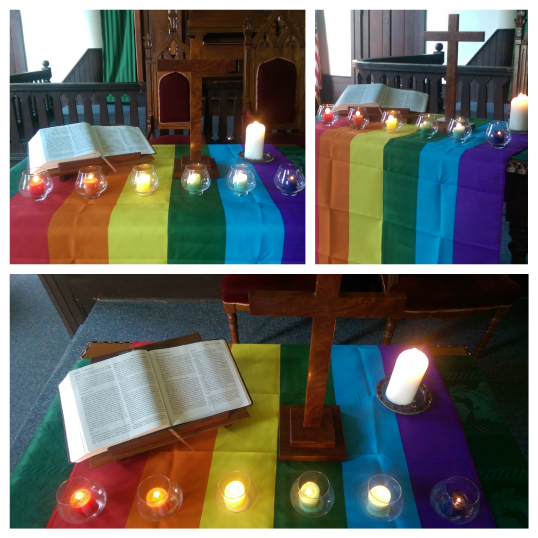
First Congregational Church UCC – Zumbrota, Minnesota

I’m sitting here trying to come up with something to say – some words of comfort, of defiance in the face of terror and evil and hate, of reassurance of God’s grace and everlasting love despite the staggering violence that occurred at the Pulse nightclub in Orlando, FL and all of the God-awful (and I really do mean God awful) words of hate-filled response spouted by other “pastors” in other parts of the country.

But I do not have the words.

And so I turn to Scripture: 7 Dear friends, let’s love each other, because love is from God, and everyone who loves is born from God and knows God. 8 The person who doesn’t love does not know God, because God is love. 9 This is how the love of God is revealed to us: God has sent his only Son into the world so that we can live through him. 10 This is love: it is not that we loved God but that he loved us and sent his Son as the sacrifice that deals with our sins. 11 Dear friends, if God loved us this way, we also ought to love each other. 12 No one has ever seen God. If we love each other, God remains in us and his love is made perfect in us. 13 This is how we know we remain in him and he remains in us, because he has given us a measure of his Spirit. 14 We have seen and testify that the Father has sent the Son to be the savior of the world. 15 If any of us confess that Jesus is God’s Son, God remains in us and we remain in God. 16 We have known and have believed the love that God has for us. God is love, and those who remain in love remain in God and God remains in them. 17 This is how love has been perfected in us, so that we can have confidence on the Judgment Day, because we are exactly the same as God is in this world. 18 There is no fear in love, but perfect love drives out fear, because fear expects punishment. The person who is afraid has not been made perfect in love. 19 We love because God first loved us. 20 If anyone says, I love God, and hates a brother or sister, he is a liar, because the person who doesn’t love a brother or sister who can be seen can’t love God, who can’t be seen. 21 This commandment we have from him: Those who claim to love God ought to love their brother and sister also. (1 John 4:7-21)

God is love, and love – not hate, not violence, not death, not fear – L.O.V.E. is from God.

To celebrate that love …
To send the message to the rest of the country and the rest of the world that love does indeed drive out fear …
To remind each other of the power and presence of that love …
To speak to that love for ALL PEOPLE …

We spoke the following litany and prayer in our worship service this past Sunday.

It focused on the violence done in Orlando, but also the other horrific and unacceptable acts of gun violence around the country. As we went through the litany, we lit candles to bring stronger and stronger light – the Light of the World – into the darkness.

So join us in our Litany Against Violence, our Prayer for Orlando (much of which came from the Right Reverend Stephen T. Lane, Episcopal Bishop of Maine)

A Litany Against Violence, A Prayer for Orlando
Opening Scripture: If I say, “Surely the darkness will cover me, and the light around me turn to night,” darkness is not dark to you, O Lord; the night is as bright as the day; darkness and light to you are both alike. – Psalm 139:11-12

Petitions:
Giver of Life and Love, you created all people … ALL PEOPLE … as one family and called us to live together in harmony and peace. Surround us – ALL of your beloved children – as we face the challenges and tragedies of gun violence – Aurora, Colorado; Charleston, South Carolina; Newtown, Connecticut; Littleton, Colorado; San Bernadino, California; Fort Hood, Texas; and, most recently, the Pulse Nightclub in Orlando, Florida.

Light red candle.

For our dear ones, for our neighbors, for strangers, and for those known to you alone,
Loving God,
Make us instruments of your peace.


Merciful God, bind up the wounds of all who suffer from gun violence – those wounded and in need of your healing, those left alone and grieving, those who’s emotional scars have them living in fear and anxiety and distress, and those who struggle to get through one more day. Bless them with your presence, and help them find hope.

Light orange candle.

For all whose lives are forever marked by the scourge of gun violence,
Loving God,
Make us instruments of your peace.

God Who Remembers, may we not forget those who have died – more than 53,000 people just last year! – in the gun violence that we have allowed to become routine. We especially lift up the 50 people who lost their lives in Orlando just a mere seven days ago. Receive them into your heart and comfort us with your promise of eternal love and care.

Light yellow candle.

For all who’s beautiful, God-given lives have been cut short by gun violence,
Loving God,
Make us instruments of your peace.


God of Compassion, we give you thanks for first responders – for police officers, firefighters, and EMTs, and all those whose duties bring them to the streets, the lobbies, the malls and the homes where the horror of gun violence takes place day after day. Give them courage and sound judgment in the heat of the moment, and grant them compassion for the victims.

Light green candle.

For those who risk their lives and their serenity as they rush to our aid,
Loving God,
Make us instruments of your peace.


God of Open Arms, we pray especially for the LGBTQ community as they process all of the pain, frustration, anger, and anguish of being targeted by this most recent and horrible attack. Help us to reach out to our brothers and sisters in ways most helpful to them – to be ears to hear their cries of sorrow and outrage, to be arms to surround them in a supportive embrace or to hold them up in a moment of overwhelming emotion, to be voices lifted in solidarity as we speak out against such raw and volatile hate. Let ALL PEOPLE see your love through us.

Light blue candle.

For all our LGBTQ brothers and sisters who feel abandoned, targeted, outraged, vulnerable, and in need of comfort,
Loving God,
Make us instruments of your peace.


God of Justice, help us, your church, find our voice. Empower us to change this broken world and to protest the needless deaths caused by gun violence – Aurora, Colorado; Charleston, South Carolina; Newtown, Connecticut; Littleton, Colorado; San Bernadino, California; Fort Hood, Texas; Orlando, Florida, and so many more. Give us power to rise above our fear that nothing can be done, and grant us the conviction to advocate for change.

Light purple candle.

For your dream of love and harmony,
Loving God,
Make us instruments of your peace.

God of Life,
God of Justice,
God of Healing,
God of Love,
Have mercy on us all.

We pray for the LGBTQ community around the world, but particularly here in this country we call home, as together we confront this devastating act of terror – the worst shooting massacre in 126 years. Our hearts are broken. Surround us with your Spirit of healing, your graceful presence in the midst of grief.

Save us from hate, from prejudice, from the ways we turn away from you and from each other. Embolden us to follow Jesus in crossing lines of hostility and suspicion, building bridges between neighbors, religions, and regions of your world. Save us from the contempt that leads to violence, and also the contempt that leads – in the wake of violence – to an even more fragmented, segregated, polarized world. Make us a people of faith, not fear.

And above all, save us from that most banal form of sin – the sin of numbness and weak resignation. Save us from accepting this as “the way things are.” Come, Holy Spirit. Breathe in us, inspire us, and wake us up — so we might renew our participation in your making “thy kingdom come, on earth as it is in heaven.”

Have mercy on us.
Save us.
Breathe in us.
Awaken us.
And make all things new.

And today, more than any other day, make us instruments of your peace and hope which you promised would pass all understanding.

In Jesus’ name, we pray.
Amen.

Sunday’s sermon: The Replacements

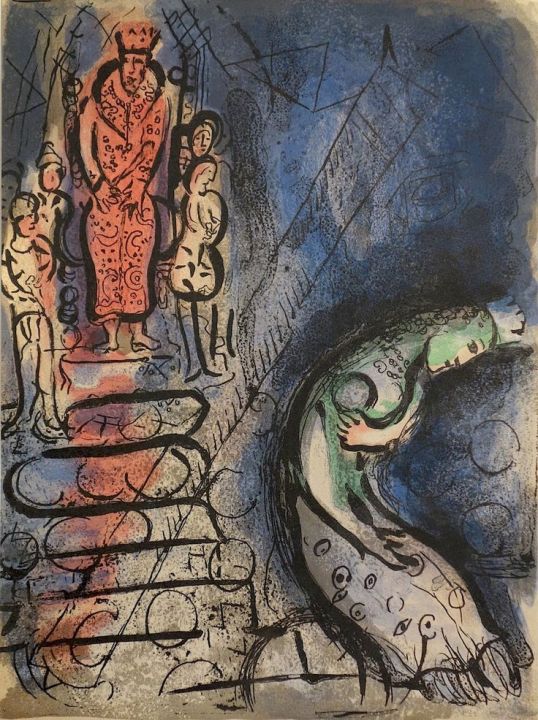
Esther Mordecai“Esther” by Marc Chagall, 1960

Text used – Esther 2:1-5, 7-9a, 16-20

  • Recap → spending the summer preaching through the book of Esther
    • About the book of Esther
      • Found in OT between Nehemiah and Job
      • Written in the late 3rd BCE
      • Written as a fictional story within a historical framework
        • Could have happened
        • Plausibility lends itself to teaching a lesson
      • Only book in the Bible that doesn’t actually mention God … at all
    • Story so far
      • Met King Ahasuerus
      • Met king’s eunuch’s (special servants)
      • Met Queen Vashti
      • Week-long party with non-stop wine service → King Ahasuerus calling for Queen Vashti so he could show off her beauty to his guests → Queen Vashti refused to come at the king’s beck and call → Vashti is stripped of her title and banished from the king’s site forevermore
      • And that is where we left it.
  • Today’s story:
    • Meet a couple more important characters
      • Esther (obvious … pretty important)
      • Esther’s cousin, Mordecai
        • Important character in Esther’s life – text: Mordecai had been a father to Hadassah (that is, Esther), though she was really his cousin, because she had neither father nor mother. The girl had a beautiful figure and was lovely to look at. When her parents died, Mordecai had taken her to be his daughter.[1]
        • Also important character in the story → I’m not giving anything away here, but much will hinge on Mordecai, his quick tongue, and his cleverness. So stay tuned …
    • However, before we get to meet Esther and Mordecai, we first catch up with King Ahasuerus in the predicament that he has placed himself in. – opening verse = a little melancholy: Sometime later when King Ahasuerus was less angry, he remembered Vashti, what she had done, and what he had decided about her.[2] → “Sometime later.” I have to wonder how much later this actually is. Remember, when King Ahasuerus became so enraged with Queen Vashti, he had been drinking wine non-stop for a week. Even though wine back in that time period wasn’t as alcoholic as it is today … even though King Ahasuerus was also feasting and therefore wasn’t drinking on an empty stomach … even if he was the biggest man in the world with the highest tolerance, there’s no way that after a week-long party like that, his judgment wasn’t at least slightly impaired when he was persuaded to banish his queen forevermore. And “sometime later,” when we pick up the story again today, he remembers.
      • Heb. “remembers” = loaded word → layers of meaning including acknowledgment and confession and acceptance
        • Same word often used throughout psalms when people are crying out to God to remember them in the midst of turmoil
          • Ps 25: LORD, remember your compassion and faithful love – they are forever![3]
          • Ps 89: Remember your servant’s abuse, my Lord! Remember how I bear in my heart all the insults of the nations,[4]
          • Ps 119: Remember your promise to your servant, for which you made me wait.[5]
        • Word that carries consequence and solemnity and the weight of contrition and repentance → In this way … in THIS way … King Ahasuerus remembers what he did to Vashti, “what he had done, and what he had decided about her.” And I have to wonder what went through King Ahasuerus mind when the gravity of his situation finally settled on him.
          • Let me ask a question: As a society, have we finally come to this point? This point of remembering with repentance? We have become so numb to all of these horrific acts of violence – as desensitized and unmindful as a week’s worth of wine. As a society, have we finally come to the point of confessing with contrition and, more importantly, with consequent actions that we have an epidemic of gun violence in this country? That we have come to idolize “my rights, my rights, my rights” so highly that we have neglected to acknowledge the rights of those being gunned down with “my rights”?
            • Not a question I can answer today
            • Question that we can begin to answer as the church together
              • Image going around social media in the wake of the shooting in Orlando last week – simple black background with two short sentences: “Lord, have mercy. Church, have courage.”
                • Courage to speak up
                • Courage to speak out
                • Courage to speak words of “no” and “enough” and “they shall beat their swords into plowshares and their spears into pruning hooks”[6]
  • Continuing with today’s Scripture story …
    • King Ahasuerus is persuaded (again) to seek out a new queen – text: So his young male servants said, “Let the king have a search made for beautiful young women who haven’t yet married. And let the king choose certain people in all the royal provinces to lead the search. Have them bring all the beautiful young women together … so that he might provide beauty treatments for them. Let the young woman who pleases you the most take Vashti’s place as queen.” The king liked the plan and implemented it.[7]
      • Hold-over from last sermon: notice King Ahasuerus is again not coming up with any plans of his own – king’s power is molded and manipulated by those around him → suggests fallibility and inconsequential nature of king’s power when compared to God’s steadfast and eternal power
    • Impression that this plan has on me = almost cartoonish!
      • Cartoon from a few years ago: “The Replacements[8] – orphaned brother and sisters who mail-ordered a phone from the back of a comic book that allowed them to replace anyone in their lives with someone they think would be better → In true cartoon fashion, these replacements never end up working out the way the children intend for them to work out, and they discover that solving their problems is never as easy as a simple replacement. And this plan that King Ahasuerus implemented sounds like cartoon to me!
        • Vashti = not really working out so well anymore
        • Call in the replacements!
    • Introduces us to both Esther and Mordecai → Now, in the description of these two central characters, the author reveals that Esther and Mordecai are Jews.
      • Little background/history lesson: Babylonian exile in 597 BCE → all the important, powerful, intelligent Jews carted off to live in Babylon → roughly 60 yrs. later, Babylon conquered by Persian empire → Jews allowed to return to Jerusalem → But not all of them chose to do so. After 60 years, some of them had built lives where they were, so they chose to stay. Esther and Mordecai were two of those Jews living as the minority in a foreign land.
  • Now, when it comes to the book of Esther, let me give you a little bit of warning. We’re going to encounter things that make us uncomfortable, things that just don’t sit quite right with us. That’s just part of Scripture. Sometimes there are things that we’re going to have to wrestle with, and the last part of our passage for this morning is one of those things – last verse of text: Esther still wasn’t telling anyone her family background and race, just as Mordecai had ordered her. She continued to do what Mordecai said, just as she did when she was in his care.[9]
    • As a woman: don’t love that Esther “continued to do what Mordecai said” → Where’s her own brain? Where’s her own will? Where’s her own heart and sense of self and empowered identity?
      • Realization: imposing 21st ideals for roles of women onto ancient story
    • More importantly: whole idea of Esther hiding her identity as a Jew – “her family background and race” – doesn’t sit comfortably
      • Again imposing 21st knowledge and freedoms onto ancient story → We live in a society that proclaims equal rights for all to life, liberty, and the pursuit of happiness. We life in a society that is hyper sensitive to individuality, to the point where there are a number of things that we don’t discuss in “polite conversation” (politics, religion, parenting choices, salaries, and so on). And yet …
        • Society in which there is still so much hate-speech directed toward LGBTQ community – even by elected officials[10] and pastors[11]! – that that hate-speech exploded into the violent act that we saw in Orlando last Sun.
        • Society in which people of color are routinely subjected to greater scrutiny whether they’re doing something as simple as walking down the aisle of a convenience store or driving a car
        • Society in which an entire religion has been so misconstrued and so vilified by the media, by public figures, and by certain presumptive presidential nominees that more than half of the American population has an unfavorable view of Islam[12]
          • Not a religion of violence
          • Not a religion that seeks to kill everyone who isn’t Muslim
          • Not a religion of intolerance and blind hatred
          • Statement  put out this week by the Islamic Institute of Minnesota[13]
          • Kareem Abdul-Jabbar’s statement – equating ISIS with all of Islam is like equating the KKK with all of Christianity
      • My point, friends, is that by our words, by our actions, by our legislation, by our sensationalized news reports, we tell people every day that they need to follow Esther’s example – to hide who they truly are in order to fit in, to assimilate as quickly and as seamlessly as possible for fear of being “found out.”
        • Jesus in gospel of John: I came so that they could have life – indeed, so that they could live life to the fullest.[14]
        • James: Brothers and sisters, don’t say evil things about each other. Whoever insults or criticizes a brother or sister insults and criticizes the Law. If you find fault with the Law, you are not a doer of the Law but a judge over it. There is only one lawgiver and judge, and he is able to save and to destroy. But you who judge your neighbor, who are you?[15] → As Christians, it’s not our job to run around pointing out all the perceived problems and missteps and sins in other people’s lives. It is our job to try to live like Jesus – a life of love, of compassion, a life of not shrinking the “accepted” circle but expanding it out to the margins … to those places where “proper society” refused to go. And a life that spoke out against intolerance, hatred, and fear. Lord, have mercy. Church, have courage. Amen.

[1] Est 2:7.

[2] Est 2:1.

[3] Ps 25:6.

[4] Ps 89:50.

[5] Ps 119:49.

[6] Is 2:4 (NRSV).

[7] Est 2:2-4.

[8]The Replacements (TV Series)” from https://en.wikipedia.org/wiki/The_Replacements_(TV_series). Last modified June 8, 2015, accessed June 18, 2016.

[9] Est 2:20.

[10] Scott Wong and Mike Lillis. “Bible verse prompts GOP walkout after LGBT vote labeled a sin” from The Hill, http://thehill.com/homenews/house/281437-bible-verse-launches-gop-meeting-spurs-walkout. Posted May 26, 2016, accessed June 19, 2016.

[11] “California pastor praises Orlando massacre” from http://www.usatoday.com/videos/news/nation/2016/06/15/85917730/. Accessed June 19, 2016.

[12] Jaweed Kaleem. “More Than Half of Americans Have Unfavorable View of Muslims, Poll Finds” from The Huffington Post, http://www.huffingtonpost.com/2015/04/10/americans-islam-poll_n_7036574.html. Posted Apr. 10, 2014, updated Apr. 10, 2015, accessed June 19, 2016.

[13] http://www.islamicinstituteofmn.com/.

[14] Jn 10:10.

[15] Jas 4:11-12.

Sunday’s sermon: An Ominous Beginning

Esther Vashti“Assérus Chasse Vashti” by Marc Chagall, 1960

Text used – Esther 1:1-3, 8-12, 14b-22

  • I decided that since it’s summer, I wanted to try something a little different for sermons. As you all know, I’ve done a number of sermon series before, but I’ve never preached straight through a particular book of the Bible – front to back, cover to cover, end to end. Straight through. I thought it could make for an intriguing summer, so I started thinking about which book we could tackle over the next few months. → had to be …
    • Relatively short – btwn. various absences and other things (joint service in Aug., for example), it had to fit into 9 weeks  cuts out books like Genesis and Acts (too long!) but also Jude (too short!)
    • Something sort of interesting – something we may not have heard a lot from in the past  steered me toward the OT as opposed to the NT
      • Certainly stories in the NT that we aren’t super familiar with, but I think it’s safe to say there are more of them in the OT
    • And I wanted it to be something a little bit challenging – something that was going to make me think a little bit. And so I settled on … Esther.
      • Short … but not too short
      • OT book – last of the historical books (Genesis through Esther)
      • Book that we don’t hear often
        • Revised Common Lectionary: assigned series of Scripture readings for each Sunday used by a number of different denominations à goes through much of the Bible on a 3-yr cycle
          • 4 readings for each Sun.: OT, Psalm, Gospel, NT
        • Only bits of Esther that show up in RCL = a few short verses from chs. 7 and 9 – 1 little reading on 1 day in a 1095 day cycle … That’s all we get.
  • But there’s so much more to Esther’s story than just those few verses can tell! You see, Esther is this odd little book in the Old Testament that tells the story of Esther, Haman, King Ahasuerus, and Mordecai. It’s a captivating story of deception and intrigue.
    • Commantery description: It contains all the elements of a popular romance novel: a young and beautiful heroine; a wicked, scheming villain; a wise older father figure; and an inept and laughable ruler. … Beneath its lighthearted surface, however, the book of Esther explores darker themes: racial hatred, the threat of genocide, and the evil of overweening pride and vanity.[1]
  • Background for Esther
    • From intro to Esther in the New Oxford Annotated Bible[2]
      • “Esther is not a work of history but a historical novella, that is, a fictional story within a historical framework.”
        • E.g. – 1st verse of this morning’s Scripture: This is what happened back when Ahasuerus lived, the very Ahasuerus who rules from India to Cush – one hundred twenty-seven provinces in all.[3]  Sounds official. Sounds accurate. Sounds historical, right? Except that there was no Persian king known as Ahasuerus. There are a number of kings that this could be, but no one knows for sure. A fictional story within a historical framework.
      • Written in late 4th BCE
      • Hotly contested throughout the centuries  You see, Esther happens to be the only book in the Bible in which God is not actually involved on an active level. In fact, God isn’t even mentioned. Not one time.
        • Not fully accepted into Jewish canon of Scripture until 3rd CE – roughly 600 years after it was written
        • Protestant reformer Martin Luther wished it had never been written
      • So what does this ancient story of royal romance and political conspiracy have to tell us about our faith? That’s what we’re going to spend the summer figuring out.
  • Today, we get the story set-up.
    • Character introductions
      • King Ahasuerus
      • Queen Vashti
      • Eunuchs – typical servants of queens in ancient times because there was no need to worry about indiscretions/infidelity
        • Eunuchs = male servants who had been neutered, so there’s no danger of any inappropriate royal hanky panky
    • Also cultural introduction – story begins with dueling extravagant feasts and week-long celebrations (King Ahasuerus’ vs. Queen Vashti’s), endless supply of wine – “as much as each guest wanted,” and an intended showing-off of the queen’s beauty (and, by association, the king’s wealth in her jewels, robes, and other beautifying agents used on her such as perfumes, oils, etc.)
      • Introduces dual cultures: Persian (written about) vs. Jewish (doing the writing/initial reading)
      • Scholar: Through the description, we get a glimpse of the Persian character: ostentatious, showy, unbridled. This is in direct contrast to the usual Jewish values of modesty and self-restraint. Although disapproval is never directly voiced, the message is clear: Such opulence, while immediately awe-inspiring, hides an empty and probably corrupt core.[4]
    • Final introduction – two important themes that will run throughout book of Esther
      • Role/status of women
      • Power – the misuse and abuse of power, the shifting of power, implications of God’s power
  • The role and status of women is certainly not a new theme within the Bible. In fact, this theme is a bit of a roller coaster throughout Scripture.
    • Strong, powerful women of the Bible
      • Deborah[5] – only female judge who led a successful military counterattack against the Canaanite army in book of Judges
      • Ruth – greatest daughter-in-law of all time who leaves her homeland, her people, and everything she knows to follow her mother-in-law and ends up not only caring and providing for her mother-in-law but also contributing to the lineage of the Messiah
      • Mary Magdalene – woman who struggled with not just one but seven demons until Jesus cast them out of her[6]; chose to follow Jesus along with a few other women; remained with Jesus to the very end, kneeling at the foot of the cross (again with a few other women and the beloved disciple) even after all the other disciples had fled; was one of the first to the tomb to discover the resurrection and the first to spread the news
    • Flip side: oppressed and mistreated women of the Bible
      • Hagar[7] – Sarah’s servant who is first forced to give herself to Abraham to produce an heir (Ishmael) when Sarah is unable to get pregnant and later abused and banished for having that very same heir after the birth of Abraham and Sarah’s son, Isaac
      • Leah[8] – Laban’s oldest daughter; “the bride that nobody wanted;” Laban tricks Jacob into marrying Leah first before he is allowed to marry her younger, prettier sister, Rachel; continues to suffer resentment and mistreatment as she is able to bear Jacob’s children while Rachel remains barren
      • Hemorrhagic woman[9] who approaches Jesus for healing – powerful stigma of her bleeding disorder kept her shunned and isolated for more than 30 years, so much so that she felt she wasn’t even worthy of any of Jesus’ time, just a hasty and superficial brush of her fingers on the fringe of his garments
    • And in our Scripture reading this morning, Queen Vashti could fall under both of these categories.
      • Strong and powerful in her denial of King Ahasuerus rude and demeaning demand: [Queen Vashti] was gorgeous, and [the king] wanted to show off her beauty both to the general public and to his important guests. But Queen Vashti refused to come as the king had ordered through the eunuchs.[10]
      • Because of that assertion of power, oppressed and mistreated – after her refusal, eunuch to the king: “[The royal order] should say that Vashti will never again come before King Ahasuerus. It should also say that the king will give her royal place to someone better than she. When the order becomes public through the whole empire, vast as it is, all women will treat their husbands properly.” … The king liked the plan, as did the other men, and he did just what [the eunuch] said.[11]
  • In this interaction, we get a glimpse of one of the many places that faith is implied in Esther.
    • You see, King Ahasuerus has the power to dethrone his queen and basically banish her for the rest of her life. – powerful punishment because women had no way of providing for themselves in this society  If she had no other family to return to – no surviving male relative such as her father, a brother, an uncle, etc. – Vashti would have had to resort to begging on the street in order to survive. That’s the power of the king.
    • However, the idea to dethrone and banish Vashti didn’t actually come from the king. It came from one of his advisors! One of the eunuchs on his court.  regular occurrence throughout Esther – learn that King Ahasuerus is a high suggestible man, other people always telling him what to do
      • This implies that King Ahasuerus power is fleeing – that it is weak, that his rule is a sham because he’s so heavily influenced by those around him that he’s not really the one making the decisions. And in this implication of the king’s frivolous and phony power, the writer of Esther was relying on the reader’s knowledge that God’s power is greater.
        • Not subsequent to the suggestions and manipulations of others but omnipotent
        • Not fleeting as King Ahasuerus rule surely will be in the grand scheme of things
        • Not fickle or petty or vindictive like King Ahasuerus power
      • In contrast to King Ahasuerus, the God that the readers know – those who read it for the first time and we who read it today, is an almighty and everlasting God, a God of justice and mercy who gathers in those who have been tossed out by society.
        • Knowledge that we readers will need as we continue through the rest of Esther’s story
          • Injustices
          • Evil dealings
          • Violent actions
        • Knowledge that carries us through our days as well
          • Our own injustices
          • Our own day-to-day dealings that frustrate and hurt and anger and challenge us
          • In the face of all of the terrible things that we see in the world – war, oppression, starvation, abuse, neglect, bullying, poverty, and so much more – we carry with us the reassurance that God is stronger. God is compassionate. Unlike King Ahasuerus, whose only desire was for a good party and to impress his guests – whose need to assert his power and dominance ended up costing him his beautiful queen … unlike this vain and volatile king, God’s heart cries out for justice and mercy and care for all creation. Amen.

[1] Sidnie White Crawford. “The Book of Esther: Introduction, Commentary, and Reflections” in The New Interpreter’s Bible Commentary series, vol. 3. (Nashville, TN: Abingdon Press, 1999), 855.

[2] “Introduction to Esther” in The New Oxford Annotated Bible: New Revised Standard Version with the Apocrypha, 3rd ed. (New York City, NY: Oxford University Press, Inc., 2001), 708-709.

[3] Est 1:1.

[4] Crawford, 880.

[5] Judges 4.

[6] Lk 8:2.

[7] Genesis 16.

[8] Genesis 29.

[9] Mk 5:25-34.

[10] Est 1:11b-12a.

[11] Est 1:19b-20a, 21.

Sunday’s sermon: Wriggling Faith

like a child

Texts used – Isaiah 40:27-31 and Mark 10:13-16

  • Last week, a pastor at Grace Lutheran Church, an ELCA Lutheran Church up in Apple Valley, posted a photo album on Facebook. This album contained 19 pictures, all celebrating the 1-year anniversary of a new initiative in their congregation: The Pray-Ground.[1]
    • Describe Pray-Ground
      • Roughly size of a large area rug
      • Lots of small tables and chairs and other furniture necessary for tiny tots – Bumbo seats, bouncy chairs, etc.
      • Also lots of toys and art supplies (chalkboard easels, foam blocks, play food made out of felt, infant playmats) for young children
    • Post included a number of pictures of lots of different kids taking full advantage of everything the Pray-Ground has to offer with their parents watching in background
    • Also included in post – pics of laminated cards that introduce first-time visitors to the purpose of the Pray-Ground: “This space in the front of the Sanctuary is intended especially for families with infants and toddlers, recognizing that small kids are often more engaged when they can see what’s going on. Small tables and chairs, baby bouncers and seats, and soft toys help keep our littlest ones occupied.” → Yes … you heard me right. This wonderful play space designed so deliberately and so lovingly is located in the sanctuary. Right up front. Just to the left of the pulpit. Visible from almost every seat in the sanctuary. The children. And not just the perfect, older, well-behaved children. The littlest. The squirrliest. The often-challenging-and-headstrong. Infants. Two year olds. Three year olds. Lord, have mercy!
    • Response to this post = VIRAL!! → In the short amount of time since this album was posted, it’s garnered more than 600 comments … more than 3600 likes (which, if you aren’t familiar with social media, is A LOT!). Thousands of people around the country have shared these pictures and this idea. It’s garnered so much attention that national ABC News did a story on the church and their Pray-Ground.
    • Why am I bringing this up this week?
      • Has nothing to do with my own children
      • Not a pitch – not me saying “this is what I think we have to do”
      • I’m bringing it up this week because last week was Pentecost – the birthday of the church, the great in-breaking of the Holy Spirit, the scattering of the gospel message to lands and nations and cultures and tongues who may never have heard it if our God was a God who was content to sit still and quiet.
        • Divine Disturber
        • Holy Hellraiser
        • Spirit of Light and Fire
        • Spirit of Rushing Wind and Sacred Water
        • Spirit of Lifting Up and Sending Out
    • In the creation of this Pray-Ground, Grace Lutheran Church in Apple Valley not only recognized the reality of the wiggle and the squirminess of children but validated that as something that can be worshipful, something that can be sacred, something that can offer us a glimpse of God that we may have forgotten how to look for in the hustle and bustle and seriousness of our day-to-day lives. Friends, our faith was never meant to be a faith that was seen and not heard, that sat still and pretty and prim and proper. Our faith was never meant to be a faith that doesn’t make waves, doesn’t rock the boat, doesn’t challenge or disturb or upset the balance. We are only a week removed from Pentecost – the day in which God came down in tongues of fire and the rush of holy wind and settled on the people and loosed their tongues and SENT. THEM. OUT. !!! Our faith is meant to look a lot less like the perfectly quiet child sitting in the pews and a lot more like the child who is bouncing and wriggling, eager and impatient to get out into the world and explore … experience … do … and be!
  • That’s why I love this story out of gospel of Mark
    • Passage: People were bringing children to Jesus so that he would bless them. But the disciples scolded them. When Jesus saw this, he grew angry and said to them, “Allow the children to come to me. Don’t forbid them, because God’s kingdom belongs to people like these children. I assure you that whoever doesn’t welcome God’s kingdom like a child will never enter it.” Then he hugged the children and blessed them.[2] → I love to picture this scene in my head. Maybe I’m just projecting here, but something tells me it looked a lot less like a picturesque scene out of a Normal Rockwell painting and a lot more like the chaotic exuberance you find in the “pictures with Santa” line at the mall at Christmas time.
      • Parents holding children ⟷ children not wanting to be held
        • Lots of movement
        • Lots of noise
        • Lots of laughter and tears
        • Lots of stressed out parents just trying to get their kids to sit still for 30 seconds so they could get their blessing from this Jesus guy that everyone kept talking about
          • (As a mom with two 3-yr-olds at home, this sounds like any given moment in our lives. Like I said … maybe I’m projecting here … I don’t know!)
      • FLIP SIDE: not hard to imagine the disciples’ response either: People were bringing children to Jesus so that he would bless them. But the disciples scolded them.[3]
        • Contextual background: role of disciples in Mark’s gospel = a little bit stooge-like → completely oblivious
          • Always giving the answer wrong
          • Always missing the point
          • Always misunderstanding what Jesus was trying to tell them
          • Today’s story = no different
        • Disciples scolded these parents seeking blessings
          • “The Teacher is too busy.”
          • “The Teacher is too important.”
          • “The Teacher is too tired.”
          • “The Teacher doesn’t have time for the likes of you.”
            • A little more contextual background: role of children in society = non-existent → Today, we recognize and value the importance of childhood experiences. We understand how our childhood shapes who we are and who we become, and we place great value on nurturing things like individuality, creativity, self-worth, and so on. But this was not the case in any society during Jesus’ time. Children were non-entities. They held zero importance. None whatsoever. They weren’t despised or intentionally neglected (not on the whole, anyway). They simply weren’t considered … at all. So for people to be bringing their children to Jesus for a blessing was, in the eyes of the disciples, a ludicrous waste of Jesus’ precious time and energy.
    • AND YET!! What does Jesus tell the disciples?: “Allow the children to come to me. Don’t forbid them, because God’s kingdom belongs to people like these children.” … Then he hugged the children and blessed them.[4] → “God’s kingdom belongs to people like these children.” People like these children … people who love with the unabashed and uninhibited love of a child … people who seek out the wonder and the beauty and the joy in the world just like a child … people who are open and willing to learn and grow and change and transform just like a child … people who aren’t afraid to trust and hope and dream and believe … people who find movement – running and wriggling and dancing and skipping – an essential way of being in this world. “God’s kingdom belongs to people like these children.”
  • “But,” you may say to me, “we are tired. We are older and grayer and slower than we used to be. We have done this and tried that. We cannot see that future. We cannot hold that dream in our hands. We can’t … we can’t … we can’t.”
    • Words from Is again: The Lord is the everlasting God, the creator of the ends of the earth. [God] doesn’t grow tired or weary. [God’s] understanding is beyond human reach, giving power to the tired and reviving the exhausted. Youths will become tired and weary, young men will certainly stumble; but those who hope in the Lord will renew their strength; they will rise up on wings like eagles; they will run and not be tired; they will walk and not be weary.[5] → I want to share another part of the Pray-Ground story with you. There were a lot of positive responses to this idea – hundreds and hundreds (if not thousands) of people applauding this church and expressing excitement about doing something similar in their own worship settings. But … there were plenty of negative comments, too. One person went so far as to declare that having children in church was “the devil’s work” because they provided a distraction from the worship.
      • As adults, we often forget …
        • Forget to look for the sparkle that the world has to offer
        • Forget the true magic of possibilities – endless and unbounded
        • Forget that life is not all about “no”s and “not yet”s and “maybe”s and hedged bets and roadblocks and hurdles and blind corners
        • Part of growing up and becoming an adult is understanding serious things like consequences and risk assessments and data analysis and all those grown up-type things. But too often, in our own lives and especially in the life of the church, we let the weight and gravitas of those parts of life overshadow the wonder, the joy, the possibilities, the spark and the sparkle. We have become so used to being responsible – being in charge – that we forget that ultimately, we are not We are not in charge. → The Lord is the everlasting God, the creator of the ends of the earth. [God] doesn’t grow tired or weary. [God’s] understanding is beyond human reach, giving power to the tired and reviving the exhausted. Youths will become tired and weary, young men will certainly stumble; but those who hope in the Lord will renew their strength; they will rise up on wings like eagles; they will run and not be tired; they will walk and not be weary.[6]
    • Theological and liturgical confession: today is Trinity Sunday = Sunday that is supposed to be devoted to celebrating the doctrine of the Trinity
      • God in three persons: Father, Son, Holy Spirit; Mother, Child, Holy Spirit; Creator, Redeemer, Sustainer … whatever language you choose for the three persons of Almighty God
      • Traditionally a Sunday of serious theological pondering and pithy word-smithing (plethora of scholarly work devoted to how to adequately and inclusively name the three persons of the Trinity without diminishing theology) and frankly dizzying doctrinal acrobatics
      • And while the importance of the Doctrine of the Trinity certainly has its place within the grand scheme of our faith and the Church universal, Jesus didn’t say, “God’s kingdom belongs to those who can work out this humdinger of a theological puzzle”! Jesus said, “God’s kingdom belongs to people like these children.” Jesus didn’t say, “God’s kingdom belongs to those who can sit perfectly still and silently in church because only the person up front is allowed to make a peep.” Jesus said, “God’s kingdom belongs to people like these children. With all their messiness; with all their giggles and skinned knees; with all their exuberance and joy; in their grass-stained jeans and baseball hats, in their chalk-smeared leggings and smudged princess dresses; with all their color and brightness and sparkle and confidence. Allow the children – all the children, just as they are – to come to me.” Thank you, Jesus! Amen.


[1] “Grace Lutheran Pray-Ground, year 1” album on Facebook from Grace Lutheran Church of Apple Valley, https://www.facebook.com/media/set/?set=a.1042935625753136.1073741834.101782736535101&type=3. Last updated May 14, 2016, accessed May 20, 2016.

[2] Mk 10:13-16.

[3] Mk 10:13.

[4] Mk 10:14, 16 (emphasis added).

[5] Is 40:28-31.

[6] Is 40:28-31 (emphasis added).

Another (past) sermon: Keep On Keeping On

I was going through papers in my briefcase (also known as my “traveling office” … yes, that’s how much stuff is in it!), and I found my sermon from a few weeks ago. I realized I hadn’t posted it yet, so here’s my sermon from May 8, 2016.

Side note: I ended up sick as a dog on Pentecost – Sun., May 15 – so there’s no sermon from last Sunday.

keep on keeping on

Texts used – Ephesians 1:15-23 and Acts 1:1-11

  • What a rollercoaster few weeks it’s been for the poor disciples, right?! Just a few short weeks ago, their beloved teacher … mentor … leader … friend … died a shameful, slow, and painful death on a cross. Then, a couple days later … he was back! The tomb was empty! The grave clothes were cast aside! He is risen indeed! And then he appeared to them in all sorts of strange and wonderful ways: hanging out with Mary Magdalene in the garden when he was fresh out of the tomb, popping up in locked rooms to reassure his disciples, displaying his wounds as hard evidence for all to see, walking incognito along the road to Emmaus, and showing up on the worst fishing day ever with the greatest catch of all time and breakfast on the beach. Crazy, right?! And it all culminates in our story from Acts this week.
    • Again, sitting down to a meal together
    • Again, presents disciples with unexplained instructions: While they were eating together, he ordered them not to leave Jerusalem but to wait for what the Father had promised. He said, “This is what you heard from me: John baptized with water, but in only a few days you will be baptized with the Holy Spirit.” As a result, those who had gathered together asked Jesus, “Lord, are you going to restore the kingdom to Israel now?” Jesus replied, “It isn’t for you to know the times or seasons that the Father has set by his own authority. Rather, you will receive power when the Holy Spirit has come upon you, and you will be my witnesses in Jerusalem, in all Judea and Samaria, and to the end of the earth.”[1] → Now, frequently throughout the gospels – both before and after his death, Jesus gave the disciples faith-and-life lessons wrapped in bizarre-sounding instructions.
      • E.g. – He said to them, “Go into the village over there. As soon as you enter, you will find a donkey tied up and a colt with it. Untie them and bring them to me. If anybody says anything to you, say that the Lord needs it.” He sent them off right away.[2]
      • E.g. – When they came to Capernaum, the people who collected the half-shekel temple tax came to Peter and said, “Doesn’t your teacher pay the temple tax?” “Yes,” he said. But when they came into the house, Jesus spoke to Peter first. “What do you think, Simon? From whom do earthly kings collect taxes, from their children or from strangers?” “From strangers,” he said. Jesus said to him, “Then the children don’t have to pay. But just so we don’t offend them, go to the lake, throw out a fishing line and hook, and take the first fish you catch. When you open its mouth, you will find a shekel coin. Take it and pay the tax for both of us.”[3]
      • And today is no different. Jesus inexplicably tells the disciples to stay put – to “wait for what the Father has promised,” to “receive power when the Holy Spirit has come upon you.” → advertisement for next week: Jesus = foreshadowing Pentecost
        • Often think of foreshadowing in terms of its use by the Kings of Suspense – Alfred Hitchcock and Stephen King → use it to build up tension and fear to the breaking point for the purpose of telling a great story
        • But there’s another side to foreshadowing: Foreshadowing can make extraordinary and bizarre events appear credible as the events are predicted beforehand, so that [we] are mentally prepared for them.[4] → In this passage, we find Jesus’ attempt to mentally and spiritually prepare the disciples for the truly extraordinary and bizarre event that is Pentecost, to add a measure of credibility to what will be a crazy in-breaking of the Holy Spirit.
  • But I think it’s safe to say that the disciples where wholly unprepared for what happened next! – text: After Jesus said these things, as they were watching, he was lifted up and a cloud took him out of their sight.[5] → What?! One minute, they were eating another pleasant meal with Jesus, listening to him and trying to follow whatever it was he was saying about the coming of the Holy Spirit … and the next minute, he’s being lifted up into heaven! Again … what?! As I said, the disciples have quite a rollercoaster ride, don’t they?
    • We can only imagine what this looked like
      • No mention of the chariot and horses of fire that took prophet Elijah up into heaven[6] → Jesus is simply “taken up”
      • Looked up famous artistic depictions of this passage – almost all (no matter time period in which they were created) have Jesus levitating feet above the heads of the disciples with his arms stretched out to the sides à la Charlie after he’s consumed the Fizzy Lifting Drinks in “Willy Wonka and the Chocolate Factory”[7] → Jesus’ face in these depictions is always composed, serene, beneficent, full of love and reassurance and purpose. But the disciples’ faces tell another story. They are astonished. They are afraid. They are confused. They are pleading. They are distraught. They are all five stages of grief – denial, anger, bargaining, depression, and acceptance – in one fell swoop. Because in their minds, the disciples are losing Jesus all over again.
        • Imagine the confusion of this scene
        • Imagine the anxiety of this scene
        • Imagine the heartbreak of this scene
        • Anytime we have to say goodbye to someone, it’s hard. We spend weeks … months … even years processing that loss. We have conversations with our deceased loved ones. We continue to mark their birthday every year as well as the anniversary of their death. We encounter them in dreams. We imagine what they would say about this new path or that life decision. They remain with us in ways that we can never anticipate in that horrible, shocking moment of loss.
          • Story of losing my cousin Julie at age 22 to double pulmonary embolism – hearing her favorite song “Time to Say Goodbye” during UDTS “Explore Your Call” weekend → I knew. I just knew. Dubuque was where I was supposed to be.
        • We who have the privilege of “reading ahead” – of knowing the full story of Scripture – we know that life and other incredible faith experiences await the disciples just around the corner. But in the moment captured in our Scripture reading this morning, the disciples are caught up in their loss. One minute, they were eating another pleasant meal with Jesus, and the next minute, he’s being lifted up into heaven. He’s gone … again.
  • Enter the angels – text: While he was going away and as they were staring toward heaven, suddenly two men in white robes stood next to them. They said, “Galileans, why are you standing here, looking toward heaven? This Jesus, who was taken up from you into heaven, will come in the same way that you saw him go into heaven.”[8]
    • Probably one of the most important questions in Scripture: “Galileans, why are you standing here, looking toward heaven?”
      • Other translations
        • The Message – “You Galileans! – why do you just stand here looking up at an empty sky?”
      • This is the crucial question because it reminds the disciples that there is still work to be done. Even in the face of Jesus’ sudden absence, even in the midst of whatever complex emotions and worries and questions and doubts and fears are running through their heads, these “two men in white robes” (as our text called them) remind the disciples that the moment has passed. The sky above them is, in fact, empty. By continuing to stare at that empty space – that space where Jesus used to be – they are allowing themselves to dwell in the past when there is a future of Holy-Spirit-work just ahead of them. They’ve simply got to redirect their gaze.
  • Sometimes, as the church, we can get stuck with a misdirected gaze just like the disciples.
    • Inward focus – too worried about our internal working, our internal politics, our internal day-to-day business → forget to look for the Holy-Spirit-work in the world around us
      • Where are we needed?
      • Where is God calling?
      • How is God still speaking not just to us but through us?
    • Pinhole focus – too focused on serving and drawing in one specific group of people (“young people,” young families) → forget that there are all sorts of people out there in all shapes, sizes, age ranges, and backgrounds who are seeking a way to God
      • g. – so many recent articles/blog posts about “reaching millennials”: how to get them back into the church, how to make church interesting/exciting/relevant/appealing to them
        • First problem with this: most millennials who have actually consulted about this couldn’t care less about all the bells and whistles → searching for authentic community … period
        • Second problem with this: ignores a gigantic portion of the population → There are more than just millennials searching for God.
      • Who can we welcome?
      • Who have we forgotten to welcome?
      • Where in our community is God directing our gaze?
    • Past focus – too caught up in what we used to be: numbers, programming, budgets, activities → forget the faith is an ever-evolving, ever-changing thing and that our job as the church is to continue to evolve and change, too
      • Who we were continues to inform and enrich our life as the church today, but we cannot go back and be the church of the 1950s … the church of the 1990s … the church of whatever “golden era” you choose because that is not the world we live in today.
      • What have we tried that’s new?
      • Where can we go that’s different?
      • Who are we today and who are we becoming (intentionally or unintentionally)?
  • We know that the story wasn’t over for the disciples. After Jesus’ ascension into heaven, they didn’t slowly fade back into the lives they had before he showed up – fishing, collecting taxes, being unassuming people with ordinary lives. Pentecost is right around the corner – an event that will shake things up like never before and disperse the Good News about God’s love and grace to the whole world … the same Good News that we believe and carry and proclaim today!
    • Encouragement in the message/the work for the message from Eph passage – Paul: I pray that the eyes of your heart will have enough light to see what is the hope of God’s call, what is the richness of God’s glorious inheritance among believers, and what is the overwhelming greatness of God’s power that is working among us believers. This power is conferred by the energy of God’s powerful strength. … God put everything under Christ’s feet and made him head of everything in the church, which is his body. His body, the church, is the fullness of Christ, who fills everything in every way.[9] → “I pray that the eyes of your heart will have enough light to see what is the hope of God’s call” … God’s call for your life, God’s call for that special work that God has for you to do in this world, and God’s call for this church. Sometimes, in our own lives and in the life of the church, we get caught up in what was. Our eyes get locked on the wrong place – the empty place, the “used to be” place” – and we forget to look forward and outward for God to move in our midst. So let us look not for what was but for what can be. Let us look not for the familiar but the hoped-for. Let us redirect our gaze toward God’s amazing future and whatever part we have to play in it. Amen.


Charge & Benediction
Whatever discouragement you’re feeling – whatever is holding you back or holding you down – in your own life or in the life of this church, along with Paul, I pray that your heart will have enough light to see what is the hope of God’s call.

* And may that great God of HOPE fill you with all joy and peace in believing so that you may abound in hope by the power of the Holy Spirit. Amen.*

[1] Acts 1:4-8.

[2] Mt 21:2-3.

[3] Mt 17:24-27.

[4] “Foreshadowing” from Literary Devices: Definition and Examples of Literary Devices website, http://literarydevices.net/foreshadowing/. Copyright 2016, accessed May 7, 2016.

[5] Acts 1:9.

[6] 2 Kgs 2:1-12.

[7] Roald Dahl (book and screenplay). Willy Wonka and the Chocolate Factory, released June 30, 1971 by Warner Bros.

[8] Acts 1:10-11.

[9] Eph 1:18-19, 22-23.

May newsletter piece

summer activities

The summer months are here. And despite all the contemporary country songs about relaxin’ in the sun during the summertime, let’s face it:

Summer
Is
BUSY!

Maybe it has something to do with the fact that, since we live in such a frigid climate, we become a little outdoor-activity crazed when the temperature finally (and sometimes reluctantly) climbs above 50°F.

Maybe it has something to do with being in desperate need of some serious sunshine and vitamin D to drive away the gloominess and greyness of the winter months.

I’d venture to say it most definitely has something to do with the fact that we feel the need to pack as much as we possibly can into those few months when our kids/grandkids/nieces & nephews/school-employed spouses are out of school.

Maybe it even has something to do with holdover feelings from our own school days. Summer is supposed to be about vacation and fun and freedom and doing, right?

Sure.

But if we’re not careful, we can let all of those wonderful plans and intentions become such a driving force that before we know it, summer’s gone, and we’re left standing and wondering, “Wait a minute … what happened?”

So this summer, I encourage you to take some time to find your own peace wherever you can.

In his letter to the Christians in Rome, Paul says:

God’s kingdom isn’t about eating food and drinking but about righteousness, peace, and joy in the Holy Spirit. Whoever serves Christ this way pleases God and gets human approval. So let’s strive for the things that bring peace and the things that build each other up.
~ Romans 14:17-19, Common English Bible

There are all sorts of different ways that we can find our peace. Some people enjoy working outside in their gardens, feeling the dirt in their hands and watching their beautiful plants grow. Some love to curl up under a tree or in a comfortable deck chair with a good book (be you an e-reader devotee or a “real book” holdout). Some have a sport or a hobby that brings them enjoyment and peace: volleyball, golf, photography, geocaching, swimming, etc. Some like to go for a walk, either alone or with a pet or with family and friends. And some people like to just sit in the quiet – inside or outside – and listen and breathe and simply be.

We have a few different ways that we get to do this together as congregations this summer, both in play and in service. We can serve together at the Dorothy Day House, at the new Habitat for Humanity builds in Cannon Falls and Red Wing, and at Feed My Starving Children. And when we feel like we’re in need of connection and fellowship with one another, we can gather for the monthly campfires (2nd Sun. in Zumbrota and 4th Sun. in Oronoco, both from 7:00-8:00 p.m.), Peace Camp, our joint worship service at the Goodhue County Fair in August, and our joint Minnesota Twins outing on Sept. 1.

Whatever plans your summer holds, I share Paul’s hope and prayer for you: Strive for that kingdom of God – that righteousness, that peace, that joy. Strive for what brings peace and builds up. Amen.

Pastor Lisa sign


Sunday’s sermon: Edged Out

do you want to get well

Texts used – Psalm 67 and John 5:1-9 (in sermon text)

  • When I was a kid, there was this recurring segment on Sesame Street. – “One of these things is not like the other”
    • Had a little song that went with it: “One of these things is not like the other. One of these things just doesn’t belong. Can you tell which one is not like the other before I finish my song?”
    • Point of the short segment = helping kids with grouping → recognizing things that are similar and things that are dissimilar
      • E.g.s – put up a picture of
        • 3 large circles and 1 small circle
        • A hammer, a saw, a pliers, and a shoe (3 tools, 1 “other”)
      • Certainly made an impact on all of us avid Sesame Street watchers → became a cult classic reference for people of a certain generation J – frequently works its way into conversations
    • This morning, we’re going to engage in our own version of “One of these things is not like the other.” Let’s call it “One of these healings is not like the other.”
  • HEALING #1 – Jairus’ daughter: Jairus, one of the synagogue leaders, came forward. When he saw Jesus, he fell at his feet and pleaded with him, “My daughter is about to die. Please, come and place your hands on her so that she can be healed and live.” So Jesus went with him. … [Before they arrived], messengers came from the synagogue leader’s house, saying to Jairus, “Your daughter has died. Why bother the teacher any longer?” … They came to the synagogue leader’s house, and he saw a commotion, with people crying and wailing loudly. [Jesus] went in and said to them, “What’s all this commotion and crying about? The child isn’t dead. She’s only sleeping.” They laughed at him, but he threw them all out. Then, taking the child’s parents and his disciples with him, he went to the room where the child was. Taking her hand, he said to her, “Talitha koum,” which means, “Little girl, get up.” Suddenly the young woman got up and began to walk around.[1]
  • HEALING #2 – Two blind men at Capernum: As Jesus departed, two blind men followed him, crying out, “Show us mercy, Son of David.” When he came into the house, the blind men approached him. Jesus said to them, “Do you believe I can do this?” “Yes, Lord,” they replied. Then Jesus touched their eyes and said, “It will happen for you just as you have believed.” Their eyes were opened. Then Jesus sternly warned them, “Make sure nobody knows about this.” But they went out and spread the word about him throughout that whole region.[2]
  • HEALING #3 – Sick man at Bethsaida (today’s Scripture): After this there was a Jewish festival, and Jesus went up to Jerusalem. In Jerusalem near the Sheep Gate in the north city wall is a pool with the Aramaic name Bethsaida. It had five covered porches, and a crowd of people who were sick, blind, lame, and paralyzed sat there. A certain man was there who had been sick for thirty-eight years. When Jesus saw him lying there, knowing that he had already been there a long time, he asked him, “Do you want to get well?” The sick man answered him, “Sir, I don’t have anyone who can put me in the water when it is stirred up. When I’m trying to get to it, someone else has gotten in ahead of me.” Jesus said to him, “Get up! Pick up your mat and walk.” Immediately the man was well, and he picked up his mat and walked. Now that day was the Sabbath.[3]
  • “One of these things is not like the other. One of these things just doesn’t belong. Can you tell which one is not like the other before I finish my song?” There are a lot of things about these threehealing stories that are different.
    • Differences
      • All come from different gospels
      • 3 different locations
      • Deal with both men and women, young and old
      • Jesus heals a wide variety of ailments, named and unnamed – even death!
    • But there is something key that is different about one of these healing stories that we just read. Have you figured out which one? Have you figured out what it is? [PAUSE] Let me give you a hint: It’s all about who initiates the healing. The last one – our Gospel reading for this morning, the passage from John about the sick man at the pool at Bethsaida – is the only healing story in which no one first asks Jesus to be healed.
      • 31 total individual healing stories throughout the gospels – all the others involve someone else initiating the healing
        • Some people asking for healing on behalf of someone else
        • Some people approach Jesus themselves
  • But the man in today’s story was just sitting by the side of the healing pool when Jesus strolled right up to him and said, “Do you want to get well?” → a couple of really interesting things about this unique interaction
    • First, man’s reaction is interesting → To us – reading and experiencing this story from the outside – Jesus asked him a simple question: “Do you want to get well?” But his response isn’t the simple “yes” or “no,” nor is it the elated gratitude (“Thank you! Thank you!”) that we expect. His response is a long explanation. It almost seems like he hears Jesus’ question as a bit of a criticism. “Don’t you want to get well? What are you doing sitting here? Why aren’t you getting in the pool? What’s wrong with you?”
      • According to tradition, angels stirred pool at Bethsaida at certain times of the day – getting into the water during those times = healing → In a heavily populated city like Jerusalem, just imagine how busy the pool was during those times of day – everyone struggling and jostling to get into the water.
      • Man’s illness is unnamed, but whatever it was made it impossible for him to get into the water in the midst of all that chaos → been edged out and edged out and edged out so many times, it seems like he’d given up – answer to Jesus’ question (“Do you want to get well?”): “Sir, I don’t have anyone who can put me in the water when it is stirred up. When I’m trying to get to it, someone else has gotten in ahead of me.”[4]
        • Hear defensiveness
        • Hear defeat
        • Hear longing
        • [read expressively]: “Sir, I don’t have anyone who can put me in the water when it is stirred up. When I’m trying to get to it, someone else has gotten in ahead of me.”
    • Interaction is also really interesting because as far as we know, faith has nothing to do with this healing
      • No proof that this man knows anything about who Jesus is
      • No proof of the man’s faith
      • Many of the other healing stories found throughout the gospels include Jesus saying something along the lines of, “Your faith has made you well.” But we find nothing of the sort in this story! In fact, faith isn’t mentioned once. The gospel doesn’t even record anything about the man’s response other than that he picked up his mat and walked away.
        • Did he go on to tell others about his miraculous experience?
        • Did he go on to praise Jesus’ name?
        • Did he even say “thank you”?
        • Or did he simply slip unnoticed into the multitude of people living in Jerusalem at the time?
        • We simply don’t know.
  • And stuck somewhere in between these two observations is where we find the rub – the growing edge – of this little story.
    • We feel for sick man at the side of the pool, don’t we?
      • Feel bad – Why hasn’t anyone helped him into the pool yet? → text tells us he’s been sick for 38 years!
      • Feel a little indignant about all of the other people that have not only passed him by but have edged him out of those healing waters day after day, year after year
        • Sympathize → We’ve all been edged out of something – big or small – that we really wanted.
          • Job/position that you applied for
          • Relationship
          • House that you had your heart set on – outbid
          • Any kind of sport that you played or other kind of competition
            • Story of my senior year in speech: participated in speech all throughout middle/high school → senior year – found the perfect poem: emotional, dramatic, powerful → had it down perfectly by the end of the season (memorized, gestures, etc.) → made it through sub-sections, had great rounds in sections … and didn’t even make it to finals at sections
              • I desperately wanted to go to the state competition. I wanted the excitement. I wanted the validation. I wanted the inclusion because so many of my friends were going. But I was edged out. And being edged out is a bitter and a painful and a lonely experience. We hear all that (and more!) echoed in the man’s response to Jesus’ question, and so our hearts ache for him.
      • At the same time, this story may hold up a bit of an uncomfortable mirror to our lives and our interactions with other people. When have our words or our actions edged someone else out? Out of “the group”? Out of what is supposedly acceptable by society and what is not? We live in a society that values (over-values?) the self-made person – someone who’s worked their way from the bottom up, scraped and saved and pulled themselves up by their bootstraps. We say we value equality. It’s even in the Declaration of Independence: “We hold these truths to be self-evident, that all Men are created equal, that they are endowed by their Creator with certain unalienable Rights, that among these are Life, Liberty, and the Pursuit of Happiness.” And yet we live in a world in which …
        • Actually debating on the floor of various state governments who can use the bathroom and who can’t[5]
        • Women are still paid 70-80% of what men are paid for the exact same job[6]
        • It is a proven fact that if your name sounds like a minority name (be it black, Latino, Arab, or anything more exotic than “John Smith”), your resume is less likely to be accepted, no matter how qualified you are[7]
        • The gap between the minimum wage and a passable living wage continues to grow → Did you know that according to research done by the National Low Income Housing Coalition, there is not a single state in American in which someone working a minimum wage job can afford a 1-bedroom apartment working 40 hrs. a week and only allotting the recommended 30% of their income to housing?[8] In Minnesota alone, someone working a minimum wage job would have to work 66 hrs. or more a week just to be able to afford housing.
          • Places like California, Washington D.C., and Hawaii, that number is either closer to or even well over 100 hrs. a week → do the math: that’s 14+ hr. days, 7 days a week!!
  • In the face of this gospel story, we have to recognize those ways in which we may be edging other people out as well, be it inadvertently or intentionally.
    • Ps reminds us this morning again and again of the inclusion that we find in God’s love: Let God grant us grace and bless us; let God make his face shine on us, so that your way becomes known on earth, so that your salvation becomes known among all the nations. Let the people thank you, God! Let all the people thank you! Let the people celebrate and shout with joy because you judge the nations fairly and guide all nations on the earth. Let the people thank you, God! Let all the people thank you! The earth has yielded its harvest. God blesses us—our God blesses us! Let God continue to bless us; let the far ends of the earth honor [God].[9] → All the nations. All the peoples. Let the far ends of the earth honor God.
    • Scholar described today’s gospel story this way: This is a healing story, but also it is a story of Jesus’ radical hospitality. Jesus heals a person who does not have faith, who knows deeply suffering and pain. This person has lived in his own world, his own prison that no one can reach into except Jesus. … Unlike other seekers, this man does not seek out Jesus. For thirty-eight years, without any family or friends, he has been alone. His lack of knowledge and his powerlessness prohibit him from looking for Jesus. However, Jesus comes to this man first.[10]
      • Speak to God’s ability to see into the core of our need whether we are able to articulate that need to God or not → man didn’t approach Jesus, Jesus approached him, knowing full well that the man needed to be healed – body and soul
        • This is both the challenge and the comfort that we find in our gospel story this morning. Yes, there are times in our lives when we are desperately in need of that healing – body, mind, or soul – and in the midst of that desperation, Jesus sees us. Jesus recognizes us and knows our need. And Jesus comes to us asking the simple question: Do you want to get well? But there are also times in our lives when we need to stop, to look around, to open our eyes to the people around us who may be even more desperate … even more in need … even more broken down than we feel. And instead of using those moments to our advantage – for our own leg up – we need to follow Jesus’ example of radical hospitality. Make a space at the pool. Make a way. Amen.

[1] Mk 5:22-24a, 35, 38-42a.

[2] Mt 9:27-31.

[3] Jn 5:1-9.

[4] Jn 5:7.

[5] Paul Heroux. “Bathroom Bill Myths and Facts” from The Huffington Post, http://www.huffingtonpost.com/paul-heroux/bathroom-bill-myths–fact_b_9814092.html. Posted Apr. 30, 2016, accessed May 1, 2016.

[6] Eileen Patten. “On Equal Pay day, key facts about the gender pay gap” from the Pew Research Center, http://www.pewresearch.org/fact-tank/2015/04/14/on-equal-pay-day-everything-you-need-to-know-about-the-gender-pay-gap/. Posted Apr. 15, 2015, accessed May 1, 2016.

[7] Jacqueline Howard. “New Study Confirms Depressing Truth About Names and Racial Bias” from The Huffington Post, http://www.huffingtonpost.com/entry/black-sounding-names-study_us_561697a5e4b0dbb8000d687f. Posted Oct. 8, 2015, accessed May 1, 2016.

[8] “Out of Reach” initiative, from the National Low Income Housing Coalition website: http://nlihc.org/oor.

[9] Ps 67.

[10] Choi Hee An. “Sixth Sunday of Easter – John 5:1-9” in Preaching God’s Transforming Justice: A Lectionary Commentary – Year C. (Louisville, KY: Westminster John Knox Press, 2012), 229.