Sunday’s sermon: Strengthening the Church

This is the first in a 3-part series on stewardship. There are a few different elements in our stewardship worship services this year that are explained in the beginning of this sermon. Those elements are included at the end of this post.

stewardship church

Text used: Acts 2:41-47

  • Well, ya’ll, it’s that time of year again – that time when shine a pointed light on how we contribute to the life and mission of this church as well as the Church universal. It’s time to think and talk and pray about stewardship.
    • Last year – talked about what we contribute
      • Resources – straight out monetary support as well as contributing things like food for the food shelf
        • Great e.g. – Pack the Pews Sunday that we participated in back in March (some food items, some monetary donations)
      • Time and talents – support through physical presence
        • Effort
        • Work
        • Using our various gifts to benefit the church
      • Heart/attention – support through being engaged and
        • Being emotionally/spiritually invested
        • Basically = caring what goes on here → making this church a top priority
    • This year, we’re going to talk about stewardship from a different standpoint. We’re going to hold those things that we contribute in our minds – our time, our talents, our resources, and our devotion – and we’re going to talk and think and pray about the ways in which we invest them in the life of the church.
      • FOCUS: How do we use all those elements of our own stewardship to actually strengthen the church? How do we move from an attitude of simply surviving to an attitude of dynamically thriving?
        • Not about half-heartedly committing these things
        • Not about simply keeping the doors open
        • Not about keeping the church limping along and just scraping by
      • 3 weeks
        • Today: talk about strengthening the church – this church
        • Next week: talk about strengthening mission
          • Mission that this church is engaged in
          • Mission that may be part of your personal lives – other groups/organizations you may support individually
        • Final week: talk about strengthening the future
          • Where is our passion taking us?
          • What are our hopes and dreams here? How can we invest in them?
        • And the best part of our stewardship series this year? You’re not just going to hear from me! Face it, you hear from me a lot. As part of this series, after each sermon, you’re going to hear from other people in the congregation – their testimonies about why they invest their time, talents, resources, and hearts into what we’re doing here and what they’re doing in their own lives. Because, friends, the whole point of being here is that we are the church together.
          • Today
            • Karen – heart for mission [explain Karen/Kim scheduling]
            • Bob – involvement and investment in the life and activity of this church
      • After the testimonies, we’re going to engage in a time of reflection.
        • Questions listed in bulletin – Think about them. Pray about them.
        • Blue post-it notes in bulletin – jot down anything that comes to you about how you can strengthen this church
          • Time, talents, resources, heart
        • Leave the post-it note on the notecard and put it in the offering plate as it passes. During the final hymn, I’ll put those post-its up on this board. As the weeks progress, we will continue to add to this picture of who we are and who we hope to be in stewardship together here in [Oronoco/Zumbrota].
  • So today, we’re diving into stewardship by talking about the ways in which we invest ourselves in the church – this church right here.
    • CONTEXT w/in the rest of the story: opening scene of Acts = Jesus’ last words to his disciples (“When the Holy Spirit comes on you, you will be able to be my witnesses in Jerusalem, all over Judea and Samaria, even to the ends of the world.”[1]) → disciples returning to Jerusalem and choosing Matthias to replace Judas Iscariot → descending flames of Pentecost → Peter’s first sermon – spur-of-the-moment thing in front of a large crowd (“Turn to God and be baptized, each of you, in the name of Jesus Christ, so your sins are forgiven. Receive the gift of the Holy Spirit. The promise is targeted to you and your children, but also to all who are far away”[2]
    • Today’s text = crowd’s response to Peter’s exhortation: That day about three thousand took [Peter] at his word, were baptized and were signed up. They committed themselves to the teaching of the apostles, the life together, the common meal, and the prayers … All the believers lived in a wonderful harmony, holding everything in common.[3] → I know that we read this today and think, “Oh my gosh, how could they do that?! At best, it sounds unattainably utopian – everyone living and sharing together in harmony, maybe a round or two of “Kumbayah” on the guitar at night. At worst, it sounds like an introvert’s worst nightmare: everyone living together and sharing everything all the time. GAH!
    • But friends, this is what we’re called to do and be as the church.
      • Live in common – translation into today
        • Common goals as a faith community
        • Common mission/purpose within our community of context
        • Common devotion to believing in and loving and serving and worshiping the Triune God
        • At our very core, this is who we are and what we do here. We are brothers and sisters in Christ. We are a community of faith. We are made one in the Holy Spirit.
          • Celebrate this in our sacraments
            • Welcoming newcomers into the faith – into the body of Christ – through baptism
            • Celebrating our commonalities in communion: shared grace, shared forgiveness, shared relationship with Christ and with one another
      • Share in life together
        • Gr. “wonderful harmony” = hearts of simplicity, sincerity, humility
        • Genuineness of sharing
          • Sharing in trust, confidence, love
          • Share our successes and our struggles
          • Share our faith walks so that we can hold each other up, carry each other along, strengthen each other and challenge each other when need be
            • What we do in sharing prayer requests – joys, concerns, and everything in between
            • What we do during coffee hour after worship
            • Even what we do on our way out → Have you ever noticed that it takes people forever just to leave? I love that! We’re so involved in sharing our lives with each other that we don’t want to go.
        • Share in efforts
          • Early church from Acts “[held] everything in common … and pooled their resources” → Isn’t this what we do here, too?
            • We pool our resources for the work of this church – in the cleaning and the maintenance, in the opening and closing of the building, in the acts of administration and in the decision-making and in the crunching of the numbers.
            • We pool our resources for the budget of this church. 
        • Share in impression of this church – face we present to the world around us à When people ask us which church we belong to or when we identify ourselves as members of this congregation, we instantly become a face for this congregation in the community. We share in the way the community sees us. We share in the way the community reacts to us and the way the community sees us react.
          • E.g. laid out by Scripture: They followed a daily discipline of worship in the Temple followed by meals at home, every meal a celebration, exuberant and joyful, as they praised God. People in general liked what they saw. Every day their number grew as God added those who were saved.[4] → “Every day their numbers grew!” Friends, whether we like it or not, our actions speak volumes about this congregation to the world around us. People need to see that we’re invested. People need to see that we care. People need to see that this church matters enough to us that our time, our talents, our resources, and our hearts are spent here. If we don’t make the work of this church a priority, why should anyone else? If we don’t find this a worthy enough place to invest of ourselves, why should anyone else?
            • Not about being perfect – not about perfect attendance, perfect faith, perfect anything
            • About being engaged – engaged in what we’re doing here, engaged in what we believe here (“engaged” not the same as “always in perfect agreement”)
  • Sue always does a stellar job of putting the bulletins together, but this week she really hit the nail on the head. Look at the front of your bulletin. There’s a quote on it: “Let us consider our callings, let us reflect on our responsibilities, and let us follow Jesus Christ.” (Thomas Monson) As we go forward thinking and talking and praying about stewardship, keep that in your minds and hearts. Consider your calling. Reflect on your responsibilities. Always with the goal and attitude of following Christ. Amen.

Testimonies

Time of Reflection
Why do I give to this church?
Why is my presence and effort in this church important?
What does my stewardship in this church mean?

[1] Acts 1:8.

[2] Acts 2:38-39.

[3] Acts 2:41-42, 44.

[4] Acts 2:46-47.
Sunday’s service: World Communion Sunday

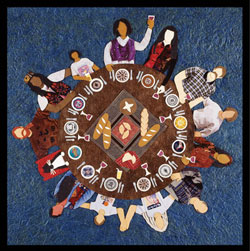
World Communion Sunday

Since yesterday was World Communion Sunday, we did things a little bit differently for the sermon. So here we go! 🙂

History of World Communion Sunday[1]

  • First celebrated as “World Wide Communion Sunday” at Shadyside Presbyterian Church in Pittsburgh, PA in 1933
    • Started as a way to “celebrate our oneness in Christ with all our brothers and sisters around the world”
  • Spread to other Presbyterian churches → denomination-wide practice by 1936
  • Promoted by the Dept. of Evangelism of the Federal Council of Churches (a predecessor of the National Council of Churches) in 1940 → went from being a “Presbyterian thing” to a multi-denominational thing
  • “Today, World Communion Sunday is celebrated around the world, demonstrating that the church founded on Jesus Christ peacefully shares God-given goods in a world increasingly destabilized by globalization and global market economies based on greed.”
    • Reason special offering taken today is being used for issues of social justice → sharing our God-given goods in a world in need

Still share in those God-given goods today

  • God-given goods of simple elements of human society & culture – bread and wine
  • God-given goods of community – shared meal
  • God-given goods of grace of a Savior who continues to offer us refreshment in body, mind, and soul when we gather around this table

Explore these God-given goods …

BREAD

Scripture – John 6:47-51: “I’m telling you the most solemn and sober truth now: Whoever believes in me has real life, eternal life. I am the Bread of Life. Your ancestors ate the manna bread in the desert and died. But now here is Bread that truly comes down out of heaven. Anyone eating this Bread will not die, ever. I am the Bread – living Bread! – who came down out of heaven. Anyone who eats this Bread will live – and forever! The Bread that I present to the world so that it can eat and live is myself, this flesh-and-blood self.”

Universality of bread

  • Crosses all the lines that we try to draw between ourselves and “the other”
    • Race
    • Language
    • Gender identification
    • Socio-economic class
    • Education level
    • Even religion.
  • Bread is a critical element in every culture around the world. It can travel easily. It can adapt to a wide variety of circumstances. A simple piece of bread can mean different thing to different people, even within the same cultural context.
    • Differences between pizza crust, cornmeal bread, unleavened matzo bread, and Wonder Bread

Story of hearing about Grass Roots: The Universe of Home by Paul Gruchow → read short passage about bread[2]

  • Jesus tells us, “I am the Bread of Life. … Anyone eating this Bread will not die, ever. … The Bread that I present to the world so that it can eat and live is myself, this flesh-and-blood self.”
  • Question: Are we looking for “Wonder Bread” version of Jesus or “homemade bread” version of Jesus?
    • Wonder Bread version: stripped down, bland, easy to swallow
      • Jesus that doesn’t make waves
      • Jesus that doesn’t challenge us
      • Jesus that doesn’t make us squirm
    • Homemade bread version: rough around the edges, has depth, full of surprises
      • Recent blog post in Huffington Post’s religious section: I’m all for love and a personal relationship with God, but I choose to follow the man who teaches that political actionis worship, that social justice is  What I and people my age are looking for is a church that preaches not just transcendental love, but that prophetic fire that makes Jesus so appealing.[3]
    • The Jesus that scares us with all of his incendiary comments and outbursts and cryptic parables is also the Jesus who most inspires us – who touches and stirs something deep within our souls – who awakens within us a burning desire to do something and be something more.
      • Jesus: I came that they may have life and have it [4]
      • Gruchow: The wholesome mystery of bread, the sacrament of it, I know now, was never in the ingredients but in the labor, and in the laborers who transfigured them into bread.[5] Ingredients vary. The particulars of our lives vary. But through his sacred and extraordinary labor – through his healing and teaching, his living and his dying and his rising again – Jesus continues to transfigure our lives into something nourishing, something strengthening, something sustaining. And when we eat this bread – whether it’s homemade or store-bought, wafers or gluten-free or even [garlic bread/graham crackers] … When we eat this bread and participate in this universal and holy mystery, we enter into that labor, too. We go out into the world satiated and yet hungry to be the body of Christ in the world.

Hymn: Let Us Break Bread Together, verse 1

WINE

Scripture – John 15:1-8: “I am the Real Vine and my Father is the Farmer. He cuts off every branch of me that doesn’t bear grapes. And every branch that is grape-bearing he prunes back so it will bear even more. You are already pruned back by the message I have spoken. “Live in me. Make your home in me just as I do in you. In the same way that a branch can’t bear grapes by itself but only by being joined to the vine, you can’t bear fruit unless you are joined with me. “I am the Vine, you are the branches. When you’re joined with me and I with you, the relation intimate and organic, the harvest is sure to be abundant. Separated, you can’t produce a thing. Anyone who separates from me is deadwood, gathered up and thrown on the bonfire. But if you make yourselves at home with me and my words are at home in you, you can be sure that whatever you ask will be listened to and acted upon. This is how my Father shows who he is – when you produce grapes, when you mature as my disciples.

Interesting thing about wine in relation to bread – wine is a temperamental thing

  • Temperamental naturel of grapes
    • Not easy to get plants started
    • Not easy to grow/maintain
    • Not easy to harvest
    • Hear echoes of this nature in beginning of our Scripture reading – Jesus speaks of farmer pruning and caring for and nurturing grapes on the vine
  • Temperamental nature of wine itself
    • Must be aged properly
    • Must be stored properly
    • For enthusiasts, must be served with the proper dishes
    • Not so terribly different from us people
      • Always in need of something
      • Always wanting something different
      • Always looking for the next best thing
      • Half the time, we don’t even know what we want, and yet we expect others – our friends, our family, our coworkers, sometimes even strangers on the street or in the grocery store – we expect them to intuitively understand what we want and what we need (or what we think we need) right in that moment. We are constantly changing, constantly in motion and in flux.
        • Kerlin Richter quote (from last week): Christianity is a messy and embodied religion, and I am a messy and embodied person.

And yet, there is utter joy amidst the messiness

  • Tradition of grape stomping: Feet have been used to crush wine for thousands of years. Ancient Romans drank wine, and it is believed that they stomped their grapes back in 200 BC to extract the juice. It makes sense to use the weight of the body to press down on grapes – it is certainly less tiring than pressing down with hands, or turning a press. Plus, stomping can easily be a group activity, and a celebratory one at that; and the creation of wine is nothing if not cause for celebration. In the United States, stomping grapes for the production of wine has been banned since the end of the twentieth century. … The practice of stomping grapes is still used by some small wineries in Portugal and Spain, but it is a rare practice, indeed. Still, stomping grapes is fun. … Grape-stomping festivals have sprung up around the country during harvest time, to satisfy the unquenchable desire to crush grapes with feet.[6]
    • Pop culture examples:
      • The hilarity of the infamous “I Love Lucy” episode in which Lucy and a rather enthusiastic Italian woman are stomping wine together[7]
      • The playfulness and romance of the scene from the movie “A Walk in the Clouds” in which the main characters are all participating in an annual wine stomping celebration on their Spanish vineyard[8]
    • Even in the midst of our fussiest, most stressful, high-maintenance moments, there are glimpses of the joy and purposefulness of God all around us.
      • Particularly visible this time of year as the leaves on the trees begin to change colors
      • Witness it in the amazing colors of sunrise/sunset (real beauties lately)
      • Hear it in delightful laugh of children
      • Feel it when you wrap cold hands around a warm mug of coffee/tea
      • Experience it in the love of family and friends

Takes a seemingly brutal and destructive act like stomping grapes to make beautiful wine → similar to another brutal and destructive but necessary act: Christ’s crucifixion

  • The darkness had to come before the light
  • Jesus knew that this was coming. He knew all about the torment and the humiliation and the pain that was to come, and yet he taught and healed and prayed and lived each day with his disciples, holding the joy and the bitterness together until the moment was right.
    • Used something as fickle and yet as vibrant and life-giving as a grape vine to describe relational nature of faith: I am the Vine, you are the branches. When you’re joined with me and I with you, the relation intimate and organic, the harvest is sure to be abundant. Separated, you can’t produce a thing. … This is how my Father shows who he is – when you produce grapes, when you mature as my disciples.

Hymn: Let Us Break Bread Together, verse 2

THE SACRED CELEBRATION

Scripture – Luke 22:7-20: The Day of Unleavened Bread came, the day the Passover lamb was butchered. Jesus sent Peter and John off, saying, “Go prepare the Passover for us so we can eat it together.” They said, “Where do you want us to do this?” He said, “Keep your eyes open as you enter the city. A man carrying a water jug will meet you. Follow him home. Then speak with the owner of the house: The Teacher wants to know, ‘Where is the guest room where I can eat the Passover meal with my disciples?’ He will show you a spacious second-story room, swept and ready. Prepare the meal there.” They left, found everything just as he told them, and prepared the Passover meal. When it was time, he sat down, all the apostles with him, and said, “You’ve no idea how much I have looked forward to eating this Passover meal with you before I enter my time of suffering. It’s the last one I’ll eat until we all eat it together in the kingdom of God.” Taking the cup, he blessed it, then said, “Take this and pass it among you. As for me, I’ll not drink wine again until the kingdom of God arrives.” Taking bread, he blessed it, broke it, and gave it to them, saying, “This is my body, given for you. Eat it in my memory.” He did the same with the cup after supper, saying, “This cup is the new covenant written in my blood, blood poured out for you.”


Friends, in this blessed meal, in this sacred celebration in which we are about to participate, Jesus took common elements – humble bread and ordinary wine – and imbued them with a meaning and a holy weightiness that is universal. We all need the grace offered to us in this bread, this body of Christ. We all need the forgiveness granted to us in this cup, this blood of Christ. We all participate in this life of faith together just as the disciples participated with Christ in that first Last meal centuries ago.

  • Still seek Christ’s presence among us … just as they did
  • Still ask for Christ’s guidance and direction … just as they did
  • Still inspire by Christ in thought, word, and deed … just as they were

When we come to this table, we celebrate the love of Christ. We celebrate the sacrifice of Christ. We celebrate the gritty humanity and true divinity of Christ. We celebrate the radical revolutionary of Christ – the one who sat with the people he wasn’t supposed to sit with, taught to the people who weren’t supposed to learn, kissed the people who weren’t supposed to be touched, and loved the people that everyone else forgot. All of that realness, all of that love and messiness and joy and pain, all of that faith and hope and desperation are here at this table, in the brokenness of the bread, in the bittersweetness of the cup. Here we worship. Here we pray. Here we praise. Here we are nourished and blessed, not so that we may stay here and genuflect before the elements themselves but so that we may take the blessing we receive here out into a hungry and hurting world. Amen.

Hymn: Let Us Break Bread Together, verse 3

[1] “World Communion Sunday” from https://www.presbyterianmission.org/ministries/worship/world-communion-sunday/. Accessed 3 Oct. 2015.

[2] Paul Gruchow. Grass Roots: The Universe of Home. (Minneapolis, MN: Milkweed Editions, 1995), 45-47.

[3] Christian Chiakulas. “Churches Could Fill Their Pews With Millennials If They Just Did This” on Huffington Post: Religion, http://www.huffingtonpost.com/christian-chiakulas/churches-millennials-if-they-just-did-this_b_8215846.html?ncid=fcbklnkushpmg00000051. Posted 30 Sept. 2015, accessed 3 Oct. 2015.

[4] Jn 10:10 (emphasis added).

[5] Gruchow, 47.

[6] “A Brief History of Stomping Wine” from Von Stiehl Winery, http://vonstiehl.com/a-brief-history-of-stomping-wine/. Written 4 Aug. 2009, accessed 4 Oct. 2015.

[7] “Lucy’s Italian Movie,” season 5, episode 23 of I Love Lucy. Original air date: 16 Apr. 1956, http://www.tv.com/shows/i-love-lucy/lucys-italian-movie-17248/.

[8] A Walk in the Clouds, produced by Zucker Brothers Productions, released 11 Aug. 1995.

Sunday’s sermon: Why Christian?

Why Christian

  • Last weekend, I was at a conference up in the cities called “Why Christian?”
    • Organized by Nadia Bolz-Weber & Rachel Held Evans
      • Nadia: organizing pastor @ House for All Sinners and Saints in CO, NY Times best-selling author, religious boundary pusher
      • Rachel: NY Times best-selling author, progerssive evangelical who “writes about faith, doubt and life in the Bible Belt”[1]
    • Filled with other female speakers – authors, pastors, and professors – who each spent about half an hour answering a complexly simple question: Why Christian?
      • In the face of the violent, oppressive, overpowering history of Christianity, why continue to be a Christian?
      • In the face of all the negative things that have been said and done in the name of God and Jesus Christ – even up to the present day – why continue to be a Christian?
      • In the face of suffering – your own or the suffering that we witness in the world each and every day – why continue to be a Christian?
      • Why Christian?
      • Simple question, right? Right. And as you can surely imagine, this question has been rolling around in my head for the past week or so. Why am I a Christian?
        • Certainly a questions you’ll have to answer for yourselves as far as individuality of it goes – Why are you still a Christian?
          • My answer: I am a Christian because of investment. Throughout my life, time and time again when I was running on low, God invested in me. God invested strength. God invested love. God invested compassion. And God invested more grace than I ever could’ve imagined possible. When that investment has pulled me up out of the trenches so many times, how can I not choose to invest in God each and every day?
        • Today we’re tackling the related question: Why are we still gathering as Christians together in this place? Why Christian here?
  • Come to church to connect to God
    • Connect to sense of the Holy, wider story/context than our own limited slice of life → Now I’m not saying that church is the only place that we can feel that connection.
      • Other places we connect
        • In nature
        • In Scripture
        • In relationships
        • In solitude
      • But it cannot be denied that there is something profound … something holy … something sacred about the way we find and relate to God in this space.
        • In the words we read and hear and sing and pray here – collective voice when we pray the Lord’s Prayer together
        • In the ways God speaks to us in the sounds as well as the silence
        • In the palpable presence of God in the sacraments
          • The roughness of the bread in our mouths
          • The bitter tang of the juice/wine on our tongues
          • The cool splash of water from the baptismal font
        • It’s about finding God, not about finding answers. → Conference quote – Allyson Dylan Robinson: With God, the closer you get to certainty, the further you get from the truth.
          • Put in a different perspective (also ADR) – from God: I am a mystery. Get over it.
  • Come to church to BE
    • Be presence/reflection of God/Christ for each other and for the world around us
    • Conference quote from Rachel Held Evans: “Our belief carries each other. Can’t pray? Can’t praise? Can’t sing? Can’t profess? Can’t witness today? The people around you can carry you today just as you can carry someone else tomorrow.” → We come to church for the community of faith – community that lifts up and supports and celebrates and cherishes.
      • Hear this call in gospel passage – Matthew 5:13-20
      • Sacred community, sacred investment in one another – not just another social club → plenty of other great places around here to meet for coffee, food, small talk, etc.
        • Do “Christian” here to …
          • Learn from each other
          • Grow with each other
          • Challenge each other
          • Be changed by each other
  • Come to church to EXPERIENCE/FEEL
    • Experience/feel God’s presence and call in our lives → be moved and stirred by that experience (call to ACTION!)
      • Jas is calling this out in our other NT Scripture this morning: James 2:14-26 → It’s important to note that James isn’t talking about works justifying That’s the idea of “works righteousness” that the Reformers raged and rebelled against. We are confirmed and accepted by God through God’s own grace alone. What we do hasn’t, doesn’t, and won’t ever earn God’s love because that love is a free gift. But James is saying that we can’t just take that gift and hoard it away. We’ve got to let it inspire us to go from this place with the fire of the Holy Spirit in our hearts and in our bellies.
        • Go out into our homes, into the community, into the world to make changes
        • Also go out into the congregation – come to church not to simply and half-heartedly “do church” but to “be church” together
          • Implies action
          • Implies investment
          • Implies being engaged in the life and works of this congregation
    • Not always easy/comfortable/safe
      • Conference quote – Emily Scott (pastor – dinner church): Being a Christian is living at the fulcrum of your fear.
      • Not about appearances → IT’S NOT ABOUT BEING/LOOKING PERFECT!!
        • Not put together? GREAT
        • Having a bad day/week/year? SUPPORT
        • Never darkened a doorstep before? WELCOME
        • Jesus didn’t hang out with the perfect people … with the put-together people … with the super strictly religious people … with the always-strong, always-right, always-happy people. Jesus hung out with the outcasts … with the sinners … with the screw-ups and the has-beens and the never-beens and the weak and the struggling.
          • Conference quote – Kerlin Richter (pastor): Christianity is a messy and embodied religion, and I am a messy and embodied person.
  • So why Christian? Why do you continue to claim that name, that identity, that Spirit out in the world? And what does it mean to connect with and be and experience that faith here in this place? What does it look like … what should it look like … what can it look like to be Christians together? Amen.

I don’t normally do this, but I’m including our charge and benediction for this service because it was so crucial to the message. Before the charge and benediction, we listened to the song “Brave” by Sara Bareilles.

Forget fear. Forget hesitation. Forget uncertainty. Forget tired. This morning, I dare you to be salt. I dare you to be light. From the bottom of my heart, I want to see you be brave!

** May the love of God surround you, may the grace of Christ abound in you and through you, and may the intensity of the Holy Spirit astound you day after day. Amen. **

[1] Rachel Held Evans, “About” on http://www.rachelheldevans.com/about. Accessed 21 Sept. 2015.

October newsletter piece

Throughout most of the month of October, we’re going to be talking about stewardship. Last year, we approached it from the standpoint of the different facets of stewardship. We talked about being faithful stewards of our resources (yes … the ‘money’ element), being faithful stewards of our time and talents, and being faithful stewards of our hearts and attention.

This year, we’re going to tackle the idea of stewardship from a different angle. We’re going to spend October talking about the different foci of stewardship. We’re going to talk about stewardship for the purpose of strengthening the church. We’re going to talk about stewardship for the purpose of strengthening mission (both through the church and outside of it). And we’re going to talk about stewardship for the purpose of the strengthening the future.

You may have noticed a key word in all of that: STRENGHTENING.

I know that stewardship often gets relegated to the role of sustaining – helping the church maintain what it’s doing, helping the church “stay afloat,” helping the church do exactly what it’s been doing.

This is “just enough” stewardship, but friends, God didn’t create us to be “just enough” caretakers, and God didn’t create the world for a “just enough” existence.

In the beginning, when God created humanity, God named us as stewards over all the creation.

So God created humankind in God’s image, in the image of God he created them; male and female God created them. God blessed them, and God said to them, “… Be responsible for the fish of the sea and over the birds of the air and over every living thing that moves on the earth.” ~ Genesis 1:27-28

Despite some previous translations, God didn’t say, “Subdue the earth.” God didn’t say, “Perfect the earth.” God certainly didn’t say, “Do whatever you want with the earth.” God named us stewards … caretakers. God made us responsible for every living thing – the plants, the animals, the bugs, the birds, and most certainly each other.

And when God was creating the world one cosmic event at a time, God didn’t sit back and call each period of creation “just enough.” God called it “good.” God called it “prosperous.” God called it “successful.” God called it “pleasing.” I don’t know about you, but none of these substitutions for good speak of “just enough” to me. They speak of fullness. They speak of vastness.

They speak of abundance.

Jesus said, “I came that they may have life, and have it abundantly.” (John 10:10) If we are to live into the role of truly faithful stewards, we have to shake off this mentality of “just enough” and embrace an attitude of “strengthening abundance.” When we look at the numbers, at the real, honest-to-goodness numbers of how our congregations are doing right now, the bottom line is written in red ink, not black ink. And it’s not because we’re horrendously off-budget for the year. We’re pretty spot-on for spending. Giving is another story.

As we venture ahead as congregations, keep these questions in mind:

How can our stewardship – of our resources as well as our time and our energy – not just maintain but strengthen our church?

How can our stewardship not just maintain but strengthen God’s mission in the world?

How can our stewardship not just maintain but strengthen our future together and the future of the body of Christ?

Pastor Lisa sign

Sunday’s sermon: Words = Power

Power

Texts used: Mark 8:27-38 and James 3:1-12

  • “Sticks and stones may break my bones, but words can never hurt me.” This is what we teach our children when they encounter people in their life who tease them, who use words to bring them down and make them feel bad. We try to take away the authority and force of those words – to minimize their importance and their impact. But as adults, even as we utter these words to give comfort and refuge, we cannot deny that words have power. We know just how truly powerful words can be. → words = power to …
    • Express ourselves
    • Explain and teach, to learn and understand
    • Build up and bring together or to tear down and divide
      • Positive power – Nobel Peace Prize winner Malala Yousafzai continues to celebrate and defend the power of words and learning even after Taliban’s failed attempt to kill her
      • Negative power – fervor and blind devotion and hate stirred up by one of the world’s greatest public speakers: Adolf Hitler
    • We cannot deny that words have power.
      • E.g. – clip from the Lord of the Rings: The Fellowship of the Ring[1]
        • Background: Frodo = hobbit inherited certain ring from his uncle (unaware of ring’s significance/history/power) learns about truly evil, powerful nature of ring joins up with Gandalf (wizard) and others in epic quest to keep the ring out of the enemy’s hands
        • [PLAY CLIP: https://youtu.be/hxz3Yna92zo→ In this moment, Gandalf’s words literally resonate with power. The sky darkens. The earth shakes. Those around him are physically affected by the words that he utters. They cower and grimace and squeeze their eyes shut as if in pain.
        • Commanding illustration of the power that words can have à And be it fantasy or reality, we cannot deny that words have power.
    • Both Scripture readings this morning speak to/illustrate the power that words truly have
  • First: staying/eternal power of Jesus’ words
    • More familiar version of text (pew Bibles): [Jesus] called the crowd with his disciples, and said to them, “If any want to become my followers, let them deny themselves and take up their cross and follow me. For those who want to save their life will lose it, and those who lose their life for my sake, and for the sake of the gospel, will save it.[2]  Christians for centuries have pondered and prayed over these verses. Can we ever truly deny ourselves? How do we “take up our crosses”? What does it mean to lose our lives to save them? In the many attempts at answers that have arisen throughout history, these words have become the cornerstone for a wide variety of faith practices.
      • Monks and nuns in monasteries – communal living, strict discipline, vows of poverty & chastity, serving those in need
      • Catholic practice of confession
      • Ancient prayer practice of examen – daily exploration of your heart, your actions, your thoughts, and your attitudes in an attempt to get closer to God
      • Incredible acts of service inspired by these words
        • E.g. – “The Secret Millionaire” (TV show)
        • Mahatma Gandhi: The best way to find yourself is to lose yourself in the service of others.
      • Jesus’ words from our text this morning: “Anyone who intends to come with me has to let me lead. … Follow me and I’ll show you how. … Self-sacrifice is the way, my way, to saving yourself, your true self.”[3] We cannot deny that words have power.
  • Also in gospel reading – power of testimony
    • Passage begins with Jesus’ seemingly-simple question: Who do the people say I am?[4]
      • Disciples initial reply: John the Baptizer, Elijah, one of the prophets
      • With a little more prompting from Jesus (“Who do you say that I am?”) – Peter’s answer: You are the Christ, the Messiah. first time he’s identified as the Messiah in Mark’s gospel
    • This is certainly a powerful pronouncement and the most easily-recognized testimony in this passage … but it’s not the only testimony. Remember, a testimony is not always about the easy, the acceptable, and the joyful. Testimonies can be about pain and struggle and tension. And so we hear Jesus’ testimony, too: “It is necessary that the Son of Man proceed to an ordeal of suffering, be tried and found guilty by the elders, high priests, and religious scholars, be killed, and after three days rise up alive.” He said this simply and clearly so they couldn’t miss it.[5]  This is the first of three times throughout Mark’s gospel that Jesus will try to warn the disciples about what is to come.
      • Powerful testimony because of the raw truth in it
      • Powerful testimony because of holy self-sacrifice in it
      • Powerful testimony because of vulnerability in it
      • Jesus’ words here are revealing. They’re profound. They’re striking. They. Are. Powerful. So powerful, in fact, that they cause Peter to “take him aside and rebuke him”[6] which in turns elicits Jesus’ shocking and powerful response: Peter, get out of my way! Satan, get lost! You have no idea how God works.[7]  Now up to this point, the words we’ve talked about have been intentional words – words chosen and spoken deliberately and carefully, words that have been thought out. But this exchange of words is one born of emotion, unbidden and uncontrolled.
        • Imagine disappointment and frustration Jesus must have felt – shared something so intimate, so compelling, and Peter pulls him aside to rebuke him
        • Imagine utter shock Peter must have felt – from the high of “You are the Messiah” crashing down to “Get behind me Satan” in a few short moments
  • We cannot deny that, intentional or unintentional, words have power. Remember what I said just a few minutes ago?  words= power to build up and bring together OR to tear down and divide
    • We are surrounded by words – articles and advertisements, status updates and Tweets, blog posts and memes [explain], news reports and meetings and everyday conversations. (Sermons) Words words words words words. And as we all know, not all those words are positive, lift-you-up words. Anyone who’s ever been bullied will tell you that it’s not just positive words that have power.
      • Cyber-bullying epidemic – statistics[8]
        • Over half of young people report being cyber bullied
        • 1/3 of those who reported being bullied received threats
        • Only 1 of 6 parents are aware of the scope/intensity of cyber bullying that their kids are experiencing
      • And goodness knows bullying extends beyond the realm of cyberspace. – so bad that there’s actually a government website connected to the Dept. of Health and Human services: stopbullying.gov
    • This is what James speaks to in our second New Testament passage this morning: A word out of your mouth may seem of no account, but it can accomplish nearly anything – or destroy it! A careless or wrongly placed word out of your mouth can do that. By your speech you can ruin the world, turn harmony to chaos, throw mud on a reputation, send the whole world up in smoke and go up in smoke with it … With our tongues we bless God our [Creator]; with the same tongues we curse the very men and women [God] made in [God’s own] image.[9]  We know that these words – these powerfully negative, powerfully destructive words are out there in the world. We’ve felt the sting of them ourselves. We’ve watched our friends, our family, and our loved ones suffer the sting, too. We know how painful and damaging these words can be. In fact, it can be argued that negative words can actually be more powerful than positive words. Studies have shown that it takes 5-6 positive comments to balance out one, single negative comment.[10]
  • Friends, we cannot deny that words have power. But we can choose to be a presence to powerfully counteract the negative instead of someone who adds to it. When we hear others tearing down, we can choose to proclaim the words to build up again. We can choose to be the cool, clear water that washes away the polluted mud. We can choose to be God’s affirmation – to be God’s “I love you,” God’s “yes,” God’s “peace be with you.” And we cannot deny that those words have power, too. Amen.

[1] “The Lord of the Rings: The Fellowship of the Ring” directed by Peter Jackson, distributed by New Line Cinema 19 Dec. 2001 (USA).

[2] Mk 8:34-35 (NRSV).

[3] Mk 8:34-35 (The Message).

[4] Mk 8:27.

[5] Mk 8:30-32.

[6] Mk 8:32 (NRSV).

[7] Mk 8:33 (The Message).

[8] “Cyber Bullying Statistics 2014” at http://nobullying.com/cyber-bullying-statistics-2014/. Modified Sept. 10, 2015, accessed 12 Sept. 2015.

[9] Jas 3:5-6, 9.

[10] Jack Zenger and Jopseh Folkman. “The Ideal Praise-to-Criticism Ratio” in Harvard Business Review online, Mar. 15, 2013, https://hbr.org/2013/03/the-ideal-praise-to-criticism/. Accessed 12 Sept. 2015.

Sunday’s sermon: A Blind Man’s Story

Lord I Believe

Texts used: Psalm 23 and John 9:1-41

Sometimes, instead of writing a “conventional sermon” (whatever that might mean), I like to take a text and imagine what living in that text might look like. What else could the story say? What might the people inside the story be saying, feeling, doing, thinking? What does the inside of the story look like? Sound like? Smell like? And in that imagining, I expand on the Scripture to help you place yourself in the story as well in the hopes that you might hear God’s word in a new way and be inspired. This is one of those stories …

The words still rang in his ears:

Get out of here! Leave this synagogue, and don’t bother coming back. You aren’t welcome here anymore.

He had been thrown out of the synagogue – actually thrown out! This was the community where he’d grown up – where he’d worshipped and observed the Sabbath with his parents and sat mourning the death of his grandparents. And now he could never go back.

The man continued wandering the streets of Jerusalem as he thought about the way things had gone, turning the recent events over and over in his mind. What a whirlwind it had been! The day had started out like any other – with him sitting by the side of the road begging passers-by for whatever coins they could spare. Because he’d been blind since birth, begging had been his whole life, so he sat by the side of the road every day, relying solely on the mercy of other people.

That’s exactly where he had been when this whole crazy mess had begun.

He’d been sitting by the side of the road begging when he heard what sounded like a fairly large group approaching. Large groups were always a bit of a wild card for the blind man. Sometimes, when one person in a large group stepped out and gave the man a coin or two, many others followed suit. But sometimes large groups meant trouble – people who wanted to cause him harm and steal whatever meager coins he’d been able to collect that day or Roman soldiers looking for someone to harass. As the man listened to this large group approach, he wondered what was in store for himself.

Looking back, he could say with all honesty that he never could have guessed.

As the group approached, he heard one of them say, “Rabbi, who sinned: this man or his parents, causing him to be born blind?”[1] The man groaned inwardly. He’d heard this question so many times before, and he hated it. It was common belief that for someone to be disabled like him, either he or his parents must have done something wrong – something to earn God’s punishment. But he had trouble understanding or believing this. He had been blind since the moment he entered the world. Could he truly have sinned while still in the womb? And what about his parents – two wonderful people who had cared for him his entire life? He knew no one was perfect, but he could hardly believe that either one of them had done anything terrible enough to make him deserve this.

And so it was a relief for him when he heard the Rabbi’s reply: “You’re asking the wrong question. You’re looking for someone to blame. There is no such cause-effect here. Look instead for what God can do. We need to be energetically at work for the One who sent me here, working while the sun shines. When night falls, the workday is over. For as long as I am in the world, there is plenty of light. I am the world’s Light.”[2] And then he heard one of the other people in the group call the rabbi by his name: Jesus. When he heard this, a little spark of hope lighted in the man’s heart.

Before he could ask Jesus any questions, the blind man heard someone spitting on the ground. What is going on? he wondered. And then he felt the mud being smeared across his eyes. It was warm, and the hands that applied it were gentle but firm – calloused and strong and sure. Even though the blind man knew that he should probably be trying to get away – I mean, who smears mud on a blind guy’s eyes?? – something kept him rooted in place. Instead of feeling annoyed or afraid, he felt calm. He felt peaceful. He felt … tingly. His eyes were tingling. He opened his mouth to say something, but Jesus spoke to him: “Go, wash at the Pool of Siloam.”[3] The Pool of Siloam was famous for its healing properties, but for whatever reason, no matter how many times he had immersed himself in the past, they’d never worked for the blind man.

He was about to tell Jesus this, but something stopped him. There was something different about this man, this gentle but determined Rabbi. So the blind man got up and began to make his way to the Pool of Siloam. When he reached the pool, he felt his way along the limestone edges until he felt first his toes, then his ankles, then his shins, and finally his knees enveloped by the cool, refreshing water. The blind man cupped his hands, dipped them into the pool, and brought some of the water to his face. He thought that, if nothing else, he could at least get this mud off of his eyes. He cupped his hands and brought the water to his face again and again, enjoying the feel of the water as it ran down his cheeks and trickled off his chin.

Finally, the blind man knew he had to get out of the pool – to make space for others who were also seeking healing. He used the tips of his fingers to rub away the final bits of mud that were clinging to his eyelashes, and opened his eyes.

He could see.

He could see!

Everything was so startlingly bright that he immediately squeezed his eyes shut, and then he opened them again right away, afraid that he had been imagining things. But no, he wasn’t imagining. He could SEE!! He quickly got out of the pool, and as he made his way toward home, his vision became clearer and clearer. The fuzzy edges of things began to solidify. He slowly became more and more accustomed to the light. It was probably the most difficult journey the man had ever taken because even though he was trying to hurry home, he kept stopping to look at all of the amazing, beautiful things along the way. There were carts in the market full of the most beautiful, exotic-looking foods! There were children running through the streets with the most beautiful smiles on their faces! There were women winding their way through the crowds wearing dresses made out of the most beautiful colors!

Finally, the man found himself on his street. He smelled the smells he always smelled at home. He heard the sounds he always heard at home. This must have been it. He slowly walked down the street, running his hand along the fronts of the houses and counting until he came to the fourth doorway on the right – his house. It was small and made of pale mud bricks – bricks that he’d run his hands over a thousand times. They were beautiful, too. He walked into the house, and there was a woman standing in the kitchen and a man standing in the common area.

Before either of them could say anything, the man declared, “I can see!”

Both his parents stopped what they were doing. His mother’s mouth hung open just a little. His father’s eyes went first to his face, then to his mother’s face, then back to the man’s own face. Then both of them came toward him, arms outstretched. They hugged him. They touched his eyes. In the midst of it all, the man told them about what had happened that morning with Jesus and his disciples.

His mother and father were so overjoyed by this miraculous healing that they dragged their son outside and shouted to all the neighbors, “Look! Look! Our son was blind but his eyes have been opened! He can see! He can see!” All the neighbors came out of their houses and marveled at this healing. Some of them didn’t even believe that he was the same man! They were convinced that he was just someone who looked like him, but many of his other neighbors recognized him. “Of course it’s him,” they said. And the man himself kept saying, “I am that man. Truly, I am that man.” Like his parents, the neighbors were all curious about how this amazing thing had happened, so they asked him again and again, “How did your eyes get opened?”[4] And so the man recounted over and over what had happened with the mud and the pool and the miracle. “Where is he? Where did Jesus go?” his neighbors asked. And he answered them truthfully: “I don’t know.”[5]

As he was retelling his story yet again, the man saw another group of people coming down the street. As the crowd parted for these men, the man realized that they must be the Pharisees. They explained to the man that because today was the Sabbath, it was sinful for Jesus to have done the work of mixing the mud, spreading it on his eyes, and healing him. “God said we are to rest on the Sabbath,” one of them reminded him sternly.

Then the Pharisees proceeded to question the man over and over and over again about what had happened. And over and over and over again, the man repeated the same story: “He put mud on my eyes, and I washed, and now I see.”[6] As the questioning continued, it became clear to the man that the Pharisees were very upset with Jesus. Finally, one of the Pharisees declared in exasperation, “Obviously, this man can’t be from God. He doesn’t keep the Sabbath!” Before the man could respond, another one of the Pharisees countered, “How can a bad man do miraculous, God-revealing things like this?”[7] And they argued amongst themselves for a short time before finally turning to the man and saying, “You’re the expert. He opened your eyes. What do you say about him?”[8]

The man thought for a moment. Certainly, those with Jesus had called him “Rabbi,” so he must be a teacher. But he did so much more than any of the other rabbis the man had ever known. He must have been more than a rabbi, so he finally answered them: “He is a prophet.”[9] The Pharisees simply shook their heads at this and continued arguing amongst themselves. As they argued, the man heard them discussing whether or not he had truly been born blind in the first place. “You never know,” one of them whispered loudly. “This could be one big, elaborate hoax to further Jesus’ agenda!”

The man could barely believe his ears. Were they serious?! Why would he lie about something like that for so long? He couldn’t imagine what might possibly be gained by a deception like that. He was about to interject into their conversation and tell them exactly what he thought about their suspicions when one of them called out, “Where are this man’s parents? We want to speak with them!” Once the man’s father and mother had been brought forward, the Pharisees asked them, “Is this your son, the one you say was born blind? So how is it that he now sees?”[10] The man felt sorry for his parents. It was obvious that they were fearful of any repercussions that might stem from their response. It had already been established by the Pharisees that anyone who supported this Jesus person – anyone who agreed with the whispers and rumors that this rabbi might be the long-awaited Messiah – would be driven out of the synagogue. In quaking voices, they said to the group, “We know he is our son, and we know he was born blind. But we don’t know how he came to see – haven’t a clue about who opened his eyes.” They took a deep breath as if strengthening their resolve, then quietly added, “Why don’t you ask him? He’s a grown man and can speak for himself.”[11]

And so the Pharisees turned again to the man who had been born blind, and again they questioned him over and over. The man could tell that they were waiting for him to say something – something negative and disparaging about Jesus – but the man refused to do so. In his frustration, one of the Pharisees finally declared, “Give credit to God. We know this man is an imposter!”[12] Even then, the man remained firm. “I know nothing about that one way or the other,” he replied steadily. “But I know one thing for sure: I was blind … I now see.”[13] Again they came at him with their questions. “What did he do to you? How did he open your eyes?” And again the man answered them. Again and again and again, he answered them. Finally, his patience ran out. “I’ve told you over and over,” he shouted, “and you haven’t listened! Why do you want to hear it again? Are you so eager to become his disciples?”[14]

Instantly, the man could tell that he had touched a very raw nerve. All of the Pharisees turned very red in the face. Their searching eyes became hostile eyes, and they crossed their arms over their chests as if to ward off his words. “You might be a disciples of that man,” they said venomously, “but we are disciples of Moses. We know for sure that God spoke to Moses, but we have no idea where this man even comes from.”[15]

For the man, this was the last straw. He could hardly believe these men. This Jesus – whoever he was – had performed a miracle and given the man the sight that had been denied him since birth. He could see! How were the Pharisees missing this? He stepped forward and raised his voice so that everyone around could hear him. “This is amazing!” he shouted. “You claim to know nothing about him, but the fact is, he opened my eyes! It’s well known that God isn’t at the beck and call of sinners, but listens carefully to anyone who lives in reverence and does God’s will.” As he was speaking, the man could see the Pharisees getting angrier and angrier, but he just couldn’t seem to keep the words inside any longer. He continued. “That someone opened the eyes of a man born blind has never been heard of – ever! If this man didn’t come from God, he wouldn’t be able to do anything.”[16]

The moment he finished, the man knew he had gone too far. The Pharisees exchanged meaningful glances, and then, slowly and deliberately, one of them stepped forward. He said to the man, “You’re nothing but dirt! How dare you take that tone with us!”[17] His voice rose with each word. “Get out of here! Leave this synagogue, and don’t bother coming back!” His last words were firm and deadly quiet: “You aren’t welcome here anymore.”

That was it. As the man who had been blind wandered through the city, he knew that he had been cut off from his community for good. But there was also a small voice inside him that was saying, “But what you said was true.” And so, having nowhere else to go, he continued to walk the streets of Jerusalem, one of his favorite Scriptures from worship running through is mind: The Lord is my shepherd, I shall not want. … Even though I walk through the darkest valley, I fear no evil; for you are with me; your rod and your staff – they comfort me.[18] I could sure use some of that comfort right now, God, he thought.

As he was walking, a familiar group approached the man. It was Jesus and his disciples. Jesus came up to the man and put his hand on his shoulder. “I heard about what happened at the synagogue,” Jesus said. “Tell me, friend, do you believe in the Son of Man?”[19] The man was silent for a long time. Finally, he said to Jesus, “I have just been driven from the only community I’ve ever known. I have nothing. I am in need of something to believe in. Who is this Son of Man? Point him out to me, sir, so that I can believe in him.”[20] Jesus smiled with warm, kind eyes and said gently, “You’re looking right at him. Don’t you recognize my voice?”

And the man knew. He knew that the rumors and whispers he’d heard about this Jesus man were true. He knew that the Pharisees were wrong. And he knew that this man was with the Messiah. Another part of the psalm began running through his mind: He leads me beside still waters; he restores my soul. … You anoint my head with oil; my cup overflows.[21] The man took a deep, shuddering breath. “Lord,” he said, “I believe.” And with a heart overflowing with gratefulness and praise and love, he worshiped him.

Surely goodness and mercy will follow me all the days of my life, and I will dwell in the house of the Lord my whole life long! Amen.

[1] Jn 9:2.

[2] Jn 9:3-5.

[3] Jn 9:7.

[4] Jn 9:10.

[5] Jn 9:12 (paraphrased).

[6] Jn 9:15.

[7] Jn 9:16.

[8] Jn 9:17 (emphasis added).

[9] Jn 9:18.

[10] Jn 9:19.

[11] Jn 9:20-21.

[12] Jn 9:24.

[13] Jn 9:25.

[14] Jn 9:26-27.

[15] Jn 9:28-29 (emphasis added, with some additions).

[16] Jn 9:30-33.

[17] Jn 9:34.

[18] Ps 23:1, 4.

[19] Jn 9:35.

[20] Jn 9:36 (paraphrased and with additions).

[21] Ps 23:2, 5b.

Sept. 2015 newsletter piece

3-Day

3 days.
60 miles.
1 purpose: to end breast cancer.

I can’t tell you how many times I’ve started writing this month’s newsletter piece just to delete it and start all over again. Those 3 days – those 60 miles – were so full.

They were full of stories – funny stories and touching stories, our stories and the stories of others that we met along the way.
They were full of emotions.
They were full of challenges …
and laughter …
and expectations …
and cheering …
and pit stops …
and medical tents …
and blisters …
and joy …
and determination …
and triumph.

See what I mean? It’s hard for me to condense all of that into a single page. But it was such a formative experience that I can’t not share it this month. So though this may come off as scattered, here goes …

There were certainly times when I struggled. I mean, the 3-Day looks great on paper – empowering and amazing and, while challenging, not impossible. It was easy to sign up and get the ball rolling. Thank you, internet. Click, click, click … and, done! And I found ourselves

And then Friday morning rolled around. Suddenly Jenny and I were standing with the crowd at the opening ceremony and they were saying, “LET’S GO!!” And we were walking. And walking. And waking. And I knew I hadn’t done nearly enough training to get me through unscathed.

But one of the t-shirts that I had made had a passage from Scripture on the back:

“God puts a little heaven in our hearts so that we’ll never settle for less. That’s why we live with such good cheer. You won’t see us drooping our heads or dragging our feet! … It’s what we trust in but don’t yet see that keeps us going.”
~ 2 Corinthians 5:5-7

Truth be told: I fully admit to drooping my head and dragging my feet, especially toward the end of the 2nd day (the longest day – more than 23 miles).

But no matter what, throughout those 3 days and 60+ miles, there’s a lot that Jenny and I had to trust in.

Every time we came to a heavily-trafficked intersection, we trusted in our safety crew to get us across the street.

Every time we visited the medical tent (which I admittedly did much more often than Jenny did), we trusted that the women and men who were volunteering their time knew how to help us with our aches and pains.

Every time we came back to camp, we trusted that our stuff would be there.

And every time we took a step, we trusted.
We trusted that we would be able to take the next step … and the next one … and the next one.
We trusted in each other.
We trusted in our ability to make a difference.
We trusted in God to walk alongside us.
And we continue to trust in a future free of breast cancer.

That kept us going …

And that still keeps us going.

Pastor Lisa sign

P.S. – For the rest of the stories, just ask! 🙂

August newsletter piece

Show me your ways, O LORD, teach me your paths. ~Psalm 25:4 (New International Version)

Sometimes it’s easy to follow God’s path.
Sometimes the way is clear …
before our eyes,
before our hearts,
before our feet.

Yeah.

But sometimes it’s not.

Sometimes it’s takes a lot of twists and turns.
Sometimes it takes some backtracking.
Sometimes we find ourselves off the path entirely and have to wind our way back again.

Is anyone else hearing the Beatles?

“The long and winding road
That leads to your door
Will never disappear.
I’ve seen that road before.
It always leads me her,.
Lead me to your door.”
~ The Long and Winding Road, 1970

Now, we all have different ways of working out how best to follow God’s path in our lives.

Do you journal?
Do you have a devotional book that you read?
Do you talk to someone?
Do you meditate?
Do you turn to music?

Or maybe you’re still searching for the best way to seek out and connect to God’s guidance in your life. Maybe you’re the kind of person that works things out best in movement.

One way that people have been connecting to God and working out their faith throughout the centuries is by utilizing a labyrinth.

labyrinth

The use of labyrinths is first documented in the early 4th century C.E. in northern Africa, though it’s assumed that they were being used even earlier. They were being incorporated into church structures themselves by the 12th and 13th centuries, the most famous being the cathedral in Chartres, France (the image in the previous column). Though labyrinths have also been used in Egyptian and Greek culture, in the Christian tradition, they signify a pilgrimage: “When Christian pilgrims could not travel to Jerusalem due to health or lack of money, they walked the labyrinth instead.  Thus, it began to represent the soul’s journey to Christ.”[1]

Just as everyone’s path with God is different, there are a number of different labyrinth patterns that can be found – simple and complex, circle-shaped and other shapes. There are also lots of ways you can “walk the labyrinth” nowadays. Many spiritual places (churches, camps, retreat centers, etc.) now have a labyrinth on their grounds so you can literally walk it. You can also find printed versions in books or online and “walk the labyrinth” with a pen. You can also buy desktop labyrinths that come with a “walking stick” of sorts – a wood pointer designed to fit into the path.

Now you’ve got my feet on the life path, all radiant from the shining of your face. Ever since you took my hand, I’m on the right way.
~ Psalm 16:11 (The Message)

Part of my calling as a pastor is to help people find new and different ways to experience and interact with their faith – new and different ways to glimpse that radiant and shining face of God. In that vein, I am happy and hopeful to introduce you to the labyrinth.

[1] “History of Labyrinths.” http://www.creativeprayer.com/labyrinths/history-of-labyrinths/

Sunday’s sermon: A God-Listening Heart

Listen Heart

Texts used: 1 Kings 3:3-14 and Psalm 111

  • I want to start this morning by taking a brief moment just to listen.
    • What’s going on around you
    • What’s going on inside you
  • Have you ever thought about how many sounds we hear in a day?
    • Loud sounds … quiet sounds
    • Pleasant sounds … harsh sounds
    • Sounds we notice … sounds we don’t
    • Now let me ask you this: When was the last time you deliberately sat in silence? … And how long did that silence last?
      • A minute
      • 2 minutes
      • 5 minutes
      • Way we usually begin the service: “Letting God In” time – time of silence → Even as I sit there centering myself in God’s presence, I have to force myself not jump up and end that time. I have to force myself to wait – to take another breath … and another … and another … to stretch out that silence.
        • Silence = our time to push away/block out/ stifle all the distractions that fill up our days and just listen
          • Listen to the world around us
          • Listen to our own bodies
          • Listen to God
        • But what might happen when we actually stop to listen?
  • Our first Scripture reading this morning is about King Solomon.
    • Man deeply familiar with distractions
      • King = distractions of royal duties (commanding armies, settling disputes, entertaining other royal dignitaries, etc.)
      • Also had hundreds of wives and thousands of concubines → Distractions galore!
      • And Solomon was also known for dabbling in many different religions. – text: Solomon loved God and continued to live in the God-honoring ways of David his father … except that he also worshiped at the local shrines, offering sacrifices and burning incense.[1] → So Solomon’s mind was distracted. His heart was distracted. And his faith was distracted.
        • Plenty of things that cause distractions for us nowadays – add noise to our lives and our souls
          • Media distractions – TV, internet, smartphones/tablets
          • Political distractions – increasingly polarizing rhetorical being hurled from both sides of the aisle
          • Social distractions – Facebook, Twitter, Instagram, Vine, etc. → these social media “tools” meant to help us connect that are actually causing us to be more and more disconnected
          • And the list could go on and on and on.
            • Orfield Laboratories in south Mpls – “the anechoic chamber” → room that is 99.9% soundproof
              • Walls: insulated steel and concrete lined with 3’ thick fiberglass acoustic wedges
              • Observation from founder: The quieter the room, the more things you hear. You’ll hear your heart beating, sometimes you can hear your lungs, hear your stomach gurgling loudly. In the anechoic chamber, you become the sound.[2] → Even in a chamber meticulously designed to block out noise, we cannot escape it. The noises come from within our own selves.
      • Sit and think for a minute about all those things – intentional and unintentional, noticeable and discreet – that pull your attention away from your life. [PAUSE]
    • We, like Solomon, can find ourselves mightily distracted. And yet, even in the midst of that distraction, Solomon encounters God.
      • Text: God appeared to Solomon in a dream: God said, “What can I give you? Ask.”[3] → What a question! As if simply encountering God wasn’t overwhelming enough, God asks Solomon the most simple and yet most complex question ever: “What can I give you?”
        • Solomon’s first response = one of insecurity: I’m too young for this, a mere child! I don’t know the ropes, hardly know the ‘ins’ and ‘outs’ of this job. And here I am, set down in the middle of the people you’ve chosen, a great people – far too many to even count.[4] → There is it. Solomon is faced with this colossal task of ruling this great nation – great in numbers, great in history, great in faith – and he doesn’t feel up to the task.
          • Question: How often do we fill the silence with noise/distractions just so we won’t have to think about our worries/fears/insecurities?
    • Solomon’s ultimate request: Give me a God-listening heart so I can lead your people well[5] → “Give me a God-listening heart so I can lead your people well.” Solomon knew the places in which he struggled. He knew his own weaknesses as well as his strengths. And he knew that there was no way he could tackle the immense task of ruling the nation of Israel on his own. So he asked for God’s help. “Help me to listen, God. Help me to hear and obey. Give me a God-listening heart.”
      • Asks for understanding, compassion, discernment, wisdom – Heb. “give your servant a heart to hear”
        • Hear love as God hears it
        • Hear need as God hears it
        • Hear justice as God hears it
        • Scholar: Wisdom has to do with who we entrust ourselves to; who we know can fill our empty buckets; whom we most believe, trust, and confide in.[6] → Solomon makes his choice passionately and definitively: Give me a God-listening heart.
  • In our psalm this morning, we hear an outpouring of just such a “God-listening heart.”
    • Begins with wide-open praise: Hallelujah! I give thanks to God with everything I’ve got![7] → This is a no-holds-barred sort of exclamation.
      • “give thanks” can also mean “give voice” and “confess” = deliberately and graciously laying everything out before God
        • The happy things
        • The not happy things
        • Everything in between
      • Follows with praise for who God is and what God does
        • God’s works are so great, worth a lifetime of study[8]
        • [God’s] miracles are his memorial – this God of Grace, this God of Love.[9]
      • Closes with reverence: [God is] so personal and holy, worthy of our respect. The good life begins in the fear of God – do that and you’ll know the blessing of God. [God’s] Hallelujah lasts forever![10]
        • “Fear of God” sounds medieval BUT Heb. “fear” = respect, honor, revere
          • Requires humility
          • Requires attentiveness
          • Requires a God-listening heart
          • Scholar: The psalmist’s closing affirmation is a radical challenge to our ways of knowing and our definitions of knowledge. … True knowledge – wisdom – is hot grounded in ourselves but in God, and it involves the embrace of God’s commitments and values.[11]
    • By exercising his/her God-listening heart, the psalmist is able to experience God in the world around him/her – in all things, in all people, in all circumstances.
  • More modern-day e.g. of a God-listening heart – passage from The Invention of Wings by Sue Monk Kidd
    • Listening to books on disc when I’m in the car (how I fill my silence) – passage that struck me as I was driving home on Thurs.: That day the silence felt unusually dull and heavy, like the weight of water. It clogged my ears and throbbed against my drums. Fidgety thoughts darted through my mind, reminding me of squirrels loose in trees. … Just a few more minutes, I told myself, and when my lids sank closed again, I had no expectations, no hope, no endeavoring – I’d given up on the Voice – and it was then my mind stopped racing and I began to float on some quiet stream. … The voice broke into my small oblivion, dropping like a dark, beautiful stone. I caught my breath. It was not like a common thought – it was distinctive, shimmering, and dense with God. [12] → When we are able to quiet ourselves … when we are able to come to God like Solomon did – in full awareness of our strengths as well as our limitations and in full awareness of our need … when we approach God with all the joy and all the reverence of the psalmist and ask for God to speak – speak to our lives, speak to the places of need in the world around us … when we practice that God-listening heart, we can find our lives distinctive, shimmering, and dense with God. Amen.

[1] 1 Kgs 3:3 (emphasis added).

[2] Liz Kilmas. “How Long Could You Last in the World’s Quietest Room? The Record Is Only 45 Minutes” in The Blaze, posted 5 April 2012, http://www.theblaze.com/stories/2012/04/05/how-long-could-you-last-in-the-worlds-quietest-room-the-record-is-only-45-minutes/. Accessed 16 August 2015.

[3] 1 Kgs 3:5.

[4] 1 Kgs 3:7b-8.

[5] 1 Kgs 3:9.

[6] Thomas W. Blair. “Proper 12 (Sunday between July 24 and July 30 inclusive) – 1 Kings 3:5-12, Pastoral Perspective” in Feasting on the Word: Preaching the Revised Common Lectionary – Year A, vol. 3. (Louisville, KY: Westminster John Knox Press, 2011), 270.

[7] Ps 111:1.

[8] Ps 111:2.

[9] Ps 111:4.

[10] Ps 111:9b-10.

[11] J. Clinton McCann, Jr. “The Book of Psalms: Introduction, Commentary, and Reflections” in The New Interpreter’s Bible Commentary series, vol. 4. (Nashville, TN: Abingdon Press, 1996), 1134.

[12] Sue Monk Kidd. The Invention of Wings. (New York, NY: Penguin Group, 2014), 209-210.

Sunday’s sermon: Livin’ on a Prayer

praying woman

Texts used – Psalm 130 and Ephesians 4:25-5:2

  • The year was 1986. Ronald Reagan was the president of the United States. The Chicago Bears were the Super Bowl champs, the Mets were the World Series champs, and the Celtics were the NBA champs. Halley’s Comet was passing by Earth’s orbit again, and the world was still reeling from historical events that had been splashed across the headlines: the major nuclear accident at the Chernobyl power plant in what was then the Soviet Union as well as the explosion of the space shuttle Challenger. In 1986, hair was big, jeans were acid washed, and rock and roll music was good and loud. Cyndi Lauper’s “True Colors” was the top of the Billboard Music Chart, and a recently-popular band called Bon Jovi released a new song on Halloween Day: [play part of “Livin’ on a Prayer”]
    • Story of “Livin’ on a Prayer”: working-class couple, Tommy and Gina, who struggle to make ends meet → According to the song, they were living on a prayer, constantly without security, stability, or financial well-being. They were endlessly striving just to keep their heads above water, fighting against those forces – social, financial, internal – that threatened to drag them down. And what got them through? A prayer. Livin’ on a prayer.
      • Timeless and universal message – need for something/someone stronger than ourselves in those times when our own strength fails
        • E.g. – 15 yrs later: acoustic version performed at “The Concert for New York City” and during the televised benefit concert “America: A Tribute to Heroes” shortly following the attacks on 9/11[1] → Again, a time in which our own strength, our own fortitude, our own patience and human stick-to-it-iveness couldn’t measure up to the overwhelming nature of what we were facing. Livin’ on a prayer.
      • Our Scriptures this morning speak to times like that – times of lostness and uncertainty, times of personal struggle and mistakes, times when we realize that we need God, times when we find ourselves livin’ on a prayer.
  • Benefits of prayer
    • Scientifically-supported[2]Despite the fact that the fastest growing “religious affiliation” group in the United States is the “nones” (those who don’t associate with any particular religion), a 2013 Pew Research poll found that more than half of Americans pray in some way every day with more than 75% of the population professing a belief that prayer is an important part of daily life. → in study after study, scientifically found to …
      • Improves self-control
      • Reduce anger and aggression (article: “make you nicer”)
      • Make you more forgiving
      • Increase trust – help build close relationships
      • Offsets negative health effects of stress (when focus is praying for others) → This last one is especially relevant to our passages this morning because it is in those moments of stress – those moments of fear, of struggle, of anxiety, of pain – that we often feel we can’t pray or shouldn’t pray. We’re afraid of what we might say to God. We’re reluctant to express our deepest, most raw feelings to God because we have this strange idea in our heads that Christians don’t act that way. Christians don’t …
        • Get angry
        • Get frustrated
        • Get disappointed
        • Get depressed
        • We’re all supposed to love each other, so that means that when we get upset or irritated – by someone else or even by God – we’re just supposed to swallow that in the face of love, right? Wrong.
          • Ps acknowledges those “down” places – text: Help, God – the bottom has fallen out of my life! [God], hear my cry for help! Listen hard! Open your ears! Listen to my cries for mercy. If you, God, kept records on wrongdoings, who would stand a chance?[3] → How many times have we been there? How many times have we woken up to the bottom falling out of our careers, our relationships, our lives? How many times have we felt ourselves dropping and all we can grab onto is the anger, the hurt, the heartache. All we can grab onto are the things that make us want to lash out. So that’s what we want to do – lash out. We want to take out all that hurt and aggravation on someone or something.
            • Sometimes person/people at the heart of our struggle
            • Sometimes ourselves
            • Sometimes first unfortunate person we happen to cross – new checkout person at store (going to slow!), driver in the car in front of you, girl/guy making your coffee
            • “Look out, world! I am upset. I am wounded. I am loaded for bear, and I am ready to burst! You better not cross me, because you’re going to regret it.”
    • Paul speaks to this in Ephesians – text: Watch the way you talk. Let nothing foul or dirty come out of your mouth. Say only what helps, each word a gift. … Make a clean break with all cutting, backbiting, profane talk.[4] → I don’t know about you, but when I’m backed into a corner – when I feel the bottom falling out – the colorful tends to come out, you know? And it happens. We’re human.
      • But as one of the scholars that I read this week said: The text does not say, “Do not be angry; anger is not Christian.” Rather, it warns against the dangers that tend to accompany anger.[5] → Remember what a few of those scientifically-supported benefits of prayer are? Improving self-control … reducing anger and aggression. Friends, sometimes life gets messy. Sometimes life gets ugly. And we’re going to react to those situations because one of the blessings and curses of being human is our emotions. And Paul isn’t saying that we shouldn’t get worked up about things. He is suggesting, however, that we need to be careful about releasing that anger on the people around us.
    • But as our psalm shows this morning, and as many other psalms show, we can always release those emotions with God. → whole psalm = outpouring of all that fear, grief, frustration
      • Cry out to God
      • Shake our fist at God
      • Voice our frustrations, misunderstandings
      • Time and time again throughout Scripture, God shows us just how much God can take. We see God’s strength in the face of our own weakness. We see God’s wisdom in the face of our own misunderstanding. We see God’s patience in the face of our own anxiety. We see God’s love in the face of our own hindrances. And this capacity that God has to absorb all of our worst moments should instill in us not a reservation about bringing those moments to God but a confidence and a level of trust.
        • Scholar: [Paul] insists that we need to speak truth because we actually are all part of one another. … Without truth, authentic community fails.[6]
          • “Speaking truth and seeking authentic relationships” – applies to our relationship with God just as readily as it applies to our relationships with other people
          • Being truthful with God = sharing our whole selves – the good, the bad, and the ugly → Through the grace of God, we have the forgiveness and freedom to express our whole selves to God in prayer. That’s the beauty. That’s the blessing. That’s the power of prayer.
  • Which brings us to the pivotal verse in our psalm this morning: I pray to God – my life a prayer – and wait for what [God will] say and do.[7] → Easier said than done, right? I mean, in 1 Thessalonians, Paul talks about praying without ceasing. Without ceasing. Day in. Day out. With the psalmist, we say, “May my life be a prayer, O God.” But man, that’s tough. That’s really tough. We’re busy. We’re scattered. We’re increasingly overstimulated and under-connected. Some days, we’re lucky to get a couple of quick minute prayers in between breakfast and bedtime. Pray without ceasing?? Seriously??
    • Important note: Paul doesn’t say “be perfect in prayer” → always something to be working at
      • Bon Jovi said it to!: “We’re halfway there … livin’ on a prayer”
    • In an attempt → expanding what we think of as prayer
      • Verbal forms of prayer – what we’re familiar with
        • Praying out loud (alone or with others)
        • Praying silently but speaking to God
      • Similar – praying in the written word
        • Journaling as prayer
        • Praying through Scripture – using the Word of God as your prayer (can be done with any Scripture but Psalms especially suited to this)
      • Less familiar forms
        • Physical prayer – prayer walk, walking a labyrinth, yoga or other body-movement spiritual practice
        • Listening prayer – sitting in silence (another tough one – not one we’re great at)
        • Visual prayer – coloring prayer, visio divina
          • Share about class at Synod School
        • The point is that there are so many ways that we can turn different aspects of our lives into prayer – things that we already do and already love to do can take on incredible meaning and depth when we approach them with an attitude of communicating with God through them.
          • Do you like to sing? Let your song be your prayer.
          • Do you like to run? Let your breathing as you run be your prayer.
          • Do you like to paint? Let your brush strokes be your prayer.
          • Do you like to garden? Let the time you spent pruning and harvesting and weeding on your knees be your prayer.
          • Do you like to fish? Let the sound of your hook sinking into the water be your prayer.
          • Any aspect of our lives can become our prayers to God because there is no part of our lives that is out of God’s reach. God hears all kinds of prayers – even the ones that we speak with our hearts instead of our voices.
            • Reassurance from the ps: As it turns out, forgiveness is your habit, and that’s why you’re worshiped.[8]
            • Paul’s description in today’s text: [God’s] Holy Spirit, moving and breathing in you, is the most intimate part of your life … Mostly what God does is love you. Keep company with [God] and learn a life of love.[9]
  • Friends, our prayers before God can take all forms. They can cover every conceivable facet of emotion from joy to sorrow to uncertainty to silliness. There is nothing – not a single thing in our lives, in our hearts, in our souls – that we cannot bring to God in prayer. Know this: God loves you. God hears you. And most importantly, God yearns to hear you. Amen.

[1] “Livin’ on a Prayer” from https://en.wikipedia.org/wiki/Livin%27_on_a_Prayer, last edited 5 Aug. 2015, accessed 6 Aug. 2015.

[2] Clay Routledge, Ph.D. “5 Scientifically-Supported Benefits of Prayer” on Psychology Today website, https://www.psychologytoday.com/blog/more-mortal/201406/5-scientifically-supported-benefits-prayer. Written 23 June 2014, accessed 6 Aug. 2015.

[3] Ps 130:1-3.

[4] Eph 4:29, 31.

[5] Jaime Clark-Soles. “Proper 14 (Sunday between August 7 and August 13 inclusive) – Ephesians 4:25-5:2, Exegetical Perspective” in Feasting on the Word: Preaching the Revised Common Lectionary – Year B, vol. 3. (Louisville, KY: Westminster John Knox Press, 2009), 329.

[6] Clark-Soles, 327.

[7] Ps 130:5.

[8] Ps 130:4.

[9] Eph 4:30; 5:2.