Sunday’s sermon: Blessing Through the Brokenness

Text used – Job 42:1-6, 10-17

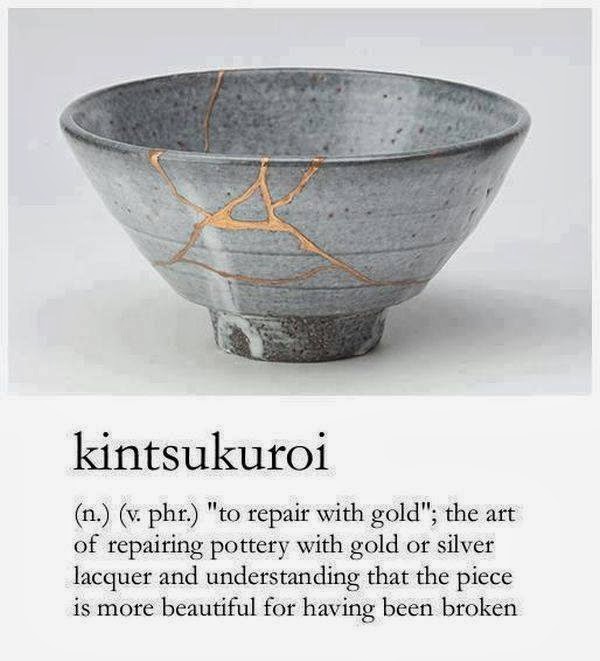
  • I want you to take a look at the picture on the front of your bulletin this morning.
    • Explain idea of kintsukuroi/kintsugi: “to repair with gold”; the art of repairing pottery with gold or silver lacquer and understanding that the piece is more beautiful for having been broken → practice that is thoroughly intentional
      • First, glue the pieces back together, making sure no piece or sliver or shard is missing
      • Paint those glued seams with gold, silver, or even sometimes platinum lacquer
        • Slowly
        • Deliberately
        • Painstakingly
        • Intentionally
      • There is something wholly and sacredly beautiful about an artform that, instead of trying to hide the brokenness of the object, highlights the repairs that have been made – the wholeness that exists in spite of the brokenness.
        • Vaneetha Risner, Christian author and blogger, about kintsugi: A broken piece that is put back together has more of a story, seems more authentic and real, is stronger and more resilient than something that has stayed pristine. The breaking of what once was, the layered and time-consuming process of putting it back together, the mending it with gold, all contribute to its value. And surprisingly, it becomes more resilient after it has been mended by kintsugi, even stronger than it was before.[1] → More beautiful than before it was broken … more valuable … than before it was broken … stronger than before it was broken …
    • What if we in the church lived this way? What if we loved this way? What if we believed this way? What if we ministered this way? → going to talk about some of those “what if”s today using one of the Bible’s most unmitigated stories of brokenness: Job
  • Today’s passage = the very end of the book of Job → But before we skip to the end, let’s talk about the book of Job as a whole.
    • Very deliberately called Job a “story” → Let me tell you why.
      • First Testament divided into 3 parts
        • Torah = history: first 5 books
        • Nevi’im = prophets: Joshua, Judges, 1/2 Samuel, 1/2 Kings as well as Isaiah, Jeremiah, Ezekiel, and the 12 Minor Prophets (Hosea, Joel, Amos, Obadiah, Jonah, Micah, Nahum, Habakkuk, Zephaniah, Haggai, Zechariah, and Malachi)
        • Ketuvim = writings: Hebrew poetry and wisdom literature → And it is within this third category – this wisdom literature category – that we find the book of Job.
          • Biblical scholar Adele Berlin: … often left to the reader has been the actual reading of the poem – the making of sense and beauty from its sounds, words, and structures, the perception that it is a unified entity with a distinctive message.[2]
    • This is particularly important when it comes to the book of Job.
      • Biblical scholar Carol Newsom’s descr. of Job: Job is a challenging book to read, not only because of the theological issues it treat but also because of the form in which it is written. It begins with a simple prose story (1:1-2:13) describing Job’s piety, the conversation between God and the satan, which leads to a decision to test Job, and the disasters that befall Job as the test of his piety. Abruptly, the style of the book changes in chap. 3, as Job and the friends who have gathered to comfort him begin to debate the meaning of what has befallen him and the proper posture Job should assume toward God. In contrast to the simple prose of the first two chapters, this dialogue is composed in elegant, sophisticated poetry, full of rare words and striking images. The climax of this section is the long speech of God from the whirlwind and Job’s brief reply. At that point, just as abruptly, the style again shifts back to simple prose for the conclusion, as Job’s well-being is restored and the remainder of his long life is briefly described. The changes between the beginning, middle, and end of the book are not merely stylistic, but also correspond to changes in the representation of characters and in the nature of the religious issues under consideration.[3] → This understanding is critical because it gives us context for the story of Job. It reiterates for us that Job is a tale from which we can learn something – an ancient fable of sorts. It’s not found in the “history” section of the First Testament. It was never meant to be read as a true story that actually happened to one man thousands of years ago. At it’s core, the book of Job is a story about brokenness and how, no matter how we experience that brokenness, God remains with us – steadfast, compassionate, and wholly present.
  • Think about the beginning of Job.
    • Job = “honest, a person of absolute integrity; he feared God and avoided evil”[4] → also a man who had everything
      • 7 sons and 3 daughters
      • 7000 sheep
      • 3000 camels
      • 500 pairs of oxen (do the math … 1000 oxen)
      • 500 female donkeys
      • “and a vast number of servants, so that he was greater than all the people of the east.”[5]
      • Also a man constantly offering up prayers and burnt offerings on behalf of himself and his family … just in case they were sinning and cursing God in their hearts.
    • Job’s unwavering faith and devotion catch the attention of the Adversary (which is what satan literally means in Hebrew) – beginning of Job: One day the divine beings came to present themselves before the Lord, and the Adversary also came among them. The Lord said to the Adversary, “Where did you come from?” The Adversary answered the Lord, “From wandering throughout the earth.”[6] → And isn’t that often how it feels when bad things happen, all? Especially in this day and age when it feels like every headline is just darker, scarier, uglier than the last. Doesn’t it feel like there’s just an undefinable malevolence “wandering throughout the earth”?
      • This Adversary = ancient Hebrews’ attempt to address what theologians today call the Problem of Evil → “Why do bad things happen to good people?” question
    • With that question in mind, all the bad things happen to Job, a good man.
      • Job’s oxen and camels are all stolen in 2 separate raids[7]
      • Job’s sheep are all burned up in “a raging fire [that] fell from the sky”[8]
      • Job’s children all die
      • Job’s body becomes covered in sores
      • Think about it, friends. Job has lost his security. Job has lost his livelihood – his job, essentially. He’s lost his family. He’s lost his health. Job is awash in grief.
        • Are you familiar with the term “ambiguous grief”? Ambiguous grief describes the grieving process when it involves someone who is still living but changed.
          • Grieving someone who is ill
          • Grieving a lost relationship (divorce, estrangement, incarceration, even a cross-country move)
          • Grieving someone suffering from any number of diseases that can either leave the body struggling but the mind intact (e.g.s – ALS or Huntington’s disease) or diseases that leave the body intact but the mind struggling (e.g.s – Alzheimer’s or dementia)
          • Grieving someone whose personality, whose life, whose circumstances, whose relationship with you has been altered by mental illness
          • There are so many of us wading through ambiguous grief in our lives. → old adage of not judging someone until you walk a mile in their shoes
        • The book of Job addresses so much of that ambiguous grief because Job is suffering both for his own tangible griefs – the loss of his children – as well as his ambiguous griefs. But through it all, God remains with Job.
    • Book of Job also addresses the pressures from the world around us to approach God or to think about God or to feel about God in a certain way
      • The vast majority of the book of Job = conversations btwn. Job and his friends → And there’s a lot that we could take away from these conversations – I mean, we’re talking about basically 38 Biblical chapters worth of conversations! … I mean, that’s not just multiple sermons’ worth of conversations, that’s multiple sermon series’ worth of conversations! But what I want us to notice today is one particular aspect of Job’s conversations with his friends about his circumstances and his faith.
        • Job’s friends = full of advice → full of suggestions and fixes and flowery words and worn out phrases → I’m sure that if “everything happens for a reason” and “when God closes a door, he opens a window” had been common phrases back when Job was written, they would be in there.
        • What Job’s interactions with his friends are lacking = listening → Job’s friends are all about telling him what to do and think and believe when it comes to God. But nothing in Job’s story tell us that his friends simply sat with Job and gave him space to be … to grieve … to find his own way back to God. They were there to convince Job, not to comfort him. And that’s so indicative of human nature, isn’t it? Especially here in the Midwest, I think. “How can I fix it? What can I do to make it better? Give me a task.” But what if the task needed most is just sitting quietly with someone utterly overwhelmed with their grief? With their brokenness? With their pain?
    • End of Job’s story – portion that we read today – is Job finding his way back to God on his own → Job has railed at God against his own self, against the land, against those who stole from him, and against even his friends who are trying to help him … but he never blames God. Throughout the entire book, Job continues to place trust in God. But he also places a little too much trust in himself.
      • Buried deep within Job – ch. 32: [Job’s three friends, Eliphaz, Bildad, and Zophar] stopped answering Job because he thought he was righteous. Elihu son of Barachel the Buzite from the clan of Ram was angry, angry with Job because he considered himself more righteous than God.[9] → In this and in the multiple chapters of Elihu’s response to Job that follow, we learn that Job’s understandable “why me?” grief response is more than likely tinged with a “why not them?” response as well. “I’ve been great, God … so why me instead of those sneaky Chaldeans who stole my camels? Why me instead of those sinners? Why me instead of … instead of … instead of …?”
        • Large portions of Job = Job listing all the ways he isn’t broken instead of bringing his true brokenness to God → out in the open, genuinely and honestly … maybe not for all the world to see, but at least with enough integrity for those who love him to see.
  • You see, it’s only after Job has acknowledged God’s supreme goodness above even his own goodness at the beginning of our text this morning that we find Job restored.
    • Today’s text: Job answered the Lord: I know you can do anything; no plan of yours can be opposed successfully. You said, “Who is this darkening counsel without knowledge?”I have indeed spoken about things I didn’t understand, wonders beyond my comprehension. You said, “Listen and I will speak; I will question you and you will inform me.” My ears had heard about you, but now my eyes have seen you. Therefore, I relent and find comfort on dust and ashes.[10] → There is humility in Job. There is acknowledgment in Job. In his brokenness and through his brokenness, he is finding the beauty of God’s love and compassion and presence.
      • Your $10 theological term for today = theodicy: a defense of God’s goodness and power in the face of evil → The entire book of Job is exactly that: a defense of God’s goodness and power in the face of all the many and varied evils we find in the world.
        • What’s the lesson I DON’T want you to take away from today: that God causes those evils just to bring us closer → That’s not what happened. In the words of contemporary Christian writer Sarah Bessey: This world has enough horrifying tyrants and torturers and cruel monsters: we don’t need to make God into one or try to baptize such things with sacred language. That is truly profane.[11]
        • What we CAN take from Job = God’s abiding and blessed presence with us no matter our stage or state of brokenness → God will always be there to put us back together, making us more beautiful, more valuable, and even stronger than we were before. Amen.

[1] https://www.vaneetha.com/journal/kintsugi-beauty-in-the-broken.

[2] Adele Berlin. “Introduction to Hebrew Poetry” in The New Interpreter’s Bible Commentary series, vol. 4. (Nashville: Abingdon Press, 1996), 314.

[3] Carol A. Newsom. “The Book of Job: Introduction, Commentary, and Reflections” in The New Interpreter’s Bible Commentary series, vol. 4. (Nashville: Abingdon Press, 1996), 320.

[4] Job 1:1.

[5] Job 1:2-3.

[6] Job 1:6-7.

[7] Job 1:14, 17.

[8] Job 1:16.

[9] Job 32:1-2.

[10] Job 42:1-6.

[11] Sarah Bessey. Field Notes for the Wilderness: Practices for an Evolving Faith. (New York: Convergent Books, 2024), 61.


Sunday’s sermon: First … Is the Worst?

Text used – Mark 10:35-45

  • Ahhh … that childhood spirit of competitiveness that has given birth to the age-old playground chants:
    • “We want a pitcher, not a belly-itcher!”
    • “See ya … wouldn’t wanna be ya!”
    • As well as the ever-classic, “Na na na na na na!”
    • And, inevitably when your team came in second at something, you touted out that tried and true chant: “First is the worst, second is the best, third is the one with the hairiest chest!” Not that we knew anything about that as elementary school kids, but hey … it rhymed, right?
      • At the core of this particularly playground gem = reality that nobody likes to lose, right?
      • Lots of different things motivate competitiveness
        • Intrinsic factors: self-worth, desire to master a task/skill, desire to be accepted
        • Extrinsic factors: presence of a rival, potential future effects of event (e.g. – being selected for a team/role or college scouts in the stands at a sporting event), desire for others to find your own contribution valuable
        • Article from ZME Science: Just as with many behavioral traits, competitiveness is not an absolute quality but instead exists on a continuum. Some individuals are highly competitive, others less so, and a select few appear to be constantly compelled to outdo others. Our perception of competitiveness also varies, with most individuals acknowledging a line between healthy and unhealthy competition. Yet, drawing this line within any specific context can be a contentious task.[1]
  • And trying to draw this particularly contentious line between healthy and unhealthy competitiveness is where we find James and John in our gospel story this morning.
    • Take a minute – remind ourselves who James and John are
      • Mk’s own descr. of their call story with Jesus: As Jesus passed alongside the Galilee See, he saw two brothers, Simon and Andrew. They were fishermen, so they were throwing fishing nets into the sea. “Come, follow me,” he said, “and I’ll show you how to fish for people.” Right away, they left their nets and followed him. After going a little farther, he saw James and John, Zebedee’s sons, in their boat repairing their fishing nets. At that very moment he called them. They followed him, leaving their father Zebedee in the boat with the hired workers.[2]
      • Mk = also the only gospel that gives James and John their infamous nickname: the Sons of Thunder – Mk 3: [Jesus] appointed twelve: Peter, a name he gave Simon; James and John, Zebedee’s sons, whom he nicknamed Boanerges, which means “sons of Thunder”; and Andrew; Philip; Bartholomew; Matthew; Thomas; James, Alphaeus’ son; Thaddeus; Simon the Cananaean; and Judas Iscariot, who betrayed Jesus.[3]
        • Scholars speculate that this particular moniker – this “sons of Thunder” – has to do with James’ and John’s personalities
          • Boisterous
          • Loud
          • Brash
          • Quick to act before thinking
    • Certainly sound like the kind of traits that could have led to today’s uncomfortable gospel situation: James and John approach Jesus à “Teacher, we want you to do for us whatever we ask.”[4] → Okay … timeout for a second. Any parent … any teacher … any babysitter … anyone who’s ever been around kids for more than 5 minutes could tell you that an opening like this is a RED FLAG!! “Mom, whatever I’m about to ask you to do … could you just, you know, say ‘yes’ to it?” Never. Gonna. Fly. Flox!! Okay, James and John … we’ll pretend we didn’t hear that … continue à next comes The Big Ask: They said, “Allow one of us to sit on your right and the other on your left when you enter your glory.”[5] → Woah woah woah woah!! Lay it all out there, why don’tcha, James and John!? Sheesh!
      • Ask = audacious because they are asking for the two seats of greatest power
        • Two seats closest to power
        • Two seats on both sides of the throne = Jesus’ 2nd and 3rd in command
        • Two seats generally reserved in the culture for those deserving the greatest honor and glory and respect
      • Ask = even more audacious when we consider what Jesus said in the verses just prior to what we read today: Jesus and his disciples were on the road, going up to Jerusalem, with Jesus in the lead. The disciples were amazed while the others following behind were afraid. Taking the Twelve aside again, he told them what was about to happen to him. “Look!” he said. “We’re going up to Jerusalem. The Human One will be handed over to the chief priests and the legal experts. They will condemn him to death and hand him over to the Gentiles. They will ridicule him, spit on him, torture him, and kill him. After three days, he will rise up.”[6] → So Jesus has just foretold his own horrible arrest, torture, death, and resurrection … and directly following that, James and John sidle up to him and say, “Hey, Jesus … can you just say yes to whatever we’re about to ask you?”
        • Scholar: To ambition and vanity, Mark adds dramatic irony. Jesus has just foretold his coming condemnation, humiliation, and death, but James and John are still dreaming of power and position. … Eager to ease into positions of power and glory, the brothers do not realize that they will soon be called upon to sacrifice everything for their cause.[7]
    • Jesus clearly isn’t thrilled with this ask – response: Jesus replied, “You don’t know what you’re asking! Can you drink the cup I drink or receive the baptism I receive?”[8] (referring to the torment and death that await him)
    • Other disciples are also definitely not thrilled with this little side conversation – text: Now when the other ten disciples heard about this, they became angry with James and John.[9] → And it’s this conflict that brings about Jesus’ often-quoted phrase about how important it is to not be first.
      • Mk’s language isn’t quite the same as the “first shall be last and the last shall be first” that we’re probably most familiar with (that language comes out of Mt’s gospel) – text: Whoever wants to be great among you will be your servant. Whoever wants to be first among you will be the slave of all, for the Human One didn’t come to be served but rather to serve and to give his life to liberate many people.[10]
  • What I find most interesting about the way Jesus frames this discussion here in Mark’s gospel is him emphasis on serving. And in this emphasis, Jesus is teaching us an important lesson about serving, and that is that the attitude behind the serving matters.
    • Poor sons of Thunder gets used as the “what not to do” example here: portrayed as serving (at least in this particular moment) for the sake of the glory it will bring to them, not for the sake of the service itself → Now, I don’t think we can paint James and John with a brush broad enough to say that’s the only reason they followed Jesus from day one or that that’s the only reason they stayed with Jesus to the end and continued to spread the gospel message long after Jesus’ death, resurrection, and ascension. We just happen to have caught James and John in this particular moment of imperfection for which they’ve become a little bit infamous.
      • Something I think “doubting Thomas” could probably understand
      • Also important to notice that James and John are more than likely not alone in this particular moment of imperfect motivation – scholar: James and John are not alone. The other disciples do not fare any better. Hearing what has happened, they get angry, and one can imagine the ensuing squabble among the disciples, which Jesus must counter with his teaching about greatness and servanthood.[11]
    • So maybe all the disciples were in a less-than-charitable mood. Maybe they all needed a refresher on why they were doing what they were doing in the first place. Maybe they all needed a bit of a spiritual and service-oriented reset. And that’s okay. I think that in the world today – even in the work of the church today – we often find ourselves in a similar place.
      • E.g. – Operation Christmas Child run by Samaritan’s Purse
        • Pack shoeboxes with small gifts for children around the world → Sounds like a great thing, right? Except when you find out that these boxes also end up including a wide array of highly fundamental religious pamphlets and tracts, and that those who receive boxes are later pressured/guilted into participating in further “religious education”/rigid indoctrination.
        • Also doesn’t take into account anything about who the children receiving these boxes are, what they or their communities actually need, how to best support their families and/or their communities, or where they might be located
          • (Admittedly tame) e.g. – shoebox with warm hat, mittens, scarf, etc. being given to a child who lives someplace where it never snows
          • Less tame e.g. – any of the ridiculous “white idea of beauty” dolls (oh … say, Barbie, for example) being sent to countries where their idea of beauty is vastly different
        • Do I believe that those sitting and filling those shoeboxes with various toys and trinkets for children are doing so out of malice or apathy? Of course not. They’re doing it because they want to help. They want to feel good about helping … but is there a true spirit of service behind that help – a spirit that seeks out the actual needs of those being served as opposed to just imposing whatever is easiest for helpers and gives that quick “Look at the good I did!” moral boost?
    • Often a pitfall for the church – has been for centuries àBut this idea of helping without truly considering the attitude behind that service and the most genuine way to go about that service can lead to some pretty atrocious things.
      • Doctrine of Discovery
      • Indian/Aboriginal Boarding Schools
      • Colonization “for the good of the natives”
      • And so on. And so on.
    • As Christians, we have the perfect example of service in Jesus Christ.
      • Jesus … who met people where they were at, not where he thought they should be
      • Jesus … who asked people what they needed of him instead of simply assuming he knew best
      • Jesus … who served those who needed it first before ever turning to those who already had enough
      • Jesus … who reached out to those whom the rest of society had long since left behind.
    • Now, I will say that service has always been something this church strives to embody. It’s something that’s at the core of who we are as this particular body of Christ here in Oronoco. It’s even part of our mission statement: “We are a community of believers whose mission is to share God’s Word, show God’s Love, serve God’s World, and strive for God’s Peace.” And I know that a lot of you are involved in various service acts and organizations within this community and beyond. And that’s great! Jesus literally calls us to serve!
      • Mt 25: “I assure you that when you have done it for one of the least of these brothers and sisters of mine, you have done it for me.”[12]
      • I just want to be sure that as we continue in this life of service to which we have been called – through this church and out in the wider world – that we remember to ask and to keep asking ourselves two questions:
        • Why am I serving?
        • How is this service helping someone today?
        • Amen.

[1] Tibi Puiu. “Why are some people so competitive? The psychology of competitiveness” from ZME Science, found at https://zmescience.com/feature-post/health/mind-brain/why-people-are-competitive/. First posted July 20, 2023, edited January 4, 2024, accessed October 20, 2024.

[2] Mk 1:16-20.

[3] Mk 3:16-19.

[4] Mk 10:35.

[5] Mk 10:37.

[6] Mk 10:32-34.

[7] James J. Thompson. “Proper 24 (Sunday between October 16 and October 22 inclusive) – Mark 10:35-45 – Theological Perspective” in Feasting on the Word: Preaching the Revised Common Lectionary – Year B, vol. 4. (Louisville: Westminster John Knox Press, 2009), 188, 190.

[8] Mk 10:38.

[9] Mk 10:41.

[10] Mk 10:43b-45.

[11] Charles L. Campbell. “Proper 24 (Sunday between October 16 and October 22 inclusive) – Mark 10:35-45 – Homiletical Perspective” in Feasting on the Word: Preaching the Revised Common Lectionary – Year B, vol. 4. (Louisville: Westminster John Knox Press, 2009), 189.

[12] Mt 25:40.

Sunday’s sermon: Jesus Loves You … And I’m Tryin’

Text used – Hebrews 2:5-12

  • The sermon title this morning is one of my favorite phrases: “Jesus loves you … and I’m tryin’!” It’s such a favorite phrase that I have a t-shirt with this phrase on it … this t-shirt, in fact!
    • Admittedly, it’s a phrase that’s often said a little tongue-in-cheek – a phrase akin to the Southern expression “bless your heart” … which actually means “you’re driving me crazy but I can’t express that in this particular moment without being rude” → Jesus loves you … and I’m tryin’.
    • As far as I can tell, it’s actually a phrase that originated from a song by contemporary Christian singer (and fellow Minnesotan!) Jason Gray – a song, oddly enough, called “Jesus Loves You (And I’m Trying).”[1] I want to read you the lyrics to that song because I want to be sure you catch them. They’re actually pretty poignant. [read lyrics]
  • And it’s that sentiment – that acknowledgment of the inherent worth of even the people we find it the hardest to get along with … the hardest to tolerate … the hardest to love … that resonates with our Scripture reading this morning.
    • Right off the bat: feels like a difficult passage because of one simple/not-so-simple word: angels – text: God didn’t put the world that is coming (the world we are talking about) under the angels’ [2] → When you pair that with the sentence it’s found in – a sentence about “the world that is coming” – and we find ourselves in one of those really difficult texts particular to the New Testament: eschatological texts.
      • “Eschatological” = simply big, fancy word for the end-times
      • Texts that scholars, pastors, Bible-thumpers and regular confused folx have been arguing over for centuries
      • My take (and the take of some of the scholars that I’ve read): the framing of this text within this idea of “the world that is coming” = not a literal prediction about the end of the world but a literary device meant to give the reader a sense of the absolute, endless nature of God – of God’s power, of God’s love, of God’s presence, of God’s grace
        • Scholar: The author of Hebrews reminds us quite early that the beginning and ending of all Christian thinking and living is God. God is the subject of the New Testament as well as of the Old.[3] → In other words, from the moment time began to the moment time ends, all of it – the everything of the world we know and the everything beyond this world – belong to God.
          • Unknown writer of Heb underscores this point with the text that s/he quotes in the next few vv: Instead, someone declared somewhere, What is humanity that you think about them? Or what are the human beings that you care about them? For a while you made them lower than angels.You crowned the human beings with glory and honor. You put everything under their control.[4] → passage from Ps 8 – a psalm of praise to the awesome power of God [read Ps 8]
            • Awesome power of God
            • Fleeting nature of humanity in the face of that awesomeness
    • Heb writer then bring it full circle to the “Jesus loves you” part of our phrase by explaining the grace poured out for us through the love and life, the death and resurrection of Jesus – text: However, we do see the one who was made lower in order than the angels for a little while—it’s Jesus! He’s the one who is now crowned with glory and honor because of the suffering of his death. He suffered death so that he could taste death for everyone through God’s grace.[5] → Hear that again, friends: “He suffered death so that he could taste death for everyone through God’s grace.” It doesn’t say Jesus tasted death so only the people I like could experience God’s grace. It doesn’t say Jesus tasted death so only the people who look like me … think like me … pray like me … love like me … speak like me … vote like me could experience God’s grace. We do such a thorough job nowadays of dividing ourselves – of walling ourselves off from one another while vilifying “the other.” The rhetoric about “the other side” has gotten so vicious, so vitriolic that we can’t even come to the same table anymore. And yet the life and love that Jesus lived – the ministry that he both preached and embodied – was a ministry of coming together.
      • Including those who had been excluded
      • But also extending the invitation to those who had done the excluding
      • Jesus gave every single person the choice: “Learn from me. Live like me. Love with me. Or don’t.” He didn’t mandate it. He didn’t force it. Because, in the end, forced love isn’t really love, is it?
  • “Yes, Jesus loves you … and I’m tryin’.” → The second half of that phrase is just as necessary as the first for two important reasons.
    • FIRST, it’s a recognition of our own faults – our own tendencies to draw those lines between “us” and “them” instead of trying to cross those lines [re-read last verse of Jason Gray’s song] → Basically, these three little words – “and I’m tryin’” – are a confession. “I’m trying, God, but sometimes … lots of times … maybe even all the time, I’m failing. I’m trying, God, but today, I’m just too angry, too scared, too hurt, too overwhelmed, too worried, too stressed. I’m trying, God. I’m trying, God. I know I’m not getting it right all the time … but I’m tryin’.”
      • Purpose of the confession portion of the prayer that we pray at the beginning of worship every Sunday morning (from the Book of Common Worship): Having praised the holiness of God, we must also face the sinful state of the world and of our lives, confessing our unworthiness to enter into God’s presence. Nevertheless, we approach God with confidence, trusting in the mercy of Jesus Christ. This turn from communal praise to corporate confession, established on the promise of God’s grace, is one of the hallmarks of the Reformed tradition. … As members of Christ’s body, we confess the reality of sin, captivity, and brokenness in personal and common life and ask God’s saving grace.[6] → Yes, Jesus loves you … and I’m tryin’.
    • SECOND reason this part of the phrase is important = it’s a pledge → It’s simultaneously a promise and a prayer to do better – to try to live and love out loud and in the most difficult circumstances the way Jesus did.
      • Heb passage speaks to this at the very end of today’s reading: This salvation belongs to many sons and daughters whom he’s leading to glory. This is because the one who makes people holy and the people who are being made holy all come from one source. That is why Jesus isn’t ashamed to call them brothers and sisters when he says, I will publicly announce your name to my brothers and sisters. I will praise you in the middle of the assembly.[7] → If Jesus himself – even with the knowledge of our imperfections and struggles – isn’t ashamed to call us siblings … If Jesus himself – even with the weight of our mistakes and our prejudices stacked upon his own shoulders – could publicly announce our name to all the world as God’s own beloved child, then we have to try to do the same.
        • Through our words
        • Through our actions
        • Even through our thoughts (which I know is such a hard part because, hey – who hears my snarky thoughts but me, right?)
        • The whole sentiment behind “Jesus loves you … and I’m tryin’” is an acknowledgment that even in the most difficult circumstances, we will try to live out our faith – to ensure that our actions and our words out there match the devotion and the grace that we crave … that we seek … that we come to find in here every Sunday morning. “Jesus loves you … and I’m tryin’” is about bridging the gap between this hour on Sunday morning and the rest of the week.
  • Conclude with story of Mister Rogers from Holy Troublemakers & Unconventional Saints by Daneen Akers[8]“Yes, Jesus loves you … and I’m trying.” Amen.

[1] Jason Gray. “Jesus Loves You (And I’m Trying)” from Land of the Living album, released by Centricity Music, November 17, 2023.

[2] Heb 2:5 (emphasis added).

[3] Fred B. Craddock. “The Letter to the Hebrews: Introduction, Commentary, and Reflections” in The New Interpreter’s Bible Commentary series, vol. 12. )Nashville: Abingdon Press, 1998), 42.

[4] Heb 2:6-8a.

[5] Heb 2:9.

[6] From “The Lord’s Day – Confession and Pardon” in the Book of Common Worship. (Louisville: Westminster John Knox Press, 2018), 5.

[7] Heb 2:10b-12.

[8] Daneen Akers. “(Mister) Fred Rogers” in Holy Troublemakers & Unconventional Saints. (Oceanside: Watchfire Media, 2019). 68-73.

Sunday’s sermon: A Tale of Bones and Breath

Text used – Ezekiel 37:1-14

  • I can’t hear this odd tale from Ezekiel without thinking about the Disney Pixar movie [1]
    • Basic storyline
      • Miguel (young boy) wants to be a musician more than anything but his family forbids anything musical → through the magic of Dia de los Muertos – the Latin American Day of the Dead festival to celebrate, remember, and honor past family members – Miguel finds himself in the Land of the Dead → goes looking for his musical idol and ends up finding the truth about his family → And, in true Disney Pixar fashion, putting all the family history pieces back together and tying everything up in a nice, happy-ending sort of way.
      • Because Miguel spends almost the entire movie in the Land of the Dead, the vast majority of the characters throughout the movie are skeletons.
        • Plenty of skeleton- and bone-related humor sprinkled throughout (for both kids and adults)
        • Definitely the part that reminds me of this tale of Ezekiel’s vision from Scripture this morning → movie full of skeletons up walking around … singing … dancing … participating in Disney-fied hijinks and mayhem
        • But one of the most touching parts in the movie is when Miguel’s quirky and somewhat scheming guide Hector seeks out the help of one of his bone buddies. (scene below) → while they’re visiting this friend, he disappears → Hector explains to Miguel that when nobody on the other side sets out your picture in an ofrenda – a family remembrance shrine – on Dia de los Muertos, you disappear in the Land of the Dead. While people remember you, in a way, your life goes on. But when you are no longer remembered, you disappear.
          • Hector’s description: When there’s no one left in the living world who remembers you, you disappear from this world. We call it the Final Death.
    • And it’s really that point – that particular element of the story, the fact that being remembered gives life, even after dead – that really had me thinking about Ezekiel’s strange tale.
  • Ezek begins today’s passage by giving us the language of prophecy → makes it clear to us that this is a vision given to him by God, not an actual occurrence – text: The Lord’s power overcame me, and while I was in the Lord’s spirit, he led me out and set me down in the middle of a certain valley.[2]
    • Literal Heb. = “hand of the Lord” → phrase often used by prophets and those who communed with God (e.g. – Moses) to express the way God was with them → didn’t literally indicate a hand but more the powerful presence of God upon them
      • Scholar: The metaphor “the hand of the Lord” describes divine action for the salvation of the Hebrews. … As an expression of divine redemption beyond social and political trauma, it appears nearly 190 times in the Hebrew Bible.[3]
  • Moves into that unforgettable description of the valley – text: It was full of bones. … I saw that there were a great many of them on the valley floor, and they were very dry.[4] → Even with so few words, it paints a vivid picture, doesn’t it?
    • Imagine it for a minute
      • Something about this valley always evokes desert → maybe it’s the “dry” description of the bones, maybe it’s because we know that the part of the world in which Ezekiel himself lived is indeed a land of deserts and desolate wilderness
      • So there’s sand and bare rock everywhere you look – not just beneath you, but to the left and right as well. Remember, this is a valley.
        • Any potential vegetation is stunted and scraggly
      • Surrounded by bones – bones that are “very dry” – as bleached and abandoned as the centerpiece in a Georgia O’Keeffe painting
      • As you imagine it, I want you to feel the desolation of it … the remoteness of it … the solitariness of it … Close your eyes. Feel the harsh wind whipping up the sand so that the grittiness of it scrapes at your arms and your cheeks. Feel the heat of the sun bearing down on your back and on your dry lips. Hear the utter silence, broken only by the whistling of the wind, the quiet rasp of the sand as it moves, possibly the skittering of some desert creature. [PAUSE] See the whiteness of all the bones around you – bones, as far as the eye can see … bones that clearly haven’t lived for a long, long time.
    • When we’re feeling depleted inside – worn out from the challenges of our day-to-day lives and the mountains we’ve had to climb … worn out from all the normal moments piled one on top of another with the weight of the hard moments bearing down on top of it all … worn out and weary, not just in our bodies, but deep, deep down in our souls … When we’re feeling depleted inside, we can relate to those bones, can’t we?
      • Wayne Muller, in Sabbath: Finding Rest, Renewal, and Delight in Our Busy Lives[5], talks about how damaging our lack of sabbath rest can be to ourselves – our bodies and our spirits – as well as our relationships and our communities
        • Drives home this point by drawing an interesting comparison: the Chinese pictograph for “busy” is composed to two characters: heart and killing.[6]
        • Emphasizes the importance of rest in the face of this culturally-driven and -demanded busyness: If busyness can become a kind of violence, we do not have to stretch our perception very far to see that Sabbath time – effortless, nourishing rest – can invite a healing of this violence. When we consecrate a time to listen to the still, small voices, we remember the root of inner wisdom that makes work fruitful. We remember from where we are most deeply nourished, and see more clearly the shape and texture of the people and things before us.[7]
  • And that’s exactly what we see in Ezekiel’s vision. Only when the bones have been given both the word of the Lord and the breath of the Lord, do they have life again.
    • Love the back-and-forth btwn God and Ezek at the beginning of this portion – text: He asked me, “Human one, can these bones live again?” I said, “Lord God, only you know.”[8] → It feels like there’s a playfulness to this as well as a challenge and a reverent deference. It almost feels like God is asking Ezekiel to dare God to bring these dry, desiccated bones back to life. “What do you think, Ezekiel? Can they live again? Can I do it?” And in response, Ezekiel leaves the ball firmly and faithfully in God’s court: “Lord God, only you ”
      • Heb. “know” = implies knowledge, yes, but also understanding and caring and choosing → Ezekiel is saying, “It’s all you, God. Only you know … only you understand … only you have the care for this … only you can make this choice. You are You, God, and I am not, so do your thing!”
    • And indeed, God does God’s thing!
      • Orders Ezek to prophesy to the bones: “I am about to put breath in you, and you will live again.”[9]
      • Ezek speaks the words God gives to him, and everything happens!
        • Bones come together
        • Sinews covered the bones
        • Flesh
        • Skin
    • But the bones needed more than the word. – text: He said to me, “Prophesy to the breath; prophesy, human one! Say to the breath, The Lord God proclaims: Come from the four winds, breath! Breathe into these dead bodies and let them live.” I prophesied just as he commanded me. When the breath entered them, they came to life and stood on their feet, an extraordinarily large company.[10] → Those dry, neglected bones needed more than God’s word. They needed God’s breath … God’s ruach … God’s Spirit to bring life into them again.
      • Significant that the scene in Coco when Miguel and Hector are visiting Hector’s friend when he disappears → doesn’t just pop out of existence → slowly fades → last moment, you hear him exhale one last breath → Bones … [deep breath in] … and breath … [deep breath out]. Death … [deep breath in] … and life … [deep breath out] … Depletion … [deep breath in] … and renewal … [deep breath out]. In that giving of breath … in that deliberate, grace-filled, Spirit-driven, life-giving act, God refused to leave behind those dry and dusty bones. Each and every one of them. And still and always, God refuses to leave behind all who felt forgotten. Even when we feel like the world has tried to forget us … even when we feel like those we love have forgotten us … even when we forget ourselves, God will never forget us. God breathes new life into us again … [deep breath in and out] … and again … [deep breath in and out] … and again.
    • Scholar: God calls the breath to come from the four winds and breathe upon the slain. So it happens. This breath is the spirit of God, the life-giving ruach God breathed into the first human creature in the garden. This breath moves forth in the Lazarus story. This same breath was breathed into Jesus crucified, lifting him up to resurrection life, and touched us when the Spirit came upon us in baptism. This breath moves through the world, raising people into new life when all the odds are against it. We need to hear the vision of Ezekiel in the valley of dry bones. It is a scene meant to live in the imagination and the heart, when we find ourselves gasping for breath, struggling to stay alive. [We] can ask [ourselves], where are the dry bones today, where is the valley of death that needs to hear the promise of the living God?[11]
      • Muller’s book on sabbath includes a number of practices to help you find sabbath rest again → conclude this morning with what he calls “The Cadence of Breath”[12]: One beautiful form of meditation is to simply follow the breath. Sit comfortably, and close your eyes. Let yourself become aware of the physical sensation of the breath, feeling the shape, texture, and duration of the inhale and the exhale. Do not change your breathing, do not strain or push in any way. Simply watch the breath breathe itself. Feel the rhythm of the breath, feel its timing, the end of the exhale, the readiness to inhale. When the mind wanders – as it will – do not worry. Simply return your awareness to the breath. Silently note each inhale or exhale, mentally noting in, out or rising, falling. Do this for five minutes at first. What do you notice about the rhythm of rest in your breathing? What do you notice about the rhythm of breath in your body? → And to that I would add, “What do you notice about the presence of God with you … in you … all around you?” Amen.

[1] Coco, written by Lee Unkrich, Jason Katz, Matthew Aldrich, and Adrian Molina, directed by Adrian Molina and Kee Unkrich. Released by Walt Disney Studios Motion Pictures, Nov. 22, 2017.

[2] Ezek 37:1.

[3] Stephen Breck Reid. “Fifth Sunday in Lent – Ezekiel 37:1-14, Exegetical Perspective” in Feasting on the Word: Preaching the Revised Common Lectionary – Year A, vol. 2. (Louisville: Westminster John Knox Press, 2010), 123.

[4] Ezek 37:1b, 2.

[5] Wayne Muller. Sabbath: Finding Rest, Renewal, and Delight in Our Busy Lives. (New York: Bantam Books), 1999.

[6] Ibid, 3.

[7] Muller, 5.

[8] Ezek 37:3.

[9] Ezek 37:5.

[10] Ezek 37:9-10.

[11] James A. Wallace. “Fifth Sunday in Lent – Ezekiel 37:1-14, Homiletical Perspective” in Feasting on the Word: Preaching the Revised Common Lectionary – Year A, vol. 2. (Louisville: Westminster John Knox Press, 2010), 127.

[12] Muller, 74-75.

Sunday’s sermon: Faith That’s Been Swamped

Text used – Mark 4:35-41

  • Let me tell you a story this morning. It’s a story about a man, and it’s a story about loss.[1] Life was going quite well for this man. He was a successful Chicago lawyer with multiple real estate investments. He had a beautiful and loving wife who had just given birth to the couple’s fourth precious daughter. Then, on Oct. 8, 1871, a fire broke out in a barn on the southwest side of Chicago – a fire that would end up burning for more than 24 hours, sweeping through a city comprised mostly of wooden buildings, wooden sidewalks, and wooden homes; a fire that would end up killing 300 people and leaving 1/3 of the city’s population homeless[2]; a fire that would destroy many of this man’s real estate investments.[3] On the heels of the devastation of this fire, this man’s finances suffered another blow with the Panic of 1873, one of the worst financial crises in American history that saw more than 100 banks across the nation fail.[4] Yet even in the face of all this hardship – or perhaps because of it – this man decided he and his family needed some time to get away. They needed to leave the troubles of their day-to-day lives behind for a bit – breathe the air of another city, another land, another continent. So he booked passage for all six of them on an iron steamship bound for France on Nov. 15, 1873. At the last minute, business obligations made it necessary for this man to stay behind, but he saw his wife and four daughter – ages 11, 9, 5, and 2 – on board and promised to join them in France as soon as he could. He waved at them from the pier as their ship departed. One week later, this French steamship – the Ville du Havre – collided with the Loch Earn, a British clipper ship, in the middle of the Atlantic Ocean. The Ville du Havre sank in just 12 minutes, killing an estimated 226 people, including the man’s four daughters – Horatio Spafford’s four daughters: Annie, Maggie, Bessie, and Tanetta. His wife, Anna, survived by clinging to a floating plank.
    • From blog where I found this story: As anyone can imagine, the accounts of the Ville du Havre sinking are terrifying. Heartbreakingly, in the last moments of daughter Annie Spafford’s life she is recorded as proclaiming: “Don’t be afraid. The Sea is His and He made it.” As Anna was thrown into the sea, she felt her baby Tanetta pulled out of her arms by the rough waves. All four daughters drowned. When Anna was finally rescued she was unconscious, floating on a piece of debris.[5]
    • The ship that rescued the survivors took them to Cardiff, Wales, and Anna sent her husband a devastating telegram: “Saved, but saved alone. What shall I do?” From Cardiff, Anna Spafford made her way to France to stay with friends, and Horatio set off for France himself to join his devastated wife.
      • Again, from the blog: At one point during the voyage, the ship’s captain summoned Horatio to his cabin and explained that he had determined the exact spot where the Ville du Havre had gone down. He let Horatio know that they were at that moment passing that very spot. Horatio then returned to his own cabin and, leaning for strength on his tremendous faith in God, wrote his famous hymn.[6] (see video below)
        • Spafford wrote the words that morning
        • Later gave the words to his Chicago neighbor, Philip P. Bliss, who composed the tune – a tune to which he gave a poignant and haunting name: Ville du Havre
  • Text: Later that day, when evening came, Jesus said to them, “Let’s cross over to the other side of the lake.” They left the crowd and took him in the boat just as he was. Other boats followed along. Gale-force winds arise, and waves crashed against the boat so that the boat was swamped. But Jesus was in the rear of the boat, sleeping on a pillow. They woke him up and said, “Teacher, don’t you care that we’re drowning?”[7]
    • Scholar: Fear. The visceral response of Jesus’ terrified disciples in a frail storm-tossed boat resonates both in the individual lives of Christians and in their corporate life in congregations and civic communities. We are afraid of the “wind and waves” that assail our fragile vessels – our lives, our churches, our cities, and nations. We fear disapproval, rejection, failure, meaningless[ness], illness, and of course, we fear death – our own death, the death of those we love, and the potential demise of the communities we cherish.[8]
    • Yes, friends. The feeling of having our lifeboat swamped is a true and present reality.
      • Swamped by pain
      • Swamped by illness
      • Swamped by loneliness
      • Swamped by grief
      • Swamped by frustration
      • Swamped by rejection
    • Yes, friends. The feeling of having our lifeboat tossed about by gale-force winds is a true and present reality.
      • Gr. “gale-force” = literally “hurricane” + general Gr. word mega = great, many, large, intense
      • So let’s talk about this storm for a minute.
        • Mk’s gospel ≠ only gospel to tell this story of Jesus and his disciples in their boat on rough and storm-tossed Sea of Galilee → also found in Mt 8[9] and Lk 8[10]
        • BUT Mk’s gospel is the only one that stages this story at night → would have made sailing out into the lake more dangerous because of the reduced visibility of the darkness of the night → Rough waters are scary enough in the daylight. Rough waters cloaked in the utter darkness of a night 2000 years ago that was unbroken by any light pollution … terrifying.
        • Historically, storms like this didn’t come up on the Sea of Galilee.[11]
          • Most people who have lived around the Sea of Galilee their whole lives have never seen high waves or huge storms like they
          • “Sea of Galilee” = actually a relatively small lake – only 13 miles long (north-south) by 7 miles wide (east-west)
            • Reference point: Lake Mille Lacs = about 16 miles long (north-south) by 14 miles wide (east-west)
          • Sea of Galilee = also 700 ft. below sea level, putting it in a more sheltered area → warm, calm, and relatively storm-free year round
        • So while it might be easy for us to dismiss this incident or to want to chastise Jesus and the disciples – “What were you thinking, going out on a boat on the sea like this!?” – there’s no reason to think they should have expected a storm like this. They do happen, but they weren’t a regular occurrence.
      • Also have to take into consideration the kind of boat that Jesus and the disciples were probably in → not a nice, big sailing ship with high sides and belowdecks areas to find shelter in a storm → Remember, the Sea of Galilee is small – smaller that Lake Mille Lacs – so the boat couldn’t be that big.
        • The Ancient Galilee Boat (a.k.a. – the “Jesus Boat”) = hull recovered from the Sea of Galilee in 1986 → old enough to have been on the water in the time of Jesus and his disciples[12]
          • Remains were 27 ft. long, 7½ ft. wide, and just over 4 ft. high → large enough to carry roughly 15 people … or Jesus and 12 disciples For all intents and purposes, we’re talking about a boat roughly the size of the pews on one side of the sanctuary. Against huge waves and gale-force winds. In the middle of a lake. At night. … “Teacher, don’t you care that we’re drowning?”
  • So often with this story, the disciples’ fear gets dismissed. It gets belittled. It gets shamed. “You’re with the Messiah,” we say. “You’re with Jesus! Have a little faith!”
    • BUT we have to remember
      • Remember that the disciples hadn’t really been with Jesus very long at this point → Sure, he’d done some amazing healing and some radical teaching so far. Maybe they’d heard some whispers. Maybe they’d entertained the glimmer of a hope that this rabbi that they were following might bring about change. But they didn’t know who he was yet. So of course they were afraid!
      • Remember that, while it’s easy for us to look back with a rational head, fear is anything but rational → Biologically, the chemicals in our brain that are produced in moments of fear take over our logical minds with built-in self-defense mechanisms – physical changes in the way our bodies function and react that are designed to keep us alive in life-threatening circumstances. There is no rationalizing in the face of fear.
        • Find that the presence and reality of the disciples’ fear in this story is a blessing → Because we all face fear in our lives – fear for ourselves, fear for our loved ones, fear for our communities, fear for our world. And just the face that the gospel-writers were real enough to include the disciples’ fear in all its irrational and terrified truth shows us that it is okay to be afraid even when we’re in the presence of the Savior. Jesus was literally in the boat with them … and still, they were afraid.
  • And indeed, Jesus was in the boat with them. – text: He got up and gave orders to the wind, and he said to the lake, “Silence! Be still!” The wind settled down and there was a great calm. Jesus asked them, “Why are you frightened? Don’t you have faith yet?” Overcome with awe, they said to each other, “Who then is this? Even the wind and the sea obey him!”[13]
    • Lots of ways Jesus’ words have been read throughout the centuries
      • Read in dismissal: “Why are you frightened? Don’t you have faith yet?”
      • Read in condemnation: “Why are you frightened? Don’t you have faith yet?”
      • Read in disappointment: “Why are you frightened? Don’t you have faith yet?”
    • But, friends, none of those are the Jesus I know. In the face of utter terror and all that comes with it – the racing heart, the wild eyes, the tears and the sobs, the desperation – the Jesus I know would not heap disdain and shame on to of the disciples’ fear. Remember the words from John’s gospel that we read a few weeks ago: “God didn’t send his Son into the world to judge the world, but that the world might be saved through him”[14]? That Jesus – the one who came to save, the one who came to embody the love and grace of God in human flesh – speaks to his terrified friends and companions with compassion and gentleness. After all, if he’d already gone so far as to calm the raging wind and waves, why would Jesus himself not be calm? “Why are you frightened? Don’t you have faith yet?”
      • Scholar: Fear is confronted in this story, but not by a sudden burst of courage or resolve on the part of the disciples. In the course of the storm, they never themselves pull themselves together. They do not, at least not on their own, discover inner resources they did not know they had. Rather, it is Jesus who calms both them and the storm with the power of his presence. [This text should] not so much challenge hearers to discover forgotten courage in themselves as it will invite them to turn again to the Lord of wind and wave, the one we trust to be more powerful than both Galilean storms and the storms that rage in our lives.[15]
  • Conclude with “A Blessing for When You Realize Everyone is Struggling” from Good Enough: 40ish Devotionals for a Life of Imperfection by Kate Bowler and Jessica Richie[16] Amen.

[1] https://blog.genealogybank.com/it-is-well-with-my-soul-the-story-of-horatio-spafford.html.

[2] https://education.nationalgeographic.org/resource/chicago-fire-1871-and-great-rebuilding/.

[3] https://blog.genealogybank.com/it-is-well-with-my-soul-the-story-of-horatio-spafford.html.

[4] https://home.treasury.gov/about/history/freedmans-bank-building/financial-panic-of-1873.

[5] https://blog.genealogybank.com/it-is-well-with-my-soul-the-story-of-horatio-spafford.html.

[6] Ibid.

[7] Mk 4:35-38.

[8] Michael L. Lindvall. “Proper 7 (Sunday between June 19 and June 25 inclusive) – Mark 4:35-41, Pastoral Perspective” in Feasting on the Word: Preaching the Revised Common Lectionary – Year B, vol. 3. (Louisville: Westminster John Knox Press, 2009), 164.

[9] Mt 8:23-27.

[10] Lk 8:22-25.

[11] https://youtu.be/pjGMXPcGp3Y.

[12] https://www.seetheholyland.net/jesus-boat/.

[13] Mk 4:39-41.

[14] Jn 3:17.

[15] Lindvall, 164, 166.

[16] Kate Bowler and Jessica Richie. “A Blessing for When You Realize Everyone is Struggling” in Good Enough: 40ish Devotionals for a Life of Imperfection. (New York: Convergent Books, 2022), 89.

Sunday’s sermon: Faith: Scattered, Seeded, Sprouting

Text used – Mark 4:26-34

  • What a perfect time of year for this passage, right?
    • Farmers in the fields all around us making sure they get all their crop for the year in the ground
      • Fields that have already been planted are even starting to get that green shimmer – You know … when the plants just start to push through the soil. The shoots are still so small that you can’t actually see individual plants from the road yet, but the field looks like it’s been covered by a bright green frost.
    • Produce sections at the grocery store filled with a wide variety of things we don’t normally get in the colder parts of the year
      • Plums
      • Cherries
      • Nectarines
      • Asparagus
      • And so on.
    • Gardens begin to burst with all they have to offer
      • Beautiful blooms
      • Lush greens and herbs
      • Delicious fruits and veggies
    • It really is the perfect time of year to be hearing Jesus’ parable about seeds and planting and growing and producing this morning.
  • Today’s parable = one of many
    • Some scholars say 30
    • Some scholars say 50 or more
    • Scholar – general purpose of a parable: Parables are stories thrown alongside our lives. In using these short, provocative stories, Jesus recognizes the importance of the imagination. In using parables Jesus is seeking a shift in our imaginations, a shift in the way we see ourselves, see God, and see others.[1]
    • I think it’s safe to say that today’s parable isn’t necessarily the most gripping or radical parable that Jesus tells.
      • Not the famous and gripping story of the Good Samaritan[2] or the Prodigal Son[3] – parables with lots of action and a narrative that keeps us engaged
      • Not the confounding and somewhat confounding and troubling parables of the unforgiving servant[4] or the barren fig tree[5] – parables that deliver dire warnings and condemnations against both uncharitable actions and apathetic inaction in the face of God’s call to bring about the kingdom of God here on earth
      • Not the encouraging and comforting parables of the lost sheep[6] or the sower[7] l – parables about how the love of God continues to seek us out and flourish both in us and through us
      • Not the stirring and circumspect parables of the ten virgins with their lamps[8] or the wedding feast[9] – parables that remind us to stay vigilant as look for God’s workings in the world around us
      • Frankly, compared to all these other parables, the one that Jesus tells today is pretty … normal.
        • Dr. Matt Skinner, ordained Presbyterian pastor and professor of NT at Luther Seminary in St. Paul points this out: No other Gospel contains this parable. Probably because it’s boring. Its plot has all the suspenseful drama of an ordinary elementary-school life sciences textbook. There are no surprises. Everything proceeds according to plan. Jesus simply speaks about seeds and what they are supposed to do. They grow and produce. Moreover, they grow and produce without your help or your intricate knowledge of germination or photosynthesis or palea, thank you very much.[10] → I mean, the parable really does read like the beginning of any basic farm journal, doesn’t it? – text: Then Jesus said, “This is what God’s kingdom is like. It’s as though someone scatters seed on the ground, then sleeps and wakes night and day. The seed sprouts and grows, but the farmer doesn’t know how. The earth produces crops all by itself, first the stalk, then the head, then the full head of grain. Whenever the crop is ready, the farmer goes out to cut the grain because it’s harvesttime.”[11] → Pretty normal. Pretty obvious. Pretty day-to-day. The seeds are planted. They grow. They get harvested. End of story.
  • True, the particulars of this parable might not be the most dramatic or attention-grabbing of those that Jesus tells, but as far as the purpose of parables goes – to bring about “a shift in our imaginations, a shift in the way we see ourselves, see God, and see others” – this one may be more radical than we initially expect.
    • Throughout much of Church history, those in power have tried to tell the people that there are all sorts of things they must do in order for them to be worthy of God to work in them.
      • Say the right prayers
      • Make the right motions
      • Go to the right churches
      • Believe the right things
      • Be the right kind of person
      • Don’t do the wrong kind of things … which for a long time was anything from asking questions about long-standing church doctrines to voicing doubts to speaking up when you weren’t supposed to … you know … like, if you were a woman. And frankly, friends, there are plenty of voices within the wider world of Christianity that still say things like this today.
    • And yet what does this morning’s Scripture say? “The seed sprouts and grows, but the farmer doesn’t know how. The earth produces crops all by itself …”
      • Matt Skinner: In other words, the reign of God will take root — whether in the world, in imperial society, or in someone’s heart, Jesus does not specify. It will grow gradually and automatically … It will grow perhaps so subtly that you won’t even notice, until at last it produces its intended fruit. … it is the nature of God’s reign to grow and to manifest itself. That’s what it does. As a lamp belongs on a lampstand, God’s reign, like a seed, must grow, even if untended and even if its gradual expansion is nearly impossible to detect.[12] → So it’s not about the perfection that we try to attain. It’s about the work that God is doing in us and through us … even when we don’t think or feel or believe that anything is happening. Even when we feel like God is moving too slowly. Even when our ability to trust and hope and believe has been whittled down to almost nothing. We don’t have to understand it. We don’t have to be able to see it. But the promise of the parable is that the fruit is coming.
  • See this in 2nd parable that Jesus tells in this morning’s passage
    • Text: He continued, “What’s a good image for God’s kingdom? What parable can I use to explain it? Consider a mustard seed. When scattered on the ground, it’s the smallest of all the seeds on the earth; but when it’s planted, it grows and becomes the largest of all vegetable plants. It produces such large branches that the birds in the sky are able to nest in its shade.”[13]
      • Size of a mustard seed = slightly larger than a poppyseed
        • 1-2 mm → So I measured this this morning. If you have a regular print bulletin, take a look at any of the semi-colons. A mustard seed is the size of the semi-colon from top to bottom. If you have a large print bulletin, take a look at any of the asterisks in front of those worship elements where I ask you to rise in body or spirit. A mustard seed is the size of those asterisks.
      • Size of a full-grown mustard tree: anywhere from 20-30 feet tall and 20-ft. circumference → For those who are spatially challenged like me, if a mustard tree were planted in the middle of the sanctuary, it would reach to the rafters and reach from the center of the aisle to the middle of each pew on both sides. Take a second. Look at the seed reference in your bulletin – either the semi-colon or the asterisk – and then imagine that tree in the middle of the sanctuary. That is what we could call “significant growth.”
    • But it’s not just about the sheer size of the mustard tree. – Skinner gives us some added context: This is not the kind of crop most people would sow. Where Jesus lived, mustard was prolific like a common and sturdy weed. It could pop up almost anywhere and start multiplying. Some of Jesus’ listeners must have groaned or chuckled. Imagine him speaking today of thistles or ground-ivy. But bigger. And more useful, since mustard has a range of medicinal qualities. In any case, the reign of God apparently isn’t much of a cash crop. Yet it grows. It is not easily eradicated. Good luck keeping it out of your well-manicured garden or your farmland. Better be careful what you pray for when you say, “Your kingdom come…”[14] → How many years have we been battling the thistles in the gardens on the west side of the building? And yet they keep popping up! How many ways has the world tried to quell our faith and the building-up of God’s kingdom?
      • Distractions galore → And yet, our faith keeps popping up.
      • Blows to our pride, our confidence, our security, our sense of self … all the things we think we need to feel stable in our life → And yet, our faith keeps popping up.
      • Challenges both from outside the Church and within → And yet, our faith keeps popping up.
      • Questions of relevancy and resiliency thrown at us day in and day out from friends, neighbors, co-workers, family: “Why do you still go to church?” → And yet, our faith keeps popping up. It continues to grow. It continues to pop up in unexpected and unbelievably enduring ways and places and situations.
    • And, friends, this is as much a message that we need to hear as a message we need to The world needs to hear that faith can be small and fragile yet full of potential. … And we need to hear it, too. The world needs to hear that faith can grow in some of the least expected places and most adverse times. … And we need to hear it, too. The world needs to hear that God can do big things even when our expectations cannot even begin to measure up. … And we need to hear it, too.
      • Conclude with “Patient Trust,” a prayer by Pierre Teilhard de Chardin, SJ[15] → Thanks be to God. Amen.

[1] Nibs Stroupe. “Proper 6 (Sunday between June 12 and June 18 inclusive) – Mark 4:26-34, Homiletical Perspective” in Feasting on the Word: Preaching the Revised Common Lectionary – Year B, vol. 3. (Louisville: Westminster John Knox Press, 2009), 141.

[2] Lk 10:29-37.

[3] Lk 15:11-32.

[4] Mt 18:23-35.

[5] Lk 13:6-9.

[6] Lk 15:3-7.

[7] Mk 4:1-9, 13-20.

[8] Mt 25:1-13.

[9] Mt 22:1-14.

[10] Matt Skinner. “Commentary on Mark 4:26-34” from Working Preacher, https://www.workingpreacher.org/commentaries/revised-common-lectionary/ordinary-11-2/commentary-on-mark-426-34-4.

[11] Mk 4:26-29.

[12] Skinner.

[13] Mk 4:30-32.

[14] Skinner.

[15] https://www.ignatianspirituality.com/prayer-of-theilhard-de-chardin/.

Sunday’s sermon: Waiting and Hoping

Text used – Psalm 130

  • I noticed something interesting this week.
    • Just started reading The Two Towers[1] to the boys at night (2nd book of J.R.R. Tolkien’s Lord of the Rings series)
      • Book I’ve read before
      • Own the extended edition DVDs of the movies directed by Peter Jackson → watched them many, many times over the years
      • So I’m more than familiar with the way The Two Towers begins.
        • Basic beginning: two of the main hobbit characters (but not Frodo, the ringbearer and central character to the whole trilogy) have been kidnapped by a huge pack of orcs → a few of the other members of the fellowship decide to go after this orc pack to rescue their friends and companions
          • Epic journey that involves days of running across vast plains dotted with rocky outcroppings
          • Involves an encounter with a group of horsemen from another kingdom → discover that this group of horsemen have already come across the orc pack and killed them all
          • Pursuing fellowship members fear for the lives of their friends → seek out the remains of the orc pack to see if they can find the still-missing hobbits
    • Now, as I said, I’ve read these books before, though it was quite a long time ago – back when I was in high school. That being said, the interesting thing that I realized as I started reading the opening scenes of this particular book to the boys last week is how much more drawn out the scenes are in Tolkien’s book.
      • From the outset of their journey to rescue their friends to finding the remains of the orc pack, the film version takes maybe 10 minutes → even includes the conversation between the pursuing fellowship members and the horsemen from the other kingdom
      • But in the book, the pursuit takes chapters! Four chapters, to be precise. The interaction with the horsemen is a whole chapter in and of itself! It was, like, a week’s worth of reading just to get through this whole interaction! And I have to admit that even as I was reading, I found myself anxious to get to the next part of the story. Even as I was reading, the waiting was sort of killing me!
  • I think Tom Petty and the Heartbreakers got it right: “The waiting is the hardest part.” [2] True that, right? I mean, there’s a reason that, whenever we’re praying for friends or family or anyone else in the midst of medical testing or those who are marking time until some sort of medical procedure, I pray for the waiting. Because waiting truly is hard.
    • As humans, we are not fans of uncertainty → And what is waiting but an extended period of uncertainty?
      • Book published in Nov. 2023 by author and journalist Maggie Jackson – Uncertain: The Wisdom and Wonder of Being Unsure[3] → exploration of why we as humans dislike uncertainty so much and how it can be a powerful tool in the processes of thinking, decision-making, and even “day-to-day flourishing”
        • In an interview with The Gray Area podcast in Feb. of this year, Jackson described her work this way: As human beings, we dislike uncertainty for a real reason. We need and want answers. And this unsettling feeling we have is our innate way of signaling that we’re not in the routine anymore.[4]
  • And that place of uncertainty … that place of unknowing … that place out of routine … that place of waiting is where we find our psalmist this morning.
    • Place of waiting for redemption … place of waiting for God – text: I hope, Lord. My whole being hopes, and I wait for God’s promise. My whole being waits for my Lord – more than the night watch waits for the morning; yes, more than the night watch waits for the morning![5]
      • “Waiting” in these vv. is not passive waiting – Heb. = waiting with tenseness and eagerness → even an element of worry, element of expecting something terrible implied with this waiting → This is the kind of waiting that takes on a life of its own. It’s the kind of waiting that has us up and pacing because if we sit still in the midst of this kind of waiting, we just might explode. It’s a fraught and frenetic kind of waiting. It’s the kind of waiting that gnaws at us the same way we gnaw at fingernails or cuticles while we’re in the midst of it. Few kinds of waiting are actually comfortable. This kind of waiting is definitively uncomfortable.
        • It is waiting for test results – the kind that can change your whole life
        • It is waiting to hear back about that job interview – the one for the position that you so badly want … so desperately need
        • It is waiting for a child gone too long past curfew
        • It is waiting for a deployed child or spouse who missed their last phone call because of the military’s favorite ambiguous term: “unforeseen circumstances”
        • It is waiting for the ultrasound tech to react –any kind of face, any kind of reaction – after you’ve suffered a loss
    • And just like the psalmist so many millennia ago, we cry out to God in the midst of these moments of fraught and frenetic waiting. – text: I cry out to you from the depth, Lord – my Lord, listen to my voice! Let your ears pay close attention to my request for mercy!
      • Scholar: In Psalm 130, the writer calls out to God from the depths of human suffering, hoping for, expecting, and insisting on God’s hearing. The psalmist has every confidence that God will hear and respond to every cry of pain because mercy, the writer insists, is who God is. The lament of Psalm 130 is familiar to our hearing and our living. The psalmist cries out to God from “the depths” … That abyss takes different shapes in individual and communal human life, but we all have had or will have some experience of it, and not always tangentially.[6]
      • Without actually calling it “waiting,” another scholar describes waiting period: Any fool can see evidence of sin in our world, but only through the eyes of faith can we begin to see signs of redemption. Psalm 130 plays within this space, standing in the black night of despair and scanning the horizon for the bare glow of hope.[7]
  • And this second scholar brings in an important element of this exploration of waiting, especially when it comes to waiting for God and waiting for salvation: the confession part.
    • Not the part we like to talk about → confession requires not only internal recognition that we’ve screwed up but an outward acknowledgment of that sin
      • Reminder that we find in this morning’s Ps = God already knows it all – text: If you kept track of my sins, Lord – my Lord, who would stand a chance?[8] → implies that, should God desire to do so, God could keep a laundry list of every misstep, the intentional ones as well as the unintentional ones → Is anyone else picturing those classic cartoons where the main character (Bugs Bunny, for instance) unrolls a scroll that’s so lengthy, it unrolls for miles? Yup. “If you kept track of my sins, Lord – my Lord, who would stand a chance?”
  • Good news woven in with the pleading and the confession and the waiting of this morning’s psalm: our God is a God of forgiveness, of steadfast and faithful love, of redemption … Our God is a God of hope.
    • Hope = flipside of the waiting coin → It is undeniable that waiting can be excruciating, but the reason that we continue to wait – that we endure that uncertainty without giving up immediately – is because we have hope: hope for a good outcome, hope for joy, hope for life, hope for new opportunities and blessings. – text: I hope, Lord. My whole being hopes, and I wait for God’s promise.[9]
      • “Waiting for God’s promises” = particularly poignant when we think about how this psalm was initially used – one of what scholars call the Psalms of Ascent – Nancy deClaissé-Walford (author and Old Testament scholar): These psalms are most likely songs that ancient Israelite pilgrims sang as they made their way to Jerusalem to celebrate a number of annual religious festivals, including Passover, the Feast of Weeks, and the Feast of Tabernacles. Jerusalem sits on a hill; so no matter where one comes from, one “goes up” to Jerusalem. Imagine traveling from your village home, meeting up with others, joyously anticipating the festive time that you would celebrate together in the city of God. And you, the travelers, would perhaps sing as you went along: well-loved, well-known traditional songs. And as one group met another, they mingled their voices and sang together.[10] → Picture that for a moment. The main road to Jerusalem was wide and heavily traveled. Every time a smaller road fed into that main road, more and more pilgrims joined the throng making their way to the Holy City for one of the many festivals – one of the many sacred times set aside during the year for repentance, for confession, and for seeking God’s forgiveness. And as they walked, bearing the physical burdens of their travel supplies and the spiritual burdens of their darkest nights, they sang. “I cry out to you from the depths, Lord,” with every step. “My Lord, listen to my voice.” “Forgiveness is with you, Lord.” Step. “I hope, Lord.” Step. “My whole being hopes.” Step. “And I wait for God’s promise.” Step.
        • One of the possible translations for that Heb. “hope” = … “wait” → In fact, “hope” is used twice in this sentence (at least, in the way it’s translated for the Common English Bible). The first way is the same word as before – the same word we used for “wait” earlier. But the second time – when the psalmist says, “My whole being hopes” – it’s a different word.
          • Heb. “hope” = waiting/enduring interlaced with implications of hope
    • And it’s on this note of hope and impending blessing … on this note of confidence and faith that God will indeed hear our cries and be with us in the midst of the dark nights of our waiting, that our psalm ends this morning. – text: Israel, wait for the Lord! Because faithful love is with the Lord; because great redemption is with our God! He is the one who will redeem Israel from its sin.[11]
      • Heb. “wait” here (“Israel, wait for the Lord!”) = hope-waiting, not tense-waiting
        • Reason for this hope-waiting = simple: GOD → More specifically, a confidence and faith in the steadfast love of God.
          • Heb. “steadfast love” = one of my favorite Hebrew words → This is the Hebrew word hesed, and it’s a word rich with meaning. It’s a word used to imply loyalty, faithfulness, kindness, favor, and grace. In my admittedly-inexpert opinion, this is the Hebrew word that is the closest equivalent to that particular “love” word that Jesus uses so often throughout the New Testament – that agape love that encompasses love for the good of others. This is the love that God has for us. This is the love in which the psalmist has unwavering faith. This is the love that gets us through – through the waiting, through the rough patches and the bumps in the road, through the struggles and the darkest nights, through all our pilgrimages … the ones we choose, and, even more importantly, the ones we don’t. “I hope, Lord. My whole being hopes, and I wait for God’s promise. My whole being waits for my Lord.” Amen.

[1] J.R.R. Tolkien. The Two Towers. (United Kingdom: Allen & Unwin), 1954.

[2] Tom Petty and the Heartbreakers. “The Waiting” from the album Hard Promises, released by Backstreet Records, May 5, 1981.

[3] Maggie Jackson. Uncertain: The Wisdom and Wonder of Being Unsure. (Guilford: Prometheus Books), 2023.

[4] Sean Illing. “Why we fear uncertainty – and why we shouldn’t” from Vox, https://www.vox.com/the-gray-area/2024/2/17/24046794/gray-area-joys-of-uncertainty-anxiety-maggie-jackson. Posted Feb. 17, 2024, accessed June 9, 2024.

[5] Ps 130:5-6.

[6] Elizabeth Webb. “Commentary on Psalm 130” from Working Preacher, https://www.workingpreacher.org/commentaries/revised-common-lectionary/ordinary-10-2/commentary-on-psalm-130-10.

[7] Deborah Anne Meister. “Proper 5 (Sunday between June 5 and June 11 inclusive) – Psalm 130, Homiletical Perspective” in Feasting on the Word: Preaching the Revised Common Lectionary – Year B, vol. 3. (Louisville: Westminster John Knox Press, 2009), 105.

[8] Ps 130:3.

[9] Ps 130:5.

[10] Nancy deClaissé-Walford. “Commentary on Psalm 130” for Working Preacher, https://www.workingpreacher.org/commentaries/revised-common-lectionary/fifth-sunday-in-lent/commentary-on-psalm-130-7.

[11] Ps 130:7-8.

Sunday’s sermon: Did You Call Me? Did You REALLY Call Me?

Text used – 1 Samuel 3:1-10

  • Six simple letters: R … E … A … L … L … Y. “Really.” A word that can pack a whole lot of meaning and emotion into six simple letters.
    • Can convey excitement → story of boys opening Nintendo Switch from David and Nana at Christmas
    • Can convey disappointment
    • Can convey shock and disbelief
    • Can convey sarcasm
    • Can convey all the whiny, exasperate reluctance you can muster → that sound every parent hears when they ask their kids to clean … anything
      • “It’s your turn to do the dishes.” → “Really?!”
      • “You need to put your laundry away.” → “Really?”
      • Or, as my dad used to say, “If you don’t clean up your room, I’m going to come in there with a scoop shovel.” “Really?!”
    • And while that particular six-letter word doesn’t actually show up in our Scripture reading this morning, I feel like a variety of those meanings and emotions can be found woven throughout this story.
  • Before we get started → dig a little deeper into who Samuel is (depth of character)
    • Son of Elkanah and Hannah
      • in Scripture: Elkanah had two wives, one named Hannah and the other named Peninnah. Peninnah had children, but Hannah didn’t. … Whenever he sacrificed, Elkanah would give parts of the sacrifice to his wife Peninnah and to all her sons and daughters. But he would give only one part of it to Hannah, though he loved her, because the Lord had kept her from conceiving. And because the Lord had kept Hannah from conceiving, her rival would make fun of her mercilessly, just to bother her. So that is what took place year after year. Whenever Hannah went to the Lord’s house, Peninnah would make fun of her. Then she would cry and wouldn’t eat anything.[1]
      • Safe to say Hannah’s life is pretty awful. I mean, yes, it told us Elkanah loves her, but she’s basically getting the short end of the stick in every aspect of her life because she’s living in this ancient culture in which the only worth a woman had was in the bearing of children. And she can’t do that.
      • So distraught over this that, during one of their (dysfunctional) family pilgrimages to Shiloh, Hannah goes again to the tabernacle there and basically throws herself at God’s feet
        • Crying
        • Praying silently (mouthing the words)
        • General state of great distress
      • But Hannah wasn’t alone in that tabernacle. → observed by Eli, the priest (same Eli in our story for this morning) → And I have to admit that from this first interaction, Eli is not my favorite person. (More on that in a bit.)
        • Eli’s initial response to Hannah = scold her for being drunk in God’s house and acting like a fool[2]
        • Hannah’s response is that she’s not drunk, “just a very sad woman”[3] who needs time to pray
        • Eli has a change of heart → blesses Hannah in the midst of her prayers: “Go in peace. And may the God of Israel give you what you’ve asked from him.”[4]
      • Following this encounter, Hannah becomes pregnant and gives birth to a baby boy: Samuel.
        • Part of Hannah’s prayer in the tabernacle that day = promise to give her child to God’s service → So when he was weaned but “still very young,”[5] Hannah does indeed take him back to the tabernacle at Shiloh and back to Eli, the priest who blessed her, and gives Samuel into his care.
  • It’s in that care that we find Samuel and Eli in today’s story – the story of Samuel’s call.
    • Samuel = still a young boy
    • Eli = old man at this point – text descr. him as one “whose eyes had grown so weak he was unable to see”[6]
    • Not exactly the people you’d expect God to call … yet in the midst of their mid-day naps, that’s exactly what happens. (Here come the “reallys,” folx!)
    • CALL #1: The Lord called to Samuel. “I’m here,” he said. Samuel hurried to Eli and said, “I’m here. You called me?” “I didn’t call you,” Eli replied. “Go lie down.” So he did.[7]
      • First “really” = Samuel’s excited and obedient “really” → He’s a young boy tasked with being the helper/assistant to this old priest. That is his whole life. But because he’s a young boy still, he’s not old enough to be jaded by the many requests places upon him each day. So when he thinks he hears his mentor call, he comes. Excited. Ready to help. “Really?”
      • Second “really” = Eli’s old and exasperated “really” → I feel like there might be a little bit of “whippersnapper” in this “really.” Eli’s old. He’s got this young boy helping him (which certainly wasn’t uncommon for the time), and as is often the case with young boys, we can guess that Samuel was more underfoot than help at times! Eli just wants his mid-day nap, and here comes Samuel running to him … again. “Really?”
    • CALL #2: Again the Lord called Samuel, so Samuel got up, went to Eli, and said, “I’m here. You called me?” “I didn’t call, my son,” Eli replied. “Go and lie down.”[8]
      • Samuel’s “really” probably remains the same here → God bless the exuberance and resilience of children, right? Even when they’ve already been deterred once, they bounce right back with all the enthusiasm and energy they had the first time around. Samuel is, by all accounts, a good child and an obedient helper, so when he thinks he hears his mentor calling him for a second time, he is once again eager to comply. “Really?”
      • Eli’s “really” here = combination of annoyance and patience so familiar to anyone who spends considerable time around young children → conveys annoyance of being interrupted yet again but patience of one who doesn’t want to hurt the child’s feelings
        • Hear this in the endearment Eli uses: “I didn’t call, my son.”
    • CALL #3: A third time the Lord called Samuel. He got up, went to Eli, and said, “I’m here. You called me?” Then Eli realized that it was the Lord who was calling the boy.[9] → the part of the story in which the “reallys” are reversed
      • Samuel’s “really” may convey just a little childhood annoyance/exasperation (hey … even good kids have their limits!)
      • Eli’s “really” is one of dawning comprehension and awe → Because it is in this moment that Eli realizes Samuel isn’t just messing around. It’s God. God’s messing around. God is calling Samuel, but, as our text said, “Samuel didn’t yet know the Lord, and the Lord’s word hadn’t yet been revealed to him.”[10] “Really, God? Really?”
    • Eli’s instruction: “Go and lie down. If he calls you, say, ‘Speak, Lord. Your servant is listening.’” So Samuel went and lay down where he’d been. Then the Lord came and stood there, calling just as before, “Samuel, Samuel!” Samuel said, “Speak. Your servant is listening.”[11] → And I can’t help but imagine Samuel’s own internal “really” of awe and disbelief here, too. “Really?! Did you call me, God? Did you really call me?!”
  • Two important things to note about Samuel’s call
    • First = the perfectly imperfect nature of those called
      • Samuel = young boy … yet God is still calling him.
      • Eli = old man, and an imperfect one at that.
        • As we mentioned previous = priest who scolded a woman in prayer because he thought she was drunk
        • Priest who’s been preparing his sons to take over for him despite the fact that sons are all horrible, immoral, corrupt men → A fact that Eli is aware of but continues to ignore.
          • And, indeed, it is because of this situation that God is calling Samuel in the first place. → 2nd part of our reading today (optional portion that we didn’t read) = God telling Samuel that Eli’s family will be forever punished because of the wrongdoings of his sons and Eli’s negligence in correcting the situation[12]
    • Brings us to the second important thing about Samuel’s call = calls are not always easy or comfortable or desirable → It could not have been easy for a young boy to deliver God’s message of censure and judgment to his own mentor, but that is what God called Samuel to do. And he did it.
  • Calling perfectly imperfect people to tasks that God needs them to do, not necessarily tasks that they themselves want to do is a pretty steady MO throughout Scripture.
    • Moses → called to speak God’s word to Pharoah despite his insistence that he didn’t speak well
    • Jacob → called to return to his homeland despite his fear of retaliation from his brother Esau
    • Ruth → called to follow her mother-in-law Naomi to Naomi’s homeland (a foreign land for Ruth) despite the fact that culture didn’t required it
    • Jonah → called to deliver God’s rebuke to the people of Nineveh
    • Jesus’ disciples → called to follow Jesus despite having already established lives and careers of their own
    • John Calvin → called to Reformation change when all he really wanted to do was be a scholar holed up in a library somewhere reading and writing (away from people!) his whole life
    • And on and on and on. Throughout the books of the Bible … throughout the historical tradition of the Church … throughout the rhythms and movements of our own days. God calls. Still. Often. And repeatedly, when necessary.
      • Scholar: How do we hear God’s call? How do we discern the meaning of the call? What should be our response? Some, like Jonah, pack up and run the other way, and some of us have tried to emulate his response down through the centuries. Others struggle for years, even lifetimes, to figure out just what God is calling them to do. Still others seem to hear God’s call with absolute clarity; they know right away exactly what it is they are to do, and they set out to accomplish it. … Decisions to respond to God’s call today are often made based on means, convenience, resources, available opportunities, job listings, desire to relocate or not, admission to one’s choice of college and seminary. Rarely, if ever are we dropped off on the temple doorstep by our mother, who dedicated us to service in God’s name.[13]
        • Famous quote by 19th English evangelist Smith Wigglesworth: God does not call those who are equipped. [God] equips those whom [God] has called.
    • Y’all, I know there are a lot of ways and reasons we like to imagine that God isn’t calling us. The timing is tough. The situation is challenging. The interpersonal dynamics don’t match up. We don’t feel like our gifts can be used right or appreciated enough. We don’t feel like we have the energy or the “right words” or the conviction to fulfill God’s call. Or other’s have told us we shouldn’t … we can’t … we’re incapable … we’re ill equipped. But God’s call is not nearly as fickle as we are. And God’s call is more persistent than our most persistent excuses. God is calling us to do and to be, to love and to speak, to witness and to work. God is calling God is calling us. Really. “Speak, Lord. Your servants are listening.” Really. Amen.

[1] 1 Sam 1:2, 4-7.

[2] 1 Sam 1:12-14.

[3] 1 Sam 1:15.

[4] 1 Sam 1:17.

[5] 1 Sam 1:24.

[6] 1 Sam 3:2.

[7] 1 Sam 3:4-5.

[8] 1 Sam 3:6.

[9] 1 Sam 3:8.

[10] 1 Sam 3:7.

[11] 1 Sam 3:9-10.

[12] 1 Sam 3:11-20.

[13] Bert Marshall. “Proper 4 (Sunday between May 29 and June 4 inclusive) – 1 Samuel 3:1-10 (11-20), Homiletical Perspective” in Feasting on the Word: Preaching the Revised Common Lectionary – Year B, vol. 3. (Louisville: Westminster John Knox Press, 2009), 75, 77.

Sunday’s sermon: The Biggest (Worst-Kept?) Secret

Text used – John 3:1-17

  • Context matters.
    • Popular book that came out a number of years ago: Eats, Shoots & Leaves: The Zero Tolerance Approach to Punctuation by Lynne Truss[1] → point of the title is that there is a vast difference btwn the phrase “eats [COMMA] shoots & leaves” and the phrase “eats shoots & leaves” without the comma
      • First e.g. = list of actions → someone eats, then they shoot, then they leave → This example is the sort of phrase that would be quite at home in any Louis L’Amour … very Wild West.
      • Second e.g. = simple description of the diet of China’s favorite cuddly creature: the giant panda
    • Importance of context extends far beyond what’s actually in a sentence – extends to where that sentence is found → Take this recent headline for example: “Elon Musk’s Neighbors Fed Up With Eyesore Yard Covered in Broken-Down Cybertrucks.”[2] It’s the kind of writing that would mean one thing if it were found on a news site like CNN … but takes on an entirely different meaning when you stumble across it on it’s actual home: the site for The Onion, a wildly satirical publication started in Madison, WI in 1988.
    • Another element of reading context: just as important to pay attention to what’s been left out as it is to pay attention to what’s still in → We’re going to play a little bit of a game this morning.
      • Telephone → “The lake was full of rubber ducks.”
        • [HAVE SOMEONE IN THE MIDDLE OF THE MESSAGE CHAIN DELIBERATELY OMIT THE WORD “RUBBER” PART WAY THROUGH → get final sentence, then introduce initial sentence]
        • The picture that you form with the final sentence is a very different picture than the one you image with the initial sentence, isn’t it?
    • And what got me thinking about the critical nature of context was our Scripture reading this morning because it contains one particular verse – possibly one of (if not the) most well-known verses in the whole Bible … a verse that is almost exclusively repeated out of context, but a verse whose context really changes the whole story – verse: God so loved the world that he gave his only Son, so that everyone who believes in him won’t perish but will have eternal life.[3]
      • Well-known because it’s many people’s favorite verse → some of the most essential parts of the gospel message in one easy-to-memorize verse AND reassuring in it’s description of how much God loves us: God so loved the world that he gave his only Son …
      • Well-known because it’s also a verse that’s been used by many as a gatekeeper verse → used to exclude those who they feel don’t “believe right”: so that everyone who believes in him won’t perish but will have eternal life.
        • Used as a “my Jesus is better than your Jesus, so you’re going to hell” sort of litmus test
      • If nothing else, it’s well known because of Rollen Stewart, the guy who used to make an appearance at a wide variety of American sporting events in the 1970s and 1980s wearing his rainbow wig and holding his “John 3:16” sign.[4]
    • And the context for John 3:16 is not only interesting but also crucial to the full message of the gospel.
  • Narrative context – John 3:16 is embedded in this fabulous story of Jesus and Nicodemus
    • Nicodemus = funky rebel character in Scripture
      • Very first verse of today’s text tells us he’s a Pharisee … not exactly a term of endearment, right? Throughout all of the gospels, it’s the Pharisees and their strict, legalistic interpretation of Jewish Holy Scripture (First Testament Scripture) that dog Jesus and his disciples at every turn. Eventually, it’s the Pharisees who will arrest and convict Jesus … who will convince Pilate to condemn him to death. And Nicodemus is one of them.
      • BUT we also have Nicodemus admission at the beginning of today’s text: [Nicodemus] said to [Jesus], “Rabbi, we know that you are a teacher who has come from God, for no one could do these miraculous signs that you do unless God is with him.”
        • Today’s text continues with Nicodemus willingly learning from Jesus
          • Asking follow-up questions (like … more than just one, so clearly he’s genuinely interested)
          • Trying to understand → working toward belief
        • Further on in Jn → Nicodemus is the one who argues with the Sanhedrin (council of Jewish leaders) against arresting Jesus[5]
      • So Nicodemus is inhabiting this radical, tenuous place in our gospel story. I think it’s safe for us to guess that’s why he came to Jesus at night – so he wouldn’t be seen collaborating with this counter-cultural, troublemaking, pot-stirring rabbi.
    • Bulk of the story = Jesus trying to teach Nicodemus about the power and work of the Holy Spirit
      • Bringing new life through baptism – text: Whatever is born of the flesh is flesh, and whatever is born of the Spirit is spirit. Don’t be surprised that I said to you, ‘You must be born anew.’[6]
      • Describing the unexplainable, unpredictable nature of the movement and work of the Holy Spirit: God’s Spirit blows wherever it wishes. You hear its sound, but you don’t know where it comes from or where it is going. It’s the same with everyone who is born of the Spirit.[7]
        • Scholar: Jesus is playing on the [Greek] word pneuma, which means both spirit and wind. God’s Spirit is an uncontrollable and unknowable as the wind. The new life that Jesus has in mind is elusive, mysterious, and entirely God’s doing. The incomprehensible wind of the Spirit blows where we do not see. People experience God’s grace in more ways than we understand.[8] → This begins to hint at why the context of this story for that particular verse – John 3:16 – is so crucial. Jesus is making it clear to Nicodemus that God’s will … God’s Spirit … God’s movement … God’s call … God’s grace are all wholly unpredictable and often impossible for mere humans to understand.
    • Nicodemus plays into this struggle to understand – text: “How are these things possible?”[9] → Jesus’s response = typically complex and cryptic reply (for Jn’s gospel)
      • About how impossible it is to believe heavenly things when you won’t even believe earthly things
      • About how the Human One came down from heaven just to be lifted up again for the sake of salvation
      • And it’s in this context of struggling to understand … in this context of a secret, nighttime conversation about belief and unbelief … in this context of one being pressured by “his people” to believe one thing when his heart is clearly telling him another thing … that we find Jesus delivering that much-loved verse: God so loved the world that he gave his only Son, so that everyone who believes in him won’t perish but will have eternal life.[10]
  • But this is not the end of the story! This is the part of the context that is so important and that has almost always been left out! – verse 17: God didn’t send his Son into the world to judge the world, but that the world might be saved through him.[11]
    • Gr. here is really telling –
      • Gr. “judge” = also separate
      • Gr. “save” = also heal
      • So “God didn’t send his Son into the world to separate the world, but that the world might be healed through him.” Friends, it is not news to anyone that our world is nothing but separation right now.
        • Separation along political lines
        • Separation along economic lines
        • Separation along racial and ethnic lines
        • Separation along religious lines
        • We have done nothing but separate ourselves into our own personal silos for too long. We have forgotten that the context of God’s love coming into the world was for healing and wholeness, not to judge and divide us into the “saved” and the “saved nots” … not to decide whose story matters and whose story is “irredeemable” … not to decide whose love counts and whose love is “an abomination” … not to decide which of Jesus’ followers are “Bible believers” and which ones are “just pretending” … not to decide who has the right language or accent or human-constructed theology or gender to speak God’s word and who’s “not good enough.”
          • Scholar: God’s desire in sending God’s Son is not condemnatory. Rather, it is redemptive. The whole mission and purpose of God in Christ is to rescue and recover humanity, from being deeply embedded in self-defeating pursuits in a physically absorbed life. God in Christ wishes to reclaim, rename, and reauthor the stories of our lives with a new life empowered by the grace of God and made manifest in the life, death, and resurrection of Christ.[12]
  • If we are going to call ourselves Christians … if we are going to take on the work of spreading the good news of the gospel through our words and our actions and our way of being in this world … if we are to indeed declare that “God so loved the world that he gave his only Son, so that everyone who believes in him won’t perish but will have eternal life,” we cannot do so without also declaring that God didn’t send that beloved Son into the world to judge us or condemn us or nitpick us or separate us, but to bring us salvation … to make us whole … to set us once and forever free from those things that try to tie us down – the things around us and the things within us … to fully enfold us in that love that covers us and gives us peace. That is the part that we cannot leave out, friends, because that is indeed the good news. Amen.

[1] Lynne Truss. Eats, Shoots & Leaves: The Zero Tolerance Approach to Punctuation. (New York: Gotham Books), 2003.

[2] https://www.theonion.com/elon-musk-s-neighbors-fed-up-with-eyesore-yard-covered-1851446594.

[3] Jn 3:16.

[4] https://en.wikipedia.org/wiki/Rollen_Stewart.

[5] Jn 7:50-51.

[6] Jn 3:6-7.

[7] Jn 3:8.

[8] Brett Young. “John 3:1-8 – Homiletical Perspective” in Feasting on the Gospels – John, vol. 1. (Louisville: Westminster John Knox Press, 2015), 59.

[9] Jn 3:9.

[10] Jn 3:16.

[11] Jn 3:17.

[12] Emmanuel Y. Lartey. “Trinity Sunday – John 3:1-17 – Pastoral Perspective” in Feasting on the Word: Preaching the Revised Common Lectionary – Year B, vol. 3. (Louisville: Westminster John Knox Press, 2009), 48.

Sunday’s sermon: The Sounds of Faith

Text used – Acts 2:1-21

  • More than just about any other story in Scripture, the story of Pentecost is a story that is meant to be interacted with – meant to be told and retold, not in a “let me read you the words on the page” sort of way but a “let me spin this tale for you with the words of my mouth and the meditations of our hearts” sort of way. It’s the kind of story that can’t (and shouldn’t!) sit still – a story of movement – a story born of the movement of the Holy Spirit, a story that inspired the movement of the earth Church, and a story that continues to move in and through us today. It’s a story with life and breath and speech and SOUND! So we’re going to explore our own faith through the sounds of this ancient story today.
  • FIRST, the WIND

    • Interactive reading → wind

[sound of wind]

One: With rushing wind and holy fire,

Many: God who moved over the deep in a holy breath,

One: Come to us this day, this Pentecost day,

Many: Arrive in the wind!

ALL: Come, Holy Spirit, come.

[sound of wind]

    • With everything that’s been going on with the weather lately, this one feels a little too acute … a little too intense. We know just how powerful wind can be.
      • Make or break moment in a variety of outdoor sporting events
        • Story of the boys’ first soccer game this year: very windy day → many a goal ended up flying wide because of the wind
        • And I’d be willing to bet that Geoff and Lance and Kim might have some stories about various golf shots flying off in an unintended direction thanks to the wind.
      • Less trivial side = terror and devastation that can be wrought by wind
        • Recent headlines of tornadoes in Missouri, Nebraska, Texas, Iowa, Tennessee, and more
        • Derecho winds that hit Iowa in Aug. 2020 (126-140 mph winds)[1] or the Boundary Waters and Canada in July 1999 (started with 58 mph winds in eastern ND and peaked at 100 mph winds in the Boundary Waters area before blowing through southern Canada and all the way to the coast of Maine at an average of 70-80 mph)[2]
        • Story of the St. Peter tornado when I was 14 yrs. old
          • From news report done by KARE 11 last year on the 25th anniversary: It’s been 25 years, but few in southern Minnesota have forgotten. On March 29, 1998, an intense supercell spawned 14 tornadoes in the St. Peter-Comfrey region, killing two and injuring 21 others. In about a four-hour span, the storm caused roughly $300 million in damage, including heavy damage to Gustavus Adolphus College in St. Peter. … On the same day, that same weather system produced an EF-4 tornado that flattened the small town of Comfrey. Three-quarters of the buildings were either damaged or destroyed by 200 mph winds, including the school and local churches. … KARE 11 meteorologist Belinda Jensen says the twister that touched down in Comfrey was on the ground for 56 miles, and debris was found more than 130 miles away.[3]
    • Wind can be a nice gentle respite – a cooling breeze on a hot day. Wind can be an ally, filling the sails of a ship to get it moving or drying out a wet field so a farmer can get back to work after the rain. Wind can be insistent – hurrying us along as it pushes us (gently or not-so-gently) from behind or impeding our journey as we try to best a strong headwind. Or wind can be outright ruinous as we see in hurricanes, tornadoes, and derecho-type weather events.
    • Text: When Pentecost Day arrived, they were all together in one place. Suddenly a sound from heaven like the howling of a fierce wind filled the entire house where they were sitting.[4]
      • Gr. “wind” = “breath” = Spirit → And the rest of that phrase makes it clear that the wind-breath-Spirit that blew through the disciples’ place that day was a powerful one. It was a strong breath. It was a violent wind. It was a forceful Spirit.
        • Wind to catch attention
        • Wind to get things moving
        • Wind to burst open the doors and fling wide the shutters – to make sure that the whole house (and everyone in it!) was open and ready for the work God had for them to do
    • We all know that feeling of being buffeted by the wind – pushed and nudged and taken by surprise. Sometimes it causes us to stumble. Sometimes it causes us to close our eyes or turn our faces away. But we cannot help but be moved by it. As you listen to the wind this morning, think about how God might be nudging you … pushing you … surprising you … moving you.
      • [play wind sound]
  • SECOND, the FIRE

    • Interactive reading → fire

[sound of fire]

One: With tongues of flame and hopes rekindled,

Many: God who lit a fire over the heads and in the hearts of the disciples that day,

One: Come to us this day, this Pentecost day,

Many: Arrive in holy flame!

ALL: Come, Holy Spirit, come.

[sound of fire]

    • Fire is a lot like wind in that it can be both useful and dangerous.
      • Useful: candles (in the absence of electricity or when you’re in a meditative/contemplative/quiet/romantic mood), cooking over an open flame (camping, bonfires, campfire nights here at church), warmth (story of staying on the Lac Courte Oreilles reservation during Spring Break in college)
      • Dangerous: fires that consumes homes … businesses … communities … millions of acres burned by wildfires every year
        • Current fires burning in Canada → poor/potentially dangerous air quality here and across the northern part of the U.S.
        • Did you know that there’s even a bird in Australia – the Black Kite Bird – that will pick up a burning stick from one fire, carry it to a safe space, and drop it into dry grass to start another fire so it can prey on the other creatures escaping the fire it just started?[5]
      • And yet even in the aftermath of that danger and destruction comes new life. → plant life that is renewed and regenerated following a forest fire
    • New life … new vision … new hope … new opportunities … new challenges … new faith. These are the things wrought by the flames of the Holy Spirit amongst the disciples that first Pentecost morning. – text: They saw what seemed to be individual flames of fire alighting on each one of them. 4 They were all filled with the Holy Spirit and began to speak in other languages as the Spirit enabled them to speak.[6]
      • More than 1000 yrs. later, a similar experience would strike a particular English clergyman by the name of John Wesley (excerpt from Wesley’s own journal): In the evening I went very unwillingly to a society in Aldersgate Street, where one was reading Luther’s preface to the Epistle to the Romans. About a quarter before nine, while he was describing the change which God works in the heart through faith in Christ, I felt my heart strangely warmed. I felt I did trust in Christ, Christ alone, for salvation; and an assurance was given me that He had taken away my sins, even mine, and saved me from the law of sin and death.[7] → That burning flame of the Holy Spirit that lit upon each of the disciples that morning has been burning throughout the ages – igniting people’s faith, warming their souls, and illuminating the work that God has for them to do in this world.
        • Not always a flame that burns brightly → Sometimes the people … the circumstances … the environment around us try to douse that flame, to hide it under a bushel and keep us from sharing and even keep us from experiencing the joy and life-giving nature of our faith. But the flame of the Holy Spirit is a persistent flame – a flame that may flicker but will never truly go out.
          • Lyrics of “Soul on Fire” by Third Day: God, I’m running for your heart. I’m running for your heart ‘til I am a soul on fire. Lord, I’m longing for your ways. I’m waiting for the day when I am a soul on fire … ‘til I am a soul on fire.[8]
          • So as you listen to the sound of the flames, think about what part of your life needs the light and warmth and spark of God’s Holy Spirit this morning.
            • [play fire sound]
  • THIRD, the COMMUNITY

    • Interactive reading → crowd

[sound of a crowd]

One: With spacious grace and depth untold,

Many: God who is present each time we gather together,

One: Come to us this day, this Pentecost day,

Many: Arrive in conversation and connection, companionship and sacred sharing!

ALL: Come, Holy Spirit, come.

[sound of a crowd]

    • It is no secret that I’m an introvert, friends, and I know I am not the only one in this room.
      • Clarification: “introvert” is not someone who hates being around other people or someone who is excessively shy → actual definition of an introvert is someone who tends to focus inward instead of outward and who gets their energy from time on their own
        • By extension: “extrovert” = someone who tends to focus outward instead of inward and gets their energy from being with other people
      • So with that working definition, the “crowd” aspect of this Pentecost story is admittedly intimidating for me. Crowds are not always my favorite places to be.
        • At a conference/meeting/retreat → need my own room to process, unwind, and rejuvenate at the end of the day
        • And yet I will also admit that some of my most formative faith experiences throughout my entire life have been in the midst of crowds.
          • Call to ministry happened in the midst of a crowd of hundreds of college students
          • Confirmation of choosing Dubuque as my seminary happened in the midst of a crowd of others exploring their calls
          • Jesus’ words in Mt: I assure you that if two of you agree on earth about anything you ask, then my Father who is in heaven will do it for you. For where two or three are gathered in my name, I’m there with them.[9]
      • Granted, this initial Pentecost crowd was decidedly bigger than “two or three.”
        • All the disciples
        • “The crowd” big enough to contain people from a wide array of places – hundreds of square miles of territories: Parthians, Medes, and Elamites; as well as residents of Mesopotamia, Judea, and Cappadocia, Pontus and Asia, Phrygia and Pamphylia, Egypt and the regions of Libya bordering Cyrene; and visitors from Rome (both Jews and converts to Judaism), Cretans and Arabs[10]
        • And amidst that crowd – amidst the multiple languages being spoken AND all the crowd noise AND all the muttering about drunkenness and new wine AND whatever else may have been going on around them in that moment – GOD SPOKE. The Good News of the gospel rang out in the ears and minds and hearts of each and every one of them in their own language, not because of any effort on the part of the disciples (no Duo Lingo or Babbel for these guys!) but because God knew the word about Jesus and grace and salvation needed to spread. So as you listen to the sound of the crowd this morning, think about where and how God might be calling you to speak.
          • [play crowd sound]

[sound of wind]

One: With rushing wind and holy fire,

Many: With visions birthed and dreams restored,

One: Blow through our lives, Holy Spirit. Light your fire within our hearts. Bless our time with one another and with you.

Many: We have arrived on this day, this Pentecost day.

ALL: Come, Holy Spirit, come.

[sound of wind]

Amen.

[1] https://en.wikipedia.org/wiki/August_2020_Midwest_derecho.

[2] https://www.spc.noaa.gov/misc/AbtDerechos/casepages/jul4-51999page.htm.

[3] https://www.kare11.com/article/weather/southern-minnesota-super-storm-25-years/89-37b8419a-6eb1-4ff7-8729-a7c874d7e0cb.

[4] Acts 2:1-2.

[5] https://www.birdnote.org/listen/shows/black-kites-do-birds-start-fires.

[6] Acts 2:3-4.

[7] Excerpt from the journal of John Wesley, https://www.ccel.org/ccel/wesley/journal.vi.ii.xvi.html.

[8] “Soul on Fire” by Third Day, © 2015 Lead Us Back: Songs of Worship album, released by Capitol CMG Publishing and Essential Music Publishing.

[9] Mt 18:19-20.

[10] Acts 2:9-11a.