Christmas Eve message

  • I have to admit, friends, that I’ve started this message about 15 times in the last few weeks.
    • Tried to write some of the image-conjuring poetry that I’ve written in the past à But I just couldn’t get the words to come this year.
    • Tried a couple of different illustrations that I thought I could carry throughout the sermon à Only to find out that they’re illustrations I’ve used in the past. (Hey … at least I’m consistent, right?)
    • Tried a lot of different things
    • But I seemed to keep ending up staring at a dauntingly blank page and a maddeningly blinking cursor. This year was just a struggle. This year … was just … a struggle. In all the ways. Right?
  • But tonight, we’re still here. Here in person or here virtually in our hearts. And the angels’ ancient good news is still our good news: “Do not be afraid; for see – I am bringing you good news of great joy for all the people: to you is born this day in the city of David a Savior, who is the Messiah, the Lord.”[1] And on hearing that joyful declaration, friends, the shepherds dropped everything and made their way to the side of the manger. They went immediately. They went eagerly. They went with haste, as Scripture tells us. And they went as they were.
    • Didn’t pause to consider the implications of their impromptu journey
      • Political implications
      • Career implications
      • Social media implications
      • Expectations (their own or anyone else’s)
    • Didn’t stop to pack anything – not the things they would definitely need … or the things they’d probably need … or the things they might need … or the things they probably wouldn’t need (but decided to pack anyway … just in case)
    • Didn’t stop to freshen up or change their clothes or make themselves “presentable” (whatever that means) → They arrived in the presence of the Savior dirty, road-worn, tired, and unsure of what exactly they were encounter. But still, they came. And tonight, friends, still … we come. We come seeking the Wonderful Counselor the guide us through the immense and overwhelming complexities of this world that we live in. We come seeking the Mighty God to bear our burdens when our strength fails us and we can no longer lift our foot … or our head … or our heart. We come seeking the Prince of Peace to wash our worries and anxieties and looming fears with peace everlasting.
      • Don’t come because we’ve done enough
      • Don’t come because we have enough
      • Don’t come because we’re prepared enough
      • With the shepherds, we come to the manger because God is our enough. When we’re out of words … when we’re out of trust … when we’re out of prayers … when we’re out of ideas … God is our enough. Tomorrow. Two weeks from Thursday. Six months from yestertime. Everyday. Always. God is our enough. Alleluia. Amen.

[1] Lk 2:10-11 (NRSV).

Sunday’s sermon: Salvation Comes in the Word

Text used – John 1:1-18

  • Increasingly, friends, it seems as though we live in an “either/or” society.
    • Either something is right or it’s wrong
    • Either you are with someone or you’re opposed to them
    • Either you’re for something or against it
    • Either you do something all the time or you would never dream of doing it
    • Increasingly, we are drawing bold, jagged lines between ourselves and those “opposed.” Or, if we aren’t necessarily drawing the lines ourselves, we’re passively allowing others to draw them for us.
      • Either you vote this way or that way
      • Either you pray this way or that way
      • Either you speak this way or that way
      • Either you believe this way or that way
      • And never the twain shall meet, right?
      • In part, the gospel of John that we read this morning was born out of a world of dangerous dichotomies.[1]
        • Written roughly 100 yrs. after Jesus’ birth
        • Gospel born out of religious turmoil
          • Persecution of Christians by Roman empire
          • Intra-religious struggles btwn. different factions of Christians at the time → different groups trying to decide exactly what they believed about who Jesus was in relation to humanity and in relation to God
        • Gospel most heavily influenced by Greek philosophy (extensive use of sharp dualistic, “either/or” language throughout Jn: dark/light, good/evil, flesh/spirit, etc.)
    • But how often is the starkness of those “either/or” choices true to reality? Logicians call these “either/or” dichotomies false dilemmas or either-or fallacies because they assume a certain problem (or belief system or experience or even simple choice) has only two potential answers or outcomes and that those outcomes must be mutually exclusive.
      • Blatantly obvious false dichotomy = offering either chocolate or vanilla ice cream doesn’t exclude every other fabulous ice cream flavor out there
    • Reality = most problems and experiences come not with one or two obvious choices but with a multitude of options and possibilities → More often than not, the answer to some problem or the choices that lie before us are more “both/and” choices than “either/or” choices.
  • Scripture reading this morning = “both/and” sort of Scripture → Most of the time, we talk about God as Divine – holy and sacred and unequivocally “other,” so far beyond us … so much greater than us … so much more than us that even within our deepest imaginings and our wildest dreams, we cannot even begin to wrap our frail and feeble human minds around the reality that is God.
    • Certainly have this reinforced in Scripture
      • Reading from Is last week: My plans aren’t your plans, nor are your ways my ways, says the Lord. Just as the heavens are higher than the earth, so are my ways higher than your ways, and my plans than your plans.[2]
      • Passage from Ps 139: There isn’t a word on my tongue, Lord, that you don’t know completely. You surround me – front and back. You put your hand on me. That kind of knowledge is too much for me; it’s so high above me that I can’t fathom it.[3]
      • Paul’s words in 1 Cor: Where are the wise? Where are the legal experts? Where are today’s debaters? Hasn’t God made the wisdom of the world foolish? … The foolishness of God is wiser than human wisdom, and the weakness of God is stronger than human strength.[4]
      • Naming God’s innate, divine “otherness” is even a part of the prayer that we pray every Sunday: Our Father who art in heaven, hallowed be thy name → “hallowed” = holy … sacred … revered … set apart … beyond me
      • Truly, friends, we cannot deny that the God we gather to praise and to worship every Sunday … the God to whom we offer our prayers and our longings and our hearts and our very lives … the God who calls us and names us and knows us inside and out … Truly, we cannot deny that our God is sacred and “other” and wholly awesome.
        • “Awesome” in the truer, older sense of the word (as opposed to the 1980s California surfer dude sense): extremely impressive or daunting; inspiring great admiration, apprehension, or fear → Indeed, as Michael W. Smith’s popular praise song declares, our God is an awesome God.
    • Awesomeness and sacred otherness = woven throughout this morning’s prologue from the gospel of Jn: In the beginning was the Word and the Word was with God and the Word was God. The Word was with God in the beginning. Everything came into being through the Word, and without the Word nothing came into being. What came into being through the Word was life, and the life was the light for all people. The light shines in the darkness, and the darkness doesn’t extinguish the light.[5] → Clearly this God of whom this gospel speaks is set apart … is more … is beyond. And since John tells us that the Word was with God and the Word was God, we can say that this Word is also set apart … more … beyond … wholly and holy “other.”
      • Clearly Gr. “Word” is more than just a couple of simple letters strung together → Gr. “Word” (logos) = word that carries an idea or expresses a thought[6] → This is word with a purpose. This is word laden with meaning and motive. This is word that has its own way of being in this world.
        • Rev. Dr. Sharon Betsworth (ordained UMC minister, NT scholar, director of Wimberly School of Religion in OKC): Logos is commonly translated as “word,” but it has a broader semantic range including “that by which the inward thought is expressed.”… The Christ is not just a “word” from God, but an expression of God’s own being. By the end of the Prologue this will be fleshed out as Christ being the beloved child of God.[7]
    • Encounter the mystery and majesty of this sacred otherness in the last verse, too: No one has ever seen God. God the only Son, who is at the Father’s side, has made God known.[8] → No one has ever seen God … but through this Word – this sacred expression of God’s own being – God has been made known to us.
  • But then, in the midst of extoling this mystical awesomeness of God, we encounter God doing a whole new thing! – text: The true light that shines on all people was coming into the world. The light was in the world, and the world came into being through the light, but the world didn’t recognize the light. The light came to his own people, and his own people didn’t welcome him. But those who did welcome him, those who believed in his name, he authorized to become God’s children, born not from blood nor from human desire or passion, but born from God. The Word became flesh and made his home among us. We have seen his glory, glory like that of a father’s only son, full of grace and truth.[9] → “The Word became flesh and made his home among us!” Or, as the Message translation puts it, “The Word became flesh and blood, and moved into the neighborhood.” Suddenly, it’s not the overwhelming divinity of God that we’re talking about but the flesh-and-blood humanity of God! In one night – in one night fraught with overfull inns and drafty stables and the blood, sweat, and tears of human birth – in one night, God went from an either/or God to a both/and God … both divine and
    • Not the first time in ancient story that a deity interacted with a human to bring about another being or even the first time that a deity took on human form → lots of that scattered throughout the pages of Greek mythology
      • Plenty of instances of Greek gods taking the shape of humans BUT those are always instances of those gods taking human form for their own personal gain as opposed to for the good of humankind
        • For revenge
        • For love
        • For sex
        • For the purpose of manipulation or blackmail
      • Also plenty of demigods in Greek mythology: Greek beings who were part mortal, part god → But for demigods like Hercules and Perseus, they were always considered less than the Olympus gods – considered less specifically because of their humanity.
    • But in this incarnation – in the tiny, vulnerable, divinely-conceived and human-born baby for whom we wait – our God Almighty did, indeed, do a whole new thing. A “both/and” thing.
      • Foretold by God through the prophet Is: Look! I’m doing a new thing; now it sprouts up; don’t you recognize it? I’m making a way in the desert, paths in the wilderness.[10]
      • New thing in that this was not about the possessive love of Greek mythology (not about God’s selfish, self-serving love for one specific human) but about the salvific love of God for all of God’s own children (for humanity, broken and striving as we are) – text: From his fullness we have all received grace upon grace; as the Law was given to Moses, so grace and truth came into being through Jesus Christ.[11]
        • Late Rev. Dr. Gail R. O’Day (ordained UCC minister, college and seminary educator, and prominent/prolific NT scholar): “In the beginning was the Word, and the Word was with God and the Word was God” and “the Word became flesh and lived among us.” These two claims are the foundation on which the rest of [John’s] gospel is built: Jesus is the incarnate word of God. … It is as the Word made flesh that Jesus brings God fully to the world. Jesus’ revelation of God is thus not simply that Jesus speaks God’s words and does God’s works, although that is part of it. It is, rather, that Jesus is God’s Word. No line can be drawn between what Jesus says and what he does, between his identity and mission in the world. Jesus’ words and works, his life and death, form an indissoluble whole that provides full and fresh access to God.[12] → “The Word became flesh and blood, and moved into the neighborhood!” Our human neighborhood, imperfect and messy and beautiful and ragged as it may be. Our human neighborhood, full of love and laughter, hope and hesitancy, worry and warring, pleasure and pain. Our human neighborhood … all because God so loved the world. Alleluia! Amen.

[1] Gail R. O’Day. “The Gospel of John: Introduction” from The New Interpreter’s Bible Commentary series, vol. 9. (Nashville: Abingdon Press, 1995), 493-511.

[2] Is 55:8-9.

[3] Ps 139:4-6.

[4] 1 Cor 1:20, 25.

[5] Jn 1:1-5.

[6] Exegesis by Rev. Elana Keppel Levy: https://somuchbible.com/word-studies/annotated-scripture/john-11-18-a/.

[7] Sharon Betsworth. “Commentary on John 1:1-18” from Working Preacher, https://www.workingpreacher.org/commentaries/narrative-lectionary/word-made-flesh-2/commentary-on-john-11-18-3.

[8] Jn 1:18.

[9] Jn 1:9-14.

[10] Is 43:19.

[11] Jn 1:16-17.

[12] O’Day, 495.

Sunday’s sermon: Salvation Comes in Abundance

Text used – Isaiah 55:1-13

  • Julia has been asking about snow and dying to make a snow angel since before Halloween.
    • Not really sure where the idea came from or who reminded her about snow angels
    • Been practicing on various floors and patches of ground (grass … cement … gravel … doesn’t really matter what) for weeks
    • And then, on Tuesday, it finally snowed. By the time I left my office on Tues. afternoon, there were at least 3 inches on the ground, and the conditions were perfect for snow angels.
      • Snow wasn’t so deep that she’d have trouble getting up or moving her arms (not like the snow we got on Friday!)
      • Snow was fluffy and soft → easy to sweep aside as she moved her arms and legs back and forth
    • But you know what? She didn’t even wait for the afternoon. Because our daycare was sick this week, Julia was at home with Peter on Tuesday, and not even an hour after the snow started, Peter texted me picture: Julia all dressed up in her snow gear (boots, hat, coat, mittens, snow pants) making a snow angel on the driveway → There was barely an inch of snow on the ground, but for that little girl who had been dreaming of making a snow angel for so many weeks, it was enough. The saying goes that “beauty is in the eye of the beholder,” but I think we can make a slight adjustment to that. I think we could say that “abundance is in the eye of the beholder” as well, and for Julia, just that little bit of snow was enough – enough for her creativity, enough for her joy.
  • Need to seek out abundance – to find that “enough” = situations Isaiah’s hearers were well accustomed to
    • Background we’ve already discussed: Is was written during the time of the Babylonian exile → Isaiah himself was part of the contingent of Jews who were captured and transported from Jerusalem to live in Babylon
    • Other background for this particular passage from Is
      • (commentary from RevGalBlogPals) Rev. Julia Seymour, pastor at Big Timber Lutheran Church in Big Timber, MT: In Isaiah 55, the people of Israel have been exiled a little over two generations. Since the prophecies Second Isaiah are generally considered to be contemporaneous with Ezekiel, these words are likely coming after the fall of Jerusalem, the destruction of the temple, and the death of many who believed God no longer favored God’s first people.[1]
      • Dr. Stephanie Mitchem, professor and chair of the Dept. of Religious Studies at the Univ. of South Carolina give further insight into the theme of this portion of Isaiah: Chapters 40-55 of Isaiah are grouped together as the Book of Consolation. This Book of Consolation had a significant place in the life of the Israelite community because it developed during the exilic period, speaking words of hope and consolation to people cut off from their homes and caught in political situations. This consolation defies the oppressive situation of their lives.[2] → Remember, the general role of prophets like Isaiah was to deliver God’s word to the people, and nearly every prophet (with the exception of Jonah) was called by God to deliver that word during a time of difficulty in the lives and history of the people of Israel.
        • Usually delivered during a time of “falling away” – a time when the people of Israel had turned to other deities and cultic practices from other cultures to satisfy their spiritual needs instead of to God → words of the prophets were a call to return to following and worshiping God
        • Usually delivered as part rebuke and part promise → There were the kind of words that we would probably try to spin as “constructive criticism” today, but let’s face it: no one likes to be corrected, especially when they don’t really think they’re doing anything wrong in the first place right? So the job of a prophet was often a difficult, thankless, and unpopular job.
          • Certainly is plenty of that rebuke – that “constructive criticism” – throughout the book of Is → But today’s passage is the other side of the coin – the promise and the reassurance from God that balances out the rebuke.
            • Promise of God’s provision for the people
            • Promise of God’s presence among the people
            • Promise of good to come in the midst of the bad
    • And through Isaiah, God frames that promise in the celebration and community of a meal – text: All of you who are thirsty, come to the water! Whoever has no money, come, buy food and eat! Without money, at no cost, buy wine and milk! Why spend money for what isn’t food, and your earnings for what doesn’t satisfy? Listen carefully to me and eat what is good; enjoy the richest of feasts.[3]
    • From there, God moves into the language of true promise and covenant – a promise of relationship and God’s own steadfastness to the people in return for the people’s devotion to God and God alone. → powerful section full of redemption, forgiveness, and hope
      • Recalls the grandness and righteousness of the people’s past by referencing King David – their greatest king, the king who brought them together as the united kingdoms, the whole people of Israel – text: Listen and come to me; listen, and you will live. I will make an everlasting covenant with you, my faithful loyalty to David. Look, I made him a witness to the peoples, a prince and commander of peoples.[4]
        • All those times that God implores the people to “listen” – Heb. = listening with attentiveness, with discernment, with intelligence, with obedience → God is asking the people to listen with their whole hearts and their whole minds, their whole lives and their whole being. This is active listening at its most truly active – listening that changes who you are and how you go about being in this world.
        • God is also reminding the people of the abundant, saving, eternal nature of God’s own promise
          • Heb. “everlasting” = particular word for time that is cyclical and unmeasurable → This is a word for time that is more drawn out and boundless – a word for time that has no beginning and no ending. And God uses this word in relation to God’s own covenant with the people, promising them a relationship that is immense and boundless and wholly inexhaustible.
          • Heb. “faithful loyalty” = two very special words combined into one phrase
            • First part = word with no true English equivalent but most often gets translated as “steadfast love” or “loving kindness” or “mercy” → word almost exclusively applied to the relationship that God has with God’s people – scholar: God’s loving-kindness is that sure love which will not let Israel go. Not all Israel’s persistent waywardness could ever destroy it. Though Israel be faithless, yet God remains faithful still. This steady, persistent refusal of God to wash his hands of wayward Israel is the essential meaning of the Hebrew word which is translated loving-kindness.[5]
            • Second part: amen = word that we’re probably actually too familiar with – Rev. Dr. Matt Schlimm (from 70 Hebrew Words Every Christian Should Know): We say [“amen”] at the end of almost every prayer. Functionally, it means, “The prayer is over. We can all open our eyes now.” The Hebrew has several shades of meaning. “Amen” comes from a cluster of words that refers to what’s true, trustworthy, reliable, and faithful. … Truth implies a commitment to reality, and faithfulness implies a commitment to others. … When we say this word at the end of prayers, we’re signaling not only that we agree with the prayer but also that we’ll do what’s needed on our part for the prayer to come true. We commit to living in a way that helps see the prayer reach fruition.[6]
            • These two words combined together put a powerful, wholehearted, authentic, desperately loving emphasis to the promise that God is extending to the people in this passage. God is offering never-ending love. God is offering God’s own presence and provision.
    • God goes on to make it clear that this is a two-way relationship. In fact, despite having been rebuffed and ignored time and time again by the people, God invites them into this blessed relationship of sacred abundance. – text: Seek the Lord when he can still be found; call him while he is yet near. Let the wicked abandon their ways and the sinful their schemes. Let them return to the Lord so that he may have mercy on them, to our God, because he is generous with forgiveness.[7] → passage rich with promise[8]
      • Heb. “found” = word that implies togetherness → promises the people that finding God means being in relationship with God
      • Heb. “near” = all-encompassing – physically near, near in time, and near in connection/allied → promises the people that God will be near to them in every way possible
      • Promise contingent on one thing: repentance – text: Let them return to the Lord so that [God] may have mercy on them. → Heb. “return” = same word as “repent”
        • Dr. Schlimm fleshes this idea out for us (again, 70 Hebrew Words Every Christian Should Know): [The Hebrew] gives people concrete images that teach them about the dangers of sin and how to get back into a right relationship with God. Instead of making religion something abstract, it’s about getting in “the zone” of a covenant with God. When we pass through God’s covenant and find ourselves in sin, we need to turn from wickedness and return to our Creator.[9]
    • Passage today ends with God’s reminder that while that promise and provision may not always take the form that we want it to take, God is with us, working and loving and healing and teaching and saving among us and through us – text: My plans aren’t your plans, nor are your ways my ways, says the LORD. Just as the heavens are higher than the earth, so are my ways higher than your ways, and my plans than your plans. Just as the rain and the snow come down from the sky and don’t return there without watering the earth, making it conceive and yield plants and providing seed to the sower and food to the eater, so is my word that comes from my mouth; it does not return to me empty. Instead, it does what I want, and accomplishes what I intend. Yes, you will go out with celebration, and you will be brought back in peace. Even the mountains and the hills will burst into song before you; all the trees of the field will clap their hands. In place of the thorn the cypress will grow; in place of the nettle the myrtle will grow. This will attest to the LORD’s stature, an enduring reminder that won’t be removed.[10]
      • Rev. Julia Seymour: Poised in this liminal and hopeful state, between exile and homecoming, God is clear. The people are in a safe space to perceive the possibilities of God’s blessings and promises. Leaning into God’s faithfulness will help them to step out in trust, to return to their land, but to that their strength is in the Lord. … The space that is here and now, the life we have, is the arena in which we learn, truly, that God’s ways are not ours. God’s words and deeds bring life, light, and love. Advent is the season, the time, when we are prepared (before being distracted) to re-focus our minds and hearts on God, especial God in Christ. … If the message of Ezekiel 37 was that nothing is too dead for God, surely the message of Isaiah 55 is that when God brings life, it will be (is) beyond anything for which we would dare to hope, much less ask.[11] → Salvation has come … is coming … will come again, friends. As we wait and wonder, question and worry, ponder and hope this Advent season, may God open our eyes to the abundance of the salvation – the “enough-ness” of that salvation – in all the circumstances we face. Amen.

[1] Julia Seymour, https://revgalblogpals.org/2013/12/09/narrative-lectionary-what-ho-edition-isaiah-55/.

[2] Stephanie Y. Mitchem. “Proper 13 (Sunday between July 31 and August 6 inclusive) – Isaiah 55:1-5, Theological Perspective” in Feasting on the Word: Preaching the Revised Common Lectionary – Year A, vol. 3. (Louisville: Westminster John Knox Press, 2011), 290.

[3] Is 55:1-2.

[4] Is 55:3-4.

[5] Norman H. Snaith, http://www.bible-researcher.com/chesed.html.

[6] Matthew Richard Schlimm. 70 Hebrew Words Every Christian Should Know. (Nashville: Abingdon Press, 2018), 16, 17.

[7] Is 55:6-7.

[8] Exegesis by Rev. Elana Keppel Levy: https://somuchbible.com/word-studies/annotated-scripture/isaiah-551-13/.

[9] Schlimm, 69.

[10] Is 55:8-13.

[11] Seymour.

Sunday’s sermon: Salvation Comes in the Breath

Text used – Ezekiel 37:1-14

  • When I was a kid, we used to listen to a particular cassette tape in the car all the time: Anne Murray’s “There’s a Hippo in my Tub.” (If you have kids or grandkids and haven’t tried out Anne Murray’s music, I highly encourage it. You can find them all on YouTube.) On that album, there’s a particular song I’ve been thinking about this week. It’s a song called “Why Oh Why.”
    • Premise: adult trying to get a child to go to sleep → child is full of questions
    • Starts off innocently enough:
      • Q: Why does a camel drink water? → A: Because a camel gets thirsty just like you and me and everybody else does.
    • Devolves from there:
      • Q: Why can’t a mouse eat a streetcar? → A: Because a mouse’s stomach isn’t big enough to hold a streetcar.
      • Q: Why can’t a cow have kittens? → A: Because … well, uhhh … because cows have little calves and cats have little kittens, and besides, dear, it’s easier that way.
    • Unanswerable questions, right? They certainly come from more than just kids.
      • Silly ones
        • Which came first – the chicken or the egg?
        • Why is the objective of golf to play the least amount of golf?
        • Why can’t a mouse eat a streetcar?
        • Mom, kids, and I came up with a really fun car game for this while we were up north last summer: What’s the opposite of _____________? (something that doesn’t have an opposite) → What’s the opposite of cloud? What’s the opposite of train? What’s the opposite of purple?
      • Serious ones
        • How big is the universe?
        • What is heaven like?
        • What’s my purpose here?
        • How long, O Lord?
    • The question posed in our Scripture reading this morning seems to be just such a question: “Human one, can these bones live again?”[1] Can these bones live again? [PAUSE] A seemingly-unanswerable question, right?
      • Hear the unanswerable nature of that question in the response given in Scripture: I said, “Lord God, only you know.” → The Biblical version of “God only knows,” right?
        • Said with exasperation?
        • Said with confusion?
        • Said with resignation?
        • Said with hope?
        • Said with faith?
        • Another unanswerable question. But how does God’s seemingly-unanswerable question continue to impart answers about God’s hope for us today?
  • To move that particular questions into the “answerable” category, we need to first understand a little bit more about Ezekiel, both the prophet and the book.
    • Greatest context comes from the beginning of Ezekiel – text: In the thirteenth year, on the fifth day of the fourth month, I was with the exiles at the Chebar River when the heavens opened and I saw visions of God.[2] → You may have caught that word “exiles,” and if you did, you might have also guessed that Ezekiel is yet another one of those prophets who spoke God’s word to the people during the Babylonian exile. So Ezekiel is a contemporary of both Isaiah and Jeremiah (though we have to remember that the Babylonian exile spanned an entire lifetime, so being contemporaries doesn’t mean that Ezekiel actually knew either Isaiah or Jeremiah). → a few differences
      • Ezekiel’s role in society (from the intro to Ezek in The CEB Study Bible): Though known to readers as a prophet, Ezekiel was first and foremost a priest in the Lord’s temple in Jerusalem. As a temple priest, he belonged to a select, privileged, educated class in Judah’s ancient society.[3]
      • Tone of Ezekiel → Ezekiel is unwaveringly blunt and even harsh in his words of judgment for the people and the nation of Judah. The God portrayed in the book of Ezekiel is not a kind and compassionate God at all.
        • Rev. Dr. Katheryn Pfisterer Darr (author and Prof. of Hebrew Scripture at Boston University’s School of Theology): Ezekiel’s oracles of judgment are filled with passion and utterly devoid of sentimentality. The God we witness through Ezekiel’s words is consumed by wrath, bent on violence, and hungry for vengeance.[4]
      • Form of Ezekiel: As we’ve seen over the past few Sunday, Isaiah and Jeremiah are more accounts of conversations between the prophets and God while Ezekiel’s prophecies come more from visions and oracles. → scholars break these into 3 general section[5]
        • chs. 1-24: sign acts and oracles of doom against Judah and Jerusalem
        • chs. 25-32: oracles against foreign nations and rulers
        • chs. 33-48: oracles concerning Israel’s future restoration → And it’s in this final section that we find our Scripture reading for today – Ezekiel’s infamous vision of the valley full of dry bones.
  • So let’s dig into that vision a little more.
    • Significant that in his vision, God places Ezekiel “in the middle of a certain valley”
      • Makes it fairly clear that Ezekiel himself is right there in the midst of the strain and brokenness, the lostness and sinfulness of the rest of the people → God didn’t set Ezekiel on the rim of the valley so he could look down on all those dry bones. God didn’t hover Ezekiel over the whole scene. God placed Ezekiel smack dab in the middle of the valley in and amongst all the rest of the dry bones, including even God’s own prophet in the deficiency and parchedness.
      • Being placed in the center of the valley also ensures that Ezekiel will be able to see it all – that Ezekiel will be able to witness and attest to the full extent of all that lies in the valley → From the center of the valley, Ezekiel cannot miss a single bone or dust cloud. He will be fully exposed – physically and visually – to the arid nature of the valley and the desiccated state of the bones. No matter where he looks, Ezekiel cannot help but see. He cannot help but witness.
        • Element of longevity/endurance to this placement – Heb. “set me down” = settle, remain, camp, wait[6] → implies that this is more than a brief visit – that God is doing more than breezing Ezekiel through this scene → There is purpose to Ezekiel’s visit to this valley of dry bones, and here he will remain until God’s message is delivered in full.
        • Just to be sure of this, God takes Ezekiel on a little tour through the valley – text: While I was in the Lord’s spirit, [God] led me out and set me down in the middle of a certain valley. It was full of bones. [The Lord] led me through them all around, and I saw that there were a great many of them on the valley floor, and they were very dry.[7]
          • Again, we see in the Hebrew just how important it is that Ezekiel fully witness the nature and state of his surroundings. → Heb. “hinneh” (that little, attention-grabbing word) = untranslated before both the phrase “there were a great many of them on the valley floor” and the phrase “they were very dry”[8]
    • Come to our seemingly-unanswerable question – text: [The Lord] asked me, “Human one, can these bones live again?” I said, “Lord God, only you know.”[9] → But instead of giving Ezekiel a simple answer that he could take back to the people, God chose to enact an answer instead.
      • Answer that comes in three phases, each set in motion by God
  • First phase = reassembly
    • Ezekiel prophecies to the bones as God commanded → bones come together → sinews cover the bones → flesh covers the sinew → skin covers the flesh
    • But at the completion of this first phase, there’s still something missing – text: There was still no breath in them.[10]
  • Second phase = BREATH
    • God to Ezekiel: [The Lord] said to me, “Prophesy to the breath; prophesy, human one! Say to the breath, The Lord God proclaims: Come from the four winds, breath! Breathe into these dead bodies and let them live.”[11]
    • Ezekiel does as God commands → breath enters the throng of bodies before him → text: When they breath entered them, they came to life and stood on their feet, an extraordinarily large company.[12] → need to take a step back for a minute and talk about this breath because this is The Key
      • Heb. “breath” = ruach – word for wind, air, breath, and spirit → So those dry, lifeless bodies that populated the valley all around Ezekiel were devoid of God’s spirit. The spirit of God was not in them. Hold onto that nugget for a while in your mind.
  • Final phase = rising up – text: [The Lord] said to me, “Human one, these bones are the entire house of Israel. They say, ‘Our bones are dried up, and our hope has perished. We are completely finished.’ So now, prophesy and say to them, The Lord God proclaims: I’m opening your graves! I will raise you up from your graves, my people, and I will bring you to Israel’s fertile land. You will know that I am the Lord, when I open your graves and raise you up from your graves, my people.”[13] → concludes with God’s promise and reassurance that God will, indeed, do this
    • But none of this could happen without the breath … without the spirit. Without the spirit of God, these bones would remain lifeless. Dry. Scattered, broken, and incomplete. But with God’s breath … God’s spirit … within them, it’s a whole different story.
      • Rev. Dr. Lisa Thompson (author, ordained Baptist minister, and Assoc. Prof. of Black Homiletics and Liturgics at the Vanderbilt University’s Divinity School): The restoration will not stop with breath; it will attend to the fleshiest matters of this situated reality from muscles to skin tissues. These bones are to become upright, Spirit-filled flesh once again. And the Holy One is the acting agent who offers the word that life can come again, precipitates the reassembly of the bones, brings forth the breath from the winds, and restores muscles and flesh.[14]
  • So what do we do with this idea of God’s spirit?
    • More often read this oracle from Ezek on Pentecost – the day when we celebrate the Holy Spirit – God’s Spirit – alighting on the disciples after Jesus’ death, resurrection, and ascension back into heaven → We say that’s what we celebrate … we say that’s what we believe … and yet in the mainline Protestant church in particular, we seem to have forgotten about the Holy Spirit or, worse yet, intentionally neglected the person and work of the Holy Spirit altogether.
      • From Becoming a Blessed Church: Forming a Church of Spiritual Purpose, Presence, and Power by N. Graham Standish: Many of today’s mainline members fear the Holy Spirit because of what they see in the Pentecostal movement, which tends to focus mostly on the Holy Spirit. … Unfortunately, too many of our churches, by ignoring and remaining closed to the Holy Spirit, have developed respiratory failure. Since we no longer breathe with the breath of the Holy Spirit, we neither aspire to become open to the Spirit nor allow ourselves to be inspired by the Holy Spirit. As a result, our churches eventually expire. We suffer such chronic respiratory failure – the failure to breathe in the Spirit and life – that our churches eventually take their last breath and die.[15] → Friends, especially in this time in which we find ourselves feeling dry and depleted, utterly spent and discarded on the valley floor, it is essential – literally, the essence … the very intrinsic nature of our faith – that we remember the power of God’s Holy Spirit with us and among us.
    • In our churches and in our lives today, we find ourselves in this time of Advent – this time of waiting.
      • Waiting for the birth of the Savior – the birth of Salvation … waiting for Salvation to come … and to come again
      • Waiting so often involves waiting in the midst of unanswered questions … questions that feel scattered around us as prominent and devastated as those dry bones
        • Rev. Dr. Thompson: As we end this calendar year, we may survey the places in our world that lay waiting for an infusion from the holy-life-force. We are living in a global pandemic. We’ve had continual racial unrest, migration crises and border struggles, wildfires, and oil spills. Ongoing social and personal upheaval are not foreign conditions in our immediate neighborhoods or across the globe. The vibrancy of life sustained eludes us daily. And yet, the mysterium tremendum of the passage is: the presence of death, loss, and grief do not thwart the uncertain but emboldened participation in the tangible possibilities of life renewed. This may be an invitation to imagine these places of participation in very concrete ways for our contemporary contexts, even as we hope against hope in a full forward-facing recovery to come.
          • Spirit that raises dry bones to new life and purpose
          • Spirit that is aching to bring about the birth of the Christ-child in our midst and in our hearts
          • Spirit that can breathe new life and new hope into even the most desolate waiting … Amen.

[1] Ezek 37:3.

[2] Ezek 1:1.

[3] John T. Strong. “Ezekiel: Introduction” from The CEB Study Bible. (Nashville: Common English Bible, 2013), OT 1315.

[4] Katheryn Pfisterer Darr. “The Book of Ezekiel: Introduction, Commentary, and Reflections” in The New Interpreter’s Bible Commentary series, vol. 6. (Nashville: Abingdon Press, 2001), 1085.

[5] Ibid, 1089.

[6] Exegesis by Rev. Elana Keppel Levy: https://somuchbible.com/word-studies/annotated-scripture/ezekiel-371-14d/.

[7] Ezek 37:1-2.

[8] Levy.

[9] Ezek 37:3.

[10] Ezek 37:8.

[11] Ezek 37:9.

[12] Ezek 37:10b.

[13] Ezek 37:11-13.

[14] Lisa Thompson. “Commentary on Ezekiel 37:1-14” from Working Preacher, https://www.workingpreacher.org/commentaries/narrative-lectionary/ezekiel-valley-of-dry-bones/commentary-on-ezekiel-371-14-10.

[15] N. Graham Standish. Becoming a Blessed Church: Forming a Church of Spiritual Purpose, Presence, and Power, 2nd ed. (Lanham: Rowman and Littlefield, 2016), 33.

Sunday’s sermon: Salvation Comes in the Waiting

Text used – Jeremiah 29:1, 4-14

  • 5 years. 5 whole years of your life. The average person spends 5 years of their life … waiting. Waiting in lines, to be more specific. And roughly 6 mos. of that 5 years is specifically waiting at traffic lights.[1] → more fun “waiting” facts[2]
    • Spend nearly 20 months of our lives waiting for our partner and/or children
    • Spend almost 7 whole years just waiting around for things like
      • Food being cooked
      • Technology
      • Boiling kettles or brewing coffee pots
      • Being on hold
    • Things that we tend to do while we’re waiting
      • Silently curse (maybe sometimes not-so-silently)
      • Lots on our phones/devices
        • Scroll through social media
        • Shop
        • Play a game
      • Spend time with loved ones (friends, family)
    • Silly, right? And yet, also a little sobering, maybe. I mean, sure, a lot of the waiting that we do is trivial waiting.
      • Think of children waiting for Christmas now
        • Excited waiting
        • Seemingly-endless waiting
        • Waiting that can be helped along and measured by fun, colorful paper chains or chocolate-filled Advent calendars
      • Even some of our less-fun waiting, though it may not feel trivial in the moment (especially if you’re waiting at a stoplight when you’re already running late), really is trivial when we look back on it. But on the other hand, there’s also the harder waiting.
        • Waiting for medical results
        • Waiting for critical appointments
          • Medical
          • Legal
          • Interviews
        • Waiting to hear from people we’re worried about
        • Waiting for a looming date – e.g.: a funeral
        • Often, these more difficult times of waiting can feel lonely and interminable – like we are bearing the weight of the unknown all by ourselves. Even if there are others waiting with us – physically beside us or joining us in our vigil waiting from afar – there seems to be something intensely isolating about waiting.
    • It cannot be denied that, whether we like it or not, waiting is a part of our lives. Always has been. Always will be. No way around it. And here in the season of Advent, we are reminded that even our faith comes with a built-in waiting component.
      • (like we talked about last week) Advent = season of waiting for the coming Messiah
        • Waiting to remember and celebrate the birth of Jesus the Christ on Christmas Eve
        • Also waiting for the return of Jesus to bring God’s Kingdom to earth
      • Scripture reading for today = beautiful and poignant reminder that we are, in fact, not alone in our waiting
        • Reminds us God is with us in the waiting
        • Reminds us that God can even bring blessings in the midst of the waiting
  • Context for Jeremiah → Once again, we find ourselves in the greater historical context of the Babylonian exile – around the late 7th to early/mid-6th BCE.[3]
    • Makes Jeremiah a contemporary of the prophet Isaiah
      • Major difference btwn. Jeremiah and Isaiah = Isaiah was taken with the contingent of captured Israelites to Babylon while Jeremiah was left in the city of Jerusalem
    • Life for Jeremiah after the exiles were taken away
      • Even after the majority of the Babylonian army has taken the captives back to Babylon, they leave a remnant behind to rule Jerusalem → So even though Jeremiah and the others were still in their homes, they weren’t free.
      • Growing anti-Babylonian sentiments that boiled over into violence, political intrigue, and danger
        • Growing faction of people wanted to flee to Egypt → In fact, it was a pro-Egyptian rebellion that spurred the Babylonians to destroy the Temple nearly a decade after the initial invasion and that contingent of Israelites had been taken to live as captives in Babylon. So unlike the people that had been taken captive and whisked off to Babylon, the remnant that were left in Jerusalem had to wake up every day confronted by the violence and devastation of their holiest place – of God’s own house. Imagine how heartbreaking that must have been! And yet despite that swift and horrific retaliation, there was still a large group of the population left in Jerusalem who believed their only refuge lay in allying themselves with Egypt
        • Babylonian-appointed governor, Gedaliah, counseled the people to stay in Jerusalem → Gedaliah is murdered by a political rival → fearful of yet more Babylonian retaliation (because the leader they had appointed had been killed), the remaining leadership fled Jerusalem and settled in Egypt → And when they fled, they took the prophet Jeremiah and his scribe, Baruch, with them. So Jeremiah finds himself in a different kind of exile. Like Isaiah, he has been forced from his home. Like Isaiah, he has words of reproach and a call to repentance for the people that are also far from their homeland. But whereas Isaiah’s word was spoken for the people who had been forcibly removed to Babylon, Jeremiah’s word was spoken for the people that had willingly fled the land and the promise that God had given them.
          • First ⅔ covers Jeremiah’s time in Jerusalem
          • Last ⅓ covers Jeremiah’s own exile in Egypt
          • Scholar about Jeremiah: Jeremiah’s laments provide a glimpse into the inner struggle of those figures who were called by God to an often demanding and, indeed, terrible task. … But not other book so vividly portrays that inner anguish created by a burden imposed that cannot be laid down. … As much as anything, therefore, the overall presentation of the prophet, which centers in his frequent conflicts with false prophets, with kings, with the religious and political leaders of the community, and finally with his God, provides important material for understanding and interpreting the prophetic role in the [First Testament].[4]
  • So let’s dig into what we read in Jeremiah today.
    • Today’s passage (part of that first ⅔ when Jeremiah’s still in Jerusalem) = interesting section from the book of Jer that’s written as a series of letters back and forth between Jerusalem and Babylon → clear in 1st verse of today’s passage: The prophet Jeremiah sent a letter from Jerusalem to the few surviving elders among the exiles, to the priests and the prophets, and to all the people Nebuchadnezzar had taken to Babylon from Jerusalem.[5]
    • Reading picks up again in v. 4 w/God’s word for the Babylonian exiles → not a word of condemnation and rebuke but a word of hope, a promise of God’s continued presence and even blessing in the waiting – text: Build houses and settle down; cultivate gardens and eat what they produce. Get married and have children; then help your sons find wives and your daughters find husbands in order that they too may have children. Increase in number there so that you don’t dwindle away. Promote the welfare of the city where I have sent you into exile. Pray to the LORD for it, because your future depends on its welfare.[6] → I think this is a really interesting directive from God that covers both the welfare of the people and the welfare of the city in which they’ve been exiled.
      • First and foremost, God directs the people to not just survive but to thrive in the midst of their waiting
        • Get settled in: build houses, cultivate gardens, get married, have children, help your children to find spouses so that the generations may continue
        • Clear directive (text): Increase in number there so that you don’t dwindle away. – Heb. “dwindle away” has connotations of getting smaller in number but also in effectiveness[7] → So basically, through Jeremiah, God is encouraging the people to remain strong not just in their numbers but also in their particular identity as God’s people and in their faith.
      • God also includes instructions on the welfare of the city that they’ve been exiled in: Promote the welfare of the city where I have sent you into exile. Pray to the LORD for it, because your future depends on its welfare. → This is such an interesting, particular little turn of phrase.
        • Heb. “promote” = seek, ask, inquire, care for[8] → There’s a distinctly active and positive element to this word. It’s a word that encompasses dedication and a concerted effort.
        • Heb. “welfare” = unexpectedly familiar word: shalom → We often translate “shalom” as peace, but it goes much deeper than that. It also includes ideas of welfare and prosperity, not in terms of excessive wealth and overabundance, but in having enough.[9] And God is speaking these words – this directive for peace and welfare and prosperity – for the city … of the captives?
          • More insight from late Rev. Dr. Patrick Miller (prolific OT scholar and former professor at both Union Presbyterian Seminary in Richmond, VA and Princeton Theological Seminary): Those who live in Babylon can find their possibilities for life only as Babylon is a viable place to live, secure and at peace. So seeking the peace and welfare of Babylon is not simply altruistic; it is a safeguard on the possibility of the deportees’ finding their own well-being in a difficult situation.[10] → So even there, in the exiles’ painful and difficult waiting, God is there among them, encouraging them into spaces of both finding blessedness and being a blessing.
    • Moves to short section of warning against false prophets
    • Finishes with section reassuring the people of God’s presence and promise in the midst of their waiting – text: The LORD proclaims: When Babylon’s seventy years are up, I will come and fulfill my gracious promise to bring you back to this place. I know the plans I have in mind for you, declares the LORD; they are plans for peace, not disaster, to give you a future filled with hope. When you call me and come and pray to me, I will listen to you. When you search for me, yes, search for me with all your heart, you will find me. I will be present for you, declares the LORD, and I will end your captivity. I will gather you from all the nations and places where I have scattered you, and I will bring you home after your long exile, declares the LORD.[11]
      • Cannot read this passage without addressing the declarations about how God brought the people to this difficult and distressing place of exile – text (from last verse): I will gather you from all the nations and places where I have scattered you, and I will bring you home after your long exile, declares the LORD. → I know that this follows the line of the popular theology of “If God brought you to it, God will bring you through it,” but I also find that to be a bit of warped theology.
        • Implies that God brings bad things to us – that God wishes us ill → How do we square that with what we pray every Sunday (maybe even every day): “Lead us not into temptation, but deliver us from evil”? Do we just say that sometimes God abides by that petition but sometimes God feels like flinging mud in our path?
        • Dr. Miller gives some much-needed insight here: The saving work of God is what God has “planned” and purposed. That is the whole point of these verses. What is happening is fully the Lord’s doing and is quite intentional, purposed ahead of time. … At the same time, it is equally true that what happens is very much shaped and affected by human acts, human decision, human words. … What God intends to do is significantly affected by what human beings do. … None of that may be quite logical, but it is that peculiar biblical claim about human freedom and divine will, or, if you will, divine freedom and human will. They are conjoined. … God’s will and freedom do not run rampant over human words and deeds – good or bad – nor does human intentionality so control what happens that God is unable to effect the divine purposes. What “happens” occurs within that tension. So we count on God to be God and pray to God in order to bring that about.[12]
      • And truly, we hear those prayers in the midst of the waiting, and we hear God’s reassuring response: “I will come and fulfill my gracious promise” … “I know the plans I have in mind for you … plans for peace, not disaster, to give you a future filled with hope” … “When you call me and come and pray to me, I will listen to you. When you search for me, yes, search for me with all your heart, you will find me” … “I will be present for you, declares the Lord.” It’s all comforting. It’s all a glimmer of hope even in the most oppressive, isolating periods of waiting.
        • Recognizes the difficulty of that waiting
        • Extends that hope even in the face of that waiting
        • Sentiment encompassed in poem “Wait” by Galway Kinnell [READ POEM]. Truly, God is with us in our waiting. Amen.

[1] https://www.thefactsite.com/how-much-time-people-spend-doing-stuff/.

[2] https://www.dailymail.co.uk/news/article-7362505/Survey-reveals-spend-hours-lives-waiting-food-cook-partner-ready.html.

[3] Patrick D. Miller. “The Book of Jeremiah: Introduction, Commentary, and Reflections” in The New Interpreter’s Bible Commentary series, vol. 6. (Nashville: Abingdon Press, 2001), 555-563.

[4] Miller, 563.

[5] Jer 29:1.

[6] Jer 29:5-7.

[7] Exegesis by Rev. Elana Keppel Levy: https://somuchbible.com/word-studies/annotated-scripture/jeremiah-291-4-14/.

[8] Ibid.

[9] Ibid.

[10] Miller, 792.

[11] Jer 29:10-14.

[12] Miller 796.

Sunday’s sermon: The Promise to Come

Text used – Isaiah 9:1-7

  • Does anyone else feel like we’re hanging out on the edge of something … of a lot of somethings?
    • Feels like we’re on the edge of both fall and winter
      • Weather seems to have one foot in the warmth of fall one day and another foot in the biting wind and snow flurries of winter the next day
      • Waning daylight hours and lengthening darkness of the night definitely feels like an edge
    • Liturgically on the edge of another year → liturgical year begins with Advent next week, so this week is the last Sunday of the current liturgical year
    • On the edge of another holiday season
      • Thanksgiving this Thurs.
      • Christmas right around the corner
    • On the more sobering side, it feels like we’re on the edge of a lot of pivotal moments in history … not many of which are good.
      • Feels like we’re on the edge of another COVID surge (at best … for some of us, it probably feels like we’re already in the thick of that surge)
      • Feels like we’re on the edge of human decency and dignity → so many ways in which human decency seems to be deteriorating and human dignity is being torn apart one microaggression and one social media attack at a time
      • Feels like our planet is on the edge of a major climate shift
        • “Storm of the Century” every few years
        • Massive wildfires
        • Drought across much of the U.S.
        • Sea levels rising
    • And after the last 21 months of pandemic living, political divisiveness, social injustice, and so much other personal stress and strain, I know a lot of us feel like we’re teetering on the edge of holding it together. If ever we were in need of a Savior, friends, it feels like that time might be now.
  • Feeling that Isaiah’s audience knew well → Remember, Isaiah was delivering God’s words of prophecy – God’s words of both difficult truth and hope-filled promise – to the people who had been taken from their home in Jerusalem to live in captivity in Babylon.
    • Only the best and brightest – those who made concerted contributions to Jewish society – were taken: government officials, temple officials, artists, law experts, teachers, and so on. → meant that some families found themselves divided
    • People who were taken captive were forced to live in Babylon – to assimilate into Babylonian society – for an entire generation
      • Some who were taken ended up dying in Babylon
      • Some who were taken ended up growing up in Babylon
      • Some who were taken ended up marrying in Babylon
      • Some whose families were taken ended up being born in Babylon – a whole generation who never knew the beauty and sacredness of their people’s home in Jerusalem
    • Surely a time of living on the edge → We don’t have any historical records to indicate that Nebuchadnezzar, the Babylonian king who captured the Israelites, nor any of his followers every gave the people of Israel any indication of how long they would have to remain in Babylon or if they would ever have a chance to return home again. Truly, Isaiah was delivering God’s word to the people living on the edge.
      • Hear that interwoven throughout our Scripture this morning
        • Beginning: Nonetheless, those who were in distress won’t be exhausted.[1] → Heb. “exhausted” = really complex word[2]
          • Only appears 3x in First Testament – twice in Job and here in Is
          • Connotations of pressing on and pouring out … not in a positive, up-by-the-bootstraps kind of way but in a depleting, giving-beyond-your-capabilities kind of way
          • Also includes this element of narrowness and constraint
          • Feeling depleted – completely poured out. Feeling severely restrained and confined. Does that sound like the exhaustion you’ve been experiencing lately?
        • Other element of Scripture reading that indicate the people of Israel have been dwelling on the edge
          • Is calls the people of Israel “people who walked in darkness”[3] → Think of how hard and uncertain it can be walking through your house in the dark. Even when it’s a house you’ve lived in for years – even decades! Even when you haven’t moved the furniture in who-knows-how-long. Even when you just glanced at the room before you turned the light off. When it’s dark, you still step tentatively because you’re unsure.
            • Happens in our house a lot – turning the living room lamps off at night means walking across a dark living room → And in a house with 3 kids, you never know what’s going to be on the floor … what you’re going to find with your bare feet.
            • Uncertainty captured in 2nd half of that verse: On those living in a pitch-dark land, light has dawned. → Heb. “pitch-dark” = same phrase that we find in Ps 23 when it says, “Even when I walk through the darkest valley” or, in more traditional translations, “though I walk through the valley of the shadow of death”[4]
          • Is speaks of God having cursed the land “at an earlier time”[5]
          • Is speaks of the “yoke that burdened [the people], the staff on their shoulders, and the rod of their oppressor”[6]
          • Is references warriors and garments rolled in blood[7]
          • Clearly, the people of Israel are living on the edge.
  • Into that edge-dwelling, Isaiah speaks words of hope-filled promise – promise of a Savior, a Messiah.
    • Promise is woven throughout this whole section of text just as the uncertainty and edge-ness is
      • Is affirms that those people who walked in darkness “have seen a great light. On those living in a pitch-dark land, light has dawned[8]
      • Despite being formerly cursed, Is also affirms that God has “made the nation great; you have increased its joy. They rejoiced before you as with joy at the harvest, as those who divide plunder rejoice.”[9]
      • That yoke and that staff and that oppressor’s rod that Is mentions have been “shattered” by God
    • Also a hope-filled promise boldly and unconditionally declared at the end of our passage this morning: A child is born to us, a son is given to us, and authority will be on his shoulders. He will be named Wonderful Counselor, Mighty God, Eternal Father, Prince of Peace. There will be vast authority and endless peace for David’s throne and for his kingdom, establishing and sustaining it with justice and righteousness now and forever. The zeal of the Lord of heavenly forces will do this.[10] → This is the promise of salvation, of deliverance, of someone who is coming to relieve the people of the stress and strain of life on the edges forevermore. This is the promise of a Messiah: Wonderful Counselor, Mighty God, Eternal Father, Prince of Peace.
  • Good news of the gospel = two-fold this morning
    • FIRST: a Savior born not into center of things – the golden thrones of royalty or the hallowed halls of governmental power or even the learned podiums of the temple priests → No, this coming Savior – this Wonderful Counselor, this Prince of Peace – was a Savior born on the edges. This coming Savior was a Savior who lived on the edges, who called disciples on the edges, who taught and healed and ministered on the edges. This coming Savior was a Savior who loved and died and rose again and saved people on the edges.
      • Wasn’t looking for perfection
      • Wasn’t looking for power
      • Wasn’t looking for people who had it all together
    • SECOND: this same Savior of the edges is the same Savior that we still wait for → I know that in mainline traditions, we don’t often talk about the returning of Christ. We don’t often talk about how the resurrected Jesus will return someday to bring God’s peace and God’s kingdom to earth. And there’s a good, Scripturally-based reason we don’t spend a lot of time preoccupied with this idea of the Second Coming.
      • Jesus in Mk (in a conversation with his disciples): They will see the Human One coming in the clouds with great power and splendor. Then he will send the angels and gather together his chosen people from the four corners of the earth, from the end of the earth to the end of heaven. … But nobody knows when that day or hour will come, not the angels in heaven and not the Son. Only the Father knows.[11] → Jesus makes two things pretty clear here. 1) The Human One (Jesus himself) will return … someday. 2) Only God knows when that day will be. The angels don’t know. Not even Jesus himself knows. Only God knows when that return will be, and we are certainly not God!
      • So when we celebrate the season of Advent in the church, we are celebrating the coming birth of the Christ child on Christmas Eve, yes, but we’re also holding sacred space for the return of Christ to bring heaven and earth together. We’re holding out hope for the everlasting grace and peace and unconditional love of God to in-dwell every part of this world – every community, every society, every heart.
        • Dr. Don Saliers (theologian, liturgical musician, retired prof. of Theology and Worship at Candler School of Theology at Emory University, father of Indigo Girls’ member Emily Saliers): Isaiah here speaks of future events in the past tense, but this is how the eternal intention to save comes to this temporal world. … This “Wonderful Counselor, Mighty God, Everlasting Father, Prince of Peace” is for all time and will be the light until all manner of things will be well.[12]
        • Further reading of that same conversation btwn. Jesus/disciples in Mk: Watch out! Stay alert! You don’t know when the time is coming. … Don’t let him show up when you weren’t expecting and find you sleeping. What I say to you, I say to all: Stay alert![13] → Again, Jesus is clear: be ready for the promise to come again. That’s where we find the 2nd element of our good news this morning: while we continue to wait for the coming again of our Savior, we have work to do. We have hearts to prepare. We have good news to share. Because of that 1st coming with the baby and the manger and the angels and everything else that followed, we once again have access to a relationship with God that we can continue to develop and deepen … even from the edges (whatever edges we’re currently inhabiting), even as we await the return of the promise to come. Yes, God waits with us in the edges. Yes, God’s love surrounds us in the edges. And yes, God calls us to witness to the good news of the gospel – of the coming Savior, the Wonderful Counselor, Mighty God, Eternal Father, and Prince of Peace – even from the edges. Because we never know who else may need the light of that good news to brighten their own edge spaces. Amen.

[1] Is 9:1a.

[2] Exegesis by Rev. Elana Keppel Levy: https://somuchbible.com/word-studies/annotated-scripture/isaiah-91-7/.

[3] Is 9:2.

[4] Levy.

[5] Is 9:1b.

[6] Is 9:4.

[7] Is 9:5.

[8] Is 9:2 (emphasis added).

[9] Is 9:3.

[10] Is 9:6-7.

[11] Mk 13:26-27, 32.

[12] Don E. Saliers. “Christmas Eve – Isaiah 9:2-7, Theological Perspective” in Feasting on the Word: Preaching the Revised Common Lectionary – Year A, vol. 1. (Louisville: Westminster John Knox Press, 2010), 102.

[13] Mk 13:33, 36-37.

Sunday’s sermon: If Water is Essential, Then …

Text used – Amos 1:1-2; 5:14-15, 21-24

  • Water is essential.
    • Essential to our planet
      • Supports cell structure for every living thing
      • Polarity of water molecules necessary for all sorts of other chemical reactions that are happening all the time
      • Required for photosynthesis
      • We’ve seen just how crucial water is as we’ve experienced drought conditions in so many parts of the country. → according to the National Integrated Drought Information System: 40.25% of the U.S. and 48% of the lower 48 states are in drought this week (Nov. 3-9) which puts 30 states in the “moderate drought” category and affects nearly 80 million people[1]
    • Essential to our bodies
      • Helps regulate temperature
      • Protects tissues, spinal cord, and joints
      • Hugely elemental part of our blood
        • Plasma = 90% water
      • Human body can survive more than a month without food but can’t even make it 3 days without water
    • Essential to our faith
      • God created water in the very beginning first light, then water
      • People of Israel’s deliverance through water
        • First in infant Moses being plucked from water of the Nile
        • Then in their final escape from Pharaoh’s army across at the Red Sea
      • Life-giving and welcoming water of baptism that brings us into the family of faith usher us into the promise of life eternal
      • Jesus calls himself and the salvation he brings the Living Water
        • Water that quenches all thirst forevermore
        • Water that cannot and will not run dry
    • I don’t think anyone would argue that water is not Water is such an essential element to life that, in its quest for extraterrestrial life, NASA’s motto is “follow the water.” Water is essentiual. Water is essential. Keep that in mind as we talk about Amos and our Scripture passage this morning.
  • Background for Amos
    • Scholars in unanimous agreement that Amos is the chronologically the earliest of the prophetic books of the First Testament – Rev. Dr. Donald Gowan (biblical scholar and prof. emeritus of Old Testament at Pittsburgh Theological Seminary): As such, it marks the beginning of a unique tradition in the history of religion: prophecies of the approaching end of the existence of God’s people based upon God’s judgment of them for failing to live according to the divine standards.[2]
    • Not part of our particular reading today, but Amos is also the only one of the prophets to include prophecies against foreign nations as well (chs. 1-2): Damascus, Gaza and the Philistines, Tyre, Edom, Ammon, and Moab in addition to his prophecies against both Israel and Judah
    • Historical and cultural setting of the book itself
      • Directly from Amos’ own words
        • Amos = a shepherd: one of the shepherds of Tekoa (near Bethlehem)
        • Text: He perceived these things concerning Israel two years before the earthquake, in the days of Judah’s King Uzziah and in the days of Israel’s King Jeroboam, Joash’s son.[3] dates the book of Amos around 760-750 B.C.E.
          • Earthquake that Amos refers to (from Donald Gowan’s work): The earthquake must have been severe, since [Zechariah] 14:5, written several hundred years later, refers to it. Evidence for substantial earthquake damage at Hazor [the largest archaeological mound in Israel], which excavators have dated to 760 B.C.E., correlates well with other evidence for the dates of Amos.[4]
    • And really, that’s all we know about the history behind the book of Amos. As far as we can tell from the text of the book itself, the nations of Israel and Judah are experiencing a period of relative peace and prosperity, though from the witness of history, we know that time won’t last much longer. But that presumed context allows us to also guess that Amos’ words of what is to come – the coming judgment and fall of the nations – was a less-than-popular message.
      • From the introduction to Amos in the Common English Bible study Bible: The basic message is that Israel (the northern kingdom) will come to an end as a nation, even though it has had a favored place in God’s plan. Amos was a stern advocate for justice and righteousness, but he found Israel full of injustice and oppression.[5]
  • Justice and righteousness … injustice and oppression. And so we come to the crux of the matter. – wholly and fully the point of today’s text
    • First portion of ch. 5 = Amos’ call to the people to justice and righteousness – his reminder to them that that is what God desires: Seek good and not evil, that you may live; and so the Lord, the God of heavenly forces, will be with you just as you have said. Hate evil, love good, and establish justice at the city gate. Perhaps the Lord God of heavenly forces will be gracious to what is left of Joseph.[6]  Good … not evil. Good … not evil. Amos is pretty clear, right? Seek good, not evil. Hate evil, love good.
      • Really important element in the Heb. here that we can’t miss: Heb. “seek” = more than just simply finding something but also includes this element of caring for what you’re seeking – of remaining involved with and invested in what you’re seeking
        • Not the kind of seeking that my 3yo does when she’s looking for a toy, finds it, plays with it for 2 mins., then decides she wants to find something else to play with or something else to do
        • Heb. word used specially to mean “worship” This is a seeking and finding and treasuring. Seeking and finding and entrusting. Seeking and finding and enduring. This is the way Amos tells the people to pursue good. This is the way Amos tells us to pursue good.
      • Interestingly, as pointed and specific as the word for “seek” is, the Hebrew word for “good” is oppositely broad and all-encompassing. – Heb. “good” = all kinds of good: welfare, joy, kindness, sweetness, graciousness, ethically good and enjoyably good There are many ways to “seek good.” There are many forms that that “good” can take. But it’s clear what God desires from us. We are to seek after and dedicate ourselves to what is blessed and kind and good.
    • Second portion of ch. 5 = Amos calling out the people In this time of relative peace and prosperity, the people’s worship has become extravagantly empty. It is lavish and grandiose but for the benefit of the opinions of others, not God. Clearly, this must be the case because even while the people continue to frequent the sanctuaries and offer the sacrifices, they also continue to fail to seek good and not evil. To put it colloquially, they are talking the talk, but they are not walking the walk. And through Amos, God makes it clear that this sort of empty worship is unacceptable. – text: I hate, I reject your festivals; I don’t enjoy your joyous assemblies. If you bring me your entirely burned offerings and gifts of food – I won’t be pleased; I won’t even look at your offerings of well-fed animals. Take away the noise of your songs; I won’t listen to the melody of your harps.[7]
      • Dr. Charles L. Aaron, Jr. (Assoc. Professor of Supervised Ministry at Perkins School of Theology in Dallas): [This passage] presents a devastating critique of the worship of the people of Israel. The critique does not comment on the form of worship, but rather that worship had no connection to the treatment of people within the society. The people who come to worship allow/commit the injustices condemned [earlier in the text]. The worship itself may have followed the proper procedure … Nevertheless, the oracle proclaims that the Lord will not respond to or accept the worship. … The injustices of society have repulsed the divinity, who will not engage in what should be the mutual joy of worship.[8]
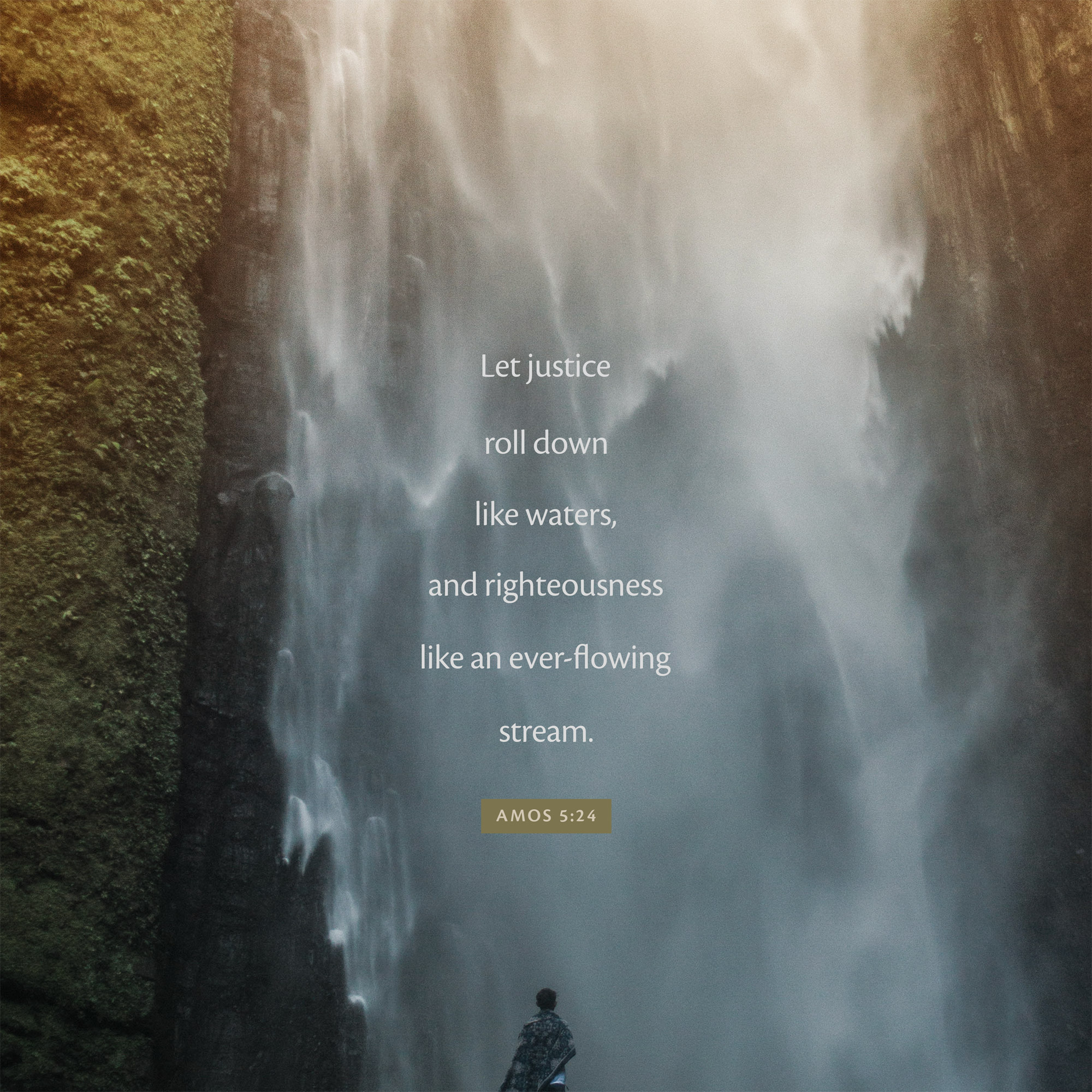
  • And then, in the face of this rebuke, we hear the words of Amos that are probably the most well-known – text: But let justice roll down like waters, and righteousness like an ever-flowing stream.[9]  Remember what we affirmed at the beginning of the sermon: Water is essential. Essential to the function and continuation of life on our planet. Essential to the function and continuation of life within our bodies. Essential to the function and continuation of our life of faith. Water is essential. And here’s God, through Amos, calling for justice to roll down like waters and righteousness like an ever-flowing stream. Justice like waters. Justice like waters. Justice like waters. So if water is essential … then so is justice.
    • Amos makes this point abundantly clear
    • God makes this point abundantly clear
    • But in society – in our country and our world and even in our faith today – these waters have been muddied beyond recognition.
      • More than 37 million people in the U.S. lived below the poverty line in 2020[10] wealth gap between the wealthy and the impoverished has been steadily growing for years
        • All of the other essential parts of living that are affected by poverty: nutrition, adequate housing/homelessness, education, medical care/insurance, child care … the list goes on and on.
        • Also encompasses the economic injustice of the wage gap
          • Men paid more than women
          • White people paid more than people of color
          • Citizens paid more than immigrants
          • the list goes on.
      • Environmental injustice
        • Despite all the talk that happens in places like Washington, D.C. and at conferences like the one happening in Scotland right now, carbon emissions are far from “in check,” causing the global temperature to continue rising to catastrophic levels
        • Plastic in our oceans = growing problem
          • 5.25 trillion macro and micro pieces of plastic in our oceans today 46,000 pieces in every square mile 269,000 tons
          • Great Pacific Garbage Patch (giant floating mass of plastic in the middle of the ocean) = 1.6 million square kilometers (bigger than the state of Texas)
          • U.S. alone contributes 38 million tons of plastic to the oceans every year
          • More than 1 million seabirds and 100,000 marine animals are killed by plastic pollution every year
      • Injustice against our neighbors We live in a time when violence against non-white people, against non-Christian people, against non-straight and non-gender-conforming people is distressingly high. The amount of hate and anger and prejudice expressed openly in society – accepted openly in society – is appalling.
    • And friends, clearly all of this injustice is not the way of God. There is nothing good about it. There is nothing loving about it. There is nothing kind about it. There is nothing hopeful about it. There is nothing of God in it. “Let justice roll down like waters, and righteousness like an ever-flowing stream.” If water is essential, then so is justice. Amen.

[1] https://www.drought.gov/current-conditions.

[2] Donald E. Gowan. “The Book of Amos: Introduction, Commentary, and Reflections” in The New Interpreter’s Bible Commentary series, vol. 7. (Nashville: Abingdon Press, 1996), 339.

[3] Amos 1:1.

[4] Gowan, 352.

[5] J. Andrew Dearman. “Amos: Introduction” from The CEB Study Bible. (Nashville: Common English Bible, 2013), 1454 OT.

[6] Amos 5:14-15.

[7] Amos 5:21-23.

[8] Charles L. Aaron, Jr. “Commentary on Amos 1:1-2; 5:14-15, 21-24” from Working Preacher, https://www.workingpreacher.org/commentaries/narrative-lectionary/amos-justice-rolls-down/commentary-on-amos-11-2-514-15-21-24-3.

[9] Amos 5:24.

[10] https://www.statista.com/statistics/233138/number-of-people-living-below-the-poverty-in-the-us/.

Sunday’s sermon: Wilderness (Un)Rest

Text used – 1 Kings 19:1-18

  • Anthony of Egypt. Paul of Thebes. Arsenius the Great. Macarius of Egypt. Syncletica of Alexandria. Theodora of Alexandria. Sarah of the Desert. Paula and Eustochium. These are just some of the names of a group of highly influential ancient Christian teachers and monastics known as the Desert Fathers and Mothers: “early Christian hermits, ascetics, and monks who lived mainly in the Scetes desert of Egypt beginning around the 3rd C.E.”[1]
    • Men and women who sought to live out their faith and deepen their relationship with God out on the farthest margins of society, both literally and spiritually
    • Came about after Emperor Constantine embraced Christianity and elevated it to the sanctioned state religion in 313 C.E.
      • Remember, before Constantine himself converted to Christianity and then declared it the official religion of the entire Roman empire, Christians were persecuted throughout the empire. This hostile atmosphere lent a certain gravity and potency to the lives and witness of the early Christians. “Being a Christian” was something that took serious commitment and intentionality because being a Christian had the real potential of getting you killed!
      • Trevor Miller (in a talk titled “Understanding Desert Monasticism” that he gave to the Northumbria Community in the United Kingdom): After 3 centuries of ‘being homeless in the world’ Christians began to find themselves in favour, rather than persecuted. The result was confusion and bewilderment in those who had accepted themselves as aliens and strangers in this world. … Constantine’s edict of toleration … resulted in the cutting edge of the Church’s life being blunted as for the first time nominalism took root (believers in name only) further resulting in mediocrity, accommodation and compromise as social standing became the reason for faith and not love of Jesus Christ. It was at this point, when Christians began to find themselves at home in the world, where those who had previously persecuted the Christians were putting out the welcome mat and sitting in the ‘same pew’, that the response to the ‘call of the desert’ began to gain momentum, beginning at first with a few, and then a multitude.[2] → So when they saw the way that cultural acceptance was watering down the Christian faith, these Desert Fathers and Mothers decided to remove themselves from the influences of the culture and take to the wilderness. And in that wilderness, they found God. Absolutely. Profoundly. Reverently. They found God. God found them.
        • Followed the example of so many throughout the Bible who found God in the wilderness
          • Those who went seeking God in the wilderness
            • In their exodus from Egypt, the people of Israel followed God into and throughout the wilderness
            • John the Baptist spent all sorts of time living out his faith in the wilderness
            • Following his baptism, Jesus followed the Holy Spirit into the wilderness for 40 days
          • Also those who found God unexpectedly in the wilderness
            • Hagar and Ishmael’s encounter with God after being thrown out of Abraham’s house
            • Moses’ encounter with God at the burning bush
            • And today’s Scripture reading – this story of the prophet Elijah fleeing into the wilderness to save his own life – is just such a story.
  • Background for where today’s story falls in the Grand Arc of God’s Story
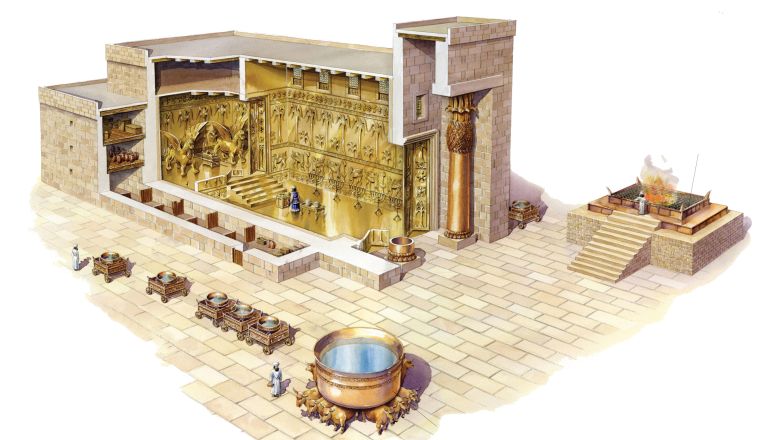
    • Last week: talked about Solomon building the Temple → point at which the kingdom of Israel was settled
      • Time of peace → peace within and peace with neighboring kingdoms/nations
      • Time of stability in the monarchy
      • Time of prosperity for the people of Israel
    • But, as seems to always be the case, this peace and stability didn’t last.
      • Following Solomon’s death, kingdom of Israel splits into the northern kingdom of Israel and the southern kingdom of Judah
      • Line of corrupt and unfaithful kings lead the kingdom of Israel further and further away from God → culminates in the rule of King Ahab and his wife Jezebel – text (1 Kgs 16): [Ahab] ruled over Israel in Samaria for twenty-two years and did evil in the Lord’s eyes, more than anyone who preceded him. … He married Jezebel the daughter of Ethbaal, who was the king of the Sidonians. He served and worshipped Baal.[3]
    • Enter Elijah the prophet – the one that God calls to bring God’s word of condemnation to King Ahab and God’s call of repentance to the people of Israel to try to bring them back to the Lord their God. → does it in just about the most drastic, theatrical, jaw-dropping way possible
      • Elijah challenges 500 of the prophets of Baal to a competition: create a giant bonfire but do not light it → whoever’s god can light the pyre is the true God → prophets of Baal spend all day calling out to their god … nothing happens → Elijah first calls for the giant pile of wood to be doused with gallons upon gallons of precious water (made even more precious because the land of Israel is in the midst of a severe drought and famine), then calls up on God → fire streams down from heaven and lights the wood → God’s fire burns so hot that the wood, the water, and even the stones and the dust are consumed[4]
      • And if Elijah had stopped there, he might have been fine … but he didn’t. → Elijah instructs all the people watching to seize the 500 prophets of Baal → Elijah slaughters them on the banks of the Kishon Brook[5]
  • Brings us to today’s story: Ahab told Jezebel all that Elijah had done, how he had killed all Baal’s prophets with the sword. Jezebel sent a messenger to Elijah with this message: “May the gods do whatever they want to me if by this time tomorrow I haven’t made your life like the life of one of them.” Elijah was terrified. He got up and ran for his life.[6]
    • Like so many before him, Elijah finds himself in the wilderness, not by choice, but by necessity. Jezebel is ready to kill him, so he throws some clothes in a bag and flees.
    • Heb. makes it clear just what a dangerous and desperate situation Elijah is in
      • Jezebel’s threat: she calls the vengeance of her own gods down upon herself if she doesn’t repay Elijah in kind for the death of her 500 prophets “by this time tomorrow” – Heb. word that she uses for “time” = definitive and definite → There are multiple words in Hebrew that get translated as “time” in English. Some are more open-ended and imprecise, more like “eternity” or “some time” or “eventually.” But that is not the word that Jezebel uses. She isn’t threatening Elijah with retribution someday. She’s very clearly threatening to repay him death for death now.
      • Heb. also makes it clear that Elijah is fully aware of just how quickly and seriously this situation has become deadly – Heb. “terrified” (“Elijah was terrified”) shares same root as word “see, perceive, know, understand” → So the Hebrew makes it clear that Elijah’s fear over Jezebel’s threat is far from a blind fear. He knows exactly what awaits him if Jezebel gets a hold of him. He understands fully and completely. And so he runs.
    • Runs into the wilderness because the wilderness is vast à figures it will be impossible for Jezebel to find him there
    • Runs into the wilderness because the same vastness that hides him also provides Elijah with a place to pour out all his fear and vulnerability – text: [Elijah] finally sat down under a solitary broom bush. He longed for his own death: “It’s more than enough, Lord! Take my life because I’m not better than my ancestors.”[7] → Heb. here is very revealing as well
      • Text says Elijah “longed for his own death” → Heb. “longed” = both an inward expression and an outward expression of emotion
        • Component of inward longing, desire, deep-seated urge
        • Component of vocalizing that longing – asking, begging out loud
  • But even here, in this most desperate, most desolate state, Elijah encounters God not once … not twice … but three separate times.
    • 1st time: Elijah falls asleep under that same broom bush → awoken by one of God’s messengers (angels) and given food and water → Elijah eats, drinks, goes back to sleep
    • 2nd time: Elijah is again awoken by one of God’s messengers à more pointed message this time – text: “Get up!” the messenger said. “Eat something, because you have a difficult road ahead of you.”[8] → This passage is really interesting because of the different ways it’s been translated. Some versions read the way ours read this morning – some minor variation of, “Eat something, because you have a difficult road ahead of you.” But other translations, like the New Revised Standard versions, read more along the lines of, “Get up and eat, otherwise the journey will be too much for you.”
      • Heb. here is a little murky/difficult (hence the varying translations) = “get up” and “eat” are clear → But the rest is a challenging combination of words with a somewhat complicated sentence structure.
      • What is clear: God’s way of preparing Elijah both bodily and spiritually for what lies ahead → And clearly, God spoke the truth! – text: Elijah got up, ate and drank, and went refreshed by that food for forty days and nights until he arrived at Horeb, God’s mountain. There he went into a cave and spent the night.[9]
    • Brings us to Elijah’s 3rd encounter with God in the wilderness – text: The LORD said, “Go out and stand at the mountain before the LORD. The LORD is passing by.” A very strong wind tore through the mountains and broke apart the stones before the LORD. But the LORD wasn’t in the wind. After the wind, there was an earthquake. But the LORD wasn’t in the earthquake. After the earthquake, there was a fire. But the LORD wasn’t in the fire. After the fire, there was a sound. Thin. Quiet. When Elijah heard it, he wrapped his face in his coat. He went out and stood at the cave’s entrance. A voice came to him and said, “Why are you here, Elijah?”[10] → This is such a fascinating interaction because it is God coming to Elijah in the wilderness in a way completely outside the realm of the way God usually comes to people throughout Scripture!
      • Dr. Nancy deClaissé-Walford (author and prof. of Old Testament and Biblical Languages at McAfee School of Theology at Mercer University in Atlanta) points out: An appearance, a manifestation, of God to humanity is called a theophany, a moment when the sovereign God physically interacts with the human realm. In the Old Testament text, God interacts with humans in dreams (Abraham: Genesis 15; Jacob: Genesis 28); in seemingly human form (Abraham: Genesis 18; Gideon: Judges 6); in fire and smoke (Moses: Exodus 3; Sinai: Exodus 19); in wind and earthquake and unexplainable phenomena (Sinai: Exodus 19; Isaiah: Isaiah 6; Ezekiel: Ezekiel 1).[11] → I think this is the most powerful part of Elijah’s story this morning. We know that he has fled into the wilderness out of necessity – as a way (the only way!) to save his own life. We know that he’s feeling desolate and vulnerable. He’s afraid. He’s uncertain. He’s discouraged. If he has any hope left, it’s barely a spark. And yet into that place of wilderness – both the wilderness landscape that surrounds Elijah and the inner wilderness that has engulfed his spirit … into that place of wilderness, God comes down and interacts with Elijah in a whole new way. A way that grabs his attention. A way that speaks to him not with the flash and flourish, the bluster and grandeur, the bombastic power that God has used before, but a stillness. A silence. A whisper. A word and a way of being to calm Elijah’s raging and comfort his fear.
  • Friends, we rage. We fear. We find ourselves in times of uncertainty and vulnerability. We have times when, like Elijah, we cry out to God, “God, this is too much!” I know that Christian pop culture likes to doll out well-worn platitudes like “God will never give you more than you can handle” and “If God brought you to it, God will bring you through it,” but in the moment – in those wilderness moments full of pain and anxiety and doubt and fear – have those platitudes ever brought comfort? Generally, no. But when we find ourselves caught in the vast emptiness of those wilderness moments, we can hold tight to Elijah’s story and the assurance that God is there in our wilderness, too, reaching out to us.
    • Maybe not the way we want
    • Maybe not the way we’ve prayed for
    • Almost definitely not the way we expect
    • But God is more familiar with wilderness wanderings and wilderness unrest than we can even begin to imagine, and God will not leave us in that wilderness alone. Amen.

[1] https://en.wikipedia.org/wiki/Desert_Fathers.

[2] https://www.northumbriacommunity.org/articles/understanding-desert-monasticism/.

[3] 1 Kgs 16:29b-31.

[4] 1 Kgs 18:1-38.

[5] 1 Kgs 18:40.

[6] 1 Kgs 19:1-3a.

[7] 1 Kgs 19:4.

[8] 1 Kgs 19:7.

[9] 1 Kigs 19:8-9a.

[10] 1 Kgs 19:11-13.

[11] Nancy deClaissé-Walford. “Commentary on 1 Kings 19:1-4 [5-7] 8-15a” from Working Preacher, https://www.workingpreacher.org/commentaries/revised-common-lectionary/ordinary-12-3/commentary-on-1-kings-191-45-78-15a (emphasis added).

Sunday’s sermon: A Holy House

Text used – 1 Kings 5:1-5; 8:1-13

  • The Lord’s word came to Solomon, Regarding this temple that you are building: If you follow my laws, enact my regulations, and keep all my commands faithfully, then I will fulfill for you my promise that I made to your father David. I will live among the Israelites. I won’t abandon my people Israel. So Solomon constructed the temple and completed it. He built the walls within the temple with cedar planks, paneled from the floor to the ceiling. He overlaid the floor of the temple with pine planks. At the back of the temple he built thirty feet of cedar panels from the floor to the ceiling. Solomon built the inner sanctuary, the most holy place. In front of this, the main hall was sixty feet. The cedar inside the temple was carved with gourds and blossoming flowers. The whole thing was cedar. No stone was seen. He set up the inner sanctuary inside the temple so that he could put the chest containing the Lord’s covenant there. The inner sanctuary was thirty feet in length, width, and height. Solomon overlaid it with pure gold and covered the altar with cedar. Solomon covered the temple’s interior with pure gold. He placed gold chains in front of the inner sanctuary and covered it with gold. He overlaid the whole temple inside with gold until the temple was completely covered. He covered the whole altar that was in the inner sanctuary with gold. He made two winged creatures of olive wood for the inner sanctuary, each fifteen feet high. The wings of the first winged creature were each seven and a half feet long. It was fifteen feet from the end of one wing to the end of the other. The second winged creature also measured fifteen feet. Both winged creatures had identical measurements and form. The height of both winged creatures was fifteen feet. Solomon placed the winged creatures inside the temple. Their wings spread out so that the wing of the one touched one wall and the wing of the other touched the other wall. In the middle of the temple, the wings of the two-winged creatures touched each other. He covered the winged creatures with gold. Solomon carved all the walls of the temple—inner and outer rooms—with engravings of winged creatures, palm trees, and blossoming flowers. He also covered the floor of the temple with gold, in both the inner and the outer rooms. He made the doors of the inner sanctuary from olive wood and carved the doorframes with five recesses. He overlaid the two olive-wood doors with gold-plated carvings of winged creatures, palm trees, and blossoming flowers. He made the door of the main hall with doorframes of olive wood with four recesses. The two doors of pinewood each pivoted on a socket. Solomon carved winged creatures, palm trees, and blossoming flowers, and covered them with gold. He built the inner courtyard with three rows of cut stone followed by one row of trimmed cedar. Solomon laid the foundation of the Lord’s temple in the fourth year in the month of Ziv. He finished the temple in all its details and measurements in the eleventh year during the eighth month, the month of Bul. He built it in seven years.[1] → What a temple, right? This was a temple of grandeur and majesty! This was a temple of reverence and veneration! This was a temple that was generations upon generations in the making.
    • Starts all the way back in Exodus after Moses and the people of Israel escaped slavery in Egypt → As they wandered through the wilderness, God required a place to dwell among the people – a holy space to inhabit. And so the people built the Tabernacle – a portable, tent-like space consecrated for worship and built to the specifications that God gave to Moses on Mount Sinai.[2]
      • Large open space (roughly half the size of a football field) enclosed by a curtain with a smaller enclosed tent-like structure (the Holy of Holies) inside that housed the sacred objects – the lampstand, the altar of incense, and the ark of the covenant – along with God’s own presence
      • Throughout those early years, Scripture tells us there were many times when Moses would go into the Tabernacle – and later, Moses and his successor, Joshua – and go into the Holy of Holies to sit it God’s presence and to speak with God.
      • And Scripture also tells us that this Tabernacle was beautiful. It was built with the finest wood and decorated with the most beautiful and expensive cloth – purple and red and pure white linen – along with gold and precious gems. And for generations, it served the people of Israel as a place to worship the Lord their God – to offer up their prayers and their sacrifices to God as they lived into their faith and the covenant life which God had entrusted to them. But it was also a temporary structure.
        • Made to be mobile
        • Made to travel from place to place with God’s people as they sought out their forever home in the land that God had promises to their ancestors – to Abraham and Isaac and Jacob
    • Next phase in the story of the Temple = King David
      • Following his long, difficult, convoluted, and frankly bloody ascension to the throne, one of the first things David did was attempt to move the ark of the covenant to a permanent and central home in Jerusalem. → yet another difficult endeavor for David fraught with all manner of setbacks BUT David is finally able to bring the ark of the covenant safely and worshipfully with much fanfare and rejoicing into the city and establish it within the tent he had constructed up on the holy hill overlooking the city[3] (today: Temple Mount)
      • Yet despite his best intentions, God makes it clear to David that he cannot and will not be the one to build a temple – God’s permanent dwelling among the people – text (1 Chr 17): When David was settled into his palace, he said to the prophet Nathan, “I’m living in a cedar palace while the chest containing the Lord’s covenant is under curtains.” Nathan replied, “Go ahead and do whatever you are thinking, because God is with you.” But that very night, God’s word came to Nathan: Go to my servant David and tell him, This is what the Lord says: You are not the one to build the temple for me to live in. … When the time comes for you to die, I will raise up a descendent of yours after you, one of your own sons, to succeed you, and I will establish his kingship. He is the one who will build me a temple, and I will establish his throne forever.[4]
  • And so we come to today’s reading.
    • Begins with Solomon’s intent to build the temple
    • Ends with Solomon’s dedication of the temple 7 yrs. later (roughly 957 B.C.E.)
    • Text: When all of Israel’s elders had arrived, the priests picked up the chest. They brought the LORD’s chest, the meeting tent, and all the holy equipment that was in the tent. The priests and the Levites brought them up, while King Solomon and the entire Israelite assembly that had joined him before the chest sacrificed countless sheep and oxen. The priests brought the chest containing the LORD’s covenant to its designated spot beneath the wings of the winged creatures in the inner sanctuary of the temple, the most holy place. The winged creatures spread their wings over the place where the chest rested, covering the chest and its carrying poles. The carrying poles were so long that their tips could be seen from the holy place in front of the inner sanctuary, though they weren’t visible from outside. They are still there today. Nothing was in the chest except the two stone tablets Moses had placed there while at Horeb, where the LORD made a covenant with the Israelites after they left Egypt. When the priests left the holy place, the cloud filled the LORD’s temple, and the priests were unable to carry out their duties due to the cloud because the LORD’s glory filled the LORD’s temple. Then Solomon said, “The LORD said that he would live in a dark cloud, but I have indeed built you a lofty temple as a place where you can live forever.”[5] → Finally, the Lord had a permanent dwelling place among the people.
      • The people were settled
      • The promised land was settled
      • The monarchy was settled 
      • And God was settled among the people
      • Rev. Dr. Alphonetta Wines (author, retired UMC pastor, biblical scholar and theologian) explains just how meaningful and significant the temple truly was to the people: The temple held deep meaning for the Israelite community. It was built on Mount Moriah where, had it not been for God’s intervention, Abraham would have sacrificed his son Isaac. Moreover, the temple was built on land that David purchased from Araunah at God’s command, to make a sacrifice to avert the death angel which had already killed 70,000 as punishment for the census David commanded. In other words, the temple was built on land where, despite dire circumstances with death on the horizon, life prevailed. … Artistic and architectural excellence made the temple something to behold. Unlike other temples, there were no gods anywhere in this temple. Instead of images of gods, there were decorations of palm trees, flowers, and cherubim, reminders of God’s creation. The Ark of the Covenant with two tablets of the Ten Instructions (Ten Commandments), Aaron’s rod, and some manna was all that was in the Holy of Holies. This sparsity was a reminder of the invisible God, the one God, transcendent and immanent, separate from yet inexorably connected to humanity and all creation.[6]
    • But as we know, it was not as permanent a dwelling place as Solomon intended it to be.[7]
      • Under the command of King Nebuchadnezzar II, Babylonians invaded Jerusalem
        • Ransacked the Temple and removed all the treasures in 604 and 597 B.C.E.
        • Completely destroyed the Temple in 587/586 B.C.E.
        • (Part of that Babylonian captivity that we’ve talked about before → after the temple was razed, the Babylonians carted off the best and brightest of Israel’s citizens and took them to Babylon where they lived for an entire generation)
      • After King Cyrus II released the Jewish captives and allowed them to return to Israel in 538 B.C.E., the people built a new Temple → completed this 2nd temple in 515 B.C.E. (less than 100 yrs. after the first Temple was destroyed)
      • During the Jewish rebellion against Rome in the late 1st C.E., the Temple was destroyed for the 2nd and final time in 70 C.E. by Roman forces under Emperor Titus
    • And we have to take a moment to acknowledge just how devastating a loss this must have been for the people of Israel. God’s true and permanent dwelling place among them had been desecrated, looted, and completely destroyed. → utter sanctity of the Holy of Holies
      • Place where the most holy relics of the people of Israel were kept
      • Place that was only entered by the high priest and only once a year on Yom Kippur – the day of atonement – to offer a sacrifice of blood and incense
      • Place where the presence of God dwelt
      • And yet this sacred place – this place of worship and sacrifice, of prayer and praise, of holiness beyond holiness – was truly and utterly gone.
  • But for us today – us Christians sitting here in our own place and time of worship, be that here in the sanctuary or viewing from the sacred space and time we’ve created at home – what can remembering Solomon’s dedication of that holy space centuries (even millennia!) ago mean for us? – again, the words of Rev. Dr. Alphonetta Wines: Remembrances of Solomon’s temple call us to wholehearted worship. When the Woman at the Well asked a question about worship, Jesus explained that worship is not about a specific place, but is a matter of spirit and truth. We would do well to examine ourselves to be sure that our worship and our lives mirror the ideals of wholehearted worship in the temple as well as Jesus’s commandments to love God, others, and oneself, for they are indeed one.[8] → To help us remember that today, we’re going to conclude our sermon with the words of our hymn. I know we don’t have Katha here to help us sing it today, but the words and the sentiment of this hymn so perfectly encompass those ideals of wholehearted worship that Dr. Wines speaks of – that wholehearted worship that we see in Solomon’s dedication of the temple and that we hear in Jesus’ command to love – that we’re going to embark on this hymn a cappella together anyway. So friends, let us join our hearts and voices in praise. Let us make a joyful noise! [SING HYMN “Let Us Build a House”] Amen!

[1] 1 Kgs 6:11-38

[2] Ex 25:10-27:21.

[3] 1 Chr 15:1-16:3.

[4] 1 Chr 17:1-4, 11-12.

[5] 1 Kgs 8:3-13.

[6] Alphonetta Wines. “Commentary on 1 Kings 5:1-5; 8:1-13” from Working Preacher, https://www.workingpreacher.org/commentaries/narrative-lectionary/solomons-temple-2/commentary-on-1-kings-51-5-81-13-3.

[7] https://www.britannica.com/topic/Temple-of-Jerusalem.

[8] Wines.

Sunday’s sermon: A Call and Response Faith

Text used – 1 Samuel 3:1-21

  • The call and response tradition has a long and colorful history throughout many cultures around the world.
    • Call and response tradition in Africa = pattern of community involvement → participation in public gatherings, civic affairs, religious rituals, and musical expression
      • Tradition that was brought to America in the slave ships → found outlets in some of the work songs that slaves sang in the fields → filtered down through the centuries into some of the most popular music of the last 2 centuries: gospel, blues, R&B, rock and roll, jazz, hip hop
    • Call and response tradition in camp songs → build community and an outlet for campers’ energy
      • E.g. – theater warm-up: “Boom Chicka Boom” → provides an easy-to-remember pattern/framework for the “song” while giving people all sorts of space to ad lib/riff on the theme
    • Call and response = great way to get students’ attention in a classroom
      • E.g. (from cartoon Julia and I were watching this week) Teacher: “One, two, three, eyes on me.” Students: “One, two, our eyes are on you.”
    • Call and response tradition in worship – two main ways
      • FIRST, also finds its roots in the African tradition → all of those things that we admittedly don’t often find in many mainline denominations
        • Pastor calling out “Can I get an amen?” in the midst of the sermon OR congregants spontaneously calling out things like “Amen” or “Preach” or “Praise Jesus” or any other audible response in the midst of the sermon
      • SECOND goes back centuries – antiphonal (back and forth, call and response) reading of psalms → been a part of praying the office (morning prayer, midday prayer, evening prayer, and compline) since the 1500s
        • Variation that we participate in every Sunday = Call to Worship/Opening Praise
    • African Interactive blog post about call and response tradition: “a fundamentally interactive form in which one group calls upon or asks questions of the other through performance, and the other answers or responds through performance. By its cyclic nature, call and response can be used for emphasis, for iterative development, and for turn-taking and complementarity between the groups involved.”[1]
    • Most central element of call and response tradition = it cannot be accomplished alone → There are a lot of traditions and worship practices that can be adapted from community practice to individual practice in some way, shape, or form. But not call and response. Call and response at its very core requires another … requires a connection … requires a relationship.
    • Today’s Scripture reading = perfect illustration of how and why our faith is a call and a response faith – a faith that requires interaction, connection, relationship
  • Before we dive into the story, let’s take a minute for a little backstory – a little context.
    • Wider context within the whole story of Scripture: chronologically, 1 Sam comes after Judges → If you look in your Bible, the book of Ruth in sandwiched in between Judges and 1 Samuel, but the books of the Bible aren’t arranged in chronological order. So what was happening at the end of Judges? The short answer is: Nothing good!
      • Judges = sort of the book in which the people of Israel are trying to get settled in the land of Canaan – intro from CEB study Bible: The book of Judges is a collection of stories about the time between Israel’s entrance into the land of Canaan and the rise of kings. It shows Israel as a society divided into tribal groups dealing with foreign enemies and each other.[2] → So throughout this whole timeframe – and even into the passage from 1 Samuel that we read this morning – the people of Israel have no central ruler. Instead, they have a series of elected judges – tribal leaders, essentially – to help make both legal and communal decisions. And like today’s leaders, these judges were far from perfect!
        • Recurring theme throughout the entire book of Jdgs: the people of Israel “did things that the Lord saw as evil” → Time and time again throughout Judges, the people turn away from God. They neglect God. They outright defy God’s commands and refuse God’s love.
        • End of Jdgs that leads into 1 Sam = no different → dark and complex story involving one man setting up an alternative worship system (against the rules), theft, abduction, forced conversion, rape and abuse, civil war, and even what could arguably be called genocide
      • Rev. Dr. Alphonetta Wines (bestselling author/editor, retired UMC pastor, biblical scholar, theologian, emotional motivator, transformational speaker, and spiritual entrepreneur): As First Samuel opens, things could not be worse for Israel. Judges, the previous book, ended with the community in chaos. … The nation was falling apart. The system of judgeships had failed miserably. With all of the chaos, how could the community possibly continue? Would it die before it began? Would the promise God made to Abraham go unfulfilled? Who would God send to begin to deal with this mess? Samuel, Israel’s last judge and first prophet since Moses, is God’s answer.[3]
    • So that brings us into 1 Samuel, but let’s narrow down our context view a little more and look at just the book of 1 Samuel itself.
      • Before today’s passage = story of Samuel’s mother, Hannah, and story of Samuel’s birth[4]
        • And sadly, Hannah’s story is not an unfamiliar one in Scripture.
          • Hannah = married to Elkanah
          • Elkanah also has another wife, Peninnah
          • Peninnah has a number of children with Elkanah, but Hannah has been unable to bear children
          • Lack of children makes Hannah miserable à misery is compounded by Peninnah’s taunting – text: [Hannah’s rival, Peninnah] would make fun of her mercilessly, just to bother her.[5]
          • One day, Hannah went to the tabernacle to pray to the Lord for a child à crying and ceaselessly mouthing her silent prayer (including promise to give her child to God if she were to become pregnant)
          • Encountered by the priest, Eli à Eli first chastises Hannah because he attributes her erratic behavior to drunkenness, not grief
          • Hannah explains her situation to Eli à Eli blesses Hannah à Hannah becomes pregnant: Samuel
        • Following Samuel’s birth, Hannah does indeed bring him to the tabernacle at the age of 3 to be raised as a nazirite, a special, consecrated servant for God
      • Also before today’s passage = long section detailing the corruption and sins of the sons of Eli, the priest: taking the best meat from offerings before they were sacrificed appropriately (essentially used this holy sacrifice as a barbeque) → Eli confronts them and tries to get them to change, but they ignore him[6]
        • See evidence of that falling away in the beginning of our text for this morning: The Lord’s word was rare at that time, and visions weren’t widely known.[7]
  • Okay, so that brings us up to today’s story – the story of Samuel’s call. – love this story!
    • FIRST, Samuel’s name = bit of foreshadowing as to the role he will play → “Samuel” = Heb. word for hear/call/consent (implies listening intelligently and obediently) + word for God → So Samuel’s name literally means “called of God” or “heard of God.”[8]
      • Setting
        • TIME: “God’s lamp hadn’t gone out yet” → means it was the middle of the night
        • PLACE: “Samuel was lying down in the Lord’s temple, where God’s chest was” → “God’s chest” = Ark of the Covenant (held precious sacred objects including the commandment tablets that God gave to Moses on Mt. Sinai)
    • Almost seems like a pantomime: God calls Samuel → Samuel thinks Eli is calling him → Samuel jumps up and runs to Eli’s side → Eli tells Samuel he didn’t call him and instructs him to go back to bed → And this happens not once … not twice … but three times before Eli finally tumbles to the fact that the call Samuel is hearing is a call from God. I mean, it almost sounds like a comedy routine, right? “Did you call me?” “No, I didn’t call you! Go back to bed!” “Did you call me?” “No, I didn’t call you! Go back to bed!” … “Did you call me?”
    • Eli finally figures out that it is the Lord’s call that Samuel keeps hearing → instructs Samuel to say, “Speak, Lord. Your servant is listening.”
      • Heb. “listening” = same word that’s wrapped up in Samuel’s own name – word that implies intelligence and obedience in the listening
    • So Samuel obediently responds as Eli instructed him to, and Samuel hears the full call of the Lord his God. And to be honest, friends, that’s almost always where we stop this reading. “Then the Lord came and stood there, calling just as before, ‘Samuel, Samuel!’ Samuel said, ‘Speak. Your servant is listening.’”[9] End of story. Contented sigh. Leaves us feeling all happy and comfortable, right? Sure … but in truth, that’s not the end of Samuel’s call story.
      • God’s call is not an easy call for Samuel – text: The Lord said to Samuel, “I am about to do something in Israel that will make the ears of all who hear it tingle! On that day, I will bring to pass against Eli everything I said about his household—every last bit of it! I told him that I would punish his family forever because of the wrongdoing he knew about—how his sons were cursing God, but he wouldn’t stop them. Because of that I swore about Eli’s household that his family’s wrongdoing will never be reconciled by sacrifice or by offering.”[10] → God isn’t calling Samuel to some easy, fabulous, run-of-the-mill task here. God isn’t simply calling Samuel to discipleship – to a life-long relationship of learning and following, of prayer and praise. God is calling Samuel – who, remember, is still just a boy at this point (or an early adolescent at most!) … God is calling Samuel to deliver this hard and harsh message to none other than his mentor and teacher. And it’s not just a message about the sins and failings of some random people. It’s a message about the severe punishment that God intends to meter out on Eli’s own sons.
        • See discomfort in Samuel’s response – text: Samuel was afraid to tell the vision to Eli.[11] → Heb. “afraid” = feeling fear but fear enmeshed with an element of respect and reverence
    • And to be honest, Samuel’s call never gets any easier either.
      • Samuel anoints Israel’s 1st king, Saul[12], despite knowing that God does not desire a monarchy for God’s people[13] (for fear that the monarchy would take the place of God in the people’s hearts or that various kings would lead the people astray … both of which happen time and time again)
      • When Saul loses God’s favor[14] (for turning away from God and leading the people astray … surprise, surprise), Samuel anoints David as king instead of Saul[15] → Samuel is right there to witness all the danger, death, and destruction that come from this dynastic change before his death[16]
  • So here’s the thing, folx. As we walk through the Grand Story of our faith again this year, we’re beginning to see once again just how messy and complicated and chaotic and broken this story is. We’re encountering all the tangled threads and twisted storylines. We’re reminded that humanity’s imperfectness is far from a modern-day phenomenon. And yet in the midst of all that chaos and brokenness – in the midst of all the turning away from God and willfully dismissing God – God still calls. God calls Samuel to faith and action. And after Samuel, God continues to call others. And even today, God calls more people. God calls us.
    • Called to faith – to that call-and-response relationship with God à faith that originates in God’s call, faith that’s embodied in that relationship and enacted in our response
      • Doesn’t promise to be an easy call
      • Doesn’t promise to be a comfortable call (actually, basically promises that it’s going to be uncomfortable!)
      • But what Scripture does promise us is that God will be there – there in the calling, there in the equipping, there in the enacting, there in the blessing, there in the struggling, there in the leading, there in the calling out, there in it all. God will be there. So speak, Lord. Your servants are listening. Amen.

[1] http://africaninteractive.org/projects/call-and-response/.

[2] Brad E. Kelle. “Judges: Introduction” in The CEB Study Bible. (Nashville: Common English Bible, 2013), 367 OT.

[3] Alphonetta Wines. “Commentary on 1 Samuel 3:1-21” from Working Preacher, https://www.workingpreacher.org/commentaries/narrative-lectionary/god-calls-samuel/commentary-on-1-samuel-31-21-3.

[4] 1 Sam 1:1-28.

[5] 1 Sam 1:6.

[6] 1 Sam 2:12-36.

[7] 1 Sam 3:1.

[8] Exegesis by Rev. Elana Keppel Levy: https://somuchbible.com/word-studies/annotated-scripture/1-samuel-31-21a/,

[9] 1 Sam 3:10.

[10] 1 Sam 3:11-14.

[11] 1 Sam 3:15b.

[12] 1 Sam 9-10.

[13] 1 Sam 8.

[14] 1 Sam 13, 15.

[15] 1 Sam 16

[16] 1 Sam 25:1.