Sept. 2016 newsletter piece

sidewalk-grass

At the end of July, I spent some continuing education time in Iowa at Synod School. You’ve seen it advertised in our newsletter, and I know I’ve spoken about it in church before. Synod School is an incredible experience open to pastors and lay people alike. It’s a week-long conference that offers a central convocation speaker (this year’s was John Bell) as well as a staggering variety of classes – everything from basket weaving and folk dancing to an in-depth study of Lamentations to the Gospel According to Harry Potter or Star Wars or the Big Bang Theory. It’s also an incredibly family-friendly experience. There were 645 participants in Synod School this year, and more than 100 of them were children. There’s educational programming for kids age 0-18 so that parents have a chance to experience some classes for themselves, but children are most definitely present and welcome.

This year, one of the courses that I took was called Managing Stress in Ministry led by Rev. Dr. Mark Sundby, an ordained minister in the United Methodist Church and currently the Executive Director of the North Central Ministry Development Center in New Brighton. In it, we spent time talking about the various aspects of ministry that can be stressful and the amount of stress that clergy are under in general compared to other professions.

But we also spent time talking about a variety of ways that we can relieve stress in our lives – not just ministers, but everyone else. We did some deep breathing exercises. We participated in some silent meditation and some guided meditations. And on the final full day of classes, we spent time experiencing a walking meditation.

The general idea of a walking meditation is to remain present in the moment and be constantly aware of your surroundings … not your mental grocery list, not your to-do list, not your email or your Facebook account or the current headlines. Be present and aware of the world around you and your place in it.

There are a number of ways to “do” a walking meditation. It can be as easy as focusing on your breathing: breathe in for a count of three with one step and out for a count of four with the next step. You can focus on the feeling of the ground under your feet. You can focus on a particular word or phrase – something to keep bringing you back to the present moment when your mind inevitably starts to wander. One of the phrases that Mark suggested to us was:

– Step one: Present moment.

– Step two: Wonderful moment.

Truly, the possibilities for walking meditations are endless.

For that final day, because the weather was beautiful and we had time, I chose to take my sandals off – to truly feel and connect with the ground beneath my feet. As I wandered through the Buena Vista University campus, I consciously kept my left foot in the grass and my right foot on the sidewalk whenever possible.

This action turned into a little bit of a guided meditation for me because I began to look at the ground under my left foot as life. Sometimes it was lush and green, soft under my feet and pleasant to walk on. Sometimes it was rocky or there were little twigs and things sticking up that were uncomfortable under my bare feet. The elevation changed slightly – sometimes a little higher, sometimes a little lower. Every step was sometime different – a new feeling, a new environment, a new experience.

At the same time, I began to look at the ground under my right foot as God. It was solid. It was strong. It was constant. No matter whether the ground under my left foot was higher or lower, the ground under my right foot was always a little bit higher still – keeping me up, keeping me steady, keeping me grounded. And in those times when there was no grass on which to place my left foot, there was always pavement to carry me forward.

Like many other people, I have always struggled with Paul’s exhortation to “pray without ceasing” in 1 Thessalonians 5:17. Life gets busy. I find myself running and running and forgetting to stop. But this exercise of walking meditation brought be closer to an understanding of what Paul might have meant. It was a chance to pray without words – to pray with my imagination, with my feelings and my fears, and yes, even with my feet.


Pastor Lisa sign


Aug. 2016 newsletter piece

hope-2

Jesus’ story of the prodigal son …

A familiar story, familiar words.

A father has two sons. The younger son decides he wants his inheritance early, so the father divides all he has and gives the younger son his share. The younger son goes off and squanders his early inheritance on “extravagant living.” When his money runs out and he begins to be in need (desperate, desperate need!), he decides to return home to his father and beg for forgiveness. While the younger son is welcomed home with open arms and a feast to end all feasts, the story ends with the older son frustrated by this welcome and the father reminding the older son that what was lost has been found. (Luke 15:11-32)

Often, a reading of this story is accompanied by a message about forgiveness – about redemption and being welcomed home. And yes, that’s certainly something we hear in this story.

But the story of the prodigal son is also a story of hope. We see the first glimmer of hope in the younger son’s initial “bright and shiny” vision for an amazing future full of all those things that he didn’t think he could find back home on the farm: excitement, adventure, and a lavish lifestyle.

Then reality comes screaming in in the form of pig food that is starting to look appetizing.

The reality that has come screaming in for us lately has been far worse – much more devastating, much more sobering, and much more painful. We’ve seen senseless and unnecessary deaths – in Orlando, in Baton Rouge, in Roseville, in Dallas, in Turkey, in Nice, and in so many other places. We’re caught in the throes of grief and loss, frustration and anxiety, distrust and shame.

Do we feel like we’ve been trampled down in the muck and the mud and the filth?

Do we feel soul-weary and spirit-worn?

Do we look up and out, and like the son in Jesus’ story, say, “God, I just want to go home?”

And therein lies the hope. Out of the muck and the mud and the filth – out of the appalling circumstances and the suffering – is a way out … a way forward.

HOPE lies in the younger son’s journey home. Every step is filled with anticipation and apprehension, dreams and doubts. Every step grows a little stronger, a little lighter, a little surer. Every step carried him further and further away from rock bottom.

HOPE lies in the home itself. It’s a safe place to land. It’s a place that holds all the sacredness and familiarity of memories as well as all the potential for new beginnings – a place to come back to as well as a place to start out from, a place of turning and returning, a place of repentance and renewal. Home is where we come together. Sometimes it’s uncomfortable. Sometimes it’s messy. But it’s the place where we come together.

HOPE lies in the father’s waiting. “While he was a long way off, his father saw him and was moved with compassion” (Lk 15:20). I’d be willing to bet that the father didn’t just happen to glance up at the right time. That father was waiting, hoping for a change of mind, hoping for a change of heart, hoping for his son to return to that place of deepest love and sincerest welcome.

HOPE even lies in the snarky, crotchety older brother. There is hope in the accountability that we find in his presence – someone to keep us honest, someone to read us as we are, whether we like it or not. And there is hope in the relationship-building and rebuilding that is yet to be: bridges to be built, hearts to be mended, and futures to be imagined together.

Friends, is any of this striking a chord? Is any of this sounding familiar? God calls us to hope, to freedom, to love and grace. May we open our eyes – in the midst of the muck and the pain, the mud and the anger, the filth and the fear. May we open our eyes and step out together to follow God’s call into hope.

Pastor Lisa sign

Sunday’s sermon post: Faith in Falling, Faith in Following

trust fall

Texts used – Psalm 62:5-12 and Mark 1:14-20

  • When I was a kid – probably 8 or 9 years old – my pastor, Pastor Jamie, took us on a camping trip up to Clearwater Forest.
    • Probably 8 or 10 kids
    • Trip full of fun and excitement
      • Stuff on our own
      • Stuff with the campers at the time (games, etc.)
    • One of the things we did on our own – just those of us from our church – that has always stuck with me was a trust fall.
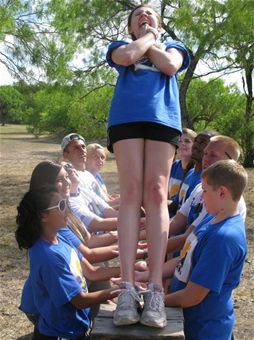
      • Describe trust fall – picnic table, grasping arms, falling backwards staying stiff
      • Now, believe you me, falling wasn’t easy! If I remember right, it took me a couple tries to get it “right” – to fall backwards staying flat instead of trying to protect myself by sitting as I fell backward. It took serious trust, especially for an incredibly shy 9-yr-old! I had to have faith that the people who I couldn’t see were actually going to be there to catch me.
  • Our passage from the gospel today is probably one of the most well-known stories – one of the most quoted. Jesus says, “Follow me and I will make you fish for people.”[1] We read about Jesus issuing The Call (capital “T”, capital “C”), and we envy those fishermen and the ease with which they simply drop their nets and stroll off down the road after Jesus. But even for these apostles, following Jesus wasn’t as easy as it may have seemed.
    • Mark: Immediately [Simon and Andrew] left their nets and followed [Jesus.] … Immediately, [Jesus] called [James and John]; and they left their father Zebedee in the boat with the hired men, and followed him.[2]
      • Gr is very telling → “left” is the key = suggests giving something up, utter release
        • Used in NT to speak of the way in which God forgives sins: God doesn’t return these sins to us at a later date. God removes them entirely … and this is how completely Simon, Andrew, James, and John released their nets, their obligations, and their lives … entirely.
        • Scholar: The fact that these men drop both occupation and family obligations to follow the one who summons them demonstrates that their call comes from God. … In a traditional society, such a break with family and occupation … was an extraordinary disruption in a person’s life. It might even have seemed offensive.[3]
          • Fishermen were not young men with no obligations
          • Fishermen were not poor men with nothing to do
          • They were probably middle-aged men with a job and families and responsibilities. And yet, they went.
    • Now, the text says they followed “immediately,” but I don’t want this word to fool you. Throughout his gospel, Mark tries to convey to the readers just how crucial it is that they hear and believe the gospel message because there is no time to waste. It shows up no less than 40 times in the gospels that is by far the shortest – only 16 chapters! So while immediacy in the gospel of Mark is a sign of the immediacy of the Kingdom of God, it probably isn’t the most accurate measure of “real” time. So the disciples’ decision to leave may not have been as “immediate” as we originally thought. Maybe they stood and talked about it together. Maybe they sat in the rocks on the shore wrestling with themselves and their newly-uttered Call. Or maybe, just as Mark says, they did simply hear Jesus’ words, get up, and walk away. Maybe it was that easy for them – without question, without hesitation, without fear. But being readers who know the whole story, we know that, even if these fishermen did make their decision quickly, the path ahead of them isn’t going to be an easy one.
      • Hassled by religious authorities of the time at nearly every turn
      • Following Jesus meant hanging out with people that had been rejected by society
        • Tax collectors
        • Sinners
        • Lepers
      • And then there’s what surely seemed to the disciples to be the most unthinkable end of the story – Jesus’ arrest, torture and death. Do you think, as those fishermen were walking away from their nets and their boats and their families, they had any inkling of the horrors that were to come? Would it have changed their decision if they did?
  • And the apostles aren’t the only ones who struggle, are they?
    • Both in personal lives and the life of the church
      • Conflicts with people we love
      • Times of emotional stress or financial hardship
      • Sometimes way seems unclear
      • Sometimes we disagree
      • We grow tired and frustrated, and at times, we feel like we just don’t have the strength to follow.
    • Fortunately, our psalm this morning gives us an enduring foundation: For God alone my soul waits in silence, for my hope is from him. He alone is my rock and my salvation, my fortress; I shall not be shaken. On God rests my deliverance and my honor; my mighty rock, my refuge is in God. Trust him at all times, O people; pour out your heart before him; God is a refuge for us.[4] → Following Jesus isn’t always easy … but the words of the psalm assure us that God will be there to catch us when we fall.
      • See this assurance in the last verse: And steadfast love belongs to you, O Lord. For you repay to all according to their work.[5] → I know that probably doesn’t sound like much of an assurance, but Hebrew for “repay” = very special root
        • Meaning: restore, fulfill … or, most commonly, peace → root = shalom
        • Scholar: Perhaps [this verse] should be rendered, “For [God] will give peace to all according to their work” … This conclusion obviously does not mean that God rewards the faithful with an easy and materially prosperous life. … Psalm 62 commends the rewarding experience of finding refuge in God alone.[6] → Ps: “My God is a refuge” – My God is a stronghold, a haven, a sanctuary. My God is my strength, my rest, my peace.
      • This psalm encourages faith. It encourages trust. What it doesn’t do is promise that that faith and trust will come easily or that they won’t be tested. But time and time again, we are reminded that our strongest, most secure refuge can be found in God. It’s like the trust fall we did with Jamie. It was difficult. It was scary. And we weren’t even falling that far! But even if everyone else hadn’t caught me, the worst I would’ve suffered was a few bumps and bruises. The stakes for the fishermen were much higher, yet still they exemplified for us the way of faith and trust and hope.
  • Painful recent example of faith and hope and trust in the face of difficulty came up just yesterday – How many of you remember that day back in 1989 when the news headlines started breaking about a boy kidnapped in small-town Minnesota? How many of you hugged your children, your grandchildren, your nieces or nephews tighter as you watched Patty Wetterling plead for the return of her son, Jacob? How many of you left porchlights on as a sign of solidarity and hope for his safe return?

Jacob Wetterling

  • Jacob Wetterling’s abduction forever changed life for children not only in Minnesota but across the country
    • Parents were far less willing to let their children go off on their own
    • Parents, grandparents, teachers had to have conversations that no one wants to have to have with children full of light and innocence and joy – conversations about strangers, about saying “no” even when you’re scared, about running … conversations about evil
    • Patty Wetterling began crusade
      • Speaking in schools – speeches that literally saved lives
        • Friend’s story: “I was walking to the outdoor pool with a friend in the summer of 1990, I had just finished kindergarten. A man in a light blue beat up car pulled up to us and offered us 5$ to get in his car. I said no and he offered 10$. I said no and that my parents would give me 10$ not to get in his car. He drove away. I knew I was not to get in his car. I knew because of Jacob Wettlering. I knew because after Jacob was abducted my parents talked to us about him. I knew not to go with this stranger because Patti Wetterling came and talked to all the kids at our elementary school about ways to stay safe. Thanks Jacob and Patti. That story could have ended very differently for me if it weren’t for you.
      • Family’s work in child safety and public policy
        • Founded Jacob Wetterling Foundation and Jacob Wetterling Resource Center – educate and assist families and communities to address and prevent the exploitation of children, by putting online and in-person safety information in the hands of every man, woman and child
        • Helped pass national law in 1994 named after Jacob that required states to establish sex offender registries
  • Through all of this – throughout the past 27 years of not knowing where their own beloved child might be – the Wetterlings have worked passionately and tirelessly out of a hope and a trust that someday, Jacob would be found. That someday he would come home. And as of yesterday, he did … but not in the way that anyone was hoping for.
    • Statement put out by Jacob Wetterling Resource Center: “We are in deep grief. We didn’t want Jacob’s story to end this way. In this moment of pain and shock, we go back to the beginning. The Wetterlings had a choice to walk into bitterness and anger or to walk into a light of what could be, a light of hope. Their choice changed the world. This light has been burning for close to 27 years. The spark began in the moments after the abduction of Jacob Wetterling, when his family decided that light is stronger than darkness. They lit the flame that became Jacob’s Hope. All of Central Minnesota flocked to and fanned the flame, hoping for answers. The light spread state-wide, nationally and globally as hearts connected to the 11 year old boy who liked to play goalie for his hockey team, wanted to be a football player, played the trombone, and loved the times he spent with his sisters, brother, and parents. Today, we gather around the same flame. The flame that has become more than the hope for one as it led the way home for thousands of others. It’s the light that illuminates a world that Jacob believed in, where things are fair and just. Our hearts are heavy, but we are being held up by all of the people who have been a part of making Jacob’s Hope a light that will never be extinguished. It shines on in a different way. We are, and we will continue to be, Jacob’s Hope. Jacob, you are loved.
  • Friends, life is not always what we want it to be. We are human. We fear. We doubt. We struggle. We get tired and frustrated and over-burdened and stretched too thin. Sometimes, the world around us can be scary and dangerous – full of pitfalls and darkness and things that go bump in the night. And sometimes we fall. But we can trust that God – our stronghold, our haven and our sanctuary, our strength, our rest and our peace – will always be there to catch us all when we fall. Amen.

[1] Mk 1:17.

[2] Mk 1:18,20.

[3] Pheme Perkins. “The Gospel of Mark: Introduction, Commentary, and Reflections” in The New Interpreter’s Bible Commentary series, vol. 8. (Nashville, TN: Abingdon Press, 1995), 539.

[4] Ps 62:5-8.

[5] Ps 62:12.

[6] McCann, 923-924.

Aug. 28 sermon: Epilogue

end of Esther
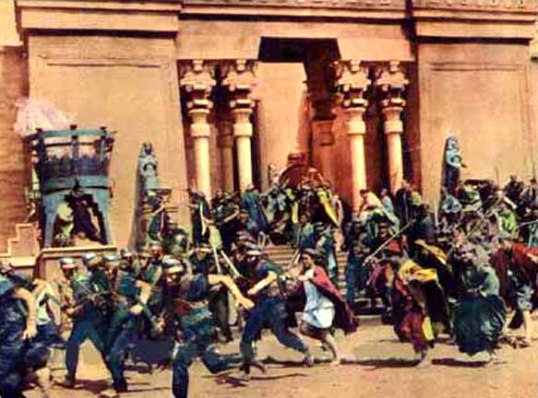
Scene from the movie “Esther and the King,” 1960

Text used – Esther 8:1-11; 9:1, 12-17

  • Before I read our Scripture this morning, I want to recap a little bit.
    • Spent basically the entire summer together in the book of Esther
      • Met all the central characters: King Ahasuerus, Queen Vashti, the palace eunuchs, Queen Esther, her cousin Mordecai, and the king’s wicked advisor Haman
      • Watched the rise and fall of the storyline
        • Queen Vashti’s banishment
        • Esther’s elevation to the throne
        • Clash between Haman and Mordecai à wounded Haman’s pride and spurred his plot to annihilate all the Jews
        • Mordecai rouse Esther to action on behalf of her people despite her own personal danger (king’s fickle temper)
        • Last week: Esther reveal that Haman’s horrible plan would affect her, too à king’s terrible rage à Haman’s death on the very pike intended for Mordecai
      • And believe it or not, I wish that was where the story ended. Despite Haman’s less-than-pleasant demise, that’s a fairly lovely end to the story. Esther’s happy. The king is happy. We’re happy. … But, friends, that’s not the end of Esther’s story. Buckle your seatbelts. Let’s finish the story of Esther together this morning.
  • [READ SCRIPTURE]
  • Do you see what I mean? Do you understand now why I said I wish that we could have ended Esther last week? Hmmm. Yeah.
    • Today’s Scripture seems to start out not too bad – rewards for Esther and Mordecai: That same day King Ahasuerus gave Queen Esther what Haman the enemy of the Jews owned. Mordecai himself came before the king because Esther had told the king that he was family to her. The king took off his royal ring, the one he had removed from Haman, and gave it to Mordecai. Esther put Mordecai in charge of what Haman had owned.[1] → Esther and Mordecai had been through a terrible ordeal. They had been subjected to severe mental and emotional strain thanks to Haman’s wickedness. Call this their “pain and suffering settlement.”
      • BUT … one thing that doesn’t sit right with me even in this – Where did that settlement come from? Did you catch it?: King Ahasuerus gave Queen Esther what Haman the enemy of the Jews owned. … Esther put Mordecai in charge of what Haman had owned. → Esther and Mordecai were rewarded with Haman’s own property and wealth. … But Haman had a family. He had a wife, Zeresh. We read about her last week. And Haman had sons – 10 sons, to be exact. Scripture doesn’t tell us anything about provisions being made for any of them. So our text this morning starts out with Esther and Mordecai profiting from the suffering of others.
        • Sit uncomfortably with anyone else?
        • Make you frown? Make you squirm a little bit?
    • And it only gets worse from there: [The scribes] wrote exactly what Mordecai ordered to the Jews, rulers, governors, and officials of the provinces from India to Cush – one hundred twenty-seven in all. … The order allowed Jews in each town to join together and defend their lives. The Jews were free to wipe out, kill, and destroy every army of any people and province that attacked them, along with their women and children. They could also take and keep anything their attackers owned. … They put to rest their troubles with their enemies and killed those who hated them. The total was seventy-five thousand dead, but the Jews didn’t lay a hand on anything their enemies owned.[2]
      • [PAUSE]
      • If you weren’t uncomfortable before, are you uncomfortable now? We’ve talked about how God isn’t explicitly mentioned in the book of Esther – about how we have to creatively seek out God in various aspects of the text. I’ll admit that that’s been a fun and interesting challenge this summer. I’ve enjoyed it! But this … I don’t want God to be in this. I don’t want to find God in this sort of retaliation – in this revenge and bloodshed and pain.
        • Totally flies in the face of what we talked about last week – how it wasn’t Esther or Mordecai or any of the Jews who called for Haman’s death, how the idea came from one of the palace eunuchs instead → We took solace in that last week – that in the face of such ugliness and evil, Esther rose above it.
        • But this week, we hear the rest of the story – the epilogue. And we shake our heads. And we question: “Why, God? Where are you in this? Why is this part of your Grand Story of faith? What could you possibly say to us in this?”
          • Truth: I struggled mightily not only with how to preach this text but whether to even preach this text
            • Would have been really easy to just leave the end of the story off → lectionary certainly doesn’t include this part of Scripture in the 3-yr. cycle
            • But I have this sometimes-pesky, strong conviction that we shouldn’t shy away from the challenging parts of Scripture … that we can’t ignore the uncomfortable texts because it’s when we wrestle with those – when we question and explore that uneasiness and hunker right down in the midst of the ugly with open eyes and open hearts – when we wrestle with these parts of Scripture, we grow in our relationships together and our relationship with God.
  • That being said, it’s still really hard to come at this Scripture to preach it. Not gonna lie. Someone came up to me after church last Sunday and asked me how I was going to preach the end of this, and my honest-to-God answer was, “I don’t know yet.” But Dick Eick overheard this exchange and passed on some wisdom that had once been passed on to him: “Sometimes, instead of preaching the text, you have to preach against the text.” And in that perception, I began to see the Light of God dawn on this text. Not in it, but through it.
    • Often talk about how we are broken people who live in a broken world
      • Comes up in worship in the form of confession (always part of our opening prayer) – just like in the relationships we have with people, in our relationship with God, when we make mistakes – when we hurt, when we offend, when we slip up, whether it’s intentional or not – we ask for forgiveness
        • Part of our worship because worship is meant to be an act of deep and genuine connection between us and God → cannot have that truth in that connection unless we come with total honesty … And so we confess. We lay our hearts and souls and very lives bare before God and ask for forgiveness. Because we’re people, and sometimes we screw up.
    • Talked about this in sermons, too → And often, these sermons are paired with Scripture passages that are shining examples of the love and joy and freedom that come from that forgiveness. These Scriptures extoll the virtues of the other side of forgiveness – the fulfilled side, the pretty side, the comfortable side … the forgiven side.
      • Today’s text = the other side – the unsatisfied side, the ugly side, the distressing side … the “not yet” side → today’s text = reason to need forgiveness
      • We hear the words of Jesus in his Sermon on the Mount: “You have heard that it was said to those who lived long ago, ‘Don’t commit murder,’ and ‘All who commit murder will be in danger of judgment.’ But I say to you that everyone who is angry with their brother or sister will be in danger of judgment. If they say to their brother or sister, ‘You idiot,’ they will be in danger of being condemned by the governing council. And if they say, ‘You fool,’ they will be in danger of fiery hell. Therefore, if you bring your gift to the altar and there remember that your brother or sister has something against you, leave your gift at the altar and go. First make things right with your brother or sister and then come back and offer your gift.”[3]
      • We hear these words juxtaposed with the staggering violence and vengeance at the end of Esther, and maybe we come to a new understanding of the need for repentance and forgiveness.
        • Cultural context: plight of the Jews → Remember, at this time – Esther and Mordecai’s time – and for a long, long time – centuries! – afterward, the Jews were a people who had been conquered and subjugated by one powerful empire after another. They had already been fighting for their right to live and worship as they wanted for generations! The whole reason they were in Persia in the first place was because Jerusalem had been conquered by Babylon, and the people had been taken into exile – forcibly removed from their homes and their center of culture and faith (the Temple). And then, when Babylon was conquered by the Persian empire, the Jews found themselves conquered and subjugated yet again.
          • Wasn’t the first attempt to wipe them out entire, and as we know, it certainly wasn’t the last
          • Centuries worth of oppression, defeat and injustice à frustration, anger, indignation finally boiled over
          • A context we cannot truly understand as people living in country of such extravagant freedoms
          • A context that cannot be ignored
        • That being said, the scale and intensity of the uprising and carnage at the end of Esther still feels extreme. Defend your lives and your family’s lives, yes, but then go after not only your attacker but also his own family and even his whole village – “women and children”? Doesn’t that feel like it’s going too far?
    • Times when we go too far – either intentionally or unintentionally
      • Words spoken (or, sometimes even worse yet, typed) in the heat of the moment: in frustration, in anger, in fear – words that cannot be taken back
      • Relationships severed in haste because of a misunderstanding, a miscommunication, or just plain laziness – bridges that take years to mend (if they ever can be mended)
      • Actions that forever tarnish a moment in time – unkind to others, unkind to ourselves
      • Maybe in those times, we feel like we’re just defending ourselves or our families. Maybe we feel like if we don’t strike first, the other person is surely going to strike at us. Whatever the reason, what we say and what we do causes other people pain. Is it as devastating as the retaliation of the Jews against the Persians? Not numbers-wise. But we all know that that old adage “sticks and stones may break my bones, but words will never hurt me” is a load of you-know-what. Words can be devastating. They can bring your whole world crashing down, and in this age of instant communication and the ability to post things anonymously, it has become far too easy to drop those kind of bombs in the lives of other people.
        • Words from book of James: Know this, my dear brothers and sisters: everyone should be quick to listen, slow to speak, and slow to grow angry. This is because an angry person doesn’t produce God’s righteousness. Therefore, with humility, set aside all moral filth and the growth of wickedness, and welcome the word planted deep inside you—the very word that is able to save you.[4] → That word that lives inside of us is God’s word – peace, love, grace (mercy and compassion that is wholly undeserved), forgiveness. Believe me, I know how hard it is to come up with these words when you’re angry, when you’re hurt, when you’re upset or frustrated or feel backed into a corner. But our Scripture reading this morning shows us just how devastating “getting back” and “getting even” can be.
  • End sermon with a time of silence
    • Think about times when you may have gone too far in a reaction
    • Think about times when someone else’s “going too far” has affected you
    • Use time for reflection and repentance
    • [LONG PAUSE]
    • Amen.

[1] Est 8:1-2.

[2] Est 8:9, 11; 9:16.

[3] Mt 5:21-24.

[4] Jas 1:19-21.

Aug. 21 sermon: The Finale

Esther Rembrandt
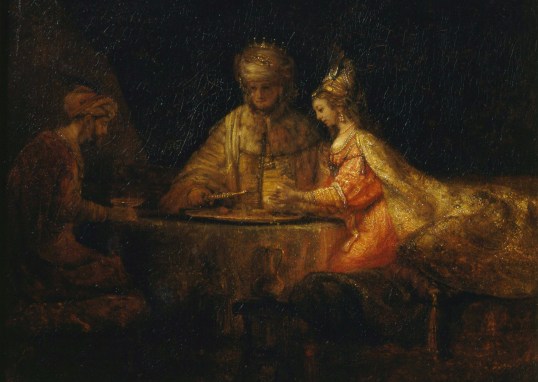
“Ahasuerus and Haman at the Feast of Esther” by Rembrandt, 1660

Text used – Esther 6:13-7:10

  • It’s been quite a while since we journeyed through the story of Esther together.
    • Recap the basics (just in case you forgot or you missed a week here or there!)
      • Persian King Ahasuerus banished his queen, Vashti, on the suggestion of one of his advisors
      • Chose Esther as new queen
      • Esther’s cousin and guardian, Mordecai, ended up crossing one of the king’s most powerful advisors, Haman → Haman’s revenge = get the king to endorse a decree to eliminate all the Jews in the Persian kingdom
        • All at once: specific time on a certain day
      • Mordecai got wind of plot and enlisted Esther to help him save their people
      • Esther invited King Ahasuerus and Haman to special feast
    • And that’s where we left Esther’s story about a month ago! We’ve also explored a lot about our faith through the story of Esther along the way.
      • Talked about strength of God’s all-encompassing compassion
      • Talked about the importance of living a life of love
      • Reminded ourselves that ultimate power lies not with us as humans but with that compassionate God
      • Reminded ourselves that in the midst of struggles and pain, God is there with us, sharing our pain and grief
      • Encouraged to seek out creative ways to oppose injustice in the world
      • Heard a warning to not let pride take control of our hearts, our lives, or our faith
  • And today, we come to the climax of Esther’s story … the final showdown between the persecutor and the persecuted … the dramatic finale of what has been a long, crazy, gripping narrative. And as with the rest of Esther’s story, today’s portion of the tale is just as theatrical.
    • Foreshadowing again in the very beginning of today’s text: Haman told his wife Zeresh and all his friends everything that had happened to him. Both his friends and his wife said to him, “You’ve already begun to lose out to Mordecai. If he is of Jewish birth, you’ll not be able to win against him. You are surely going to lose out to him.”[1]
      • “Everything that had happened to him” refers to Haman having to so lavishly and publicly honor Mordecai in last portion of Esther’s story that we read back in July
        • King learned that Mordecai saved his life
        • King asked Haman how to honor someone whom he greatly values
        • Haman mistakenly assumed the king was talking about himself, so he concocts elaborate display involving one of the king’s own robes, one of the king’s own horses, and the honored one being paraded through the streets while his praises were shouted for all to hear
        • King loved this idea … but Haman ends up having to do all of that for Mordecai (enemy) → goes home utterly humiliated and begins grumbling and complaining to his friends and his wife
      • So in the midst of Haman trying to build himself back up after such a terrific blow to his pride, his wife and his friends basically said to him, “Give up. This isn’t going to end well for you. You can’t beat Mordecai.” And even while they were all in the midst of discussing this, the palace eunuchs arrived once again to collect Haman and bring him to a feast at Queen Esther’s palace. And as readers, we are left with Haman’s wife’s words of warning hanging in the air. [PAUSE] Remember that.
    • When they got to feast, King Ahasuerus once again asked Esther what he could possibly give to her: “This is the second day we’ve met for wine. What is your wish, Queen Esther? I’ll give it to you. And what do you want? I’ll do anything—even give you half the kingdom.”[2] → Here, friends, is the opening that Esther needed. Here is the exact opportunity that we can only imagine Esther had been praying for. The king – the most powerful man, perhaps in all the world but certainly in her world – has pledged to give her whatever she wants. She needs only to ask.
      • Imagine how her heart must have been racing
      • Imagine how her pulse must have been thundering in her ears
      • Imagine how her nerves must have set loose a thousand butterflies fluttering about in her stomach
      • Think about it for a minute. Do you remember how truly powerful King Ahasuerus was? He banished Vashti with a single decree. He condemned an entire people with yet another decree. He had the power to put a person to death simply for appearing in his presence without first being properly summoned and invited. And Esther was about to ask him for a massive
    • Esther: “If I please the king, and if the king wishes, give me my life—that’s my wish—and the lives of my people too. That’s my desire. We have been sold—I and my people—to be wiped out, killed, and destroyed. If we simply had been sold as male and female slaves, I would have said nothing. But no enemy can compensate the king for this kind of damage.”[3] → Short … sweet … and powerfully to-the-point. Esther doesn’t mince words. She simply and compellingly asks King Ahasuerus for her life and the lives of her people.
      • Can imagine the uproar that follows
        • King demanding to know who has done such a horrible thing to his treasured new queen
        • Esther naming Haman
        • Terror and disbelief dawning on Haman’s face as he realizes what is happening
        • King storming out to pace the gardens (presumably to let a little of his anger burn off) only to come back to find Haman perched on Esther’s own divan (big “no no” … huge!) begging for mercy → throws king into an even greater rage: The king returned from the palace garden to the banquet room just as Haman was kneeling on the couch where Esther was reclining. “Will you even molest the queen while I am in the house?” the king said. The words had barely left the king’s mouth before covering Haman’s face with dread.[4]
    • And once again, King Ahasuerus falls prey to his own suggestibility: Harbona, one of the eunuchs serving the king, said, “Sir, look! There’s the stake that Haman made for Mordecai, the man who spoke up and did something good for the king. It’s standing at Haman’s house—seventy-five feet high.” “Impale him on it!” the king ordered. So they impaled Haman on the very pole that he had set up for Mordecai, and the king’s anger went away.[5]
      • Foreshadowing from first verse in today’s reading is fulfilled
  • Now, I want you to notice something here, because believe it or not, this is where I see God in this part of Esther’s story. Who has been so grievously wronged throughout this tale? Mordecai and Esther and the rest of the Jews. And yet, who is it that calls for such brutal and exacting retaliation against Haman? One of the eunuchs … not Not Esther. Not one of the Jews. The king has already promised Esther ANY.THING she wants. She can have it. It’s hers. All she has to do is ask. She could have asked for revenge as well – for pain, for suffering, for some sort of payback that will make Haman wish he’d never even met a Jew. But she didn’t.
    • Friends, we know that there are lots of times in our lives when we want to “get back” at someone – when we want to take justice into our own hands.
      • Small scale: cut off in traffic, dealing with a rude customer/service person (depending on which side of the counter you’re on) → all those day-to-day slights that leave us feeling frustrated and rankled, those things that sort of fester and gnaw at us until we’re all worked up
      • Plenty of large scale e.g.s: wars and violence around the world (picture of Syrian boy who survived air strikes this week); men, women and children abducted or purchased from family members and forced into human trafficking every year, children taken from their homes and their families and forced to be child soldiers, corrupt government mismanaging and downright stealing aid relief that is mean for thousands of people reeling from natural disasters → We read about situations like these in the news, and they make our blood boil. We want to see something done. We want someone to pay – to be held accountable for the pain and suffering. We want to see justice … or, at least, what we think of as justice.
        • Particular e.g.: mass shooting at the Emanuel African Methodist Episcopal Church in Charleston, S.C. just over a year ago – angry and hate-fueled white man named Dylann Roof attended a Bible study at the church, then shot and killed 9 people during the following prayer service before fleeing
          • Later arrested by police
          • During Roof’s bond hearing back in 2015, the family members of his 9 victims were invited to address the court – to shed some light on the lives that he’d so viciously cut short. Very often, these types of addresses (made either by the victims themselves or by family members) are pleas for the court to “exact justice” – pleas for guilty verdicts and harsh sentences before the trial itself has even begun. But not that day. The family members of the 9 victims spoke to the court about forgiveness and God’s grace.[6]
            • Sister of Rev. DePayne Middleton Doctor: I acknowledge that I am very angry. But DePayne … taught me that we are the family that love built. We have no room for hating, so we have to forgive. I pray God on your soul.
            • Daughter of Ethel Lance: I forgive you. You took something very precious away from me. … You hurt me. You hurt a lot of people. If God forgives you, I forgive you.
  • In today’s passage, Esther = champion for those hurting and desperate and in need without exacting revenge → She was the only one in that room that truly had the “right” to ask for revenge – the only one who’s life was actually being threatened by Haman’s evil and hateful plan – but instead, she asked for life. As Christians – as people who declare ourselves disciples of the Living Word, of Love Incarnate, of the One who conquered death to bring eternal life – we are called to follow Esther’s example: to seek life, not payback … to seek restoration, not retaliation … to spread light, not darkness.

[1] Est 6:13.

[2] Est 7:2.

[3] Est 7:3-4.

[4] Est 7:8.

[5] Est 7:9-10.

[6] Elahe Izadi. “The powerful words of forgiveness delivered to Dylann Roof by victims’ relatives” on The Washington Post website, https://www.washingtonpost.com/news/post-nation/wp/2015/06/19/hate-wont-win-the-powerful-words-delivered-to-dylann-roof-by-victims-relatives/?utm_term=.78fd03369733. Posted June 15, 2015, accessed Aug. 21, 2016.

[7] tobyMac. “Speak Life” from Eye On It album, released Aug. 24, 2012, ForeFront Records.

Outdoor Service: Something a Little Bit Different

On Sun., Aug. 14, 2016, the OZ congregations gathered in Oronoco for their annual joint service. For the past 5 years, this service has been held at the Goodhue County Fair in Zumbrota. This year, the decision was made to return to hosting an outdoor service and picnic at one of the churches. 

And because we were outside, I thought, “Let’s do things totally differently.”

Okay … full disclosure: I also realized early in the week that we had no way to project sound. For our members who have trouble hearing, that’s a necessity, so that basically cut out any kind of conventional worship element like a sermon. 

So here’s what we did …


* Welcome: Brothers and sisters, this is the day that the Lord has made! Let us rejoice and be glad in it!

* Opening prayer thanking God for the relationship between the two churches, the beautiful day, and the chance to worship together as well as asking God to speak to us in new and different ways as we worshiped.

* Scripture readings:
Psalm 100
Hebrews 10:23-25

* Explanation of Worship
Storybook walk/activities
Prayer Stations

* Re-gathering

* Prayer:
Pastoral Prayer
Lord’s Prayer

* Benediction: Go in peace to love and serve God TOGETHER. Amen!

* Passing the Peace of Christ (this led into our picnic together)

So you may be wondering what the heck a “storybook walk and activities” was or what our prayer stations were. Well … let me tell you! 

Storybook Walk/Activities
My mom is a librarian who does some incredibly fun stuff during her summer reading program including a storybook walk. My dad made 35 sign boards for her – basically a bunch of wooden boards (12″ x 18″) nailed to posts. I pounded the posts into the ground to create the path for our story.

And what story did we use? When God Was a Little Girl by David Weiss.
When God Was a Little Girl
This is an amazing story with beautiful illustrations that tells the story of creation from a totally new and different angle. If you aren’t familiar with this book – if it isn’t already on your bookshelf – trust me … GO BUY IT! It’s fun. It’s creative. It’s the kind of story that will pull in children and adults alike and give you plenty to talk about afterwards. Go buy it … right now!

Okay, so here’s how we used the book. I made color photocopies of all the pages of my copy of the book and mounted them onto the wooden boards with double stick carpet tape (indoor/outdoor is super strong, so that’s what I used). The idea was for people to walk the path, read the story, and enjoying the illustrations as they went along. I actually did this with my 3-yr-old twin boys, and it was incredibly fun, especially since we were reading about beauty and creation out in nature on a gorgeous summer morning!

At most of the pages (not all), there was some sort of activity for people to do as well. Here’s how that went:

  • Pg. 3: Guess the mileage from Madison, WI to Decorah, IA (smartphones not allowed!). The winner got a fancy cupcake purchased from a local bakery. YUM!
  • Pg. 5: I purchased a bunch of 8″ x 10″ foam core boards (because they were a lot cheaper than canvases for 25 people!), and asked everyone to take a board for themselves.
  • Pg. 6: On the boards – Draw a giggle!
  • Pg. 9: On the boards – Draw a song.
  • Pg. 10: On the boards – Draw love.
  • Pg. 13: On the boards – Draw light. *With this board, I included glue and glitter. Since we were outside, clean-up was immediate!*
  • Pg. 14: There was a small pile of river rocks (purchased from local craft store) with hearts on them (using a Sharpie Oil Paint marker). I encouraged everyone to take a rock as a remind of the steadfast and foundational nature of God’s love for them. Also, on the boards – Add water.
  • Pg. 17: We had a card table covered with butcher paper. I asked people to draw flowers on the paper – to create a beautiful garden together as a community of faith.
  • Pg. 18: I put out Play Doh (yes … I borrowed my 3-yr-olds’ Play Doh!) and asked people to use it to create a person.
  • Pg. 25: On the boards – Add a rainbow.
  • Pg. 27: Tip toe to the next sign (because the little girl in the story has almost fallen asleep).
  • Pg. 29: I used Microsoft Publisher (one of the label templates) and basic cardstock to create little cards that said, “GOD LOVES YOU. You are God’s beautiful and unique echo.” Everyone was encouraged to take a card.

Prayer Stations
We also had seven prayer stations set up that people could wander through them and spend as much (or as little) time at each station as they liked. For this, I created small prayer books that were simply 1/2 sheets of printer paper folded into a book with a cardstock cover. On the cover was a quote from Mahatma Gandhi: “Prayer is not asking. It is a longing of the soul. It is a daily admission of one’s weakness. It is better in prayer to have a heart without words than words without a heart.”

Here are the prayer stations:

Labyrinth prayer station
Okay, so this is the one prayer station that I planned but didn’t end up having enough time to put together. I was going to chalk a simple labyrinth in one corner of our parking lot. However, there was just too much to put together before church to get this one done, too. That being said, I still think it’s a really great idea for an outdoor prayer station.

Words prayer station
For this prayer station, I used a website to generate a word search that had 50 different words describing faith in it. I used one of the leftover wooden boards from the storywalk and more of the double stick carpet tape to mount the word search in a place where lots of people could look at it at once. I also enlarged the word find to be kinder to less-than-20/20 eyes. 

Water prayer station
This one was easy. We took a few tables out and put them on the lawn. On one of the tables, I simply placed a large bowl of water.

Tags prayer station
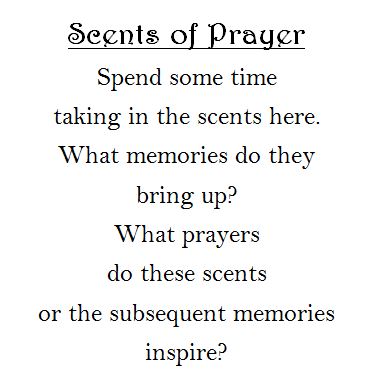
I had a large box of basic luggage tags (the ones that look like they’re made out of tan file folders). I put that box along with some colored flair pens at the base of one of our trees and attached this sign to the tree (again … double stick carpet tape). People wrote their prayers on the tags and used the wire on the tags to hang the prayers in the tree.

Scents prayer station
Okay, this one was really fun! I had seven little bowls (custard bowls, my mom always called them), and each bowl had a different scent item in it: coffee beans, a rose, fresh-cut grass, cinnamon sticks, fresh mint leaves, dirt, and … hmmm … can’t remember the last one. (That’s what happens when you wait a month to post stuff. Sorry.) People had time to smell each of these in turn and reflect on what memories those scents brought up for them.

Nature weaving prayer station
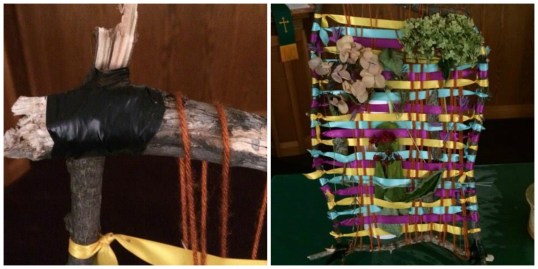
This one took a little prep work beforehand. I took some sticks and created a rectangle-ish frame. (I used electrician’s tape in the corners, but however you can get them to stay together works.) Then I used yarn and colorful ribbon to create a loom within that frame. (This whole process took probably 1-1.5 hrs the night before … just FYI.) Before church, I asked a few different parishioners to walk around the church property and gather all sorts of nature bits – leaves, flowers, feathers, bark … anything. They were all lying on one of the tables with the loom for any and all to use. Here’s a close up of the corner (left) and the finished product (right):

prayer weaving collage

Mirrors prayer station
This one was super easy! I went to one of the local craft stores and bought 5 different mirrors – different sizes, different shapes. Then I laid them on the ground. Done! Two quick things about this, though: 1) I made sure that this station was a little way away from the other stations just to be sure no one stepped on the mirrors, and 2) I laid them out in a place that would reflect some interesting things. They were on the edge of a tree area, so some would reflect the tree, some would reflect sky, and some would even reflect the church building (depending on how you look in them).

Well … that’s it! We had a really wonderful time trying some new things and experiencing God in new ways together.

Catching Up …

time neverending

Okay … so I’m a little bit behind.

At the end of July, I took a week of continuing ed leave followed by a week of vacation. This covered Sun., July 24 – Sun., Aug. 7. The following Sunday (Aug. 14), the OZ churches had their annual joint service. We did an outdoor service that was completely and wonderfully unconventional.

And then I took another few days of vacation to head to the cabin with my family.

And then the rest of Aug. – between family obligations and church obligations – got a little crazy.

So now, I’m catching up. So here come:

  • a breakdown of the outdoor service
  • 3 sermons
  • 2 newsletter articles

Yup … bear with me. Thanks!

Litany for Hope

hope

I wrote the following litany to be a part of the worship service at our presbytery meeting on July 12, 2016. I wrote it in early June … before Alton Sterling, before Philando Castile, before the murder of police officers in Dallas and Baton Rouge, before the violence in Turkey and in Nice, France. As the pain and violence and distrust and abuse of power in the world around us continues to spiral out of control, our need for hope and for God’s peace grows. And so we pray – desperately and with light in our hearts – for that hope and peace.

If you desire, please feel free to use this litany in whatever way you need to. All I ask is that you credit it appropriately. Thanks, and God bless.

* Litany of Hope
Reader 1: From the voices of Scripture –
Reader 2: From psalms we’ve read and sung and prayed…
Reader 3: The Psalms boldly sing out,
“HOPE in the Lord!
Be strong!
Let your heart take courage!
HOPE in the Lord!”
ALL: We hear God’s words of HOPE. We hear the boldness of God’s CALL.

Reader 1: From the ancient echo of prophetic voices …
Reader 2: Isaiah, the Prophet, boldly declares,
“Those who HOPE in the Lord
Will renew their strength.
They will fly up on wings like eagles;
They will run, and not be tired;
They will walk and not be weary.”
ALL: We hear God’s words of HOPE. We hear the boldness of God’s CALL.

Reader 3: From the sermons of old …
Reader 1: Simon Peter boldly proclaims,
“My heart was glad and my tongue rejoiced.
Moreover, my body will live in hope,
Because you won’t abandon me to the grave,
Nor permit your holy one to experience decay.
You have shown me the paths of life;
Your presence will fill me with happiness.”
ALL: We hear God’s words of HOPE. We hear the boldness of God’s CALL.

Reader 2: From letters read over and over again …
Reader 3: To the Ephesians Christians and down through the ages, Paul boldly encourages,
“I pray that the eyes of your heart
Will have enough light to see what is the hope of God’s call,
What is the richness of God’s glorious inheritance among believers,
And what is the overwhelming greatness of God’s power
That is working among us believers.”
ALL: We hear God’s words of HOPE. We hear the boldness of God’s CALL.

Reader 1: We do indeed hear God’s words of HOPE.
Reader 2: We do indeed hear the boldness of God’s CALL.
ALL: But faith is about more than just hearing.

Reader 3: All around us, we see the world trying to tear itself apart –
Reader 1: Flood waters reaching devastating levels in a matter of hours …
Reader 2: Bullets flying and people dying in nightclubs, shopping centers, workplaces, schools …
Reader 3: Thousands of people fleeing the only lives they’ve ever known out of fear and desperation, fleeing into waters cold and dangerous, unwelcoming and deadly …
Reader 1: Countries and cities, provinces and regions where for far too long, violence and terror, conflict and rage, ruin and anguish have been the “normal way of life” …
Reader 2: Political posturing and finger-pointing and name-calling and an overall refusal to come to the table in peace that has left our political system in shambles …
Reader 3: Words of hate slung pointedly and deliberately at this group or that: refugees, Muslims, immigrants, the black community, the LGBTQ community, those who are poor, those who are homeless, those who struggle with mental illness, those who are “not like me” …

Reader 1: We see the headlines,
Reader 2: We see the news feeds,
Reader 3: We see the posts on social media,
ALL: But faith is about more than just seeing.

Reader 1: God calls to our hearts.
Reader 2: God calls to our minds.
Reader 3: God calls to our spirits.
ALL: God calls us to be people of bold faith, people of prophetic hope.

Reader 1: God calls to our talents.
Reader 2: God calls to our gifts.
Reader 3: God calls to our dreams.
ALL: God calls us to be people of bold faith, people of prophetic hope.

Reader 1: God calls us in the midst of our fears and our doubts.
Reader 2: God calls us in the face of our struggles and our failings.
Reader 3: God calls us in all our brokenness and messy humanity.
ALL: God calls us to be people of bold faith, people of prophetic hope.

Reader 1: Because we are not called to “leave well enough alone,”
ALL: God calls us to hope for a brighter future.
Reader 2: Because we are not called to let it all be “someone else’s problem,”
ALL: God calls us to hope for justice that is equal and unfailing.
Reader 3: Because we are not called to “maybes” and “not sures” and “I don’t knows,”
ALL: God calls us to hope as we confidently walk together, listening and discerning, leading and encouraging. God calls us with hope. God calls us to hope. God calls us for hope. And with the reassurance and the joy that that hope brings, we answer God’s call: HERE I AM. SEND ME.

Sunday’s sermon: Pride … And Not the Good Kind

Haman and Mordecai

Text used: Esther 6:1-12

  • Up until today, our Esther story has been fairly serious
    • A banished queen
    • A weak-willed king
    • A royal advisor on a major (and very evil) power trip
    • An entire people that have been sentenced to death
    • A young woman carrying the weight of it all on her shoulders
    • That’s a whole lotta heavy.
  • Today’s bit of the story = a little different → This is about as close to “comic relief” as the story of Esther gets, ya’ll. Today’s story involves a quirky little situation between King Ahasuerus, Haman, and Mordecai.
    • Kicks off with funny little bit right in verse 1: That same night, the king simply couldn’t sleep. He had the official royal records brought in, and his young male servants began reading them to the king.[1] → Did you catch that? The king was having trouble sleeping, so he had the official records brought in so his servants could read him to sleep with them. They’re that exciting. They’re that thrilling. They’re that … boring.
      • Better than counting sheep!
      • Hey, this story needed a little levity, right?
    • Okay, so as the servant boys were reading the royal records to the king, he heard something that was new to him: They came to the report about Mordecai informing on Bigthan and Teresh. (They were the two royal eunuchs among the guards protecting the king’s doorway, who secretly planned to kill King Ahasuerus.)[2] → Now, in order to understand this part, we actually have to go back a little bit.
      • May remember that at the beginning of this series, we were skipping around a little bit – didn’t read all of chs. 1, 2 or 4
        • Long chapters
        • Lots of names and details secondary to the main story
        • Basically, trying to save you a little headache
        • However, one of those little bits that we needed to skip over at the time is what we need to circle back to right now – end of ch. 2 (last 3 verses), occurs right after Mordecai offends Haman and Haman hatches his horrible plan: At that time, as Mordecai continued to work at the King’s Gate, two royal eunuchs, Bigthan and Teresh, became angry with King Ahasuerus. They were among the guards protecting the doorway to the king, but they secretly planned to kill him. When Mordecai got wind of it, he reported it to Queen Esther. She spoke to the king about it, saying the information came from Mordecai. The matter was investigated and found to be true, so the two men were impaled on pointed poles. A report about the event was written in the royal record with the king present.[3]
        • So Mordecai heard the two eunuchs plotting and saved the king’s life, and someone wrote it down in the royal record. … And then it was forgotten … until today.
    • Maybe it’s because he was in such a good mood (after Esther’s first feast and anticipating the second feast). Maybe it was the insomnia talking. Whatever the reason, King Ahasuerus suddenly became swept up in the idea that something drastic had to be done to honor and reward this man who had saved his life – Mordecai.
      • Saw Haman standing out in the courtyard waiting to be recognized and invited into the king’s presence
      • Quickly invited Haman in
      • Requested the counsel of one of his closest, most trusted advisors: When Haman entered, the king asked him, “What should be done for the man whom the king really wants to honor?”
        • Thinking, of course, of Mordecai as he said this
  • Now, here’s where another one of the broader themes in the book of Esther pops up. It’s a theme that we’ve encountered before, though not one that we’ve named outright as of yet. It’s the theme of pride … and, more specifically, the perils of pride.
    • Certainly good facets to pride
      • Taking pride in your work = work harder and do a better job
      • Showing your family, friends, kids that you’re proud of them conveys attentiveness – can show how much you love and care for them
      • Plenty of people take pride in where they come from:
        • Hometown
        • Alma maters
        • Country
        • Heritage
          • E.g. – story of Eileen and heritage → My mother-in-law has always been incredibly proud of the fact that she’s 100% Norwegian, and she’s always teased my father-in-law about having just a little bit of Swedish in him. He’s only 95% Norwegian! But lately, she’s been digging into family history, and she’s discovered that he’s actually got a lot of English ancestry. And while coming to terms with the fact that her children aren’t as thoroughly Norwegian as she thought they were, she’s also found some incredible bits of that English heritage to be proud of. Pride in heritage … it can be a funny thing!
    • But there is also an ugly side of pride.
      • Athletes so bent on winning that they cheat
        • Steroid scandals
        • Intentionally injuring other players – trying to “take them out”
        • Does anyone else remember “Deflategate”[4] back in 2015?
          • AFC Championship football game
          • New England Patriots vs. Indianapolis Colts
          • Patriots won the game → later found guilty of tampering with footballs to make them easier to throw, catch, grip in colder weather
        • Even darker side of pride gone wrong = pride in heritage taken too far
          • Pride of Nazis Aryanism → led to deaths of millions of Jews but also millions of Gypsies, people with disabilities, LGBT people, and Jehovah’s Witnesses as well as the sterilization of mixed race children
          • Pride in white America throughout the centuries led to …
            • Slavery
            • Abominable Jim Crow laws
            • Segregation
            • Birth of such hateful and violent organization as the Klu Klux Klan and 433 other nationally recognized, race-based hate groups (according to report put out by the Southern Poverty Law Center in 2013)[5]
  • This dark and all-consuming pride is the kind of pride that Haman had. Haman’s pride was what started the whole mess in the first place. Mordecai refused to bow to Haman … which hurt his pride … which prompted him to decide to have not only Mordecai but all of the Jews simultaneously and systematically murdered. You might also remember that Haman was boldly and brazenly displaying that pride at the end of our reading last week – bragging to his wife and all his friends about his wealth, about his family (about the fact that he had so many sons), about his position as the king’s advisor, and especially about the special feasts that he had been invited to with the king and with Queen Esther.
    • Today’s Scripture reading = particularly painful blow to Haman’s pride → When the king asked about displaying great honor for someone, Haman’s pride led him to immediately believe that the king could only be talking about himself.
      • Launched into a ridiculously lavish description: Have servants bring out a royal robe that the king himself has worn and a horse on which the king himself has ridden. … Have [that servant] personally robe the man whom the king really wants to honor and lead him on the horse through the city square. As he goes, have him shout, “This is what the king does for the man he really wants to honor!”[6]
        • Ancient Persian version of a tickertape parade
    • But poor Haman … the king wasn’t talking about him. When he spoke of a man whom the king wanted to greatly honor, he was talking about Mordecai – the man who had saved his life … the man who Haman had made into his arch enemy.
      • King even (unknowingly) adds ultimate insult to injury – instead of asking one of the servants to place the robe on Mordecai and lead the horse through the city and shout out Mordecai’s praise, King Ahasuerus asked Haman himself to do it → Haman himself had to place the robe on his enemy’s shoulders. Haman himself had to lead his enemy through the street in a position of greatest honor. Haman himself had to cry out the king’s praise and appreciation for his enemy. Can’t you just feel the shame burning in Haman’s cheeks and heart? Can’t you feel the humiliation twisting in his gut?
        • Text: Afterward, Mordecai returned to the King’s Gate, while Haman hurried home feeling great shame, his head covered.[7]
  • So where is God in this? What message do we hear about our faith in this story of Haman’s pride and shame?
    • Warning about pride, especially in relation to faith
      • Verse from Prov: Pride comes before disaster, and arrogance before a fall.[8]
      • More contemporary version (and probably the only time you’ll ever hear me quote the timeless and eloquent Meat Loaf – 1980’s rocker – in a sermon): “The truth is hard to swallow if you’re choking on your pride.”[9] → As we said earlier, there’s nothing wrong with having a healthy pride in aspects of our lives and ourselves, and that includes our faith. Our faith has been tested and tried throughout history and throughout our own lives, and there is power in the legacy of our faith as well as the way that faith has lifted us up and sustained us. It is an integral part of who we are and how we go about being in this world – our words, our actions, and everything in between.
        • Similar to pride in our heritage (where we come from) – spiritual heritage
      • BUT … pride in our faith can be taken too far as well.
        • Crusades throughout the Middle Ages
          • Purpose: regaining control of Jerusalem (Holy Land) from Muslim rulers
          • Hundreds of bloody battles and unspeakable atrocities committed … all in the name of God
        • Spanish Inquisition
          • Purported purpose: quell heresy
          • Way it ended up being use: tool of fear and manipulation, neighbor against neighbor, petty payback, often directed at people who were different
            • Jews
            • Muslims
            • Scientists/free thinkers
            • Anyone who thought differently than the Church
          • In America: Salem witch trials – similar to Spanish Inquisition
            • Purpose: rid themselves of “presence of the devil” within their midst
            • Way it ended up being use: tool of fear and manipulation, neighbor against neighbor, petty payback, often directed at people who were different
              • Widows
              • Natural healers
              • Scientists/free thinkers
              • Anyone who didn’t align with the Puritan beliefs
    • Friends, there’s a difference between healthy pride and fanatical pride. Healthy pride gives us purpose – a sense of empowerment and honor and satisfaction in who we are and what we do. Fanatical pride closes our ears, our minds, and our hearts to the world around us. It tells us that my way is the only “right” way, and that everything else is not only wrong but dangerous. As a nation, pride has us spiraling out of control, refusing to come to the table with those who hold a different belief, different opinion, different worldview than ourselves. We are becoming more and more isolated from each other because we refuse to open ourselves up to the possibility that there might be something we don’t know, something we don’t understand.
      • World of social media and online pseudo-news sources (“pseudo” because they purposefully only present one side of the issue) allows us to surround ourselves with only facts, articles, opinions that support our opinions and our beliefs → feeding not only our pride but our distrust and contempt for “the other side”
        • Blue Feed vs. Red Feed” interactive comparison graphic going around Facebook – compares “red side” posts and “blue side” posts about the same topics → shows just how much we insulate ourselves with the media/pseudo-news that we choose
    • “Pride comes before disaster, and arrogance before a fall.” God created us to be in relationship with each other – to reflect God’s own love and grace, forgiveness and joy in the way that we see one another and treat one another. We cannot let our pride choke that truth from our hearts, our lives, and especially from our prayers. Amen.

[1] Est 6:1.

[2] Est 6:2.

[3] Est 2:21-23.

[4] “Deflategate” from Wikipedia, https://en.wikipedia.org/wiki/Deflategate. Accessed July 14, 2016.

[5] Amanda Macias, “This Map Shows Where America’s Hate Groups Live and Operate” from The Business Insider website, http://www.businessinsider.com/active-hate-groups-by-state-2014-2. Published Mar. 4, 2014, accessed July 14, 2016.

[6] Est 6:8, 9 (emphasis added).

[7] Est 6:12.

[8] Prov 16:18.

[9] Meat Loaf, “Did I Say That?” from Couldn’t Have Said It Better, released 2003.

Sunday’s sermon: Creative Opposition

MLK Jr quote

Text used – Esther 5:1-14

  • Continuing with Esther today
    • Now that we’re about halfway through the book of Esther, does anyone else feel like the story’s been all downhill so far?
      • First drop: Queen Vashti stripped of her title and banished for refusing the answer the king’s arrogant, drunken summons
      • Second drop: Esther made queen but did so by hiding her background and her family – by hiding the fact that she is a Jew
      • Third drop: Mordecai’s defiance of Haman (refusal to bow) and Haman’s revenge (plan to annihilate not just Mordecai but all the Jews)
      • Fourth drop (last week): Esther’s reticence to get involved (fear of approaching King Ahasuerus when she hadn’t been summoned)
      • Certainly every good story has to involve conflict and challenge. There’s got to be something to overcome … something sort of problem or complication or crisis. But come on! How much more conflict and crisis can one story take, right?
    • Fortunately, in the part of Scripture that we just read this morning, the story of Esther is starting to turn around.
      • Today’s portion of the story = all about good beginning to counteract that bad
  • Bad-to-good flip: the suggestibility of King Ahasuerus → We’ve talked a number of times throughout this series about how weak and pliable King Ahasuerus was and about how detrimental the king’s suggestibility had been.
    • Weak will/suggestibility led to …
      • Banishment of Queen Vashti à advisors’ idea, not the king’s: Then Memucan spoke up in front of the king and the officials. … “Now, if the king wishes, let him send out a royal order and have it written into the laws of Persia and Media, laws no one can ever change. It should say that Vashti will never again come before King Ahasuerus. It should also say that the king will give her royal place to someone better than she.” … The king liked the plan, as did the other men, and he did just what Memucan said.[1]
      • Haman’s evil and vindictive plot against Mordecai becoming law: Then Haman said to King Ahasuerus, … “If the king wishes, let a written order be sent out to destroy them, and I will hand over ten thousand kikkars of silver to those in charge of the king’s business. The silver can go into the king’s treasuries.” The king removed his royal ring from his finger and handed it to Haman. … The king said to Haman, “Both the money and the people are under your power. Do as you like with them.”[2]
      • Safe to say 2 of the lowest points in the story so far → both caused by king’s weak-willed suggestibility
    • Today’s text – Esther begins to set up her own opportunity to suggest that King Ahasuerus take action
      • Dressed in her finest clothes “and stood in the inner courtyard of the palace, facing the palace itself,”[3] just waiting for the king to notice her and invite her in
        • Done very deliberately to circumvent law we talked about last week: Any man or woman who comes to the king in the inner courtyard without being called is to be put to death.[4]
      • Invited king and Haman to special feast – king’s response: “Hurry, get Haman so we can do what Esther says.” → at first feast (today’s story), invites king and Haman to a second feast on the following day so Esther can tell the king what she wants
        • Age-old adage: “A way to a man’s heart is through his stomach.” Hmmm … Esther may not be so far off here because not only does she have the king eager to hear and grant her request, she’s also got Haman all excited. – text: Haman boasted … “Queen Esther has invited no one else but me to join the king for food and drinks that she has prepared. In fact, I’ve been called to join the king at her place tomorrow!”[5]
  • Another bad-to-good flip = Esther’s courage/presence → When we left Esther at the end of last week’s Scripture reading, she was timid and afraid. Mordecai had ordered her to go to King Ahasuerus and ask him to save the Jews from the utter destruction that Haman was planning, but because of the law (and probably also because she was hesitant to be exposed as a Jew herself), Esther didn’t want to do that. While Mordecai talked her into taking this risk, she remained far from enthusiastic about it. And yet, in our text for this morning, we find Esther confident. We find her strong. We find her seemingly in control – of herself and of the situation.
    • Much more heroine-esque
    • Find Esther coming at “the problem” (Haman’s law to annihilate all the Jews”) from a different angle → Last week, when we read that Mordecai ordered Esther to go to the king and request that the Jews be saved, I think we can assume that this wasn’t necessarily the approach that Mordecai had in mind.
      • Probably was thinking of something more direct
      • Maybe expected Esther to throw herself on the king’s mercy …
        • Go to the king weeping
        • Reveal her own “family background and race” (as Scripture put it)
        • Beg the king to have mercy on her and her people and to spare them from this horrible fate
      • But obviously, this is not Esther’s plan. She has thought this out. She has planned and prayed and fasted and formulated a whole different approach – creative opposition to Haman’s hatred and evil. → powerful witness in this seemingly-simple act
        • Witness to just how strong and faithful and intelligent she could be → in turn, inspirational for other women throughout the ages who have read this story
          • Remember how disparaged the place of women was at the beginning of this story? – the whole reason Vashti was deposed and banished (according to king’s advisor): “News of what the queen did will reach all women, making them look down on their husbands. … There will be no end of put-downs and arguments. … When the order becomes public through the whole empire, vast as it is, all women will treat their husbands properly.”[6] → In enacting this plan of hers – in daring to take matters into her own hands – Esther gives strength and voice to all those women who had been long-silenced, long-subjugated, and long-scorned. In the face of the widely held belief that women should be seen and not heard, Esther uses being seen and heard to her advantage, not for own personal gain but for the wellbeing of an entire people.
            • Takes a strength
            • Takes a confidence
            • Where did Esther find these things? In those three days of fasting – in coming to God in humility, in need, and in prayer.
            • Found courage to step out and to speak out in her faith
  • Friends, I know I’m not the only one in this room this morning who is exhausted – who’s spirit is weary and worn down by the headlines that we have seen this week: Alton Sterling … Philando Castile … the police officers killed in Dallas – Brent Thompson … Patrick Zamarripa … Michael Krol … Michael Smith … Lorne Ahrens. As I sat and worked on this sermon last night, I did so in the midst of the news of protestors shutting down I-94 in St. Paul and their struggle with police – firecrackers and bottles that were thrown, smoke bombs that were deployed, officers injured, protestors arrested.
    • No words for the way that this violence seems to have spiraled out of control → kind of events that leave us aching and empty, disconcerted and grieving, bewildered and in shock
    • Kind of events that lead to …
      • A society based on fear
      • A society based on mistrust
      • A society based on retaliation
      • But brothers and sisters, this is not the people that God created us to be. We are created to be people of grace. We are created to be people of love. And yet we are also created to be people of justice … far from the selective justice that seems to be going around now-a-days.
        • Last week, Mordecai convinced Esther to act by saying to her, “Maybe it was for a moment like this that you came to be part of the royal family.”[7] → “Maybe God has a plan for you in all of this. Maybe there is some special work for you to do – work that will bring justice and peace to those of us who have been oppressed and condemned. Maybe, in this moment, it is your turn to speak out. To act. To change the world.” And in our part of the story today, friends, Esther did it. She acted. With those who were hurting – those who had been oppressed and badgered and pushed to the breaking point – with them in mind, she found a creative way to oppose what was happening and what was going to happen.
          • Hear God saying to us: Maybe it was for a moment like this that you were created – a moment to speak out against violence, against racism and the racial profiling that has led to so many unnecessary deaths, against whole idea of lumping all kinds of people (be they black people, police officers, or anyone else) into one judgment based solely on the actions of a few … a moment to oppose what is swiftly becoming a culture of fear and mistrust, retaliation and violence … a moment to reach out to your neighbor with open arms instead of closed fists
    • One of today’s assigned lectionary readings happens to be Jesus’ parable of the Good Samaritan[8] – story of the man beaten and left for dead by the side of the road
      • Passed up by the expected “good guys”, the acceptable people (priest and Levite/judge)
      • Helped and cared for by none other than a Samaritan – the outcast, the enemy, the “wrong crowd” kind of guy
      • Story Jesus told in response to simple question: “Who is my neighbor?”
        • Question that has led to creative opposition throughout the ages – Martin Luther King, Jr., Mahatma Gandhi, the Dalai Lama, those who helped escaped slaves reach freedom via the Underground Railroad, those who helped thousands of Jews escape the Nazis during the Holocaust → people who refused to accept that “the way things are” is the way things have to be, people who first asked “who is my neighbor” before asking “what’s best/easiest/safest/most beneficial for me”
        • Just like these people throughout history who have struggled against injustice, Esther struggled. Esther feared. Esther worried. Esther had doubts and hesitations. But when she was confronted with injustice – with pain and violence and suffering – she refused to sit idly by. Despite her fears and hesitations, Esther sought a creative opposition.
          • SPOILER ALERT: not a perfect analogy because end of Esther’s story is far from peace-filled and non-violent
            • Foreshadowing of this in Haman’s boasting today: Haman liked [his wife’s idea] and had the [seventy-five foot high spiked pole] prepared.[9] → spiked pole that will come into play later on in much different role that Haman intends
            • Still, Esther approached problem from a different angle
    • I think we’ve seen more than enough of violent reactions and retaliations just in the past week alone. It’s time for us to stop asking “Who can I blame?” and start asking “Who is my neighbor?” It’s time for us to stop coming to the conversation with clenched fists and come instead with open hands. It’s time for us to take a long, hard look in the mirror and recognize our own fears, our own struggles, our own hesitations and preconceived notions and prejudices and how those affect the way we see other people.
      • Quote from MLK, Jr.: Darkness cannot drive out darkness; only light can do that. Hate cannot drive out hate; only love can do that. → Darkness and hate have been the automatic, go-to response for too long … far too long. It’s time we come together in creative opposition – dressed in our finest with feasts prepared, with light, with love, asking “Who is my neighbor?” Amen.

[1] Est 1:16, 19, 21.

[2] Est 3:8, 9-11.

[3] Est 5:1.

[4] Est 4:11.

[5] Est 5:11, 12.

[6] Est 1:17, 18, 20a.

[7] Est 4:14.

[8] Lk 10:25-37.

[9] Est 5:14.